





#DigitalAssets #tokenization
The Great Tokenization Race: Why Real-World Assets Have Become Crypto’s Most Important Story
Every few years, the cryptocurrency industry discovers a narrative powerful enough to reshape the entire conversation.
In earlier eras, investors focused on digital payments, decentralized finance, and blockchain gaming. Each wave attracted attention, investment, and innovation. Some delivered lasting value. Others faded as quickly as they arrived.
Today, one topic stands above almost every other discussion among investors, institutions, developers, and market analysts.
Tokenization.
Not as a buzzword.
Not as a marketing slogan.
But as a potentially transformative shift in how ownership itself is recorded, transferred, and managed.
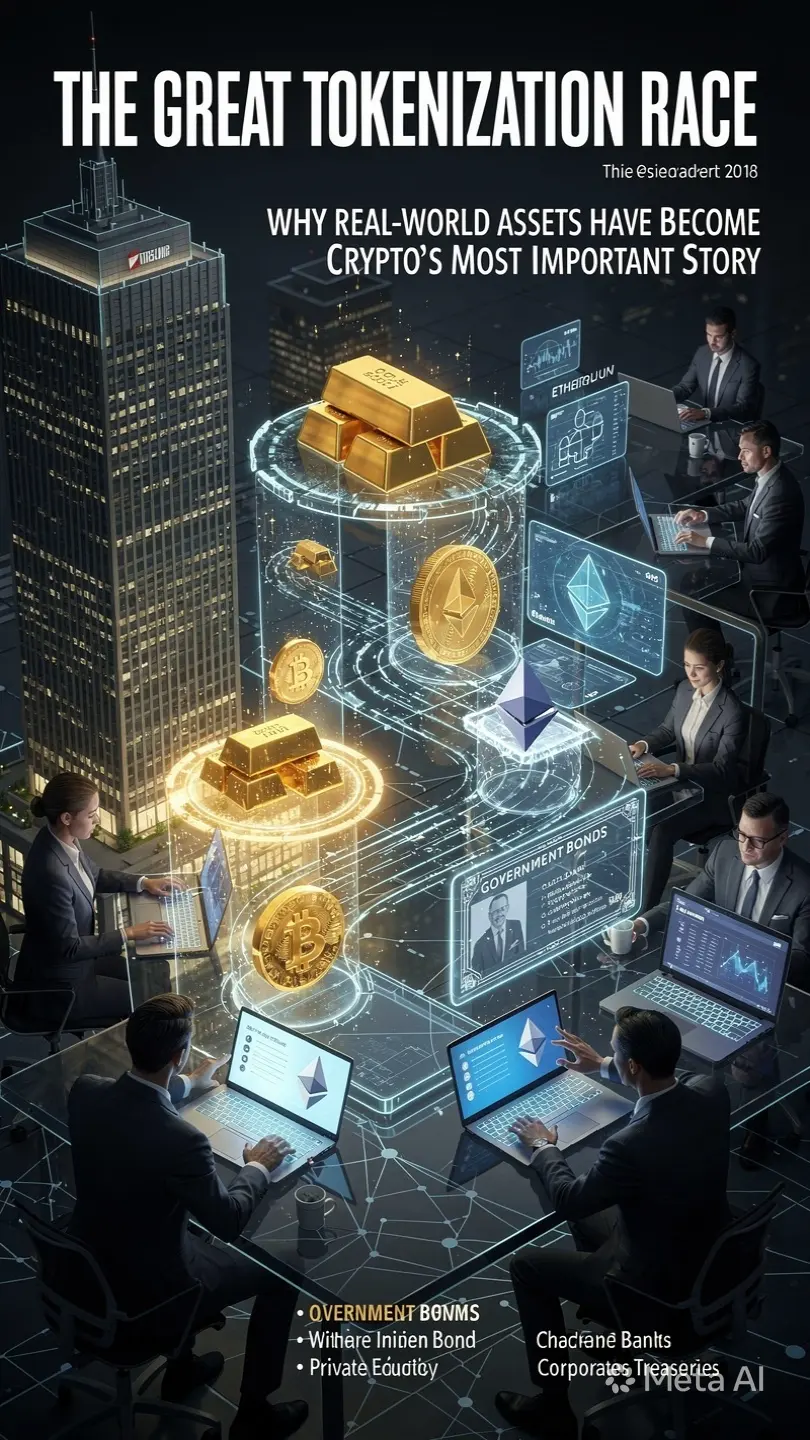
The concept is deceptively simple. Real-world assets such as real estate, bonds, commodities, private equity, and other financial instruments can be represented digitally on blockchain networks. Ownership becomes easier to divide, transfer, track, and verify.
The implications are enormous.
Traditional financial systems often operate through layers of intermediaries, paperwork, settlement delays, and geographic limitations. Tokenization offers a vision of financial markets that move faster, operate more efficiently, and provide broader access to investment opportunities.
For years, the idea remained largely theoretical.
That is no longer the case.
Across the financial sector, serious efforts are underway to explore how tokenized assets could improve market infrastructure. Large institutions are studying ways to digitize ownership records, streamline settlement processes, and unlock liquidity in markets that have historically been difficult to access.
This shift explains why tokenization has become one of the most closely watched developments in the cryptocurrency industry.
Unlike many previous narratives, its potential audience extends far beyond crypto enthusiasts.
It reaches banks.
Asset managers.
Investment funds.
Corporate treasuries.
Governments.
And eventually, ordinary investors.
Professional investors are particularly interested because tokenization addresses a problem that has existed for decades: inefficiency.
Many traditional assets remain difficult to trade, expensive to manage, or inaccessible to smaller investors. Digital representation has the potential to reduce friction while increasing transparency and flexibility.
If successful, the impact could be measured not in billions, but in trillions of dollars.
Yet enthusiasm alone does not guarantee success.
The road ahead remains challenging.
Regulatory frameworks continue evolving. Technical standards must mature. Security requirements remain demanding. Market participants must gain confidence that tokenized systems can operate reliably under real-world conditions.
These are significant obstacles.
They are also the kinds of obstacles that accompany every major financial innovation.
From a trader’s perspective, tokenization represents more than a technological trend.
It represents a long-term investment thesis.
The most successful investors often identify structural transformations before they become obvious to the broader market. They understand that the largest opportunities are rarely created by short-term excitement. Instead, they emerge when new infrastructure begins changing how industries operate.
Tokenization appears increasingly capable of becoming such a transformation.
That does not mean every project connected to the theme will succeed.
History suggests the opposite.
Periods of innovation inevitably attract both genuine builders and opportunists. Careful analysis remains essential. Investors must distinguish between meaningful adoption and empty promises.
The winners will likely be platforms capable of delivering real utility, regulatory compatibility, operational reliability, and measurable economic value.
Those qualities matter more than headlines.
More than hype.
More than temporary market excitement.
As the cryptocurrency industry continues evolving, tokenization is emerging as one of the few narratives capable of connecting blockchain technology with the broader global economy.
That connection could prove decisive.
Because the next phase of digital asset growth may not come from creating entirely new forms of value.
It may come from transforming the way existing value moves through the world.
If that happens, future historians may look back on this period as the moment when blockchain technology stopped existing alongside traditional finance and began merging with it.
And that possibility is precisely why tokenization has become one of the most important stories in the market today.
The Great Tokenization Race: Why Real-World Assets Have Become Crypto’s Most Important Story
Every few years, the cryptocurrency industry discovers a narrative powerful enough to reshape the entire conversation.
In earlier eras, investors focused on digital payments, decentralized finance, and blockchain gaming. Each wave attracted attention, investment, and innovation. Some delivered lasting value. Others faded as quickly as they arrived.
Today, one topic stands above almost every other discussion among investors, institutions, developers, and market analysts.
Tokenization.
Not as a buzzword.
Not as a marketing slogan.
But as a potentially transformative shift in how ownership itself is recorded, transferred, and managed.
The concept is deceptively simple. Real-world assets such as real estate, bonds, commodities, private equity, and other financial instruments can be represented digitally on blockchain networks. Ownership becomes easier to divide, transfer, track, and verify.
The implications are enormous.
Traditional financial systems often operate through layers of intermediaries, paperwork, settlement delays, and geographic limitations. Tokenization offers a vision of financial markets that move faster, operate more efficiently, and provide broader access to investment opportunities.
For years, the idea remained largely theoretical.
That is no longer the case.
Across the financial sector, serious efforts are underway to explore how tokenized assets could improve market infrastructure. Large institutions are studying ways to digitize ownership records, streamline settlement processes, and unlock liquidity in markets that have historically been difficult to access.
This shift explains why tokenization has become one of the most closely watched developments in the cryptocurrency industry.
Unlike many previous narratives, its potential audience extends far beyond crypto enthusiasts.
It reaches banks.
Asset managers.
Investment funds.
Corporate treasuries.
Governments.
And eventually, ordinary investors.
Professional investors are particularly interested because tokenization addresses a problem that has existed for decades: inefficiency.
Many traditional assets remain difficult to trade, expensive to manage, or inaccessible to smaller investors. Digital representation has the potential to reduce friction while increasing transparency and flexibility.
If successful, the impact could be measured not in billions, but in trillions of dollars.
Yet enthusiasm alone does not guarantee success.
The road ahead remains challenging.
Regulatory frameworks continue evolving. Technical standards must mature. Security requirements remain demanding. Market participants must gain confidence that tokenized systems can operate reliably under real-world conditions.
These are significant obstacles.
They are also the kinds of obstacles that accompany every major financial innovation.
From a trader’s perspective, tokenization represents more than a technological trend.
It represents a long-term investment thesis.
The most successful investors often identify structural transformations before they become obvious to the broader market. They understand that the largest opportunities are rarely created by short-term excitement. Instead, they emerge when new infrastructure begins changing how industries operate.
Tokenization appears increasingly capable of becoming such a transformation.
That does not mean every project connected to the theme will succeed.
History suggests the opposite.
Periods of innovation inevitably attract both genuine builders and opportunists. Careful analysis remains essential. Investors must distinguish between meaningful adoption and empty promises.
The winners will likely be platforms capable of delivering real utility, regulatory compatibility, operational reliability, and measurable economic value.
Those qualities matter more than headlines.
More than hype.
More than temporary market excitement.
As the cryptocurrency industry continues evolving, tokenization is emerging as one of the few narratives capable of connecting blockchain technology with the broader global economy.
That connection could prove decisive.
Because the next phase of digital asset growth may not come from creating entirely new forms of value.
It may come from transforming the way existing value moves through the world.
If that happens, future historians may look back on this period as the moment when blockchain technology stopped existing alongside traditional finance and began merging with it.
And that possibility is precisely why tokenization has become one of the most important stories in the market today.