# CLARITYActPassesSenateCommittee

3.59M

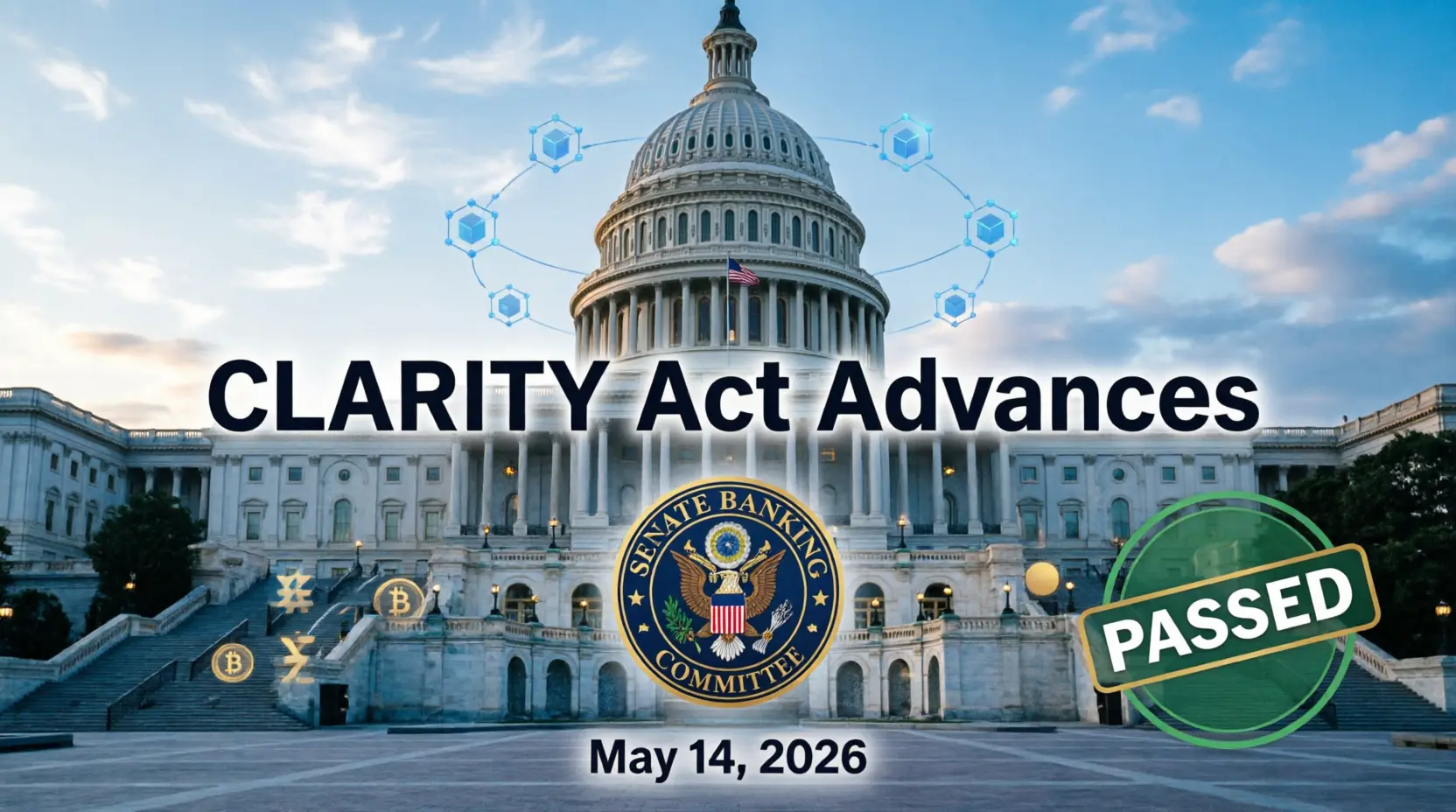
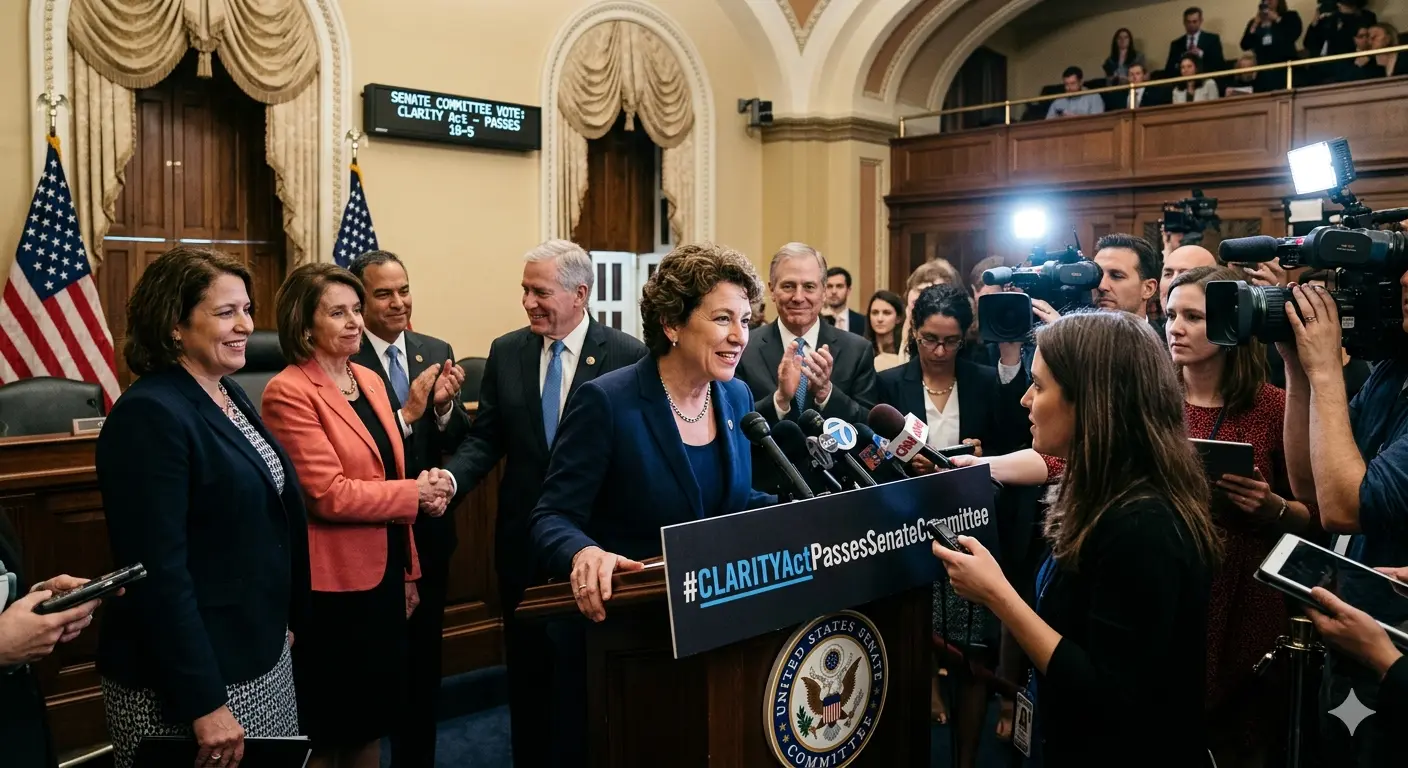
On May 14, the Senate Banking Committee passed the CLARITY Act by a 15 to 9 vote, advancing it to a full Senate vote. All 13 Republican committee members voted in favor, joined by two Democrats. The bill aims to clarify SEC and CFTC jurisdiction and provide protections for DeFi protocol developers. Polymarket data shows the implied probability of the bill becoming law in 2026 has risen to 74 percent. The next step is to reconcile with the House version before it can be sent to the president for signature.

#CLARITYActPassesSenateCommittee
CLARITY Act Passes Senate Committee — Digital Asset Regulation Enters a Defining Era
The movement of the CLARITY Act through Senate committee discussions is being viewed across financial markets as one of the most significant regulatory developments for the digital asset industry in recent years. While crypto markets have historically been driven by innovation, speculation, and rapid technological growth, the next phase of industry expansion increasingly depends on one critical factor: regulatory certainty.
For years, digital asset companies, investors, develo
post-image
post-image
post-image
  • Reward
  • Comment
  • Repost
  • Share
#CLARITYActPassesSenateCommittee
🏛️ CLARITY Act Passes Senate Committee — This Is the Moment Crypto Has Been Building Toward
It happened. The CLARITY Act just cleared the Senate committee and honestly I have been waiting to write this post for months.
This is not a small procedural step. Passing Senate committee is the most significant legislative milestone the stablecoin regulation debate has reached since the conversation began in Washington. Bills that clear committee with meaningful votes go to the full Senate floor. And bills that reach the Senate floor with bipartisan backing get passe
BTC0.08%
ETH0.39%
COIN-8.14%
post-image
  • Reward
  • 12
  • Repost
  • Share
discovery:
To The Moon 🌕
View More
#CMEToLaunchNasdaqCryptoIndexFutures #CLARITYActPassesSenateCommittee
🏛️ CLARITY Act Passes Senate Committee — This Is the Moment Crypto Has Been Building Toward
It happened. The CLARITY Act just cleared the Senate committee and honestly I have been waiting to write this post for months.
This is not a small procedural step. Passing Senate committee is the most significant legislative milestone the stablecoin regulation debate has reached since the conversation began in Washington. Bills that clear committee with meaningful votes go to the full Senate floor. And bills that reach the Senate fl
BTC0.08%
ETH0.39%
COINON1.11%
post-image
Crypto_Buzz_with_Alex
#CLARITYActPassesSenateCommittee
🏛️ CLARITY Act Passes Senate Committee — This Is the Moment Crypto Has Been Building Toward
It happened. The CLARITY Act just cleared the Senate committee and honestly I have been waiting to write this post for months.
This is not a small procedural step. Passing Senate committee is the most significant legislative milestone the stablecoin regulation debate has reached since the conversation began in Washington. Bills that clear committee with meaningful votes go to the full Senate floor. And bills that reach the Senate floor with bipartisan backing get passed.
Let me tell you why this matters beyond the obvious.
There is a specific category of institutional capital that has been completely frozen on the sidelines — not because of macro concerns, not because of Bitcoin's price, but purely because compliance teams at major financial institutions could not sign off on crypto allocations without a clear regulatory framework. These are real firms with real money managing real fiduciary responsibilities. The CLARITY Act clearing committee just changed their internal calculus overnight.
The banking sector fought this hard. The member rewards clause drew fierce opposition from institutions terrified of deposit flight toward higher yielding stablecoin alternatives. The fact that the bill survived committee despite that opposition tells you the bipartisan momentum behind digital asset regulation has genuine depth — not just crypto-friendly politicians but mainstream lawmakers who understand that America ceding stablecoin leadership to other jurisdictions is a national security issue.
Polymarket had passage probability sitting around 61% heading into this week. That number moves significantly higher today. And institutional positioning moves ahead of probability shifts not after them.
The market reaction will be the real test. Watch stablecoin-adjacent tokens, DeFi infrastructure projects and Coinbase specifically in the next 24 to 48 hours. These are the most direct beneficiaries of regulatory clarity and they will price in this development faster than the broader market.
Bitcoin and Ethereum benefit too but more indirectly — through the unlocking of institutional capital flows that regulatory clarity enables rather than through direct protocol impact.
The CLARITY Act is not law yet. Full Senate vote still ahead. But clearing committee was the hardest part. The finish line just got significantly closer.
Are you positioning ahead of a full Senate vote? Which assets are you most focused on? Drop below 👇
#CLARITYActPassesSenateCommittee #GateSquare #Crypto @Gate_Square
repost-content-media
  • Reward
  • 8
  • Repost
  • Share
discovery:
To The Moon 🌕
View More
#CLARITYActPassesSenateCommittee
The crypto market may look calm on the surface right now, but structurally something extremely important just changed in Washington.
The CLARITY Act passing through Senate committee is not just another political headline. This is one of the first moments where digital asset regulation in the United States is beginning to transition from uncertainty toward an actual operational framework institutions can work with.
For years the biggest problem facing crypto adoption inside traditional finance was never technology. It was never liquidity. And it was definitely
BTC0.08%
ETH0.39%
post-image
post-image
  • Reward
  • 1
  • Repost
  • Share
HighAmbition:
2026 GOGOGO 👊
Most people are focused on whether the CLARITY Act passes.
Washington is already thinking about something else:
Who actually controls crypto regulation *after* it passes.
Right now the CFTC only has one sitting commissioner left. Four seats are empty.
That becomes a serious issue if Congress suddenly hands the agency major authority over crypto markets.
Because regulation is never just about laws.
It’s about the people interpreting them.
The CLARITY Act could shift a large part of crypto oversight away from the SEC and toward the CFTC, especially for commodity-style digital assets.
That means
BTC0.07%
  • Reward
  • 4
  • Repost
  • Share
discovery:
LFG 🔥
View More
#CLARITYActPassesSenateCommittee
The CLARITY Act just cleared a major hurdle and markets are starting to price in real regulatory certainty for crypto.
On May 14, the U.S. Senate Banking Committee passed the CLARITY Act by a 15–9 vote, officially advancing it to a full Senate floor vote.
What makes this moment important is not just the vote — but the political signal behind it:
✔️ All 13 Republican members supported the bill
✔️ Joined by 2 Democrats
✔️ Strong bipartisan momentum emerging around crypto market structure
📌 What the CLARITY Act actually aims to do:
• Define clear jurisdiction b
post-image
  • Reward
  • 2
  • Repost
  • Share
HighAmbition:
good information 👍👍
View More
#CLARITYActPassesSenateCommittee
The CLARITY Act, recently advanced through the U.S. Senate Banking Committee with a bipartisan 15–9 vote, marks a historic shift in U.S. digital asset regulation. While the development is fundamentally bullish for long-term crypto adoption, Bitcoin experienced a short-term correction due to profit-taking, macro uncertainty, and “sell the news” dynamics.
Bitcoin is currently trading on Gate.io around $77,600–$78,400, after recently testing highs near $81,000–$82,000, reflecting a controlled consolidation phase rather than structural weakness.
CLARITY Act Overvi
BTC0.07%
HighAmbition
#CLARITYActPassesSenateCommittee
The CLARITY Act, recently advanced through the U.S. Senate Banking Committee with a bipartisan 15–9 vote, marks a historic shift in U.S. digital asset regulation. While the development is fundamentally bullish for long-term crypto adoption, Bitcoin experienced a short-term correction due to profit-taking, macro uncertainty, and “sell the news” dynamics.
Bitcoin is currently trading on Gate.io around $77,600–$78,400, after recently testing highs near $81,000–$82,000, reflecting a controlled consolidation phase rather than structural weakness.
CLARITY Act Overview
The CLARITY Act (Digital Asset Market Clarity Act) is designed to establish a full legal framework for crypto markets in the United States, removing long-standing ambiguity that has restricted institutional participation.
Key Features:
Classification of digital assets into securities and commodities
Defined jurisdiction split between CFTC (commodities) and SEC (securities)
Regulatory licensing framework for crypto exchanges
Stablecoin issuance and reserve requirements
Custody, auditing, and reporting standards for institutions
Legal recognition of compliant blockchain-based financial systems
Market Support & Opposition:
Supporters: Coinbase, Circle, Ripple, a16z, and policy-aligned regulators
Opponents: 일부 banking groups and labor organizations concerned about systemic risk and consumer protection
This creates a foundational regulatory bridge between traditional finance and digital asset ecosystems.
Market Reaction: Why Bitcoin Dropped Despite Positive News
1. Sell the News Dynamics
Bitcoin had already priced in regulatory optimism:
Rally phase pushed price toward $81K–$82K resistance zone
News confirmation triggered profit realization
Short-term correction followed toward $77K–$78K range
This is a standard behavior in mature financial markets.
2. Resistance Zone Pressure
Strong sell orders concentrated near $80K psychological level
Short-term traders exited leveraged positions
Liquidity pockets triggered rapid downside wicks
3. Macro Environment Influence
Rising U.S. Treasury yields increased opportunity cost of holding risk assets
Dollar strength created additional pressure on crypto liquidity
Equity market softness contributed to correlated risk-off sentiment
4. Liquidation Cascade
Over-leveraged long positions were flushed out
Futures market imbalance amplified downward momentum
Spot markets stabilized after leverage reset
5. Regulatory Timeline Uncertainty
Even with Senate progress:
Full Senate vote still pending
House approval required
Final presidential signing uncertain
Markets continuously discount time risk, not just outcome.
Bitcoin Price Structure & Market Behavior
Current Range Dynamics
Support Zone: $75,500 – $76,800
Mid Range: $77,000 – $79,000
Resistance: $80,500 – $82,500
Bitcoin is currently consolidating inside a broad high-volatility range after a strong multi-week rally.
Scenario-Based Outlook
Bullish Scenario:
Break above $82,500 resistance
Potential move toward $85K–$88K
Extended momentum could push toward $90K+
Neutral Scenario:
Range-bound movement between $76K–$81K
Market digestion of regulatory headlines
Bearish Scenario:
Breakdown below $75K support
Possible retest of $72K–$70K liquidity zone
Institutional Adoption Catalyst
Regulatory Clarity Unlocks Capital Flows
The Act significantly reduces legal uncertainty, enabling:
Pension funds to evaluate Bitcoin exposure
Insurance portfolios to consider allocation
Corporate treasuries to revisit balance sheet diversification
Previously, regulatory ambiguity was the biggest barrier—not volatility.
Banking System Integration
Traditional finance integration accelerates through:
Federally compliant custody solutions
Bitcoin-backed lending systems
Institutional clearing and settlement infrastructure
This reduces friction between fiat and crypto ecosystems.
Market Structure Evolution
Bitcoin is transitioning into a hybrid asset class:
Structural Improvements:
Increased institutional participation stabilizes liquidity
ETF-driven flows reduce retail-driven volatility spikes
Stronger correlation with macro liquidity cycles
Identity Shift:
Bitcoin evolves further into:
A macro hedge asset
A regulated commodity instrument
A global liquidity-sensitive digital reserve asset
Volatility Analysis
Short-Term Volatility (High)
Volatility remains elevated due to:
Legislative milestones
Macro liquidity shifts
Leverage-driven derivatives positioning
Price swings between $77K–$82K reflect this instability.
Medium-Term Stabilization
As regulatory clarity improves:
Tail-risk events decline
Institutional models normalize Bitcoin exposure
Liquidity depth increases significantly
This leads to smoother price discovery over time.
Structural Volatility Outlook
Baseline volatility decreases gradually
Event-driven spikes remain possible
Institutional flows reduce random micro volatility
Bitcoin becomes less chaotic but not low-volatility.
Institutional Strategy Response
Phase 1: Legal & Compliance Evaluation
Institutions begin reassessing:
Custody providers
Exchange compliance status
Internal allocation mandates
This phase is slow but foundational.
Phase 2: Gradual Allocation Deployment
Likely capital flows into:
Bitcoin ETFs
Direct custody solutions
Hedge fund exposure increases
Corporate treasury pilot allocations
Early adopters lead the transition.
Phase 3: Infrastructure Expansion
Demand increases for:
Regulated prime brokers
Institutional lending platforms
Settlement networks
Derivatives clearing systems
This creates long-term ecosystem expansion.
Risk Framework Evolution
Institutional models now adjust:
Lower regulatory risk premium
Improved risk-adjusted returns for Bitcoin
Enhanced portfolio diversification models
However, full-scale adoption remains gradual due to governance cycles.
Market Sentiment Outlook
Short-Term Sentiment:
Neutral to slightly volatile
Driven by news digestion and liquidity shifts
Mid-Term Sentiment:
Bullish structural bias
Institutional accumulation expected on dips
Long-Term Sentiment:
Strongly positive if legislation fully passes
Bitcoin increasingly seen as institutional-grade macro asset
Conclusion
The CLARITY Act represents a structural turning point for Bitcoin and the broader crypto ecosystem. While short-term price action reflects profit-taking and uncertainty, the long-term implications are decisively constructive.
Bitcoin’s movement from $82K highs to the $77K–$78K consolidation zone reflects healthy market digestion rather than trend reversal.
Over time, the Act is expected to:
Expand institutional participation
Reduce regulatory uncertainty
Strengthen infrastructure development
Improve market efficiency and liquidity depth
Bitcoin is transitioning from a speculative asset into a globally integrated financial instrument, with increasing stability, deeper liquidity, and stronger institutional participation shaping its next phase of growth.
repost-content-media
  • Reward
  • Comment
  • Repost
  • Share
#CLARITYActPassesSenateCommittee
The CLARITY Act, recently advanced through the U.S. Senate Banking Committee with a bipartisan 15–9 vote, marks a historic shift in U.S. digital asset regulation. While the development is fundamentally bullish for long-term crypto adoption, Bitcoin experienced a short-term correction due to profit-taking, macro uncertainty, and “sell the news” dynamics.
Bitcoin is currently trading on Gate.io around $77,600–$78,400, after recently testing highs near $81,000–$82,000, reflecting a controlled consolidation phase rather than structural weakness.
CLARITY Act Overvi
BTC0.08%
post-image
post-image
post-image
  • Reward
  • 2
  • Repost
  • Share
MissCrypto:
Ape In 🚀
View More
The Regulatory Trap: Grok AI Warns of Stagnation for XRP if Clarity Act Fails
$XRP price trajectory in 2026 is becoming increasingly tethered to the outcome of the Clarity Act in the United States. According to a recent forecast by Grok AI, the digital asset risks a period of prolonged stagnation or even a significant decline if this pivotal piece of legislation fails to pass. While $XRP has shown resilience, trading between 1.40 and 1.50 dollars after a recent rebound, the absence of a clear legal framework would likely remove a primary catalyst for an institutional-led bull run. Without the
XRP0.21%
BTC0.08%
post-image
  • Reward
  • Comment
  • Repost
  • Share
#CLARITYActPassesSenateCommittee CLARITY Act Passes Senate Committee What This Means for Crypto and What Comes Next
The Historic Vote
On May 14, 2026, the U.S. Senate Banking Committee voted 15–9 to advance the Digital Asset Market Clarity Act the CLARITY Act marking the first time a comprehensive crypto market-structure bill has cleared a Senate panel. Two Democrats, Senators Ruben Gallego of Arizona and Angela Alsobrooks of Maryland, broke with their party to support the bill, giving it the bipartisan backing that many thought was impossible after four months of deadlock.
Senate Banking Comm
BTC0.08%
ETH0.39%
post-image
  • Reward
  • 8
  • Repost
  • Share
Crypto_Buzz_with_Alex:
2026 GOGOGO 👊
View More
Load More