























*Data last updated: 2026-05-04 19:41 (UTC+8)
As of 2026-05-04 19:41, Anduril (ANDURIL) is priced at $0, with a total market cap of --, a P/E ratio of 0.00, and a dividend yield of 0.00%. Today, the stock price fluctuated between $0 and $0. The current price is 0.00% above the day's low and 0.00% below the day's high, with a trading volume of --. Over the past 52 weeks, ANDURIL has traded between $0 to $0, and the current price is 0.00% away from the 52-week high.
ANDURIL Key Stats
Learn More about Anduril (ANDURIL)
Gate Learn Articles
If Polymarket doesn’t launch a token, what other assets remain for speculation in prediction markets?
The article introduces each project's background, innovations, and market performance. It also showcases the diversity and potential of the prediction market sector through detailed case studies.
2025-09-05
If Polymarket isn’t launching its own token, what opportunities remain for speculation in the prediction market?
Polymarket, the leading prediction market project, has secured investment from Trump Jr.'s 1789 Capital. As a result, investor interest is shifting from token issuance to IPOs. This article spotlights six major prediction market projects that have not yet launched tokens: Flipr, UMA, Augur, Azuro, PNP, and Hedgemony. It examines how their development strategies differ across social integration, infrastructure, AI-driven features, and other areas.
2025-09-04
The finalized stablecoin bill and the increasingly uneasy bankers on Wall Street
The article offers an in-depth look at how these institutions are leveraging stablecoins and blockchain technology to solve the high costs and inefficiencies associated with traditional cross-border payments, and details their ongoing efforts to ensure regulatory compliance.
2025-07-22
Anduril (ANDURIL) FAQ
What's the stock price of Anduril (ANDURIL) today?
What are the 52-week high and low prices for Anduril (ANDURIL)?
What is the price-to-earnings (P/E) ratio of Anduril (ANDURIL)? What does it indicate?
What is the market cap of Anduril (ANDURIL)?
What is the most recent quarterly earnings per share (EPS) for Anduril (ANDURIL)?
Should you buy or sell Anduril (ANDURIL) now?
What factors can affect the stock price of Anduril (ANDURIL)?
How to buy Anduril (ANDURIL) stock?
Risk Warning
Disclaimer
Other Trading Markets
Anduril (ANDURIL) Latest News
In one year, the valuation increased by 140%. Who is writing the checks for defense AI?
On March 26, Shield AI, a military AI company, announced that it had completed a $2.0 billion funding round. Its valuation jumped from $5.3 billion a year earlier to $12.7 billion, a 140% increase. The lead investors were not Silicon Valley venture capital firms, but global PE giant Advent International and the security and resilience investment arm of JPMorgan Chase—together investing $1.5 billion in equity financing. According to a report by Bloomberg, Blackstone injected an additional $500 million in preferred stock and committed to $250 million in delayed drawdown of loan facilities. A $2.0 billion funding round in itself is not what matters. What matters is who is writing this check. This is a slice of how the capital structure in defense technology is shifting. If you put Shield AI and Anduril—another company in the same track—on the same timeline, the trend becomes clear immediately. In October 2023, Shield AI’s Series F valuation was $2.7 billion. Anduril’s Series E valuation at the end of 2022 was about $8.5 billion. By March 2026, Shield AI rose to $12.7 billion, while, according to TechBuzz AI, Anduril is seeking a new round of financing at a $60 billion valuation. In a period of just over two years, both companies completed valuation jumps of more than 4x. 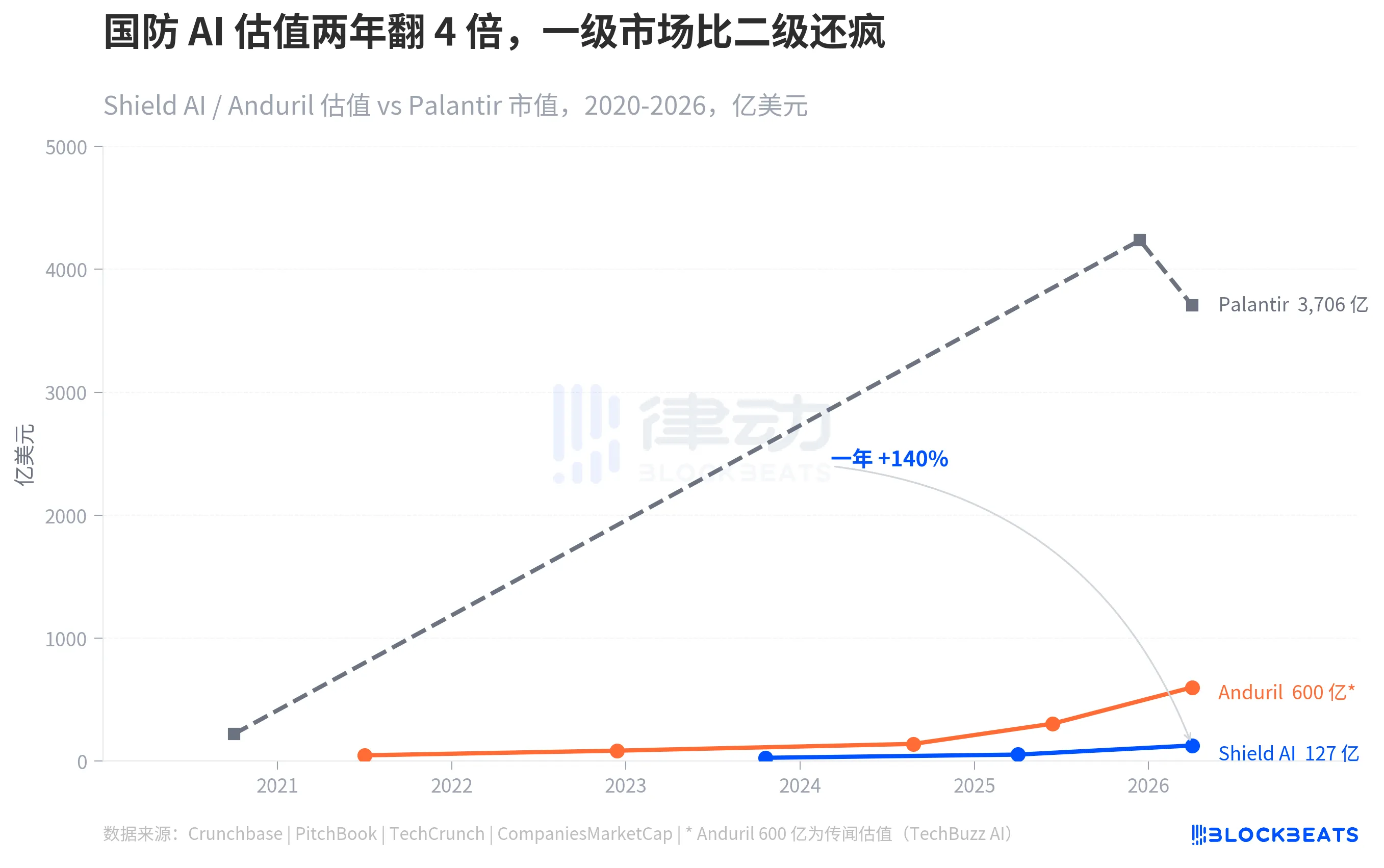 The slope of this curve became noticeably steeper in 2025. Based on estimates by Sacra, Anduril’s 2025 revenue will reach $2.1 billion, up 110% year over year, and its 2026 revenue forecast is $4.3 billion. Shield AI has not disclosed revenue, but according to Tracxn data, its cumulative funding has already exceeded $3.0 billion. Valuation growth is far outpacing revenue growth, indicating that the market’s pricing for defense AI companies has shifted to a “platform expectations” model: not valuing by current revenue, but by the position it can secure in future military procurement systems. As a point of reference, Palantir—the only publicly listed company in the defense AI space—had a market cap of about $22 billion at its September 2020 IPO. According to its Q4 earnings report, Palantir’s Q4 2025 revenue reached $1.41 billion, up 70% year over year, and its FY2026 full-year revenue guidance is $7.18 billion to $7.20 billion. By the end of 2025, its market cap ballooned to more than $420 billion. The primary and secondary markets are telling the same story—only the valuation curve in the primary market is steeper than the one after Palantir went public. Driving the valuation surge is not just capital expectations. Shield AI has deployed product lines: the already-in-service MQ-35 V-BAT vertical takeoff and landing reconnaissance unmanned aircraft, and the next-generation autonomous fighter X-BAT, announced in October 2025. According to DroneXL, the X-BAT unit price is about $27 million—less than one quarter of the F-35—its range reaches 2,300 miles, it does not require a runway (it can take off from a trailer), and it plans for mass production in 2029. In February 2026, Shield AI’s core AI engine, Hivemind, was selected by the U.S. Air Force to provide mission autonomy for Anduril’s Fury unmanned drone (serial number YFQ-44A) in the Collaborative Combat Aircraft (CCA) program, according to The Defense Post. Flight demonstrations are expected to take place within the next few months. In the same round of financing, Shield AI also acquired the flight simulation software company Aechelon Technology. Aechelon’s simulation technology had previously been used to train U.S. military pilots; after the acquisition is completed, Shield AI holds all three links: training data generation, autonomous flight algorithms, and a hardware platform. But what truly makes the valuation curve steeper is a structural change in the source of funds. Shield AI’s earlier rounds were led by venture capital and strategic investors such as Andreessen Horowitz and L3Harris. In this round, the lead investors switched to PE giant Advent International and JPMorgan Chase, while Blackstone provided preferred stock and debt financing. This is not an isolated case. According to a report by Bisnow, the U.S. Army has awarded data center construction contracts for two military bases to Carlyle and CyrusOne, a company affiliated with KKR. Each project is worth $2.0 billion, with leases lasting up to 50 years. According to S&P Global data, in just the first two and a half months of 2025, the total deal value for PE/VC in the global aerospace and defense sector already reached $4.27 billion, with 83% flowing into North America. PE giants are no longer only making financial investments in the military sector—they are starting to treat defense infrastructure as a long-term asset class for allocation. 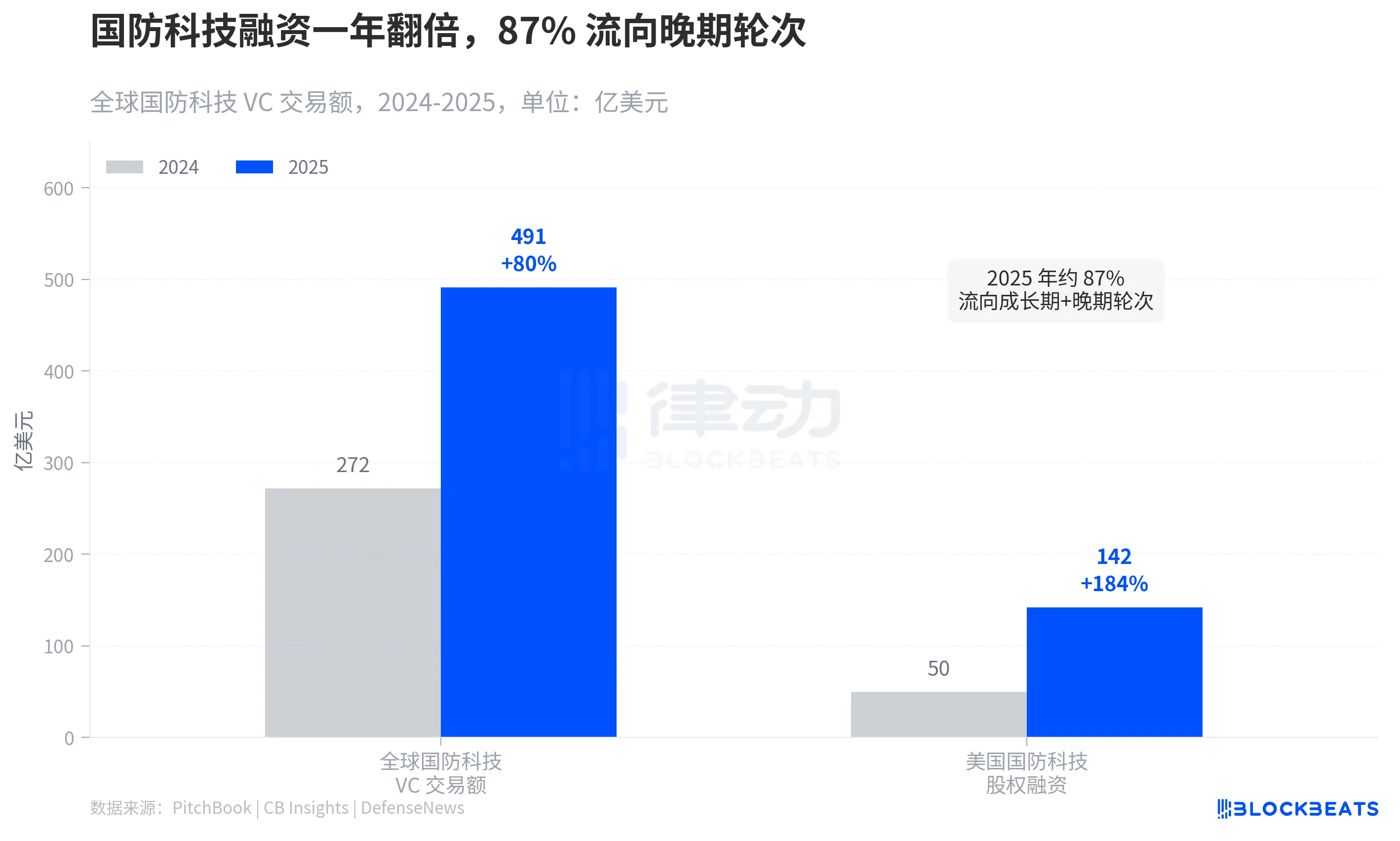 According to PitchBook data, in 2025 global defense tech VC deal value reached $49.1 billion, nearly doubling from $27.2 billion in 2024. DefenseNews reports that U.S. domestic defense tech equity financing surged from $5.0 billion in 2024 to $14.2 billion—an increase of nearly 3x. Of this, about 87% of the capital flowed to growth-stage and late-stage rounds. Funds are no longer going to experimental prototypes, but to companies that are preparing mass production and deliveries. JPMorgan Chase estimates that since 2021, global defense tech has cumulatively absorbed about $130 billion in venture capital. Behind the influx of these funds is a clear buyer signal. Per the U.S. Department of Defense FY2026 budget request, the Pentagon for the first time set up a separate budget line for AI and autonomous systems, totaling $13.4 billion. Of this, airborne unmanned drones take $9.4 billion—more than 70%. Seaborne autonomous platforms take $1.7 billion, software and cross-domain integration takes $1.2 billion, and underwater systems take $730 million. This is the AI-specific allocation carved out of the Pentagon’s total FY2026 budget of $1.01 trillion. Previously, the U.S. military had never treated AI and autonomous systems as an independent budget category. In an AI strategy memorandum released by Defense Secretary Pete Hegseth in January 2026, he clearly stated that the U.S. military will become an “AI-prioritized combat force,” and listed seven FY2026 priority projects, including autonomous drone swarm systems and an AI-driven kill chain execution system. 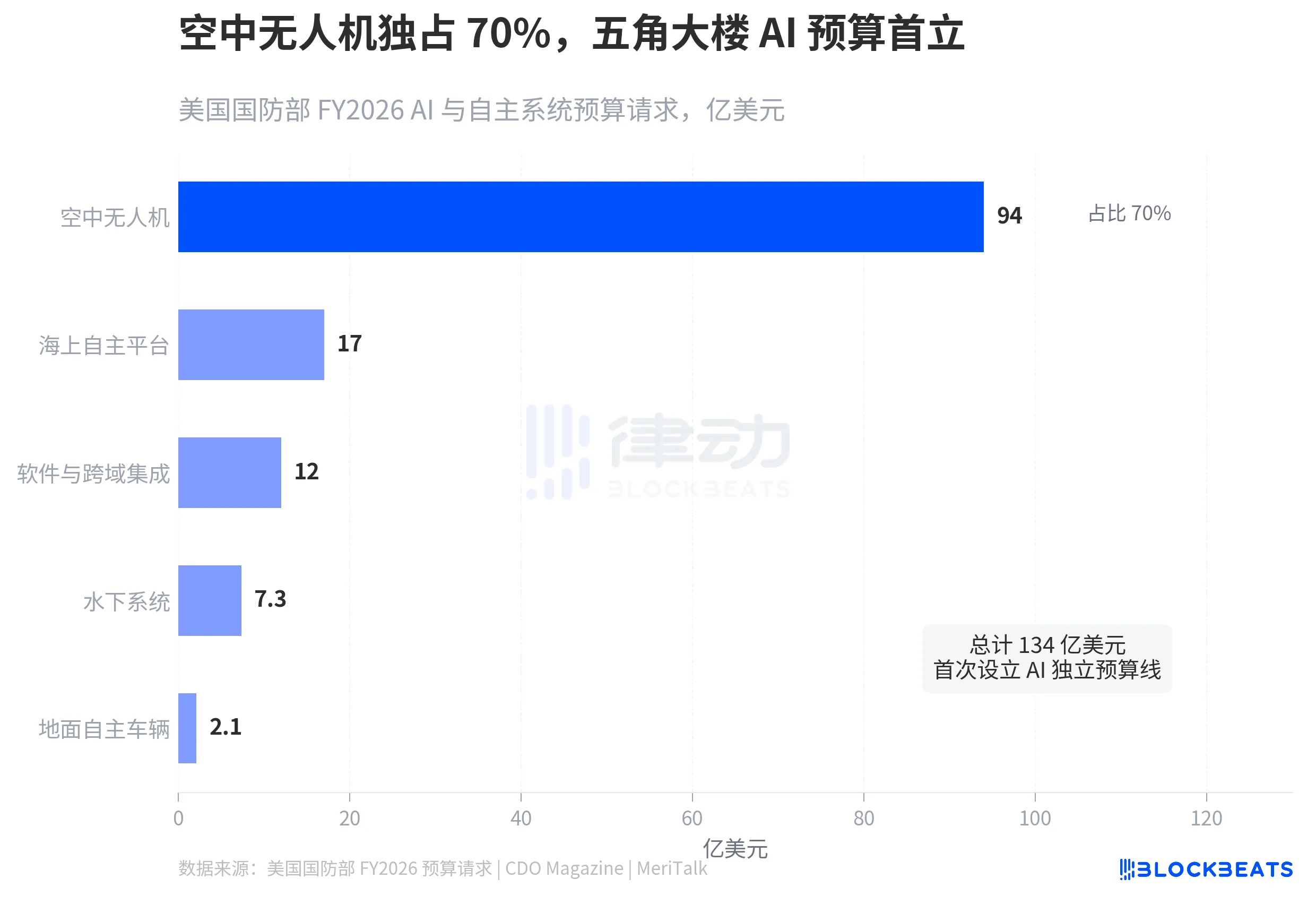 The $9.4 billion air drone budget lines up precisely with the core product lines of Shield AI and Anduril. The Pentagon is not “exploring” military applications of AI—it is purchasing. The Air Force’s CCA program plans to make its first mass-production decisions in FY2026. When the Pentagon uses a $13.4 billion budget to place orders for AI drones, and when PE uses 50-year leases to operate military bases as infrastructure, the capital logic in defense technology has already switched from a venture-capital-style betting track to infrastructure-level asset allocation. Click to learn more about the job openings from Luyun BlockBeats **Welcome to join the official Luyun BlockBeats community:** Telegram subscription group: https://t.me/theblockbeats Telegram discussion group: https://t.me/BlockBeats_App Twitter official account: https://twitter.com/BlockBeatsAsia
2026-03-25 17:58VCX Perpetual Contracts Launch on Gate Contract Stocks Section, Supporting 1-20x Leverage for Long and Short Positions
Gate News bot message, according to Gate official announcement The Gate Contract Stock Zone has launched live trading of VCX perpetual contracts, settled in USDT, supporting 1-20x long and short positions. Leverage can be selected at the time of order. VCX (Fundrise Innovation Fund) is a publicly traded venture capital fund listed on the New York Stock Exchange, with an investment portfolio including top private tech and AI companies such as OpenAI, Anthropic, Databricks, SpaceX, Anduril, Ramp, and others.
2025-12-22 22:16Banking startup Erebor secures $350 million in funding after receiving FDIC approval.
According to Jincai Finance, Erebor, a bank startup co-founded by Anduril CEO Palmer Luckey, has completed a $350 million financing round at a valuation of approximately $4.35 billion after receiving approval from the Federal Deposit Insurance Corporation (FDIC) to establish a national bank. This round of financing was led by Lux Capital, with other investors including Peter Thiel's Founders Fund, 8VC, and Haun Ventures. Erebor was established in 2025, planning to provide traditional banking and crypto-related products and services, targeting clients in the U.S. innovative economy sectors such as virtual currency, artificial intelligence, and manufacturing. The bank is expected to officially launch next year.