Laxi

vip
Age 0.6 Year
Peak Tier 5
No content yet
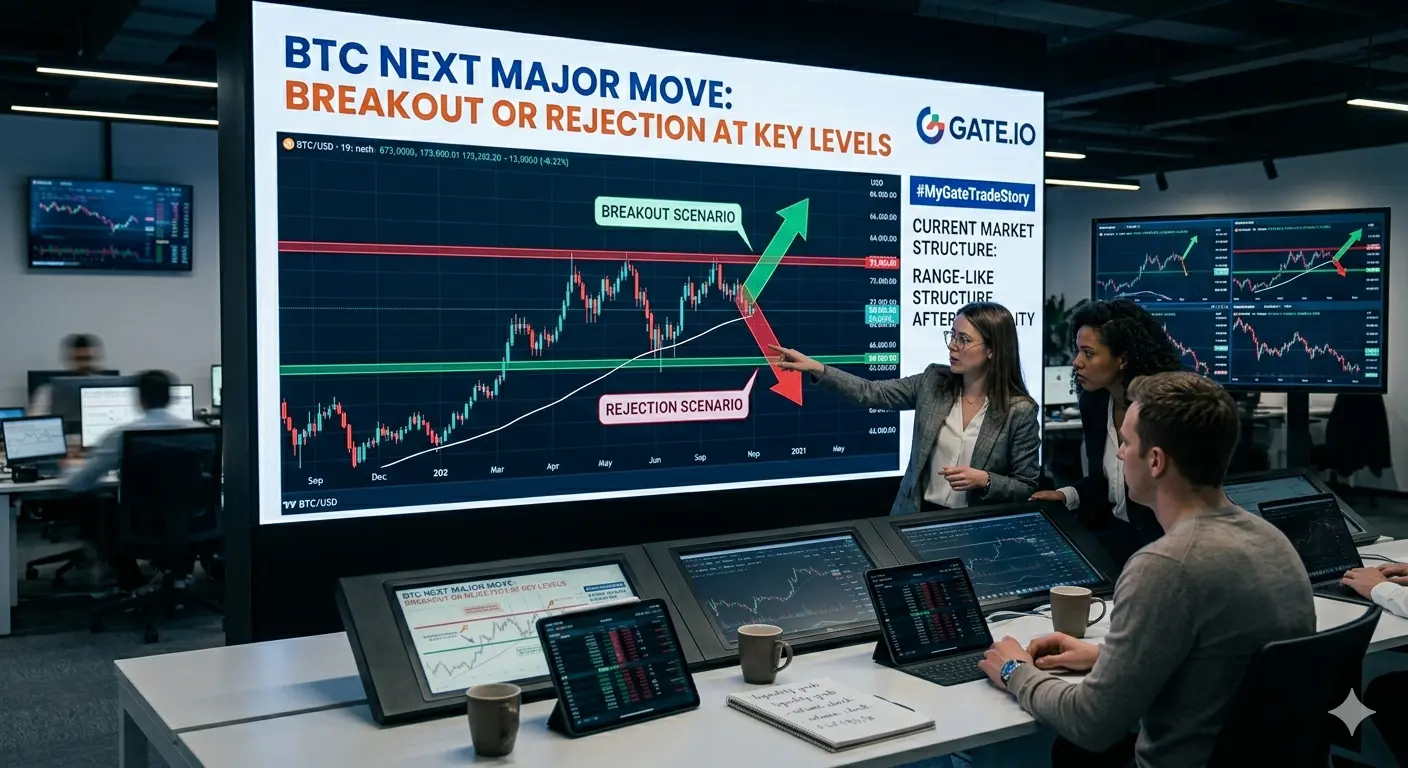
𝐁𝐓𝐂 𝐍𝐞𝐱𝐭 𝐌𝐚𝐣𝐨𝐫 𝐌𝐨𝐯𝐞 𝐏𝐫𝐞𝐝𝐢𝐜𝐭𝐢𝐨𝐧: 𝐁𝐫𝐞𝐚𝐤𝐨𝐮𝐭 𝐨𝐫 𝐑𝐞𝐣𝐞𝐜𝐭𝐢𝐨𝐧 𝐚𝐭 𝐊𝐞𝐲 𝐋𝐞𝐯𝐞𝐥𝐬
#MyGateTradeStory
𝐂𝐮𝐫𝐫𝐞𝐧𝐭 𝐌𝐚𝐫𝐤𝐞𝐭 𝐒𝐭𝐫𝐮𝐜𝐭𝐮𝐫𝐞
Bitcoin is currently trading in a critical phase where the market is trying to decide between continuation of the trend or a deeper correction. Price action has been moving in a range-like structure after strong volatility phases, which shows that the market is building liquidity on both sides. This type of structure usually appears before a major breakout or breakdown, where the next directional move becom
BTC5.02%
MrFlower_XingChen
𝐁𝐓𝐂 𝐍𝐞𝐱𝐭 𝐌𝐚𝐣𝐨𝐫 𝐌𝐨𝐯𝐞 𝐏𝐫𝐞𝐝𝐢𝐜𝐭𝐢𝐨𝐧: 𝐁𝐫𝐞𝐚𝐤𝐨𝐮𝐭 𝐨𝐫 𝐑𝐞𝐣𝐞𝐜𝐭𝐢𝐨𝐧 𝐚𝐭 𝐊𝐞𝐲 𝐋𝐞𝐯𝐞𝐥𝐬
#MyGateTradeStory
𝐂𝐮𝐫𝐫𝐞𝐧𝐭 𝐌𝐚𝐫𝐤𝐞𝐭 𝐒𝐭𝐫𝐮𝐜𝐭𝐮𝐫𝐞
Bitcoin is currently trading in a critical phase where the market is trying to decide between continuation of the trend or a deeper correction. Price action has been moving in a range-like structure after strong volatility phases, which shows that the market is building liquidity on both sides. This type of structure usually appears before a major breakout or breakdown, where the next directional move becomes significantly stronger.
𝐊𝐞𝐲 𝐋𝐞𝐯𝐞𝐥𝐬 𝐓𝐡𝐚𝐭 𝐌𝐚𝐭𝐭𝐞𝐫 𝐌𝐨𝐬𝐭
At this stage, the most important factor is not random price movement but key liquidity zones. Bitcoin is respecting major support and resistance areas where buyers and sellers are actively defending positions. The market is currently reacting around a critical mid-range zone, and whichever side wins this battle will likely control the next major trend.
Upper resistance zone = potential breakout trigger
Lower support zone = liquidation + accumulation area
Mid-range = indecision zone where fake moves often occur
This structure suggests that the market is preparing for expansion after compression.
𝐁𝐫𝐞𝐚𝐤𝐨𝐮𝐭 𝐒𝐜𝐞𝐧𝐚𝐫𝐢𝐨
If Bitcoin successfully breaks above the resistance zone with strong volume, the market could enter a bullish expansion phase. A breakout without volume is usually weak, but a breakout with strong participation often leads to fast momentum-driven rallies.
In a bullish breakout scenario:
Short positions may get liquidated
Momentum traders will enter aggressively
Price can move rapidly due to low resistance above
In such conditions, the market often moves in a fast impulse wave, not slow movement, because liquidity gets thin above resistance zones.
𝐑𝐞𝐣𝐞𝐜𝐭𝐢𝐨𝐧 𝐒𝐜𝐞𝐧𝐚𝐫𝐢𝐨
If Bitcoin fails to break resistance and gets rejected, the market can shift into a bearish continuation or deeper retracement phase. Rejection usually happens when buyers fail to sustain momentum and sellers regain control at key levels.
In a rejection scenario:
Long positions may face liquidation pressure
Price can quickly move back into support zones
Market sentiment can turn bearish rapidly
This is often where retail traders get trapped, buying breakouts that fail or chasing momentum too late.
𝐋𝐢𝐪𝐮𝐢𝐝𝐢𝐭𝐲 𝐁𝐞𝐡𝐚𝐯𝐢𝐨𝐫 𝐀𝐧𝐚𝐥𝐲𝐬𝐢𝐬
Modern Bitcoin price movement is heavily driven by liquidity. The market does not move randomly—it moves toward areas where stop losses are concentrated. Equal highs, equal lows, and breakout zones often act as liquidity targets.
Currently, both sides of the market are building liquidity:
Above resistance = trapped short liquidity
Below support = trapped long liquidity
This creates a setup where a strong move can trigger a liquidity sweep followed by trend expansion.
𝐕𝐨𝐥𝐮𝐦𝐞 𝐚𝐧𝐝 𝐌𝐨𝐦𝐞𝐧𝐭𝐮𝐦 𝐅𝐚𝐜𝐭𝐨𝐫
Volume is the confirmation tool for any breakout or rejection. Without volume, price movement is often fake or short-lived. A true trend shift requires participation from both retail and institutional players.
Key observation points:
Rising volume on breakout = strong trend confirmation
Low volume breakout = potential fake move
High rejection volume = strong reversal signal
Momentum is what converts a simple move into a sustained trend.
𝐌𝐚𝐜𝐫𝐨 𝐁𝐚𝐜𝐤𝐠𝐫𝐨𝐮𝐧𝐝 𝐈𝐦𝐩𝐚𝐜𝐭
Beyond technical structure, macro factors like inflation data, interest rates, and ETF flows also influence Bitcoin direction. When liquidity conditions are favorable, breakouts are more likely to sustain. When macro uncertainty is high, markets tend to fake breakouts and reverse quickly.
This is why traders must combine:
Technical structure
Liquidity behavior
Macro environment
Ignoring any one factor increases risk significantly.
𝐈𝐧𝐬𝐭𝐢𝐭𝐮𝐭𝐢𝐨𝐧𝐚𝐥 𝐁𝐞𝐡𝐚𝐯𝐢𝐨𝐫
Large players usually do not chase price. They accumulate during consolidation and distribute during expansion. Current structure suggests that institutions are likely positioning during range formation, waiting for liquidity expansion before committing fully.
This is why range markets often feel “manipulated” to retail traders.
𝐑𝐢𝐬𝐤 𝐌𝐚𝐧𝐚𝐠𝐞𝐦𝐞𝐧𝐭 𝐈𝐦𝐩𝐨𝐫𝐭𝐚𝐧𝐜𝐞
In this type of uncertain structure, risk management becomes more important than prediction. Traders should avoid over-leveraging and instead focus on:
Waiting for confirmation
Avoiding early entries in range
Using strict stop loss levels
Targeting high probability zones only
Survival is more important than catching every move.
𝐅𝐢𝐧𝐚𝐥 𝐏𝐫𝐞𝐝𝐢𝐜𝐭𝐢𝐨𝐧 𝐕𝐢𝐞𝐰
At this moment, Bitcoin is at a decision point. The market is compressing energy and building liquidity for the next major expansion. A breakout above resistance could trigger a strong bullish phase, while rejection could lead to deeper correction and liquidity hunting below support.
The next move will likely be fast and aggressive, meaning traders must be prepared for volatility rather than slow trends.
𝐂𝐨𝐧𝐜𝐥𝐮𝐬𝐢𝐨𝐧
Bitcoin is currently in a critical equilibrium zone between buyers and sellers. The structure suggests that a major move is approaching, but direction will depend on liquidity confirmation, volume strength, and macro support. In such environments, patience and disciplined execution are the only real edge.
#PredictWorldCupWin40000U #PredictWorldCupShare20000U @Gate_Square @GateSquare
repost-content-media
  • Reward
  • 3
  • Repost
  • Share
ybaser:
To The Moon 🌕
View More
𝐈𝐧𝐭𝐞𝐫𝐞𝐬𝐭 𝐑𝐚𝐭𝐞𝐬 𝐚𝐧𝐝 𝐒𝐭𝐨𝐜𝐤 𝐌𝐚𝐫𝐤𝐞𝐭 𝐄𝐟𝐟𝐞𝐜𝐭: 𝐀 𝐂𝐨𝐦𝐩𝐥𝐞𝐭𝐞 𝐌𝐚𝐫𝐤𝐞𝐭 𝐌𝐞𝐜𝐡𝐚𝐧𝐢𝐬𝐦 𝐀𝐧𝐚𝐥𝐲𝐬𝐢𝐬
#MyGateTradeStory
𝐖𝐡𝐲 𝐈𝐧𝐭𝐞𝐫𝐞𝐬𝐭 𝐑𝐚𝐭𝐞𝐬 𝐌𝐚𝐭𝐭𝐞𝐫 𝐟𝐨𝐫 𝐌𝐚𝐫𝐤𝐞𝐭𝐬
Interest rates are one of the most powerful tools in the global financial system. They are set by central banks like the Federal Reserve and directly control the cost of borrowing money in the economy. When interest rates change, they don’t just affect banks or loans—they reshape how investors value stocks, crypto, real estate, and every major asset class. In simple
MrFlower_XingChen
𝐈𝐧𝐭𝐞𝐫𝐞𝐬𝐭 𝐑𝐚𝐭𝐞𝐬 𝐚𝐧𝐝 𝐒𝐭𝐨𝐜𝐤 𝐌𝐚𝐫𝐤𝐞𝐭 𝐄𝐟𝐟𝐞𝐜𝐭: 𝐀 𝐂𝐨𝐦𝐩𝐥𝐞𝐭𝐞 𝐌𝐚𝐫𝐤𝐞𝐭 𝐌𝐞𝐜𝐡𝐚𝐧𝐢𝐬𝐦 𝐀𝐧𝐚𝐥𝐲𝐬𝐢𝐬
#MyGateTradeStory
𝐖𝐡𝐲 𝐈𝐧𝐭𝐞𝐫𝐞𝐬𝐭 𝐑𝐚𝐭𝐞𝐬 𝐌𝐚𝐭𝐭𝐞𝐫 𝐟𝐨𝐫 𝐌𝐚𝐫𝐤𝐞𝐭𝐬
Interest rates are one of the most powerful tools in the global financial system. They are set by central banks like the Federal Reserve and directly control the cost of borrowing money in the economy. When interest rates change, they don’t just affect banks or loans—they reshape how investors value stocks, crypto, real estate, and every major asset class. In simple terms, interest rates decide how “expensive” or “cheap” money is, and this directly influences market liquidity and risk appetite.
𝐇𝐢𝐠𝐡 𝐈𝐧𝐭𝐞𝐫𝐞𝐬𝐭 𝐑𝐚𝐭𝐞 𝐄𝐧𝐯𝐢𝐫𝐨𝐧𝐦𝐞𝐧𝐭
When interest rates are high, borrowing becomes expensive for companies and consumers. Businesses reduce expansion plans, hiring slows, and corporate profits often decline. At the same time, investors shift money away from risky assets like stocks and move toward safer instruments such as government bonds or savings accounts that now offer higher returns. This creates downward pressure on stock markets, especially growth stocks and tech companies that depend heavily on future earnings expectations.
𝐋𝐨𝐰 𝐈𝐧𝐭𝐞𝐫𝐞𝐬𝐭 𝐑𝐚𝐭𝐞 𝐄𝐧𝐯𝐢𝐫𝐨𝐧𝐦𝐞𝐧𝐭
In contrast, low interest rates create a favorable environment for stock markets. When borrowing is cheap, companies can expand easily, invest in innovation, and increase profitability. Investors also find bonds less attractive, so capital flows into equities and other risk assets. This leads to higher valuations, stronger liquidity, and bullish market trends, especially in sectors like technology, AI, and high-growth companies.
𝐇𝐨𝐰 𝐈𝐧𝐭𝐞𝐫𝐞𝐬𝐭 𝐑𝐚𝐭𝐞𝐬 𝐀𝐟𝐟𝐞𝐜𝐭 𝐒𝐭𝐨𝐜𝐤 𝐕𝐚𝐥𝐮𝐚𝐭𝐢𝐨𝐧𝐬
Stock prices are largely based on future earnings discounted to present value. When interest rates rise, the discount rate increases, which reduces the present value of future earnings. This means even if a company is performing well, its stock price may fall because future profits are worth less today. This is why growth stocks usually react more strongly to interest rate changes compared to value stocks.
𝐈𝐧𝐯𝐞𝐬𝐭𝐨𝐫 𝐌𝐨𝐧𝐞𝐲 𝐅𝐥𝐨𝐰 𝐒𝐡𝐢𝐟𝐭𝐬
Interest rate changes also affect where money flows in the financial system. In a high-rate environment, investors prefer fixed income assets like bonds because they offer stable returns with lower risk. In a low-rate environment, bonds become less attractive, pushing capital into equities, crypto, and alternative investments. This shift in liquidity is one of the main reasons stock markets rally during rate-cut cycles.
𝐒𝐞𝐜𝐭𝐨𝐫-𝐖𝐢𝐬𝐞 𝐈𝐦𝐩𝐚𝐜𝐭
Different sectors react differently to interest rate changes. Technology and growth stocks are most sensitive because their value depends heavily on future earnings. Financial sectors like banks may benefit from moderate rate increases because they can earn more from lending spreads. Defensive sectors such as utilities and consumer staples tend to remain more stable during high-rate environments because demand remains relatively constant.
𝐌𝐚𝐫𝐤𝐞𝐭 𝐒𝐞𝐧𝐭𝐢𝐦𝐞𝐧𝐭 𝐀𝐧𝐝 𝐄𝐱𝐩𝐞𝐜𝐭𝐚𝐭𝐢𝐨𝐧𝐬
Markets don’t just react to current interest rates—they react to expectations of future rate changes. If investors expect rate cuts in the future, markets often start rallying in advance. Similarly, if future rate hikes are expected, markets may decline even before the actual policy change happens. This makes forward guidance from central banks extremely important for traders and investors.
𝐌𝐚𝐜𝐫𝐨 𝐂𝐲𝐜𝐥𝐞 𝐂𝐨𝐧𝐧𝐞𝐜𝐭𝐢𝐨𝐧
Interest rates are closely connected to inflation and economic growth. Central banks increase rates to control inflation and decrease them to support economic expansion. This creates a full macro cycle where markets move in phases: tightening cycles usually create volatility and corrections, while easing cycles support bull markets and asset price expansion.
𝐂𝐨𝐧𝐜𝐥𝐮𝐬𝐢𝐨𝐧
Interest rates are one of the most important drivers of stock market behavior. High rates reduce liquidity and put pressure on valuations, while low rates increase liquidity and support risk-taking. However, the real market reaction depends not just on current rates but on expectations, inflation trends, and central bank guidance. Understanding this relationship is essential for navigating both short-term volatility and long-term investment cycles.
#PredictWorldCupWin40000U #PredictWorldCupShare20000U @Gate_Square @GateSquare

repost-content-media
  • Reward
  • Comment
  • Repost
  • Share
𝐀𝐈 𝐒𝐞𝐜𝐭𝐨𝐫 𝐆𝐫𝐨𝐰𝐭𝐡 𝐅𝐨𝐫𝐞𝐜𝐚𝐬𝐭: 𝐓𝐡𝐞 𝐍𝐞𝐱𝐭 𝐆𝐥𝐨𝐛𝐚𝐥 𝐄𝐜𝐨𝐧𝐨𝐦𝐢𝐜 𝐓𝐫𝐚𝐧𝐬𝐟𝐨𝐫𝐦𝐚𝐭𝐢𝐨𝐧
#MyGateTradeStory
𝐆𝐥𝐨𝐛𝐚𝐥 𝐀𝐈 𝐌𝐚𝐫𝐤𝐞𝐭 𝐎𝐮𝐭𝐥𝐨𝐨𝐤
The artificial intelligence sector is entering an unprecedented expansion phase, driven by rapid adoption across industries, massive infrastructure investment, and accelerating demand for automation. According to recent industry forecasts, global AI spending is projected to reach trillions of dollars by 2026, reflecting one of the fastest technology adoption cycles in modern history. This growth is not limit
MrFlower_XingChen
𝐀𝐈 𝐒𝐞𝐜𝐭𝐨𝐫 𝐆𝐫𝐨𝐰𝐭𝐡 𝐅𝐨𝐫𝐞𝐜𝐚𝐬𝐭: 𝐓𝐡𝐞 𝐍𝐞𝐱𝐭 𝐆𝐥𝐨𝐛𝐚𝐥 𝐄𝐜𝐨𝐧𝐨𝐦𝐢𝐜 𝐓𝐫𝐚𝐧𝐬𝐟𝐨𝐫𝐦𝐚𝐭𝐢𝐨𝐧
#MyGateTradeStory
𝐆𝐥𝐨𝐛𝐚𝐥 𝐀𝐈 𝐌𝐚𝐫𝐤𝐞𝐭 𝐎𝐮𝐭𝐥𝐨𝐨𝐤
The artificial intelligence sector is entering an unprecedented expansion phase, driven by rapid adoption across industries, massive infrastructure investment, and accelerating demand for automation. According to recent industry forecasts, global AI spending is projected to reach trillions of dollars by 2026, reflecting one of the fastest technology adoption cycles in modern history. This growth is not limited to software alone but spans across AI infrastructure, chips, cloud platforms, data centers, and enterprise applications, making AI a foundational layer of the global digital economy.
𝐈𝐧𝐟𝐫𝐚𝐬𝐭𝐫𝐮𝐜𝐭𝐮𝐫𝐞 𝐃𝐫𝐢𝐯𝐢𝐧𝐠 𝐓𝐡𝐞 𝐁𝐨𝐨𝐦
A major driver of AI sector growth is infrastructure expansion. Hyperscalers and cloud providers are aggressively investing in AI-optimized data centers, GPUs, networking systems, and high-performance computing clusters. Research indicates that AI infrastructure alone accounts for a large portion of total AI spending and is expected to grow significantly over the coming years. This wave of investment is being fueled by increasing demand for generative AI, AI agents, and enterprise automation systems, which require massive computational power.
𝐄𝐧𝐭𝐞𝐫𝐩𝐫𝐢𝐬𝐞 𝐀𝐝𝐨𝐩𝐭𝐢𝐨𝐧 𝐄𝐱𝐩𝐚𝐧𝐬𝐢𝐨𝐧
One of the most important shifts in 2026 is the transition of AI from experimental tools to core business infrastructure. Enterprises across finance, healthcare, manufacturing, and retail are now integrating AI into daily operations. However, many companies are still in early stages of adoption, focusing on efficiency improvements and incremental productivity gains rather than full transformation. This indicates that the next phase of growth will come when organizations begin scaling AI into mission-critical workflows and decision systems.
𝐒𝐩𝐞𝐧𝐝𝐢𝐧𝐠 𝐁𝐨𝐨𝐦 𝐀𝐧𝐝 𝐂𝐚𝐩𝐢𝐭𝐚𝐥 𝐄𝐱𝐩𝐚𝐧𝐬𝐢𝐨𝐧
Global AI spending is expected to grow at extremely high rates, with estimates showing 40%–50%+ annual growth in key segments. This includes investments in AI software platforms, model development, cybersecurity, and AI-powered automation systems. The scale of capital deployment suggests that AI is not just a trend but a structural shift similar to the rise of the internet or mobile computing. Companies are competing aggressively to secure compute capacity and data infrastructure before demand exceeds supply.
𝐂𝐡𝐢𝐩𝐬, 𝐌𝐞𝐦𝐨𝐫𝐲 𝐚𝐧𝐝 𝐇𝐚𝐫𝐝𝐰𝐚𝐫𝐞 𝐁𝐨𝐭𝐭𝐥𝐞𝐧𝐞𝐜𝐤𝐬
A critical factor shaping AI growth is hardware limitation. The industry is experiencing strong demand for GPUs, HBM memory, advanced semiconductors, and AI accelerators, creating supply bottlenecks across the ecosystem. Semiconductor demand is expected to surge dramatically, driven largely by AI workloads, making hardware one of the most important segments in the entire AI value chain. This bottleneck is also increasing pricing power for leading chip manufacturers and infrastructure providers.
𝐀𝐈 𝐀𝐠𝐞𝐧𝐭𝐬 𝐚𝐧𝐝 𝐍𝐞𝐱𝐭 𝐏𝐡𝐚𝐬𝐞 𝐎𝐟 𝐆𝐫𝐨𝐰𝐭𝐡
The next stage of AI evolution is the rise of AI agents, which can perform complex tasks autonomously across multiple systems. This shift is expected to significantly increase compute consumption, as AI systems move from single-response models to continuous reasoning and multi-step workflows. Experts predict that this will trigger a new wave of demand for cloud computing and enterprise AI integration, further accelerating sector growth over the next decade.
𝐌𝐚𝐫𝐤𝐞𝐭 𝐎𝐩𝐩𝐨𝐫𝐭𝐮𝐧𝐢𝐭𝐲 𝐚𝐧𝐝 𝐑𝐢𝐬𝐤𝐬
While the growth outlook for AI remains extremely strong, risks are also emerging. High valuations, infrastructure constraints, energy demands, and uncertain monetization timelines could create volatility in AI-related equities. Additionally, competition among tech giants may compress margins in the long term. Despite these risks, the structural demand for AI solutions continues to strengthen, suggesting that long-term growth remains intact.
𝐅𝐢𝐧𝐚𝐥 𝐎𝐮𝐭𝐥𝐨𝐨𝐤
The AI sector is transitioning from early adoption into a full-scale global expansion phase. With trillions in projected spending, rapid enterprise integration, and accelerating infrastructure buildout, AI is positioned to become one of the most influential economic forces of the next decade. Short-term volatility may continue, but the long-term trajectory points toward sustained and exponential growth driven by technological transformation across every major industry.
#PredictWorldCupWin40000U #PredictWorldCupShare20000U @Gate_Square @GateSquare

repost-content-media
  • Reward
  • Comment
  • Repost
  • Share
𝐔𝐒𝐀 𝐯𝐬. 𝐏𝐚𝐫𝐚𝐠𝐮𝐚𝐲: 𝐌𝐚𝐭𝐜𝐡 𝐏𝐫𝐞𝐝𝐢𝐜𝐭𝐢𝐨𝐧 𝐀𝐧𝐝 𝐀𝐧𝐚𝐥𝐲𝐬𝐢𝐬
#MyGateTradeStory
𝐌𝐚𝐭𝐜𝐡 𝐎𝐯𝐞𝐫𝐯𝐢𝐞𝐰
The upcoming match between the USA and Paraguay presents an interesting clash of styles. The USA enters the game with a squad that combines athleticism, pace, and tactical flexibility, while Paraguay traditionally relies on defensive organization, physicality, and disciplined team structure. Both teams understand the importance of securing points early, making this a potentially intense and competitive encounter.
𝐔𝐒𝐀’𝐬 𝐊𝐞𝐲 𝐒𝐭𝐫𝐞𝐧𝐠𝐭𝐡𝐬
The USA has c
MrFlower_XingChen
𝐔𝐒𝐀 𝐯𝐬. 𝐏𝐚𝐫𝐚𝐠𝐮𝐚𝐲: 𝐌𝐚𝐭𝐜𝐡 𝐏𝐫𝐞𝐝𝐢𝐜𝐭𝐢𝐨𝐧 𝐀𝐧𝐝 𝐀𝐧𝐚𝐥𝐲𝐬𝐢𝐬
#MyGateTradeStory
𝐌𝐚𝐭𝐜𝐡 𝐎𝐯𝐞𝐫𝐯𝐢𝐞𝐰
The upcoming match between the USA and Paraguay presents an interesting clash of styles. The USA enters the game with a squad that combines athleticism, pace, and tactical flexibility, while Paraguay traditionally relies on defensive organization, physicality, and disciplined team structure. Both teams understand the importance of securing points early, making this a potentially intense and competitive encounter.
𝐔𝐒𝐀’𝐬 𝐊𝐞𝐲 𝐒𝐭𝐫𝐞𝐧𝐠𝐭𝐡𝐬
The USA has continued to develop a younger generation of players competing at high levels across Europe and North America. Their biggest advantages are quick transitions, strong pressing, and the ability to create chances through wide attacking play. If the USA can control possession and maintain a high tempo, they will likely force Paraguay into a more defensive approach.
Another major advantage is squad depth. The USA generally has more attacking options available from the bench, which can become crucial during the later stages of the match when fatigue starts affecting defensive concentration.
𝐏𝐚𝐫𝐚𝐠𝐮𝐚𝐲’𝐬 𝐏𝐚𝐭𝐡 𝐓𝐨 𝐒𝐮𝐜𝐜𝐞𝐬𝐬
Paraguay's best chance lies in maintaining defensive discipline and capitalizing on counterattacks or set-piece opportunities. Historically, Paraguay has been difficult to break down when defending deep and staying compact between the lines.
If Paraguay can frustrate the USA early and keep the score level, pressure may begin shifting toward the American side. In such situations, one counterattack or set-piece goal could dramatically change the game.
𝐊𝐞𝐲 𝐁𝐚𝐭𝐭𝐥𝐞 𝐎𝐧 𝐓𝐡𝐞 𝐅𝐢𝐞𝐥𝐝
The midfield battle will likely determine the outcome. If the USA controls possession and dictates tempo, they should generate enough opportunities to create scoring chances. However, if Paraguay successfully disrupts passing lanes and slows the game down, the match could become much more balanced.
Transitions will be especially important. The team that manages defensive transitions better may gain a significant advantage.
𝐌𝐲 𝐏𝐫𝐞𝐝𝐢𝐜𝐭𝐢𝐨𝐧
Based on overall squad quality, attacking depth, and recent development, I believe the USA enters this match as the favorite. Paraguay has the defensive structure to keep the game competitive, but over ninety minutes the USA appears to have more ways to create and convert chances.
Predicted Result: USA 2–1 Paraguay
Prediction: YES for USA Win
While Paraguay is capable of causing problems, the USA's attacking quality and depth give them a slight edge in what should be a closely contested match.
𝐅𝐢𝐧𝐚𝐥 𝐓𝐡𝐨𝐮𝐠𝐡𝐭
Football predictions are never guaranteed, especially in international tournaments where momentum and individual moments can change everything. However, looking at squad depth, tactical flexibility, and offensive potential, the USA appears better positioned to secure all three points. Fans should expect a competitive match with opportunities for both teams, but the USA holds the advantage heading into kickoff.
#USMayCPIHits3YearHigh
#PredictWorldCupWin40000U #PredictWorldCupShare20000U @Gate_Square @GateSquare

repost-content-media
  • Reward
  • Comment
  • Repost
  • Share
𝐌𝐲 𝐏𝐞𝐫𝐬𝐨𝐧𝐚𝐥 𝐓𝐫𝐚𝐝𝐢𝐧𝐠 𝐒𝐭𝐨𝐫𝐲: 𝐅𝐫𝐨𝐦 𝟖𝟐,𝟕𝟖𝟖 𝐓𝐨 𝟓𝟗,𝟏𝟎𝟎 – 𝐀 𝐋𝐞𝐬𝐬𝐨𝐧 𝐈 𝐖𝐢𝐥𝐥 𝐍𝐞𝐯𝐞𝐫 𝐅𝐨𝐫𝐠𝐞𝐭
#MyGateTradeStory
𝐓𝐡𝐞 𝐄𝐱𝐜𝐢𝐭𝐞𝐦𝐞𝐧𝐭 𝐎𝐟 𝐀 𝐒𝐭𝐫𝐨𝐧𝐠 𝐌𝐚𝐫𝐤𝐞𝐭
Every trader dreams of catching a strong market trend and turning it into a profitable opportunity. My story began when the market was trading around 82,788. At that time, confidence was extremely high across the crypto market. Many investors believed the bullish momentum would continue, and discussions about new highs were becoming increasingly common. The overall trend look
MrFlower_XingChen
𝐌𝐲 𝐏𝐞𝐫𝐬𝐨𝐧𝐚𝐥 𝐓𝐫𝐚𝐝𝐢𝐧𝐠 𝐒𝐭𝐨𝐫𝐲: 𝐅𝐫𝐨𝐦 𝟖𝟐,𝟕𝟖𝟖 𝐓𝐨 𝟓𝟗,𝟏𝟎𝟎 – 𝐀 𝐋𝐞𝐬𝐬𝐨𝐧 𝐈 𝐖𝐢𝐥𝐥 𝐍𝐞𝐯𝐞𝐫 𝐅𝐨𝐫𝐠𝐞𝐭
#MyGateTradeStory
𝐓𝐡𝐞 𝐄𝐱𝐜𝐢𝐭𝐞𝐦𝐞𝐧𝐭 𝐎𝐟 𝐀 𝐒𝐭𝐫𝐨𝐧𝐠 𝐌𝐚𝐫𝐤𝐞𝐭
Every trader dreams of catching a strong market trend and turning it into a profitable opportunity. My story began when the market was trading around 82,788. At that time, confidence was extremely high across the crypto market. Many investors believed the bullish momentum would continue, and discussions about new highs were becoming increasingly common. The overall trend looked healthy, buying pressure remained strong, and market sentiment was overwhelmingly positive. Based on my analysis and the optimism surrounding the market, I believed the uptrend still had room to continue.
𝐓𝐡𝐞 𝐑𝐞𝐚𝐬𝐨𝐧 𝐁𝐞𝐡𝐢𝐧𝐝 𝐌𝐲 𝐂𝐨𝐧𝐟𝐢𝐝𝐞𝐧𝐜𝐞
Before entering the trade, I spent considerable time studying market structure, support zones, and momentum indicators. Previous pullbacks had been followed by strong recoveries, which increased my confidence in the bullish trend. Every dip seemed to attract buyers, creating the impression that the market was preparing for another upward move. Like many traders, I felt comfortable holding my position because the broader trend appeared to support my expectations. At that moment, the possibility of a major correction seemed distant.
𝐓𝐡𝐞 𝐅𝐢𝐫𝐬𝐭 𝐖𝐚𝐫𝐧𝐢𝐧𝐠 𝐒𝐢𝐠𝐧𝐬
As time passed, the market started showing subtle signs of weakness. Price movement became less aggressive, momentum slowed, and resistance levels became harder to break. Initially, these signals did not appear dangerous because corrections are a normal part of any healthy trend. Many traders, including myself, viewed the pullback as a temporary pause before the next rally. However, the market was quietly changing beneath the surface, and those early warning signs would later prove far more important than they seemed at the time.
𝐓𝐡𝐞 𝐂𝐫𝐚𝐬𝐡 𝐓𝐡𝐚𝐭 𝐂𝐡𝐚𝐧𝐠𝐞𝐝 𝐄𝐯𝐞𝐫𝐲𝐭𝐡𝐢𝐧𝐠
What started as a normal correction eventually turned into a powerful wave of selling pressure. Support levels that many traders expected to hold were broken one after another. Fear began replacing optimism, and market sentiment shifted dramatically. Watching the price fall from 82,788 to 59,100 was a shocking experience. The decline erased a significant portion of market value and transformed what once looked like a promising opportunity into one of the most challenging trading situations I had ever faced.
𝐓𝐡𝐞 𝐄𝐦𝐨𝐭𝐢𝐨𝐧𝐚𝐥 𝐁𝐚𝐭𝐭𝐥𝐞
One of the hardest parts of trading is not the analysis itself but managing emotions when the market moves against you. As prices continued falling, emotions such as fear, uncertainty, regret, and frustration became increasingly difficult to ignore. Every trader experiences moments when confidence is tested, and this was one of those moments for me. The market was moving rapidly, headlines were becoming more negative, and every new drop increased pressure on traders to make quick decisions.
𝐓𝐡𝐞 𝐌𝐢𝐬𝐭𝐚𝐤𝐞 𝐎𝐟 𝐅𝐨𝐥𝐥𝐨𝐰𝐢𝐧𝐠 𝐒𝐞𝐧𝐭𝐢𝐦𝐞𝐧𝐭
A valuable lesson I learned was that market sentiment can change much faster than most traders expect. When prices are rising, it is easy to believe that the trend will continue forever. Social media becomes filled with bullish predictions, and caution often disappears. However, markets are driven by cycles, and extreme optimism can sometimes signal increasing risk. The crash reminded me that relying solely on market sentiment is dangerous and that independent analysis is always necessary.
𝐓𝐡𝐞 𝐈𝐦𝐩𝐨𝐫𝐭𝐚𝐧𝐜𝐞 𝐎𝐟 𝐑𝐢𝐬𝐤 𝐌𝐚𝐧𝐚𝐠𝐞𝐦𝐞𝐧𝐭
The drop from 82,788 to 59,100 reinforced one of the most important principles in trading: protecting capital is more important than chasing profits. No matter how strong a setup appears, unexpected events can completely change market direction. Proper risk management, position sizing, and exit planning are essential because they allow traders to survive periods of extreme volatility. A trader who manages risk effectively can recover from setbacks, while a trader who ignores risk may not get a second chance.
𝐓𝐡𝐞 𝐕𝐚𝐥𝐮𝐞 𝐎𝐟 𝐏𝐚𝐭𝐢𝐞𝐧𝐜𝐞
This experience also taught me the importance of patience. Markets often create emotional pressure that encourages traders to act impulsively. During periods of fear, many participants make decisions based on emotion rather than strategy. Looking back, I realized that patience is one of the most powerful tools available to traders. Waiting for confirmation, respecting market conditions, and avoiding emotional reactions can often produce better results than constantly trying to predict every move.
𝐓𝐡𝐞 𝐋𝐞𝐬𝐬𝐨𝐧𝐬 𝐈 𝐆𝐚𝐢𝐧𝐞𝐝
Although the decline was painful, it became one of the most valuable educational experiences of my trading journey. It taught me that discipline matters more than confidence, risk management matters more than predictions, and emotional control matters more than short-term profits. Losing trades are never enjoyable, but they often provide lessons that successful trades cannot. Every challenge reveals weaknesses and creates opportunities for improvement.
𝐋𝐨𝐨𝐤𝐢𝐧𝐠 𝐅𝐨𝐫𝐰𝐚𝐫𝐝
Today, when I look back at the move from 82,788 to 59,100, I do not see only a market crash. I see a turning point in my development as a trader. The experience forced me to become more disciplined, more patient, and more focused on long-term success rather than short-term excitement. Markets will always experience unexpected corrections, but traders who learn from those moments become stronger and more prepared for future opportunities.
𝐂𝐨𝐧𝐜𝐥𝐮𝐬𝐢𝐨𝐧
The journey from 82,788 to 59,100 reminded me that trading is not simply about making money. It is about continuous learning, adapting to changing conditions, and developing the mindset required to survive in uncertain markets. Every crash contains a lesson, every setback offers experience, and every challenge helps build a better trader. While this decline was difficult, the knowledge gained from it has become one of the most valuable assets in my trading journey.
#PredictWorldCupWin40000U #PredictWorldCupShare20000U @Gate_Square @GateSquare

repost-content-media
  • Reward
  • Comment
  • Repost
  • Share
#ShareYourUSStocksWinNvidia
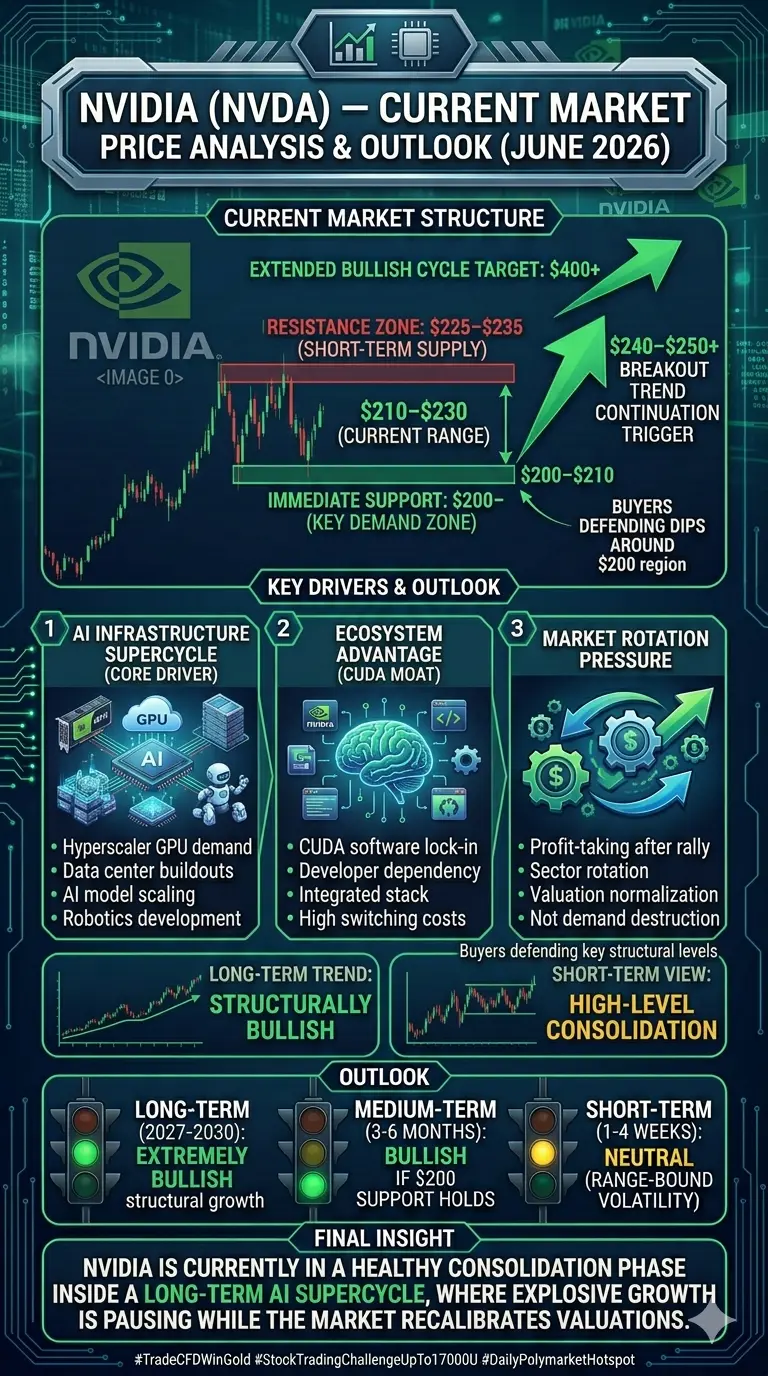
NVIDIA (NVDA) — Current Market Price Analysis & Outlook (June 2026)
NVIDIA is currently trading in a high-level consolidation phase after a historic AI-driven rally, where the stock has transitioned from explosive expansion into a volatility and valuation digestion zone. Despite short-term fluctuations across the semiconductor sector, NVIDIA remains the core anchor of the global AI infrastructure ecosystem, with price action heavily influenced by institutional positioning, AI capital expenditure cycles, and sector-wide rotation.
---
📊 Current Market Structure
At c
MrFlower_XingChen
#ShareYourUSStocksWinNvidia
NVIDIA (NVDA) — Current Market Price Analysis & Outlook (June 2026)
NVIDIA is currently trading in a high-level consolidation phase after a historic AI-driven rally, where the stock has transitioned from explosive expansion into a volatility and valuation digestion zone. Despite short-term fluctuations across the semiconductor sector, NVIDIA remains the core anchor of the global AI infrastructure ecosystem, with price action heavily influenced by institutional positioning, AI capital expenditure cycles, and sector-wide rotation.
---
📊 Current Market Structure
At current levels:
🟢 Current range: ~$210–$230
🟢 Immediate support: $200–$210 (key demand zone)
🔴 Near resistance: $225–$235 (short-term supply zone)
🚀 Breakout zone: $240–$250+ (trend continuation trigger)
NVIDIA is currently trading inside a tight consolidation band following a strong macro uptrend, with buyers consistently defending dips around the $200 region.
---
⚡ What Is Driving NVIDIA Right Now
1. 🤖 AI Infrastructure Supercycle (Core Driver)
NVIDIA remains at the center of global AI expansion:
Hyperscaler GPU demand (training + inference)
Data center buildouts
AI model scaling requirements
Robotics + autonomous systems development
Even during pullbacks, underlying AI demand remains structurally strong.
---
2. 🧠 Ecosystem Advantage (CUDA Moat)
NVIDIA’s dominance is not just hardware—it is ecosystem-driven:
CUDA software lock-in
Developer dependency across AI workloads
Integrated hardware + software + networking stack
This creates extremely high switching costs and reinforces long-term leadership.
---
3. 🔄 Market Rotation Pressure
Recent weakness is largely due to:
Profit-taking after extreme multi-year rally
Sector rotation into industrials, financials, healthcare
Valuation normalization after peak optimism
Importantly, this is not demand destruction, but capital reallocation.
---
📉 Technical Market View
NVIDIA is currently in a:
> Late-stage uptrend consolidation within a long-term bullish supercycle
This typically indicates:
Strong trend remains intact
Momentum cooling after exponential gains
Market waiting for next catalyst (Blackwell expansion / earnings cycle)
---
🧭 Key Price Zones
🟢 $200–$210 → Strong institutional support zone
🟡 $210–$230 → Consolidation range (current battle zone)
🔴 $230–$240 → Resistance ceiling
🚀 $240–$250+ → Breakout continuation zone
---
⚖️ Market Interpretation
Current structure suggests:
✔ AI demand = still extremely strong
⚠ Short-term = consolidation + volatility
🔄 Market phase = valuation reset + rotation
📊 Trend = still structurally bullish, not broken
---
🔮 Outlook
Short-term (1–4 weeks): Neutral (range-bound volatility)
Medium-term (3–6 months): Bullish if $200 support holds
Long-term (2027–2030): Extremely bullish if AI adoption continues scaling globally
---
🧠 Final Insight
NVIDIA is currently in a healthy consolidation phase inside a long-term AI supercycle, where explosive growth is pausing while the market recalibrates valuations. The company remains the central infrastructure provider for artificial intelligence, and nearly every major AI trend—from cloud computing to robotics—still flows through its ecosystem.
The current price action reflects profit-taking and rotation, not structural weakness, suggesting that NVIDIA’s long-term trajectory remains intact, even if short-term momentum is temporarily paused.
---
📌 Post Format
NVIDIA (NVDA) Market Update — June 2026
NVIDIA is currently trading in a high-level consolidation range near $210–$230, following a historic AI-driven rally that positioned the company as the central infrastructure leader of the global artificial intelligence ecosystem. Recent price action reflects a valuation digestion phase, where strong gains are being followed by consolidation and sector-wide capital rotation rather than any deterioration in AI demand. The stock continues to benefit from powerful structural drivers including hyperscaler GPU demand, data center expansion, and the dominance of its CUDA software ecosystem, which maintains extremely high switching costs across the AI industry. Technically, NVIDIA is holding a critical $200–$210 support zone, while resistance is forming near $230–$240, creating a tight consolidation structure. This phase is best described as a late-cycle uptrend consolidation, where momentum cools but the broader trend remains intact. While short-term volatility persists due to profit-taking and sector rotation, the long-term AI infrastructure supercycle remains firmly in place. Overall, NVIDIA remains structurally bullish, with the current phase representing a pause in momentum rather than a reversal of trend.
#TradeCFDWinGold #StockTradingChallengeUpTo17000U #DailyPolymarketHotspot @Gate_Square @GateSquare

repost-content-media
  • Reward
  • Comment
  • Repost
  • Share
#ShareYourUSStocksWinNvidia
SMH (VanEck Semiconductor ETF) — Current Market Price Analysis & Outlook (June 2026)
SMH is currently trading in a post-rally correction phase, reflecting a broad cooling in semiconductor momentum after an extended AI-driven expansion cycle. The ETF, which represents the overall semiconductor ecosystem including NVIDIA, TSMC, Broadcom, AMD, and Micron, is now showing signs of valuation compression and sector rotation rather than fundamental weakness in demand.
---
📊 Current Market Structure
At current levels:
🟢 Current range: ~$300–$340 (approx. consolidation ban
MrFlower_XingChen
#ShareYourUSStocksWinNvidia
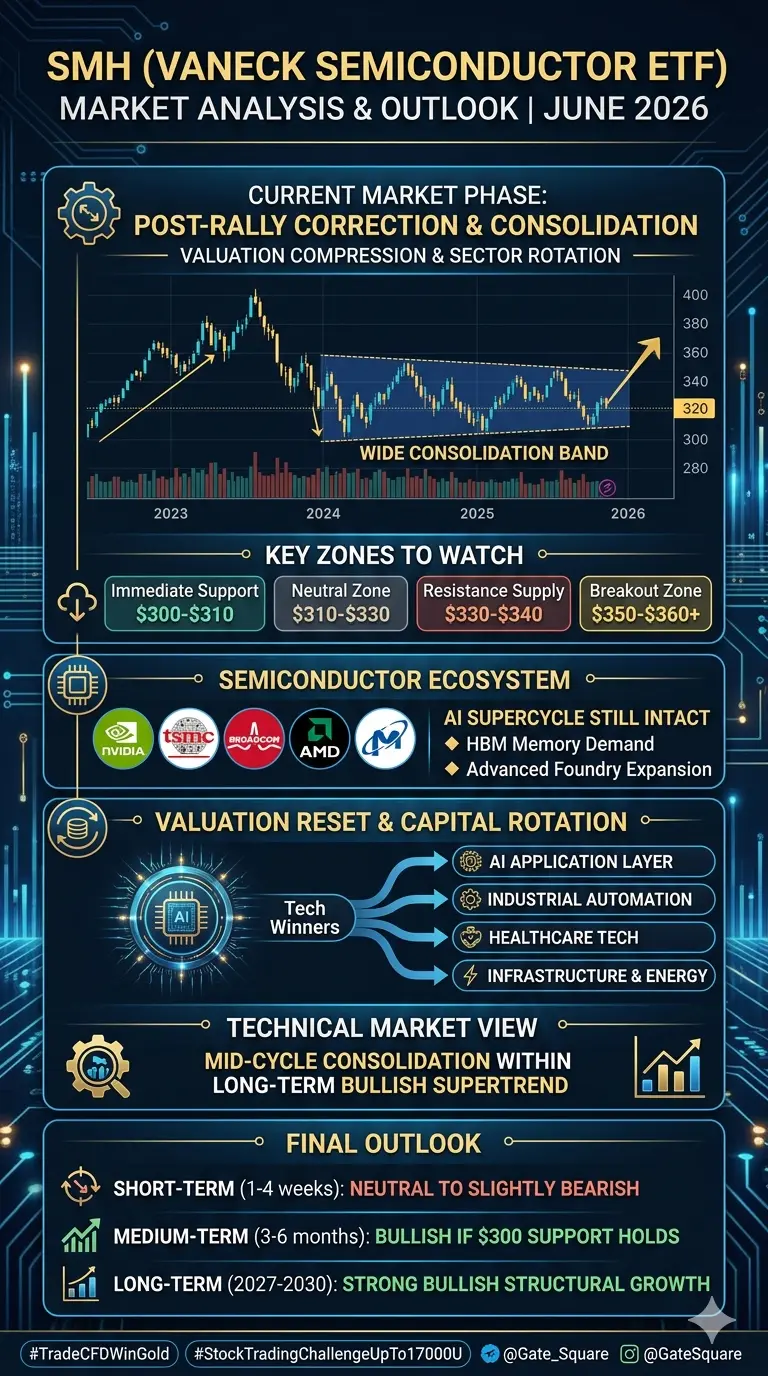
SMH (VanEck Semiconductor ETF) — Current Market Price Analysis & Outlook (June 2026)
SMH is currently trading in a post-rally correction phase, reflecting a broad cooling in semiconductor momentum after an extended AI-driven expansion cycle. The ETF, which represents the overall semiconductor ecosystem including NVIDIA, TSMC, Broadcom, AMD, and Micron, is now showing signs of valuation compression and sector rotation rather than fundamental weakness in demand.
---
📊 Current Market Structure
At current levels:
🟢 Current range: ~$300–$340 (approx. consolidation band)
🟢 Immediate support: $300–$310 (key demand zone)
🔴 Resistance: $330–$340 (first supply zone)
🚀 Breakout zone: $350–$360+ (trend continuation trigger)
SMH is currently moving inside a wide consolidation structure, where buyers are defending key supports but upside momentum is temporarily capped.
---
⚡ What Is Driving SMH Right Now
1. 💡 AI Supercycle Still Intact
Semiconductors remain the backbone of the AI revolution:
GPUs for model training and inference
HBM memory demand
Advanced packaging and foundry expansion (TSMC-led)
Optical networking growth
Demand is still strong, but expectations are already high.
---
2. 🔄 Phase Shift in AI Market
The market is transitioning:
> AI Infrastructure Phase → AI Deployment Phase
This shift means:
Earlier winners (chipmakers) are consolidating gains
Capital is rotating toward AI application companies
Growth expectations are normalizing from extreme levels
---
3. 💰 Valuation Reset Pressure
Despite strong earnings, SMH is under pressure because:
Semiconductor stocks priced in aggressive growth
Even good results trigger profit-taking
Institutional investors are rebalancing exposure
---
📉 Technical Market View
SMH is currently in a:
> Mid-cycle consolidation within a long-term bullish supertrend
This structure typically indicates:
Strong trend is not broken
Momentum is cooling
Market is digesting previous gains before next move
---
🧭 Key Zones to Watch
🟢 $300–$310 → Strong institutional support
🟡 $310–$330 → Neutral consolidation zone
🔴 $330–$340 → Heavy resistance supply
🚀 $350–$360 → Breakout confirmation zone
---
🌍 Sector Rotation Dynamics
A major theme affecting SMH is capital rotation:
Institutional flows are shifting into:
Industrial automation
Infrastructure & energy systems
Healthcare technology
Financial services
AI application layer companies
This does not signal an exit from tech, but rather a broadening of market leadership, which historically strengthens bull markets over time.
---
⚖️ Market Interpretation
Current SMH behavior suggests:
✔ Long-term semiconductor demand = very strong
⚠ Short-term = valuation digestion phase
🔄 Market = rotating leadership, not ending cycle
This is a pause in momentum, not a structural breakdown.
---
🔮 Outlook
Short-term (1–4 weeks): Neutral to slightly bearish (range-bound pressure)
Medium-term (3–6 months): Bullish if $300 support holds
Long-term (2027–2030): Strong bullish structural growth trend
---
🧠 Final Insight
SMH represents the core infrastructure layer of the AI economy, and while short-term volatility reflects valuation resets and capital rotation, the underlying demand drivers remain intact. The current phase is best described as a healthy consolidation within a long-term AI supercycle, where leadership temporarily cools before the next expansion wave begins.
---
📌 Post Format
SMH Market Update — June 2026
SMH is currently trading in a broad consolidation range near $300–$340, reflecting a cooling phase in semiconductor momentum after a powerful AI-driven rally. The ETF remains structurally supported by strong demand across the semiconductor ecosystem, including GPUs, memory chips, foundry services, and advanced AI infrastructure components. However, recent price action shows that the sector is undergoing a valuation reset and capital rotation phase, as institutional investors diversify into other sectors following years of semiconductor outperformance. Technically, SMH is holding a key $300–$310 support zone, while resistance is forming around $330–$340, creating a wide range-bound structure. Despite short-term pressure, the long-term semiconductor growth narrative remains intact, driven by continued AI infrastructure spending and global digital transformation. This phase represents a mid-cycle consolidation within a broader AI supercycle, where momentum pauses but the structural trend remains bullish. Overall, SMH is not showing signs of structural weakness, but rather a temporary digestion phase before the next potential expansion cycle.
#TradeCFDWinGold #StockTradingChallengeUpTo17000U #DailyPolymarketHotspot @Gate_Square @GateSquare
repost-content-media
  • Reward
  • Comment
  • Repost
  • Share
#ShareYourUSStocksWinNvidia
AAPL (Apple Inc.) — Current Market Price Analysis & Outlook (June 2026)
Apple Inc. is currently trading around $307–$310, sitting very close to its 52-week highs near the $315–$317 region, showing that the stock is still in a strong long-term uptrend but entering a consolidation phase near resistance. After a powerful multi-month rally, price action is now stabilizing as the market digests gains, with buyers consistently defending the psychological $300 level, which has become the key structural support zone for the stock.
---
📊 Current Market Structure
At current
MrFlower_XingChen
#ShareYourUSStocksWinNvidia
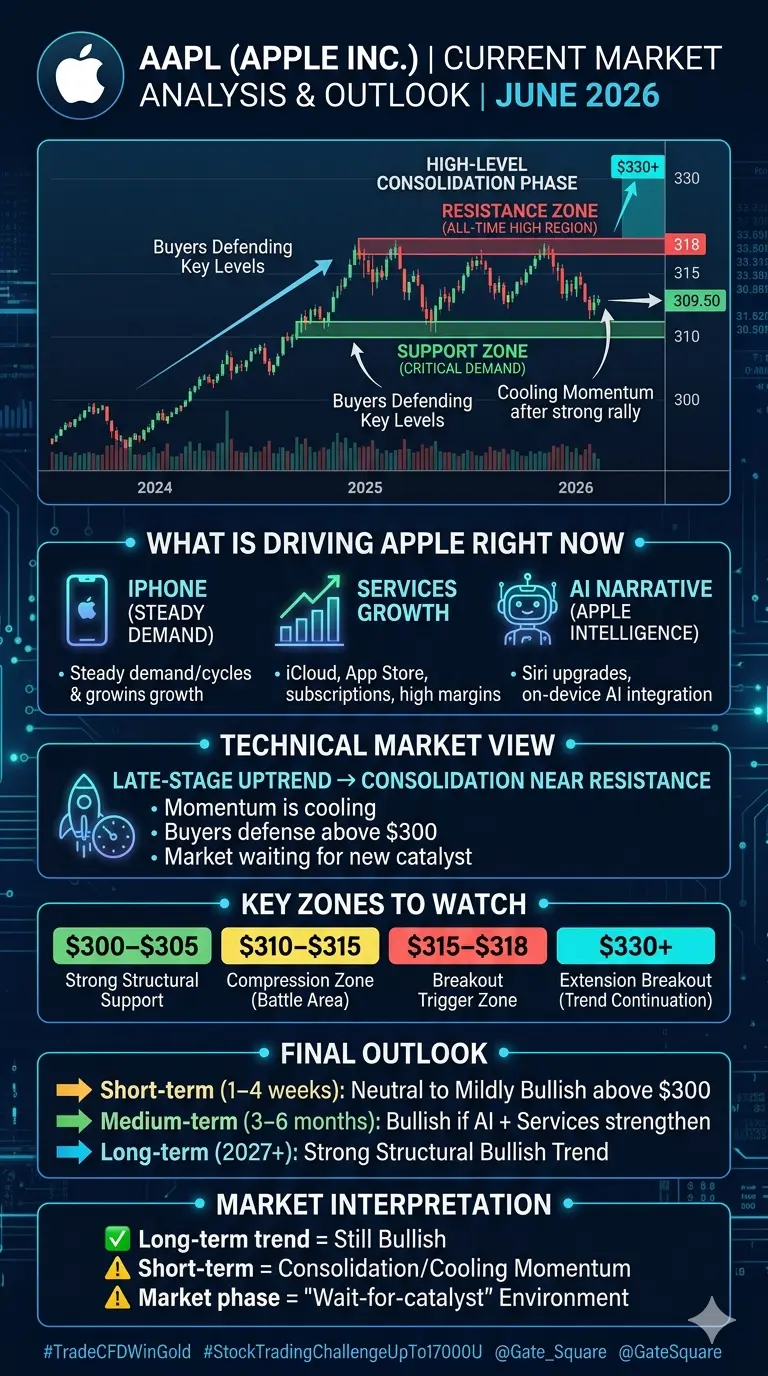
AAPL (Apple Inc.) — Current Market Price Analysis & Outlook (June 2026)
Apple Inc. is currently trading around $307–$310, sitting very close to its 52-week highs near the $315–$317 region, showing that the stock is still in a strong long-term uptrend but entering a consolidation phase near resistance. After a powerful multi-month rally, price action is now stabilizing as the market digests gains, with buyers consistently defending the psychological $300 level, which has become the key structural support zone for the stock.
---
📊 Current Market Structure
At current levels:
🟢 Current range: ~$307–$310
🟢 Key support: $300–$305 (critical demand zone)
🔴 Immediate resistance: $315–$318 (all-time high region)
🔴 Extension breakout zone: $330–$350
Apple is effectively trading in a tight high-level consolidation band, where volatility is reduced compared to earlier expansion phases.
---
⚡ What Is Driving Apple Right Now
1. 📱 iPhone Cycle Stability
Apple’s core revenue engine remains strong, with steady iPhone demand driven by upgrade cycles and ecosystem retention. This continues to anchor revenue consistency even in slower global hardware conditions.
---
2. 💰 Services Growth Engine
The Services segment (iCloud, App Store, subscriptions) continues to expand, improving Apple’s:
Margins
Earnings stability
Long-term valuation quality
This is a key reason Apple maintains premium pricing.
---
3. 🤖 AI Narrative (Apple Intelligence)
Market focus is increasingly shifting toward Apple’s on-device AI strategy, especially:
Siri upgrades
AI-powered ecosystem features
Device-level intelligence integration
While not as aggressive as competitors, it is seen as a potential future upgrade cycle catalyst.
---
📉 Technical Market View
Apple is currently in a:
> Late-stage uptrend → consolidation near resistance
This typically indicates:
Momentum is cooling after strong rally
Buyers still defend key levels ($300)
Market is waiting for a new catalyst (earnings / AI rollout / product cycle)
---
🧭 Key Zones to Watch
🟢 $300–$305 → Strong structural support
🟡 $310–$315 → Compression zone (battle area)
🔴 $315–$318 → Breakout trigger zone
🚀 $330+ → Trend continuation expansion
---
⚖️ Market Interpretation
Current structure suggests:
✔ Long-term trend = still bullish
⚠ Short-term = consolidation / cooling momentum
⏳ Market phase = “wait-for-catalyst” environment
Apple is not showing weakness—it is showing maturity in its uptrend after a strong expansion cycle.
---
🔮 Outlook
Short-term (1–4 weeks): Neutral to mildly bullish above $300
Medium-term (3–6 months): Bullish if AI + services momentum strengthens
Long-term (2027+): Strong structural bullish trend remains intact
---
🧠 Final Insight
Apple is transitioning from a high-growth rally phase into a high-quality consolidation phase. The stock is no longer driven only by iPhone cycles, but increasingly by its ecosystem strength, services dominance, and AI integration narrative.
The current price action reflects a market waiting for the next major catalyst, not a reversal of trend.
---
📌 Post Format
AAPL (Apple) Market Update — June 2026
Apple Inc. is currently trading around $307–$310, near its all-time high zone around $315–$317, reflecting a strong but mature uptrend. The stock is consolidating after a multi-month rally, with buyers consistently defending the critical $300 psychological support level, while resistance remains firm near $315–$318. Apple’s strength continues to be driven by its resilient iPhone upgrade cycle, rapidly growing high-margin Services segment, and increasing investor focus on its AI integration strategy (Apple Intelligence). Despite slower global hardware markets, Apple maintains structural strength due to its ecosystem lock-in, massive cash flow, and ongoing share buybacks. Technically, the stock is in a late-stage uptrend consolidation phase, meaning momentum has slowed but the broader trend remains intact. The market is now in a “wait-for-catalyst” mode, where the next major breakout will likely depend on AI monetization progress or new product cycle acceleration. Overall, Apple remains structurally bullish, but short-term upside requires a new growth trigger to break above the current resistance ceiling.
#TradeCFDWinGold #StockTradingChallengeUpTo17000U #DailyPolymarketHotspot @Gate_Square @GateSquare
repost-content-media
  • Reward
  • Comment
  • Repost
  • Share
#BitcoinRalliesOver5Percent
Bitcoin is currently trading around $63,000–$64,000, showing a strong +5% rebound after finding solid support near the $59,000–$60,000 zone. This move marks a key shift in short-term sentiment, where buyers are actively defending major demand levels and attempting to rebuild bullish momentum after recent macro-driven selling pressure.
The recovery is being supported by a combination of institutional ETF inflows, short-covering activity, and long-term holder conviction, which is helping stabilize price action after weeks of volatility. Despite ongoing concerns aroun
BTC4.94%
MrFlower_XingChen
#BitcoinRalliesOver5Percent
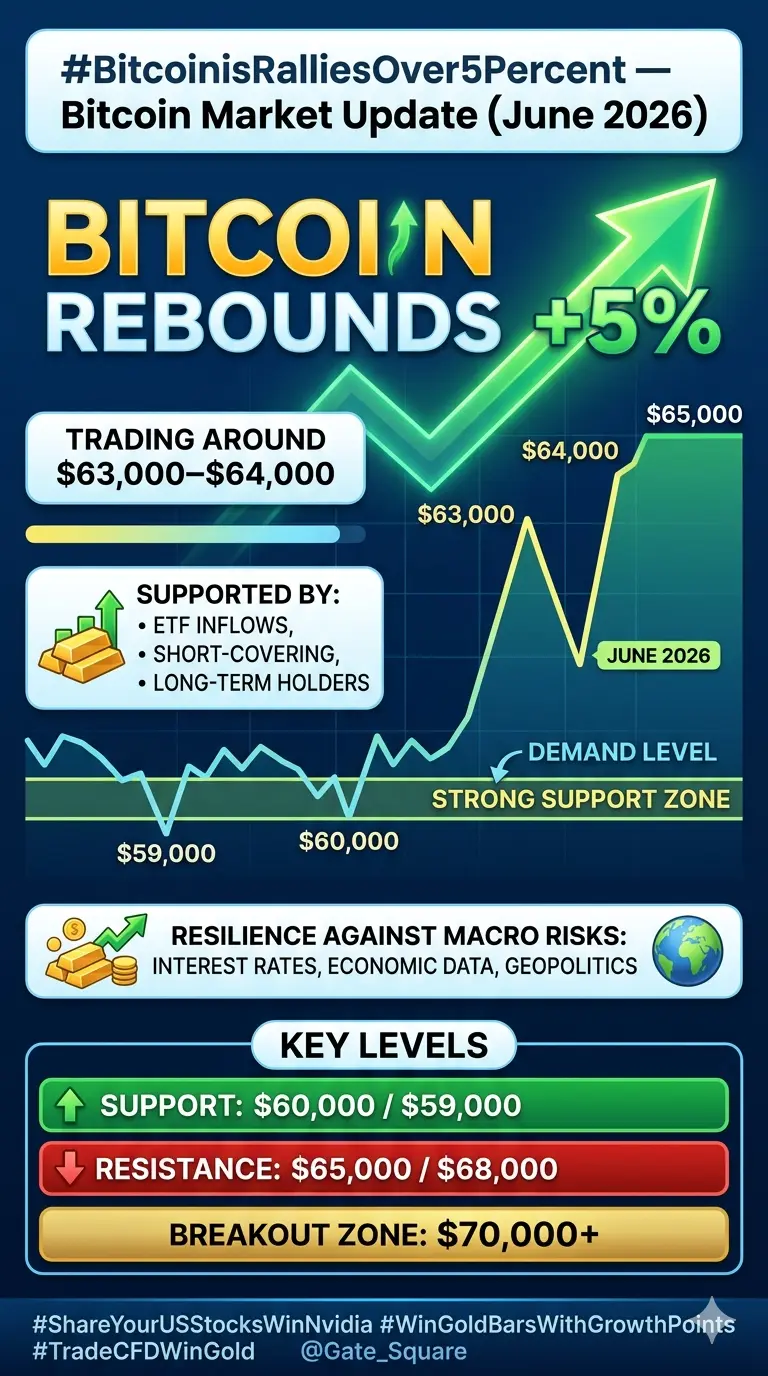
Bitcoin is currently trading around $63,000–$64,000, showing a strong +5% rebound after finding solid support near the $59,000–$60,000 zone. This move marks a key shift in short-term sentiment, where buyers are actively defending major demand levels and attempting to rebuild bullish momentum after recent macro-driven selling pressure.
The recovery is being supported by a combination of institutional ETF inflows, short-covering activity, and long-term holder conviction, which is helping stabilize price action after weeks of volatility. Despite ongoing concerns around higher interest rates, strong US economic data, and geopolitical uncertainty, Bitcoin continues to demonstrate resilience around key structural support levels.
From a technical perspective, the market is now consolidating between $60,000 support and $65,000 resistance. A decisive breakout above $65,000–$68,000 could open the path toward $70,000+, while failure to hold $60,000 would likely lead to another retest of lower support zones.
The broader macro environment remains the key driver. Bitcoin is still highly sensitive to Federal Reserve policy expectations, liquidity conditions, and risk sentiment across global markets, but institutional participation through ETFs has strengthened demand compared to previous cycles.
Overall, this +5% rebound is not just a short bounce—it reflects renewed buyer confidence and strong accumulation behavior at key support levels. The market is now at a critical decision point where Bitcoin must either confirm recovery above resistance or remain in a broader consolidation phase.
Key Levels:
Support: $60,000 / $59,000
Resistance: $65,000 / $68,000
Breakout Zone: $70,000+
#ShareYourUSStocksWinNvidia #WinGoldBarsWithGrowthPoints #TradeCFDWinGold @Gate_Square
repost-content-media
  • Reward
  • Comment
  • Repost
  • Share
#StrongNonfarmPayrollsRekindleRateHikeFear
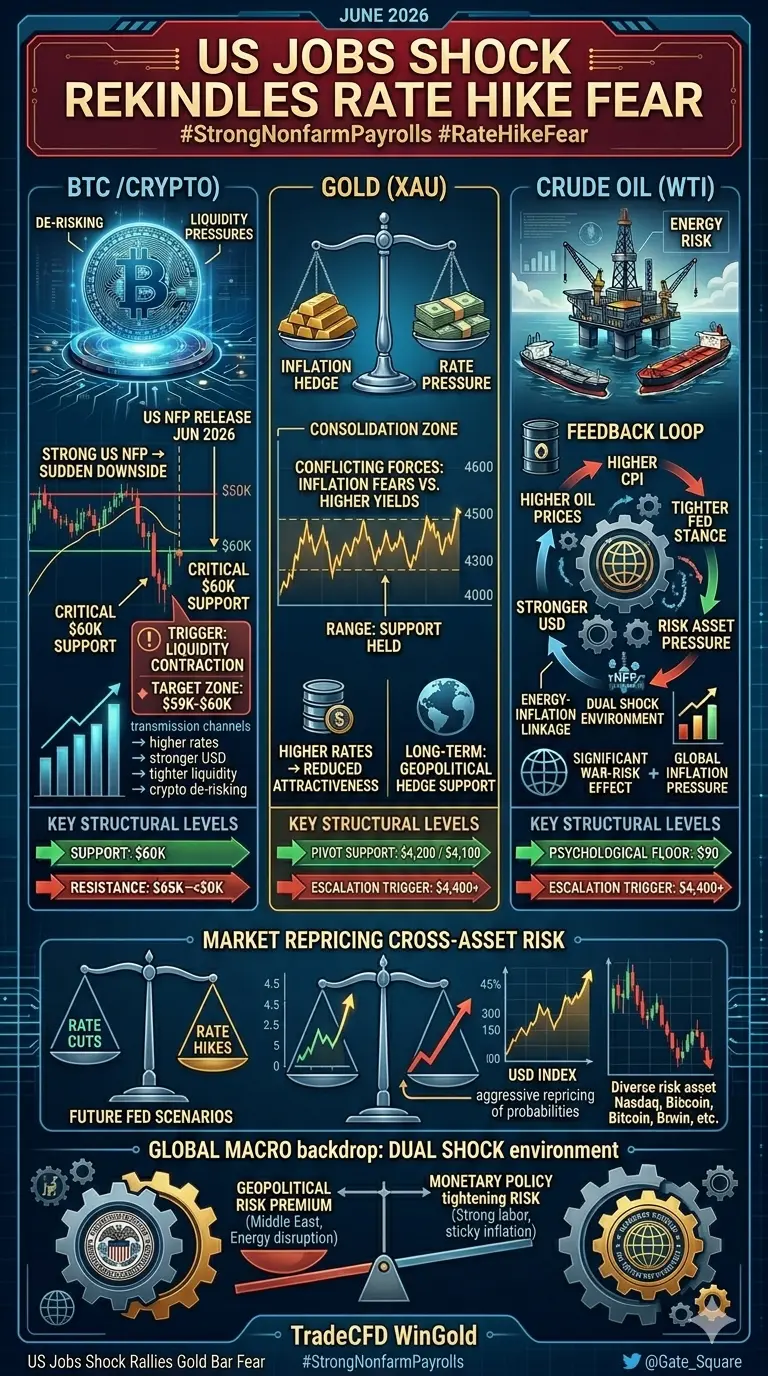
𝙐𝙎 𝙅𝙤𝙗𝙨 𝙎𝙝𝙤𝙘𝙠 𝙍𝙚𝙠𝙞𝙣𝙙𝙡𝙚𝙨 𝙍𝙖𝙩𝙚 𝙃𝙞𝙠𝙚 𝙁𝙚𝙖𝙧 — 𝙈𝙖𝙧𝙠𝙚𝙩 𝙍𝙚𝙥𝙧𝙞𝙘𝙞𝙣𝙜 𝘾𝙧𝙤𝙨𝙨-𝘼𝙨𝙨𝙚𝙩 𝙍𝙞𝙨𝙠
On June 2026, global markets were shaken after the latest US labor data showed a much stronger-than-expected Nonfarm Payrolls (NFP) report, signaling that the American economy remains far more resilient than investors had priced in. The US economy added approximately 172,000 jobs, nearly double consensus expectations (~85,000), while unemployment held steady near 4.3%. This immediate upside surprise forced a rapid an
BTC4.94%
MrFlower_XingChen
#StrongNonfarmPayrollsRekindleRateHikeFear
𝙐𝙎 𝙅𝙤𝙗𝙨 𝙎𝙝𝙤𝙘𝙠 𝙍𝙚𝙠𝙞𝙣𝙙𝙡𝙚𝙨 𝙍𝙖𝙩𝙚 𝙃𝙞𝙠𝙚 𝙁𝙚𝙖𝙧 — 𝙈𝙖𝙧𝙠𝙚𝙩 𝙍𝙚𝙥𝙧𝙞𝙘𝙞𝙣𝙜 𝘾𝙧𝙤𝙨𝙨-𝘼𝙨𝙨𝙚𝙩 𝙍𝙞𝙨𝙠
On June 2026, global markets were shaken after the latest US labor data showed a much stronger-than-expected Nonfarm Payrolls (NFP) report, signaling that the American economy remains far more resilient than investors had priced in. The US economy added approximately 172,000 jobs, nearly double consensus expectations (~85,000), while unemployment held steady near 4.3%. This immediate upside surprise forced a rapid and violent repricing across interest rate expectations, Treasury yields, and risk assets.
The key macro shift was not just the strength of the jobs data—but the change in narrative. Markets had been positioned for a future of rate cuts and easing liquidity, based on expectations of a slowing economy. Instead, the labor market data reinforced a completely different scenario: persistent economic strength + elevated inflation = longer restrictive policy or even renewed tightening risk.
This is where the term “rekindle” becomes critical. It reflects the sudden return of Federal Reserve rate hike fear, which had largely faded in previous months. With inflation still hovering near 3.8% YoY, the strong employment print reignited concerns that the Federal Reserve System may be forced to delay cuts or even consider additional tightening if inflation proves sticky.
The transmission mechanism is straightforward but powerful:
Strong job growth → higher wages → stronger consumer spending → increased demand pressure → inflation persistence → tighter monetary policy expectations.
Markets reacted instantly. US Treasury yields surged, with the 10-year moving sharply higher toward the mid-4% range, while short-term yields also jumped as traders aggressively repriced Fed expectations. Rate futures data showed a sharp increase in the probability of future tightening scenarios, reflecting a sudden shift in sentiment from “rate cuts in sight” to “higher-for-longer uncertainty.”
💥 Risk Asset Reaction: Bitcoin Leads the Downside
The crypto market reacted fastest and hardest.
Bitcoin dropped sharply after the release
Broke below the critical $60,000 psychological support level
Briefly touched the $59K zone before stabilizing
Extended weekly drawdown into deep correction territory
This move highlighted Bitcoin’s continued sensitivity to global liquidity expectations, even as long-term institutional adoption grows.
The transmission channels were clear:
Higher rates → stronger USD → tighter liquidity → reduced risk appetite → crypto de-risking
Bitcoin’s behavior confirms a key macro reality: in 2026, it is still heavily influenced by global interest rate expectations, even if its long-term narrative is evolving toward digital reserve asset status.
🪙 Gold: Inflation Hedge vs Rate Pressure
Gold initially reacted with volatility rather than direction.
Inflation fears support long-term demand
Higher yields reduce short-term attractiveness
Result: consolidation rather than breakout
Despite macro uncertainty, gold remains structurally supported as investors hedge against geopolitical risk and inflation persistence, especially amid ongoing energy-related shocks.
🛢️ Oil & Inflation Linkage
Oil remains the most critical inflation driver in the current macro regime. With ongoing geopolitical instability in the Middle East and elevated supply risk perceptions, energy prices continue to sustain inflation pressure.
This creates a feedback loop:
Higher oil → higher CPI → tighter Fed stance → stronger USD → risk asset pressure
🌍 Macro Backdrop: Dual Shock Environment
Markets are now caught between two powerful forces:
1. Geopolitical risk premium (Middle East tensions, energy disruption risk)
2. Monetary policy tightening risk (strong labor market, sticky inflation)
This combination creates a “double tightening” effect on global liquidity conditions.
📉 Market Structure Summary
BTC: Bearish volatility, key support near $60K
Gold: Range-bound but structurally supported
Oil: Inflation-sensitive upside risk remains elevated
USD & Yields: Primary drivers of cross-asset volatility
🔎 Final Outlook
The latest NFP report has fundamentally changed the near-term macro narrative. Instead of anticipating policy easing, markets are now forced to price in the possibility that the fight against inflation is not over, and that monetary policy may remain restrictive for longer than expected.
In this environment, every data release becomes a liquidity shock trigger, and every strong economic print is interpreted through a bearish lens for risk assets.
For traders and investors, the key is no longer prediction—it is reaction to volatility regimes driven by macro surprises, not trends.
@Gate_Square
repost-content-media
  • Reward
  • Comment
  • Repost
  • Share
𝗕𝗶𝘁𝗰𝗼𝗶𝗻'𝘀 𝟱% 𝗥𝗲𝗯𝗼𝘂𝗻𝗱: 𝗖𝗮𝗻 𝗧𝗵𝗲 𝗥𝗲𝗰𝗼𝘃𝗲𝗿𝘆 𝗖𝗼𝗻𝘁𝗶𝗻𝘂𝗲?
Market Recovery and Investor Sentiment
Bitcoin's return above $63,000 is one of the most important developments in the cryptocurrency market this week. After facing significant selling pressure and widespread concerns about the impact of stronger-than-expected U.S. economic data, Bitcoin has rebounded by more than 5% in just 24 hours. This move suggests that much of the fear surrounding potential interest-rate hikes has already been priced into the market. Buyers have returned aggressively, and sentiment has
BTC4.94%
ETH10.93%
SOL11.39%
MrFlower_XingChen
𝗕𝗶𝘁𝗰𝗼𝗶𝗻'𝘀 𝟱% 𝗥𝗲𝗯𝗼𝘂𝗻𝗱: 𝗖𝗮𝗻 𝗧𝗵𝗲 𝗥𝗲𝗰𝗼𝘃𝗲𝗿𝘆 𝗖𝗼𝗻𝘁𝗶𝗻𝘂𝗲?
Market Recovery and Investor Sentiment
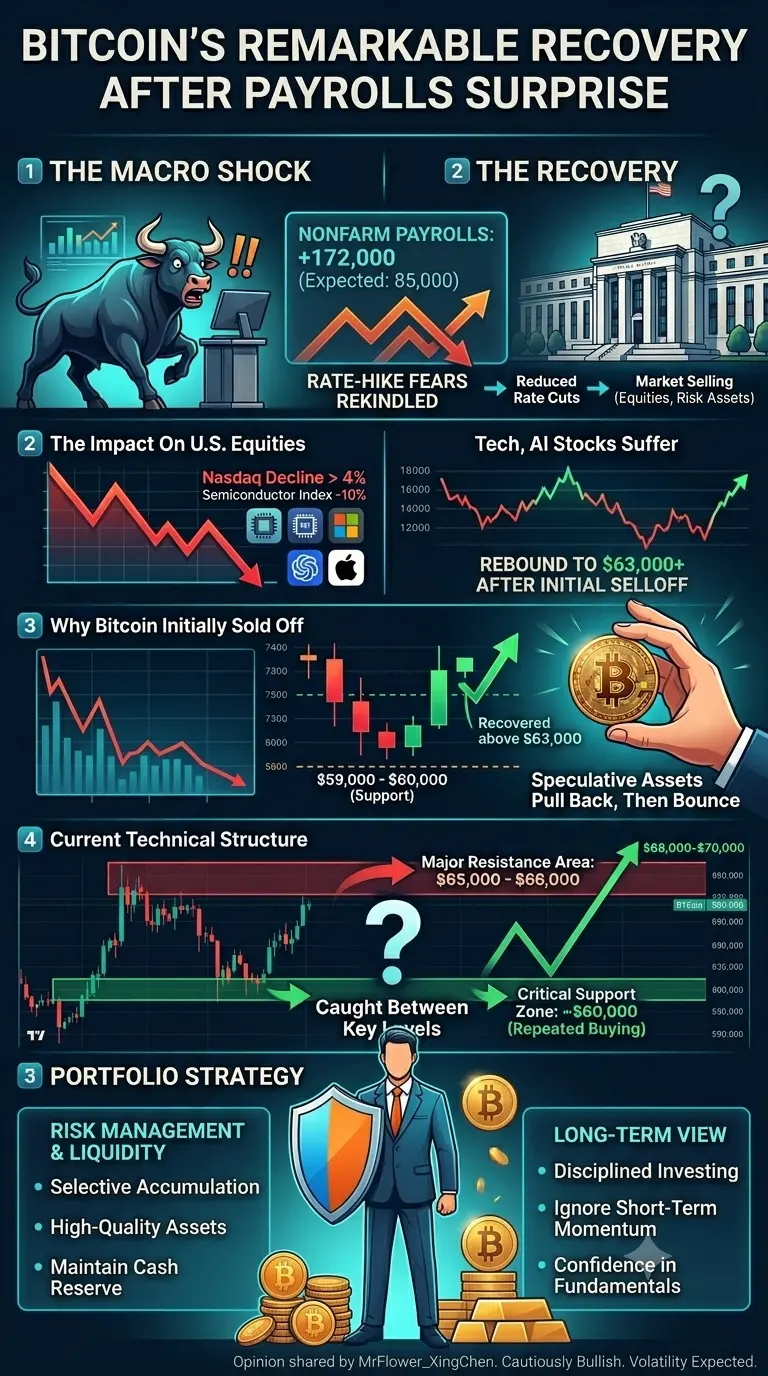
Bitcoin's return above $63,000 is one of the most important developments in the cryptocurrency market this week. After facing significant selling pressure and widespread concerns about the impact of stronger-than-expected U.S. economic data, Bitcoin has rebounded by more than 5% in just 24 hours. This move suggests that much of the fear surrounding potential interest-rate hikes has already been priced into the market. Buyers have returned aggressively, and sentiment has improved across the entire digital asset sector.
Why the Rebound Matters
The significance of this rally extends beyond Bitcoin alone. Ethereum, Solana, and several other major cryptocurrencies have also recorded strong gains, indicating that investors are not simply rotating into one asset but are becoming more confident in the broader crypto market. Historically, rallies supported by multiple sectors tend to be more sustainable than those driven by a single asset. This broad participation is one of the strongest arguments in favor of a continued recovery.
Can Bitcoin Continue Moving Higher?
My answer is yes, Bitcoin's rebound can continue, but the next few days will be critical. The current recovery appears stronger than a typical relief rally because it is supported by improving market sentiment, increased trading activity, and renewed interest in risk assets. If buyers remain active and macroeconomic conditions stay relatively stable, Bitcoin has the potential to extend its gains and challenge higher resistance levels.
Key Resistance Levels to Watch
The first major resistance zone I am monitoring is between $65,000 and $66,000. This area previously acted as a strong barrier and could attract selling pressure once again. If Bitcoin successfully breaks above this range and converts it into support, the next important target becomes the $68,000-$70,000 region. A decisive move above these levels would strengthen the bullish outlook and could trigger another wave of buying interest from both retail and institutional participants.
The Risk of Market Volatility
Despite the positive momentum, volatility remains the biggest short-term risk. Financial markets rarely move upward in a straight line, and Bitcoin is no exception. Profit-taking, unexpected economic data, central bank comments, or geopolitical events could create temporary pullbacks. However, as long as Bitcoin maintains support above recently reclaimed levels, these pullbacks may simply represent healthy consolidation rather than a major trend reversal.
My Current Trading and Investment Strategy
In the current environment, I am focusing on disciplined accumulation rather than aggressive speculation. Instead of chasing rapid price movements, I prefer gradually building positions through a dollar-cost averaging strategy. This approach helps reduce emotional decision-making and allows me to take advantage of market volatility without exposing my portfolio to unnecessary risk.
Portfolio Positioning
My portfolio remains concentrated in Bitcoin and Ethereum, which I believe continue to offer the strongest long-term fundamentals in the cryptocurrency industry. At the same time, I am closely watching high-quality altcoins such as Solana for potential opportunities if the broader market recovery continues. Maintaining a balance between growth opportunities and risk management remains my primary objective.
My Final Outlook
I believe Bitcoin will eventually break above the next major resistance zone, but the path higher is unlikely to be smooth. Short-term volatility and pullbacks should be expected, yet the overall structure of this rebound appears constructive. If Bitcoin successfully holds above $63,000 and overcomes the $65,000-$66,000 resistance area, the probability of a move toward $68,000-$70,000 increases significantly. For now, I remain cautiously bullish while continuing to prioritize patience, risk management, and strategic accumulation.
Opinion shared by MrFlower_XingChen.
#TradeCFDWinGold #StockTradingChallengeUpTo17000U #DailyPolymarketHotspot @Gate_Square @GateSquare
#BitcoinRalliesOver5Percent
repost-content-media
  • Reward
  • Comment
  • Repost
  • Share
#BitcoinRalliesOver5Percent
𝗕𝗶𝘁𝗰𝗼𝗶𝗻 𝗥𝗲𝗰𝗹𝗮𝗶𝗺𝘀 $𝟲𝟯,𝟬𝟬𝟬 — 𝗜𝘀 𝗧𝗵𝗶𝘀 𝗧𝗵𝗲 𝗕𝗲𝗴𝗶𝗻𝗻𝗶𝗻𝗴 𝗢𝗳 𝗔 𝗡𝗲𝘄 𝗥𝗲𝗰𝗼𝘃𝗲𝗿𝘆 𝗣𝗵𝗮𝘀𝗲?
Current Market Situation
After one of the most volatile weeks of 2026, Bitcoin has successfully rebounded above $63,000 and recovered more than 5% within 24 hours. Only days ago, panic dominated the market as BTC briefly fell below $60,000, triggering widespread fear across the crypto sector. However, buyers quickly defended the psychological $60,000 support zone, proving that significant demand still exists despite the broader correcti
BTC4.94%
ETH10.93%
SOL11.39%
MrFlower_XingChen
#BitcoinRalliesOver5Percent
𝗕𝗶𝘁𝗰𝗼𝗶𝗻 𝗥𝗲𝗰𝗹𝗮𝗶𝗺𝘀 $𝟲𝟯,𝟬𝟬𝟬 — 𝗜𝘀 𝗧𝗵𝗶𝘀 𝗧𝗵𝗲 𝗕𝗲𝗴𝗶𝗻𝗻𝗶𝗻𝗴 𝗢𝗳 𝗔 𝗡𝗲𝘄 𝗥𝗲𝗰𝗼𝘃𝗲𝗿𝘆 𝗣𝗵𝗮𝘀𝗲?
Current Market Situation
After one of the most volatile weeks of 2026, Bitcoin has successfully rebounded above $63,000 and recovered more than 5% within 24 hours. Only days ago, panic dominated the market as BTC briefly fell below $60,000, triggering widespread fear across the crypto sector. However, buyers quickly defended the psychological $60,000 support zone, proving that significant demand still exists despite the broader correction. Recent trading activity places Bitcoin around the $63,000 region after recovering from lows near $59,000.
What Triggered The Rebound?
The rebound appears to be the result of several factors converging at the same time. First, the market has largely digested concerns surrounding stronger-than-expected economic data and the possibility of higher interest rates for longer. Second, extreme bearish sentiment created conditions for a relief rally as traders who were heavily positioned for further downside were forced to cover short positions. Third, long-term holders have shown remarkable resilience, with on-chain data suggesting that panic selling has remained relatively limited despite the sharp correction.
The Bigger Picture: Bitcoin Is Still In A Correction
While the recent rebound is encouraging, investors should remember that Bitcoin remains significantly below its 2025 all-time high above $120,000. The cryptocurrency has experienced one of its most challenging starts to a year in over a decade, with substantial capital rotating into AI-related equities and other high-growth sectors. The correction has been amplified by large ETF outflows and changing investor preferences, which have temporarily reduced institutional demand for Bitcoin.
Can Bitcoin's Recovery Continue? My View
My answer is yes, the recovery can continue, but confirmation is still required. The most important achievement for bulls was reclaiming the $63,000 level after briefly losing control of the $60,000 support zone. This suggests that buyers are still willing to accumulate aggressively when Bitcoin reaches attractive valuation areas. However, a sustainable recovery requires more than a single strong day. Bitcoin must continue producing higher lows and maintain strong trading volume over the coming sessions.
Key Resistance Levels To Watch
The first major resistance level I am monitoring is between $64,500 and $66,000. This area has repeatedly acted as a ceiling during recent trading sessions and remains the first major obstacle for bulls. If Bitcoin breaks and holds above this zone, the next target becomes the $68,000-$70,000 range, which could significantly improve market sentiment and attract fresh capital back into the crypto market. Several technical analysts continue to identify these levels as the most important battlegrounds for the next phase of price action.
Why $60,000 Remains The Most Important Support
On the downside, the $60,000 level remains the most critical support zone in the market. This area has repeatedly attracted buyers and currently serves as the line separating a recovery scenario from a deeper correction. If Bitcoin can continue defending this level, confidence is likely to improve. A sustained break below it, however, could invite renewed selling pressure and delay any larger recovery attempt. Many traders and investors are now treating $60,000 as the market's most important psychological level.
Institutional Flows Remain A Major Challenge
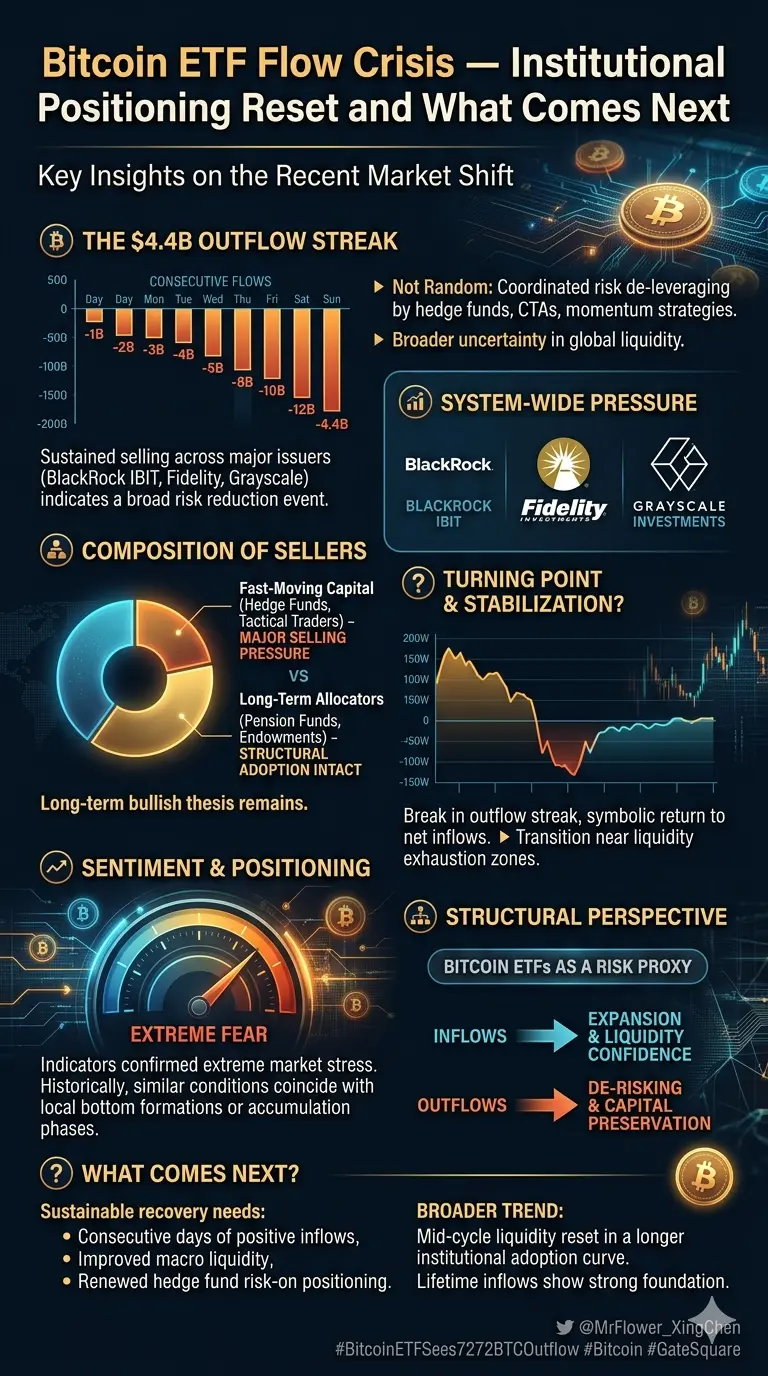
One factor preventing me from becoming aggressively bullish is the continued weakness in ETF flows. During recent weeks, Bitcoin-related ETFs have experienced billions of dollars in net outflows, indicating that institutional investors remain cautious. Historically, major bull runs have been supported by strong institutional demand. Until ETF flows stabilize and begin turning positive again, Bitcoin may continue facing resistance during recovery attempts.
My Current Trading Strategy
In the current environment, I am avoiding excessive leverage and focusing on capital preservation and gradual accumulation. Rather than attempting to predict every short-term move, I prefer adding to positions incrementally through dollar-cost averaging. Volatility remains extremely high, and preserving capital allows investors to take advantage of opportunities without exposing themselves to unnecessary risk. In uncertain markets, patience often outperforms aggressive speculation.
Portfolio Positioning
At present, my portfolio remains concentrated in Bitcoin and Ethereum, which continue to represent the strongest long-term assets within the digital asset ecosystem. I am also monitoring Solana and several high-quality infrastructure projects for potential opportunities if market conditions continue improving. However, I am prioritizing quality over speculation and maintaining sufficient cash reserves to capitalize on any future pullbacks.
Final Outlook: What Happens Next?
My expectation is that Bitcoin will eventually break above the $65,000-$66,000 resistance zone, but the path forward will likely include periods of volatility and consolidation. The recent rebound is stronger than many expected, yet the market still faces challenges including ETF outflows, macroeconomic uncertainty, and cautious institutional sentiment. If buyers successfully push Bitcoin above $66,000 and convert that area into support, a move toward $68,000-$70,000 becomes increasingly realistic. Until then, disciplined risk management remains the most important strategy.
My Answer To Gate Square's Question
Yes, I believe Bitcoin's rebound can continue. My next key resistance zone is $65,000-$66,000, followed by $68,000-$70,000. For now, I am accumulating gradually, maintaining cash reserves, avoiding excessive leverage, and focusing on long-term opportunities rather than short-term market noise.
Opinion shared by MrFlower_XingChen.
#TradeCFDWinGold #StockTradingChallengeUpTo17000U #DailyPolymarketHotspot @Gate_Square @GateSquare
Recent Bitcoin rebound above $63,000, ETF outflow data, and June 2026 market developments.
repost-content-media
  • Reward
  • Comment
  • Repost
  • Share
𝗦𝘁𝗿𝗼𝗻𝗴 𝗡𝗼𝗻𝗳𝗮𝗿𝗺 𝗣𝗮𝘆𝗿𝗼𝗹𝗹𝘀 𝗥𝗲𝗸𝗶𝗻𝗱𝗹𝗲 𝗥𝗮𝘁𝗲-𝗛𝗶𝗸𝗲 𝗙𝗲𝗮𝗿𝘀: 𝗜𝘀 𝗧𝗵𝗲 𝗠𝗮𝗿𝗸𝗲𝘁 𝗢𝘃𝗲𝗿𝗿𝗲𝗮𝗰𝘁𝗶𝗻𝗴?
A Jobs Report That Shocked Financial Markets
The latest U.S. Nonfarm Payrolls report delivered one of the biggest surprises of the year. Economists were expecting approximately 85,000 new jobs, yet the U.S. economy added 172,000 jobs, nearly double market expectations. On the surface, stronger employment should be viewed as positive news because it reflects economic resilience and continued labor market strength. However, financial markets reacted negat
BTC4.94%
MrFlower_XingChen
𝗦𝘁𝗿𝗼𝗻𝗴 𝗡𝗼𝗻𝗳𝗮𝗿𝗺 𝗣𝗮𝘆𝗿𝗼𝗹𝗹𝘀 𝗥𝗲𝗸𝗶𝗻𝗱𝗹𝗲 𝗥𝗮𝘁𝗲-𝗛𝗶𝗸𝗲 𝗙𝗲𝗮𝗿𝘀: 𝗜𝘀 𝗧𝗵𝗲 𝗠𝗮𝗿𝗸𝗲𝘁 𝗢𝘃𝗲𝗿𝗿𝗲𝗮𝗰𝘁𝗶𝗻𝗴?
A Jobs Report That Shocked Financial Markets
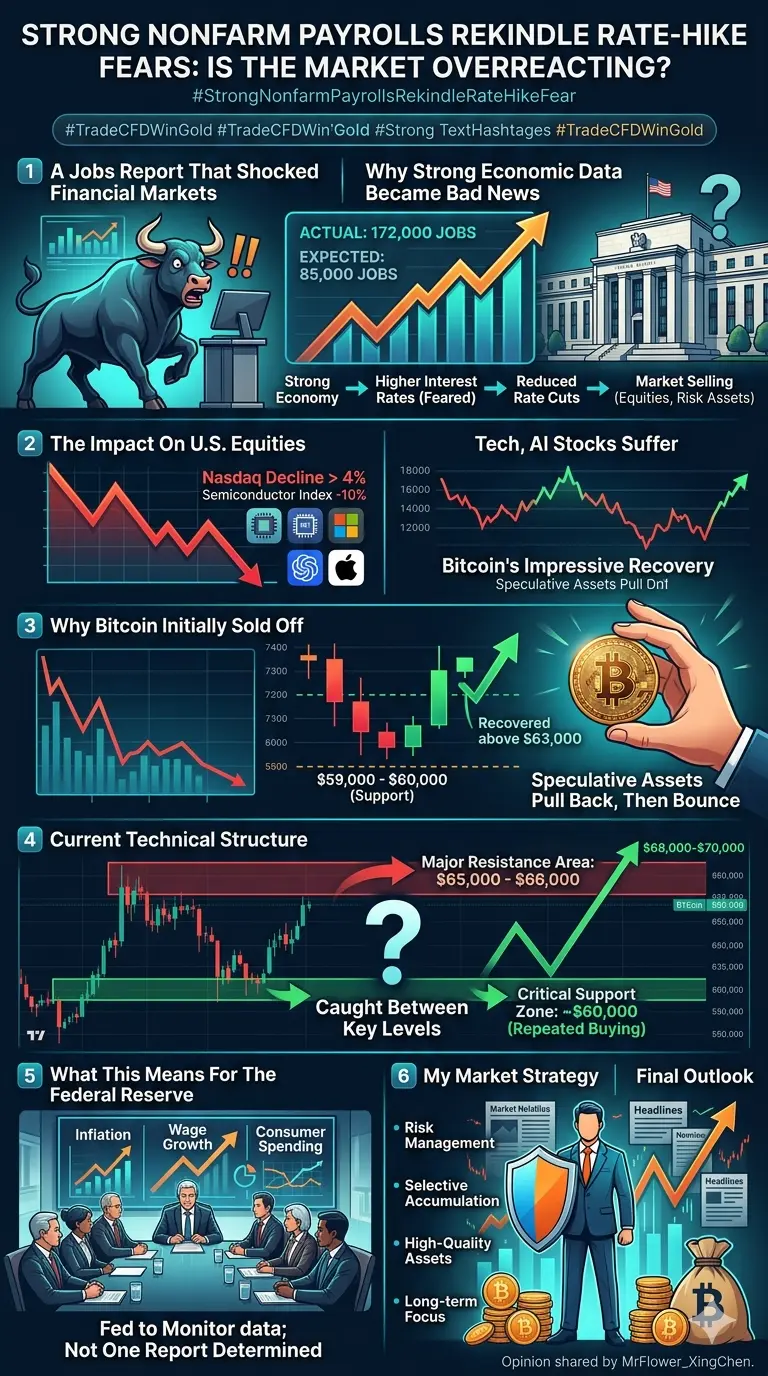
The latest U.S. Nonfarm Payrolls report delivered one of the biggest surprises of the year. Economists were expecting approximately 85,000 new jobs, yet the U.S. economy added 172,000 jobs, nearly double market expectations. On the surface, stronger employment should be viewed as positive news because it reflects economic resilience and continued labor market strength. However, financial markets reacted negatively because a stronger economy can also reduce the urgency for the Federal Reserve to lower interest rates. Investors immediately began reassessing monetary policy expectations, triggering a wave of selling across risk assets.
Why Strong Economic Data Became Bad News
The current market environment remains heavily dependent on interest-rate expectations. For months, investors have been anticipating easier monetary conditions and potential rate cuts to support economic growth. When employment data significantly exceeded expectations, traders interpreted the report as evidence that inflationary pressures could remain elevated for longer. As a result, expectations for future Federal Reserve tightening increased sharply. Market estimates for a year-end rate hike jumped dramatically, causing investors to reduce exposure to higher-risk assets.
The Impact On U.S. Equities
Technology stocks experienced the strongest reaction to the payroll surprise. The Nasdaq declined more than 4%, while the Philadelphia Semiconductor Index lost over 10%, highlighting how sensitive growth-oriented sectors remain to changes in interest-rate expectations. Higher rates generally reduce the present value of future earnings, making high-growth companies particularly vulnerable. AI-related stocks and semiconductor companies, which had been among the strongest performers during previous months, faced aggressive profit-taking as investors rushed to adjust their portfolios.
Why Bitcoin Initially Sold Off
Bitcoin was not immune to the market-wide risk-off sentiment. As fears of higher interest rates spread through global markets, investors reduced exposure to speculative assets, causing Bitcoin to fall sharply toward the $59,000-$60,000 support zone. The decline demonstrated that despite Bitcoin's growing maturity as an asset class, it still reacts to major macroeconomic developments. Rising yields, a stronger U.S. dollar, and tighter financial conditions generally create headwinds for cryptocurrencies in the short term.
Bitcoin's Impressive Recovery
Despite the initial selloff, Bitcoin's response over the following days was remarkably constructive. Buyers stepped in aggressively near major support levels, helping BTC recover above $63,000. This rebound suggests that long-term investors continue viewing significant pullbacks as buying opportunities. The ability to recover quickly after a macro-driven selloff often reflects underlying market strength and confidence among participants. Rather than collapsing under pressure, Bitcoin demonstrated resilience that many traders did not expect.
Current Technical Structure
At current levels near $63,000, Bitcoin remains trapped between a critical support zone and a major resistance area. The most important support remains around $60,000, which has repeatedly attracted buyers during recent weakness. On the upside, the first significant resistance lies between $65,000 and $66,000. A successful breakout above this range would improve market sentiment considerably and could open the door toward $68,000-$70,000. Until that happens, traders should expect continued volatility and rapid price swings.
What This Means For The Federal Reserve
While markets reacted aggressively to the jobs report, one employment release alone does not determine future monetary policy. Federal Reserve officials will continue monitoring inflation, wage growth, consumer spending, and broader economic conditions before making major policy decisions. The payroll data certainly strengthens the argument for maintaining higher rates, but it does not automatically guarantee another rate hike. Future inflation reports will likely have an equally important impact on policy expectations.
My Market Strategy
In the current environment, I am focusing on risk management and selective accumulation rather than aggressive speculation. Market volatility remains elevated, and sudden macroeconomic headlines can quickly change sentiment. I prefer maintaining exposure to high-quality assets such as Bitcoin while preserving enough liquidity to take advantage of future opportunities. Instead of chasing short-term momentum, I believe disciplined accumulation during uncertainty provides a stronger long-term risk-reward profile.
Final Outlook
My view is that the market may have overreacted to the payroll surprise in the short term, but the report serves as an important reminder that macroeconomic factors still dominate investor sentiment. Bitcoin's ability to recover above $63,000 despite widespread fear is encouraging and suggests that demand remains healthy. If BTC successfully breaks above $65,000-$66,000, bullish momentum could accelerate. However, if macroeconomic concerns intensify and support at $60,000 fails, another corrective wave remains possible.
For now, I remain cautiously bullish on Bitcoin while expecting continued volatility as markets digest the implications of stronger-than-expected U.S. economic data.
Opinion shared by MrFlower_XingChen.
#StrongNonfarmPayrollsRekindleRateHikeFear
#TradeCFDWinGold #StockTradingChallengeUpTo17000U #DailyPolymarketHotspot @Gate_Square @GateSquare
repost-content-media
  • Reward
  • Comment
  • Repost
  • Share
𝗜𝗿𝗮𝗻-𝗜𝘀𝗿𝗮𝗲𝗹 𝗘𝘀𝗰𝗮𝗹𝗮𝘁𝗶𝗼𝗻 𝗥𝗲𝘁𝘂𝗿𝗻𝘀 𝗧𝗼 𝗧𝗵𝗲 𝗖𝗲𝗻𝘁𝗲𝗿 𝗢𝗳 𝗚𝗹𝗼𝗯𝗮𝗹 𝗠𝗮𝗿𝗸𝗲𝘁𝘀 — 𝗪𝗵𝗮𝘁 𝗜𝘁 𝗠𝗲𝗮𝗻𝘀 𝗙𝗼𝗿 𝗕𝗶𝘁𝗰𝗼𝗶𝗻 𝗔𝗻𝗱 𝗥𝗶𝘀𝗸 𝗔𝘀𝘀𝗲𝘁𝘀
A New Phase Of Middle East Tensions
Global markets received another geopolitical shock after Iran launched ballistic missiles toward Israel's Ramat David Airbase, marking the first direct strike on Israeli territory since the April ceasefire. Although Israeli defense systems reportedly intercepted the missiles, the significance of the event extends far beyond the military outcome. The attack demonstrate
XAUUSD3.27%
BTC4.94%
MrFlower_XingChen
𝗜𝗿𝗮𝗻-𝗜𝘀𝗿𝗮𝗲𝗹 𝗘𝘀𝗰𝗮𝗹𝗮𝘁𝗶𝗼𝗻 𝗥𝗲𝘁𝘂𝗿𝗻𝘀 𝗧𝗼 𝗧𝗵𝗲 𝗖𝗲𝗻𝘁𝗲𝗿 𝗢𝗳 𝗚𝗹𝗼𝗯𝗮𝗹 𝗠𝗮𝗿𝗸𝗲𝘁𝘀 — 𝗪𝗵𝗮𝘁 𝗜𝘁 𝗠𝗲𝗮𝗻𝘀 𝗙𝗼𝗿 𝗕𝗶𝘁𝗰𝗼𝗶𝗻 𝗔𝗻𝗱 𝗥𝗶𝘀𝗸 𝗔𝘀𝘀𝗲𝘁𝘀
A New Phase Of Middle East Tensions
Global markets received another geopolitical shock after Iran launched ballistic missiles toward Israel's Ramat David Airbase, marking the first direct strike on Israeli territory since the April ceasefire. Although Israeli defense systems reportedly intercepted the missiles, the significance of the event extends far beyond the military outcome. The attack demonstrates that regional tensions remain unresolved and that the risk of a broader conflict continues to increase. Financial markets dislike uncertainty, and geopolitical escalation creates exactly the kind of environment investors fear most.
Why This Event Matters To Investors
Geopolitical conflicts affect markets because they introduce uncertainty into future economic expectations. Investors suddenly have to evaluate risks related to energy supplies, trade routes, military responses, sanctions, and broader diplomatic relations. The latest exchange between Iran and Israel has raised concerns that a cycle of retaliation could continue. Iran has already warned that any new Israeli strike would trigger a larger response, while Israel has vowed strong retaliation. This creates a situation where markets must constantly price in the possibility of further escalation.
The Immediate Impact On Financial Markets
Whenever geopolitical tensions intensify, investors typically move capital away from risk assets and toward defensive positions. Stock markets often experience increased volatility, bond demand rises, and commodities such as oil and gold attract safe-haven flows. Cryptocurrency markets have historically reacted in a similar manner. During periods of geopolitical uncertainty, many traders reduce leverage and seek to preserve capital rather than aggressively pursue risk. This shift in sentiment can produce rapid price swings across Bitcoin and the broader digital asset market.
Bitcoin's Unique Position During Global Crises
Bitcoin occupies a unique position in modern financial markets. Some investors view it as digital gold and a hedge against instability, while others still classify it as a high-risk speculative asset. Because of this dual identity, Bitcoin's reaction to geopolitical events is often complex. In the short term, risk-off sentiment can pressure prices lower as traders reduce exposure. However, if uncertainty persists and confidence in traditional financial systems weakens, Bitcoin can also attract capital from investors seeking alternatives to conventional assets.
Current Bitcoin Market Structure
Bitcoin recently recovered above the $63,000 level after experiencing significant volatility caused by macroeconomic concerns and interest-rate fears. The recovery demonstrates that buyers remain active despite negative headlines. However, geopolitical developments now represent an additional variable that traders must consider. As long as Bitcoin remains above major support near $60,000, the broader recovery structure remains intact. A sustained move above the $65,000-$66,000 resistance zone would strengthen the bullish outlook considerably.
How Geopolitical Risk Could Influence Crypto
If tensions remain contained and diplomatic channels prevent further escalation, markets may gradually shift their focus back toward economic fundamentals, inflation, and monetary policy. In that scenario, Bitcoin's recent recovery could continue. However, if military actions intensify and regional instability expands, increased volatility across all financial markets becomes likely. Short-term liquidations, risk reduction, and capital flight could create additional downward pressure before longer-term investors step in.
My Current Strategy
In periods of heightened uncertainty, I focus on flexibility rather than prediction. My strategy is centered on maintaining exposure to high-quality assets while preserving enough liquidity to respond to changing market conditions. Rather than making emotional decisions based on headlines, I prefer monitoring key support and resistance levels while allowing the market to confirm its direction. Risk management becomes significantly more important when geopolitical developments can change market sentiment overnight.
Final Outlook
The Iran-Israel escalation has become one of the most important drivers of global financial markets. While the immediate military impact may have been limited due to successful interceptions, the broader implications for investor sentiment are substantial. Markets are now attempting to determine whether this event represents a temporary flare-up or the beginning of a more prolonged confrontation.
My view is that Bitcoin remains fundamentally resilient, but traders should expect elevated volatility until greater clarity emerges. If geopolitical tensions stabilize, Bitcoin could continue its recovery toward higher resistance levels. If the conflict expands, risk assets may face another period of turbulence before finding a sustainable direction.
In uncertain times, patience, discipline, and risk management often become more valuable than any individual market prediction.
Opinion shared by MrFlower_XingChen.
#IranAttacksIsrael
repost-content-media
  • Reward
  • Comment
  • Repost
  • Share
𝙉𝙑𝘿𝘼 𝙖𝙣𝙙 𝘼𝙄 𝙎𝙚𝙘𝙩𝙤𝙧 𝙊𝙪𝙩𝙡𝙤𝙤𝙠 𝟮𝟬𝟮𝟲 — 𝙈𝙖𝙧𝙠𝙚𝙩 𝙎𝙩𝙧𝙪𝙘𝙩𝙪𝙧𝙚, 𝙑𝙖𝙡𝙪𝙖𝙩𝙞𝙤𝙣 & 𝙏𝙧𝙖𝙙𝙞𝙣𝙜 𝙎𝙩𝙧𝙖𝙩𝙚𝙜𝙮
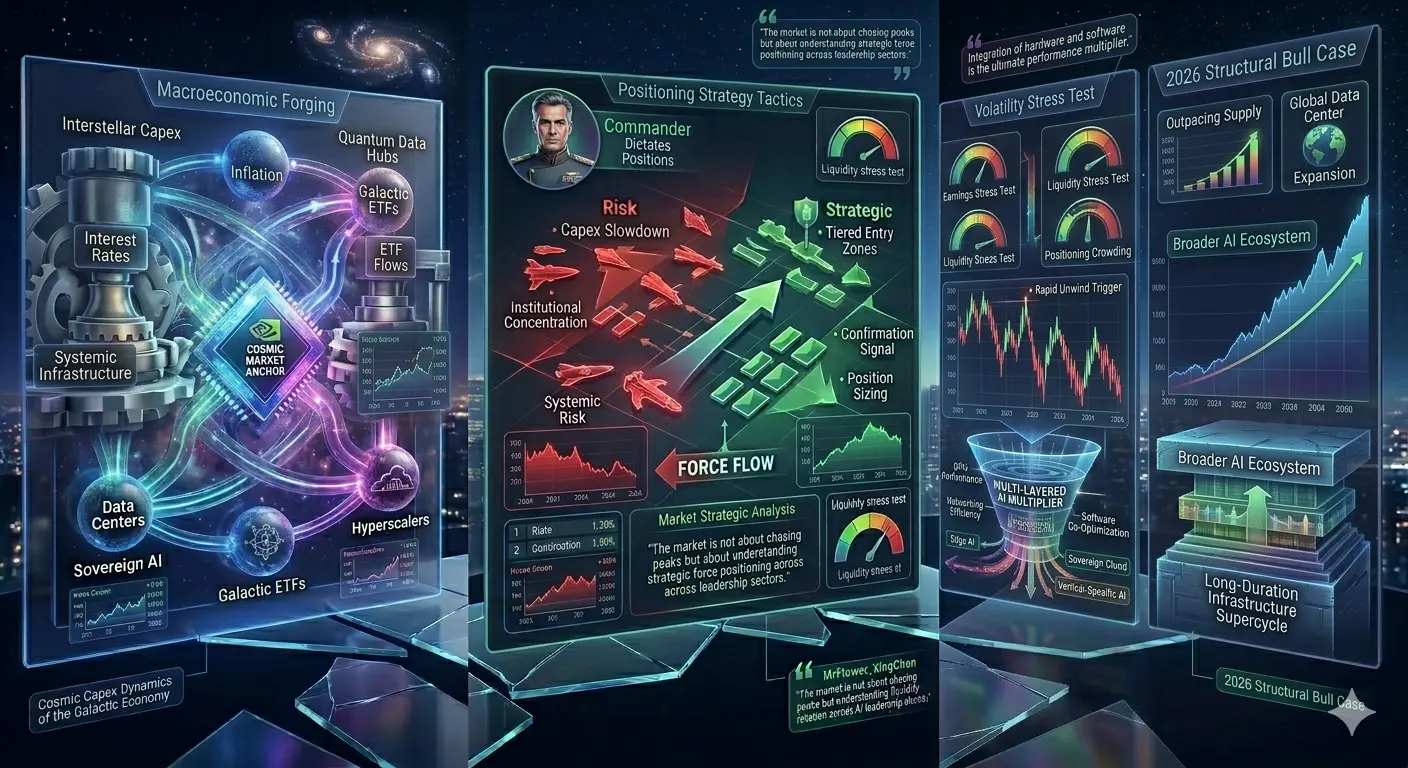
The current U.S. equity landscape is still heavily dominated by the AI-driven capital cycle, and within this cycle, NVIDIA Corporation remains the central liquidity magnet of the entire semiconductor ecosystem. The key thesis in 2026 is not just about earnings growth, but about whether the market can continue to justify compressed or expanded valuation multiples under shifting macro conditions such as interest rate expectations, ETF flows, and instit
MrFlower_XingChen
𝙉𝙑𝘿𝘼 𝙖𝙣𝙙 𝘼𝙄 𝙎𝙚𝙘𝙩𝙤𝙧 𝙊𝙪𝙩𝙡𝙤𝙤𝙠 𝟮𝟬𝟮𝟲 — 𝙈𝙖𝙧𝙠𝙚𝙩 𝙎𝙩𝙧𝙪𝙘𝙩𝙪𝙧𝙚, 𝙑𝙖𝙡𝙪𝙖𝙩𝙞𝙤𝙣 & 𝙏𝙧𝙖𝙙𝙞𝙣𝙜 𝙎𝙩𝙧𝙖𝙩𝙚𝙜𝙮
The current U.S. equity landscape is still heavily dominated by the AI-driven capital cycle, and within this cycle, NVIDIA Corporation remains the central liquidity magnet of the entire semiconductor ecosystem. The key thesis in 2026 is not just about earnings growth, but about whether the market can continue to justify compressed or expanded valuation multiples under shifting macro conditions such as interest rate expectations, ETF flows, and institutional rebalancing. From my observation, NVDA is no longer simply a “growth stock” narrative; it has transformed into a systemic infrastructure asset tied to global data center expansion, sovereign AI investments, and hyperscaler capex cycles. At the same time, volatility is increasing because positioning is crowded, meaning every earnings cycle becomes a liquidity stress test rather than just a fundamentals update.
From a sector perspective, the Semiconductor & AI ecosystem is now a multi-layered structure rather than a single trade. Companies like Advanced Micro Devices and Microsoft Corporation are indirectly shaping AI demand through cloud infrastructure and alternative compute strategies, while AI infrastructure demand continues to spill into leveraged instruments such as ETFs like SOXL. The key risk factor here is valuation compression under macro tightening, where even strong revenue growth may not prevent short-term downside if liquidity conditions weaken. However, the bullish structural argument still stands: AI compute demand is outpacing supply, and chipmakers are effectively selling into a long-duration infrastructure supercycle. This creates a scenario where dips are often driven by sentiment rather than fundamental breakdown, which is critical for positioning strategy.
Technically and strategically, NVDA behaves like a momentum-anchor asset for the entire AI trade. When NVDA trends upward, beta exposure across semiconductors expands aggressively, and when it corrects, leveraged products experience amplified drawdowns. In this environment, my trading approach is focused on tiered entry zones, risk-managed accumulation, and event-driven volatility tracking rather than blind directional bets. Key signals to monitor include data center revenue acceleration, gross margin stability, and forward guidance revisions, which often matter more than headline EPS beats. Risk-wise, the biggest threats remain interest rate uncertainty, AI capex slowdown risk, and overconcentration of institutional holdings, which could trigger rapid unwinds. Still, the broader 2026 outlook remains structurally bullish as long as AI infrastructure investment continues at scale.
From the viewpoint of MrFlower_XingChen, this market is not about chasing peaks but about understanding liquidity rotation across AI leadership stocks, where NVDA acts as the primary signal generator for the entire sector trend. Strategic positioning in this environment requires patience, confirmation-based entries, and awareness that volatility is not noise—it is the price of participation in a high-growth technological supercycle.
#分享美股交易赢英伟达股票
#TradeCFDWinGold #StockTradingChallengeUpTo17000U #DailyPolymarketHotspot @Gate_Square @GateSquare
#ShareYourUSStocksWinNvidia
repost-content-media
  • Reward
  • Comment
  • Repost
  • Share
#BTC
𝘽𝙞𝙩𝙘𝙤𝙞𝙣 𝙈𝙖𝙧𝙠𝙚𝙩 𝙊𝙪𝙩𝙡𝙤𝙤𝙠 𝙅𝙪𝙣𝙚 𝟮𝟬𝟮𝟲 — 𝙈𝙖𝙘𝙧𝙤 𝙋𝙧𝙚𝙨𝙨𝙪𝙧𝙚, 𝙇𝙞𝙦𝙪𝙞𝙙𝙞𝙩𝙮 𝘾𝙮𝙘𝙡𝙚 & 𝙋𝙧𝙞𝙘𝙚 𝙎𝙩𝙧𝙪𝙘𝙩𝙪𝙧𝙚
The current phase of Bitcoin shows a clear transition from speculative momentum into a macro-driven liquidity contraction environment, where price behavior is increasingly influenced by global financial tightening rather than crypto-native catalysts. As of June 8, 2026, Bitcoin is trading at approximately $63,500 USDT, reflecting recent volatility after a sharp correction of nearly 20% from its recent peak. This type of price action indi
BTC4.94%
MrFlower_XingChen
#BTC
𝘽𝙞𝙩𝙘𝙤𝙞𝙣 𝙈𝙖𝙧𝙠𝙚𝙩 𝙊𝙪𝙩𝙡𝙤𝙤𝙠 𝙅𝙪𝙣𝙚 𝟮𝟬𝟮𝟲 — 𝙈𝙖𝙘𝙧𝙤 𝙋𝙧𝙚𝙨𝙨𝙪𝙧𝙚, 𝙇𝙞𝙦𝙪𝙞𝙙𝙞𝙩𝙮 𝘾𝙮𝙘𝙡𝙚 & 𝙋𝙧𝙞𝙘𝙚 𝙎𝙩𝙧𝙪𝙘𝙩𝙪𝙧𝙚
The current phase of Bitcoin shows a clear transition from speculative momentum into a macro-driven liquidity contraction environment, where price behavior is increasingly influenced by global financial tightening rather than crypto-native catalysts. As of June 8, 2026, Bitcoin is trading at approximately $63,500 USDT, reflecting recent volatility after a sharp correction of nearly 20% from its recent peak. This type of price action indicates that the market is no longer in a pure bullish expansion phase, but instead operating within a highly sensitive equilibrium zone, where both upward recoveries and downward breakdowns are heavily dependent on liquidity conditions and institutional participation.
What makes the current structure particularly important is the dominance of macroeconomic forces over on-chain fundamentals. Strong U.S. labor data, rising Treasury yields, and a strengthening U.S. dollar have collectively created a headwind for risk assets, pushing investors to reduce exposure to volatile instruments like Bitcoin. At the same time, consecutive ETF outflows suggest that institutional capital is actively rotating away from crypto and into sectors perceived as more stable or more immediately profitable, particularly AI-driven equities and traditional tech infrastructure plays. This rotation has weakened the structural support behind Bitcoin’s rally attempts, making each rebound more fragile and less sustainable unless backed by renewed inflows.
From a sentiment perspective, the market is currently in a fear-dominant but reactive phase, where traders are responding aggressively to macro signals rather than long-term conviction. Even though Bitcoin has managed to stabilize above key psychological levels after its recent decline, the lack of consistent inflows means the recovery lacks depth. This creates a market environment where rallies are often interpreted as temporary relief rather than structural reversals. The introduction of volatility-focused instruments such as CME’s Bitcoin volatility futures also highlights how institutional players are adapting to this regime, treating Bitcoin increasingly as a tradable volatility asset rather than a directional growth asset.
Technically, Bitcoin remains in a wide consolidation band with elevated volatility, where liquidity pockets above and below current price levels are constantly tested. In such conditions, price direction becomes less predictable and more dependent on external macro catalysts such as inflation data, interest rate expectations, and ETF flow reversals. The key bullish trigger would be a sustained return of institutional inflows combined with a weakening dollar environment, which could restore momentum and reintroduce trend continuation dynamics. Without these conditions, the market risks remaining stuck in a choppy, range-bound structure with frequent false breakouts and liquidity-driven reversals.
From a strategic perspective, this environment demands a disciplined and defensive approach rather than aggressive leverage-based positioning. The most important factor is not chasing short-term moves but understanding liquidity cycles and macro alignment. Bitcoin is currently acting as a global risk appetite indicator, meaning its price reflects broader investor confidence in liquidity conditions rather than isolated crypto fundamentals. In this sense, the current market is less about prediction and more about timing exposure around macro inflection points.
Overall, Bitcoin’s June 2026 outlook is defined by macro uncertainty, institutional hesitation, and fragile liquidity recovery attempts, with price stability heavily dependent on external financial conditions. Until a clear shift in liquidity direction occurs, volatility will remain elevated and directional conviction will stay limited.
#BitcoinRalliesOver5Percent #ShareYourUSStocksWinNvidia
repost-content-media
  • Reward
  • Comment
  • Repost
  • Share
🐶 𝗗𝗼𝗴𝗲𝗰𝗼𝗶𝗻 (DOGE)
The current price action of Dogecoin around the $0.0850 zone reflects a clear transition from mid-May speculative momentum into a cooling and distribution-driven phase, where short-term buyers have lost control and sellers are gradually dictating direction. After the recent peak near $0.1153, the market has entered a corrective structure characterized by lower highs, weakening volume, and declining futures participation, signaling that the previous bullish impulse has fully exhausted its immediate liquidity. On-chain behavior further confirms this shift, as “smart m
DOGE5.16%
MrFlower_XingChen
🐶 𝗗𝗼𝗴𝗲𝗰𝗼𝗶𝗻 (DOGE)
The current price action of Dogecoin around the $0.0850 zone reflects a clear transition from mid-May speculative momentum into a cooling and distribution-driven phase, where short-term buyers have lost control and sellers are gradually dictating direction. After the recent peak near $0.1153, the market has entered a corrective structure characterized by lower highs, weakening volume, and declining futures participation, signaling that the previous bullish impulse has fully exhausted its immediate liquidity. On-chain behavior further confirms this shift, as “smart money” wallets holding 100M–1B DOGE have reduced exposure to a five-month low, suggesting that larger participants are currently in risk-off positioning rather than accumulation. At the same time, derivatives data showing Open Interest at a two-month low highlights fading retail leverage activity, which often reduces volatility but also removes upward breakout fuel. From a technical perspective, the $0.10 level remains the most important psychological and structural resistance, acting as a pivot where failed recovery attempts have repeatedly been rejected, while immediate downside pressure is concentrated around the $0.0800 support zone, which now acts as the critical line between consolidation and deeper correction. A decisive breakdown below this level could expose DOGE to a more extended retracement phase, potentially targeting lower liquidity pockets formed during earlier accumulation cycles. Momentum indicators such as MACD remain firmly in negative territory, confirming that bearish control is still dominant, although the pace of decline appears to be stabilizing rather than accelerating, which sometimes precedes short-term relief bounces. Fundamentally, Dogecoin continues to maintain a strong market presence with a large circulating supply of approximately 148.6 billion tokens and a steady inflation rate near 3.5% annually, which creates a structural headwind for long-term price expansion unless demand consistently increases. Prediction market sentiment also reflects caution, with only an estimated 8% probability of DOGE reclaiming $0.11 by late June, indicating that traders are not currently pricing in a strong upside catalyst in the immediate term. In this environment, the broader structure suggests that DOGE is in a liquidity reset phase, where volatility compresses before the next directional move is defined by either a reclaim of $0.10 resistance or a breakdown below $0.080 support. From the perspective of MrFlower_XingChen, this is a classic post-rally digestion zone, where patience and confirmation matter more than early positioning, as the market is still searching for a new equilibrium after speculative exhaustion.
#TradeCFDWinGold #StockTradingChallengeUpTo17000U #DailyPolymarketHotspot @Gate_Square @GateSquare
#ShareYourUSStocksWinNvidia
  • Reward
  • Comment
  • Repost
  • Share
𝗕𝗶𝘁𝗰𝗼𝗶𝗻 𝗘𝗧𝗙 𝗙𝗹𝗼𝘄 𝗖𝗿𝗶𝘀𝗶𝘀 — 𝗜𝗻𝘀𝘁𝗶𝘁𝘂𝘁𝗶𝗼𝗻𝗮𝗹 𝗣𝗼𝘀𝗶𝘁𝗶𝗼𝗻𝗶𝗻𝗴 𝗥𝗲𝘀𝗲𝘁 𝗮𝗻𝗱 𝗪𝗵𝗮𝘁 𝗖𝗼𝗺𝗲𝘀 𝗡𝗲𝘅𝘁
The recent $4.4B outflow streak from Bitcoin ETFs marks one of the most important institutional positioning shifts since the launch of spot ETFs. This was not a random retail-driven correction — it was a coordinated risk de-leveraging cycle across macro hedge funds, CTA models, and short-term institutional momentum strategies, reflecting broader uncertainty in global liquidity conditions.
Over the course of 13 consecutive trading sessions, ETFs tied to
BTC4.94%
MrFlower_XingChen
𝗕𝗶𝘁𝗰𝗼𝗶𝗻 𝗘𝗧𝗙 𝗙𝗹𝗼𝘄 𝗖𝗿𝗶𝘀𝗶𝘀 — 𝗜𝗻𝘀𝘁𝗶𝘁𝘂𝘁𝗶𝗼𝗻𝗮𝗹 𝗣𝗼𝘀𝗶𝘁𝗶𝗼𝗻𝗶𝗻𝗴 𝗥𝗲𝘀𝗲𝘁 𝗮𝗻𝗱 𝗪𝗵𝗮𝘁 𝗖𝗼𝗺𝗲𝘀 𝗡𝗲𝘅𝘁
The recent $4.4B outflow streak from Bitcoin ETFs marks one of the most important institutional positioning shifts since the launch of spot ETFs. This was not a random retail-driven correction — it was a coordinated risk de-leveraging cycle across macro hedge funds, CTA models, and short-term institutional momentum strategies, reflecting broader uncertainty in global liquidity conditions.
Over the course of 13 consecutive trading sessions, ETFs tied to Bitcoin experienced sustained selling pressure, with the majority of outflows concentrated in major funds like BlackRock IBIT, alongside heavy redemptions in products offered by Fidelity Investments and Grayscale Investments. This pattern signals that the pressure was not isolated to one issuer but rather a system-wide risk reduction event.
What makes this phase particularly important is the composition of sellers. Data suggests that the largest selling pressure came from fast-moving hedge funds and tactical macro traders, not long-term allocators such as pension funds or endowments. This distinction matters because it indicates that the structural adoption thesis for Bitcoin remains intact, even though short-term speculative capital exited aggressively.
A key turning point arrived when the outflow streak finally broke, registering a small but symbolically important return to net inflows. While the magnitude was minimal compared to prior redemptions, it represented a shift in momentum behavior. Historically, such transitions often appear near liquidity exhaustion zones, where forced selling begins to fade and price stabilizes after testing psychological levels.
At the same time, broader sentiment indicators confirmed extreme stress in the market, with fear readings deep in “Extreme Fear” territory, suggesting that positioning had become heavily one-sided. In past cycles, similar conditions have frequently coincided with local bottom formations or extended accumulation phases, although they do not guarantee immediate recovery.
From a structural perspective, Bitcoin ETFs have now evolved into a real-time proxy for institutional risk appetite. When inflows dominate, markets enter expansion phases driven by liquidity confidence. When outflows dominate, the system transitions into de-risking and capital preservation mode, often leading to sideways or corrective price behavior.
The critical question now is whether the recent stabilization marks a true regime shift or simply a temporary pause. A sustainable recovery would require multiple consecutive days of positive inflows, combined with improved macro liquidity conditions and renewed risk-on positioning from hedge funds. Without that confirmation, the market remains vulnerable to another leg of selling pressure.
However, the broader ETF structure still shows strong lifetime inflows, meaning that the long-term adoption trend has not broken. Instead, what we are witnessing is a mid-cycle liquidity reset inside a longer institutional adoption curve, where short-term volatility masks a still-intact structural demand base.
MrFlower_XingChen views this phase as a transition from aggressive expansion to positioning equilibrium, where the market is searching for a new balance between liquidity risk and long-term conviction. If inflows gradually return, this zone could later be recognized as a key accumulation period in Bitcoin’s institutional history. However, failure to stabilize flows would likely extend the correction into deeper liquidity regions before a stronger base is formed.
#BitcoinETFSees7272BTCOutflow #Bitcoin #GateSquare
#BitcoinETFSees7272BTCOutflow
repost-content-media
  • Reward
  • Comment
  • Repost
  • Share
𝗦𝗽𝗮𝗰𝗲𝗫 𝗜𝗣𝗢 — 𝗕𝗧𝗖 𝗮𝗻𝗱 𝗦&𝗣 𝟱𝟬𝟬 𝗟𝗶𝗾𝘂𝗶𝗱𝗶𝘁𝘆 𝗜𝗺𝗽𝗮𝗰𝘁 𝗠𝗮𝗽
The potential SpaceX IPO at a multi-trillion valuation level represents more than a single equity event — it acts as a global liquidity reallocation shock that temporarily reshapes capital flow across Bitcoin and the S&P 500. When a mega-IPO of this scale enters the market, institutional portfolios are forced to rebalance risk exposure, creating short-term pressure across multiple asset classes simultaneously.
In the S&P 500, the primary impact comes through liquidity competition and capital rotation. Insti
BTC4.94%
MrFlower_XingChen
𝗦𝗽𝗮𝗰𝗲𝗫 𝗜𝗣𝗢 — 𝗕𝗧𝗖 𝗮𝗻𝗱 𝗦&𝗣 𝟱𝟬𝟬 𝗟𝗶𝗾𝘂𝗶𝗱𝗶𝘁𝘆 𝗜𝗺𝗽𝗮𝗰𝘁 𝗠𝗮𝗽
The potential SpaceX IPO at a multi-trillion valuation level represents more than a single equity event — it acts as a global liquidity reallocation shock that temporarily reshapes capital flow across Bitcoin and the S&P 500. When a mega-IPO of this scale enters the market, institutional portfolios are forced to rebalance risk exposure, creating short-term pressure across multiple asset classes simultaneously.
In the S&P 500, the primary impact comes through liquidity competition and capital rotation. Institutional investors typically fund large IPO allocations by reducing exposure to high-beta growth stocks, especially in sectors already trading at elevated valuations such as AI, semiconductors, and cloud infrastructure. Stocks like NVIDIA and other mega-cap technology leaders can experience temporary momentum loss as capital is redirected into IPO participation. However, this does not necessarily indicate structural weakness in the index — instead, it reflects a short-term narrowing of market breadth, where leadership becomes more concentrated in defensive and cash-heavy names while speculative growth segments cool down.
For Bitcoin, the impact channel is slightly different but equally important. Bitcoin exposure through ETFs such as those managed by BlackRock, Fidelity Investments, and Grayscale Investments makes it highly sensitive to institutional liquidity shifts. During a major IPO event, hedge funds and macro traders often reduce exposure to volatile assets like Bitcoin to free up capital for primary market allocations. This creates temporary ETF outflows or reduced inflow momentum, leading to short-term price pressure even if long-term demand remains intact.
At the same time, Bitcoin is structurally different from equities because it does not rely on earnings or valuation expansion cycles. Its supply is fixed, and long-term ETF adoption continues to act as a stabilizing force. This means that while IPO-driven liquidity drains can cause short-term volatility, Bitcoin typically retains stronger post-event recovery dynamics once capital rotation stabilizes and risk appetite returns to broader markets.
The key interaction between BTC and SPX during a mega-IPO phase is not directional but cyclical. In the early phase, liquidity is pulled into the IPO, causing both Bitcoin and growth-heavy segments of the S&P 500 to experience mild pressure or consolidation. In the middle phase, volatility increases as positioning adjusts. In the final phase, capital gradually rotates back depending on IPO performance and broader macro conditions, often leading to a rebound in both risk assets if sentiment stabilizes.
Overall, the SpaceX IPO acts as a temporary liquidity magnet rather than a permanent capital drain. It reshapes the timing of flows rather than the long-term direction of markets. The S&P 500 may experience short-term breadth weakness, while Bitcoin may see ETF flow compression, but both assets remain structurally tied to the same global liquidity cycle.
MrFlower_XingChen views this event as a cross-market liquidity reset mechanism, where capital is temporarily concentrated into a single high-profile equity narrative before gradually redistributing back into broader risk assets. The outcome depends less on the IPO itself and more on how quickly institutional liquidity normalizes afterward and whether risk appetite returns to expansion mode across equities and crypto.
#SpaceXRoadshowHighlightsAsteroidMining
repost-content-media
  • Reward
  • Comment
  • Repost
  • Share
  • Pinned