# USNetCapitalInflowsHitRecord884B

16.08M

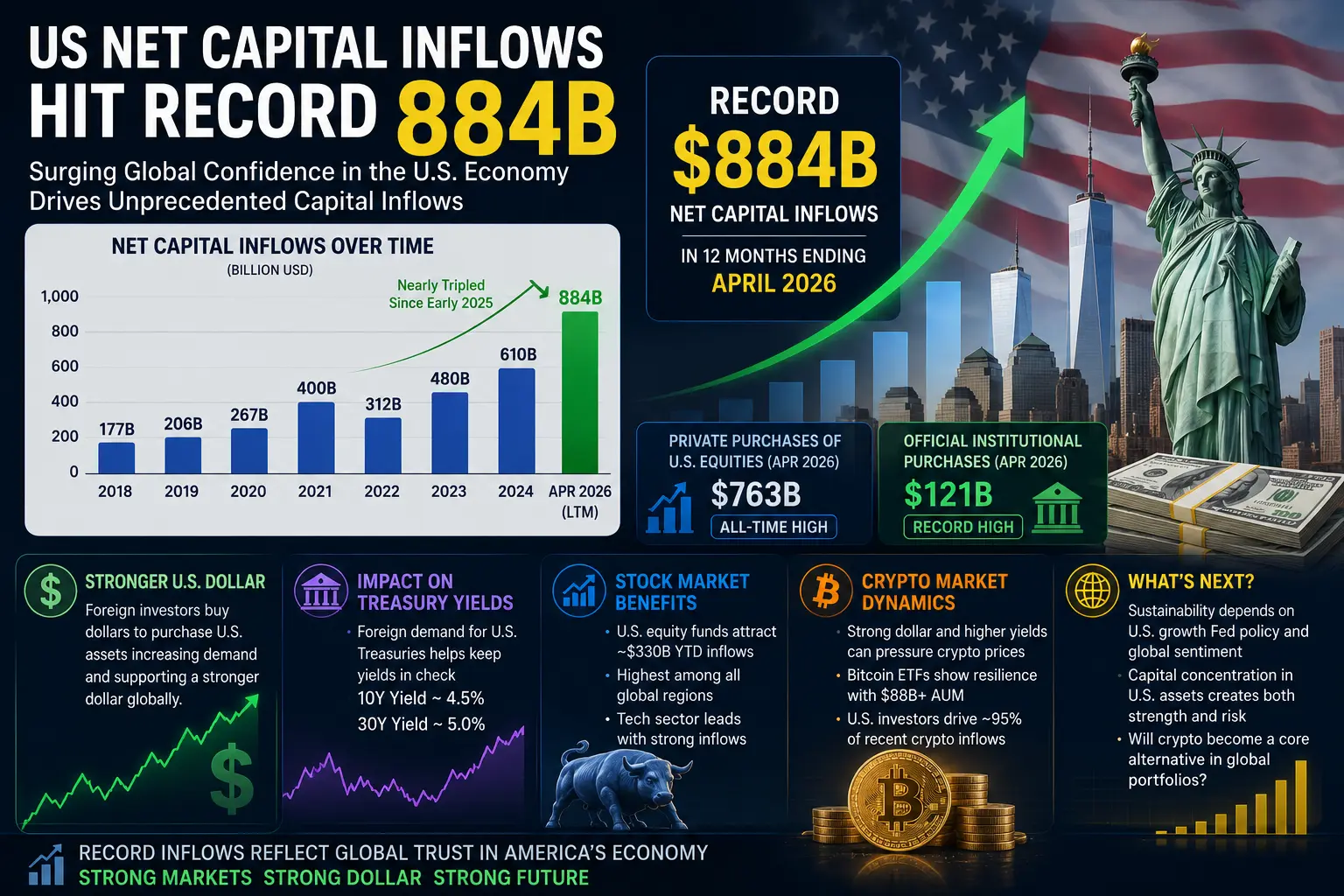
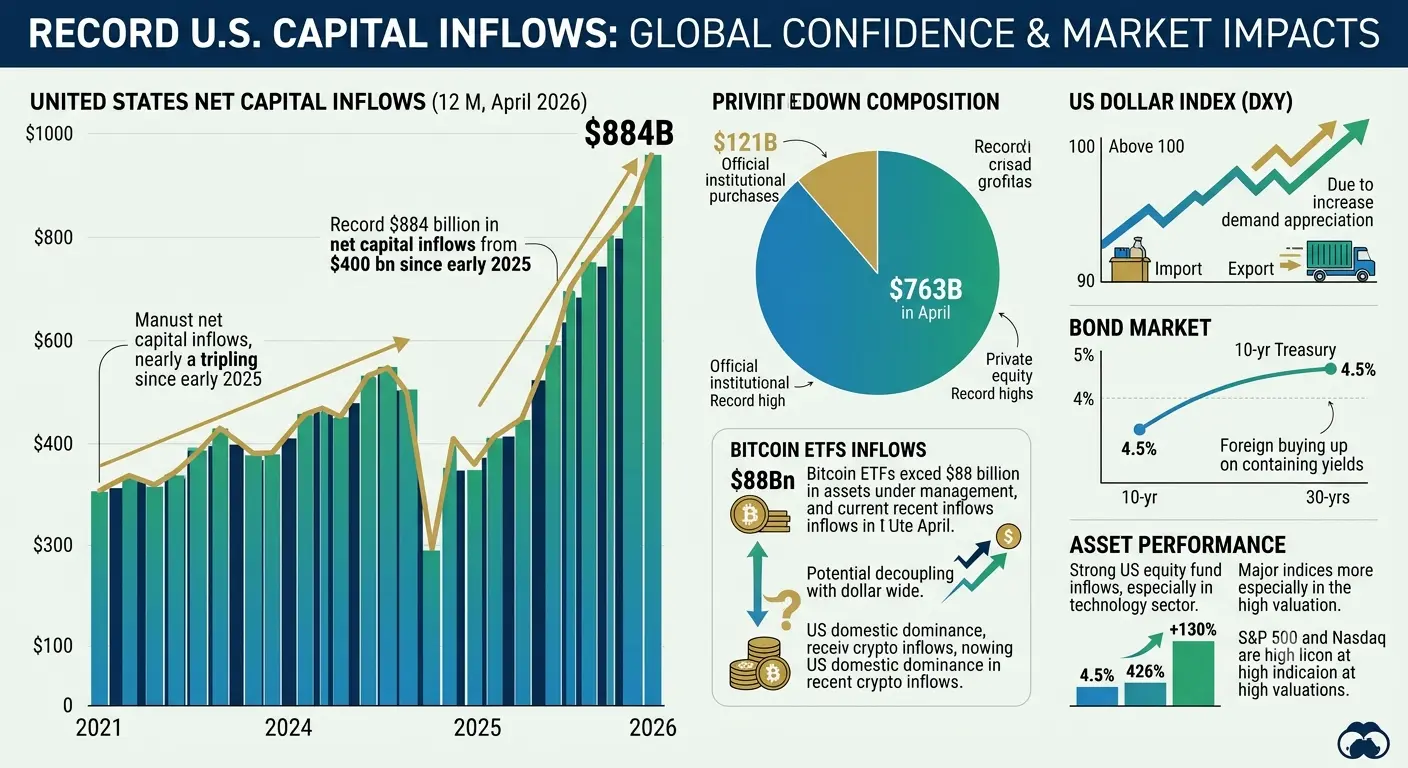
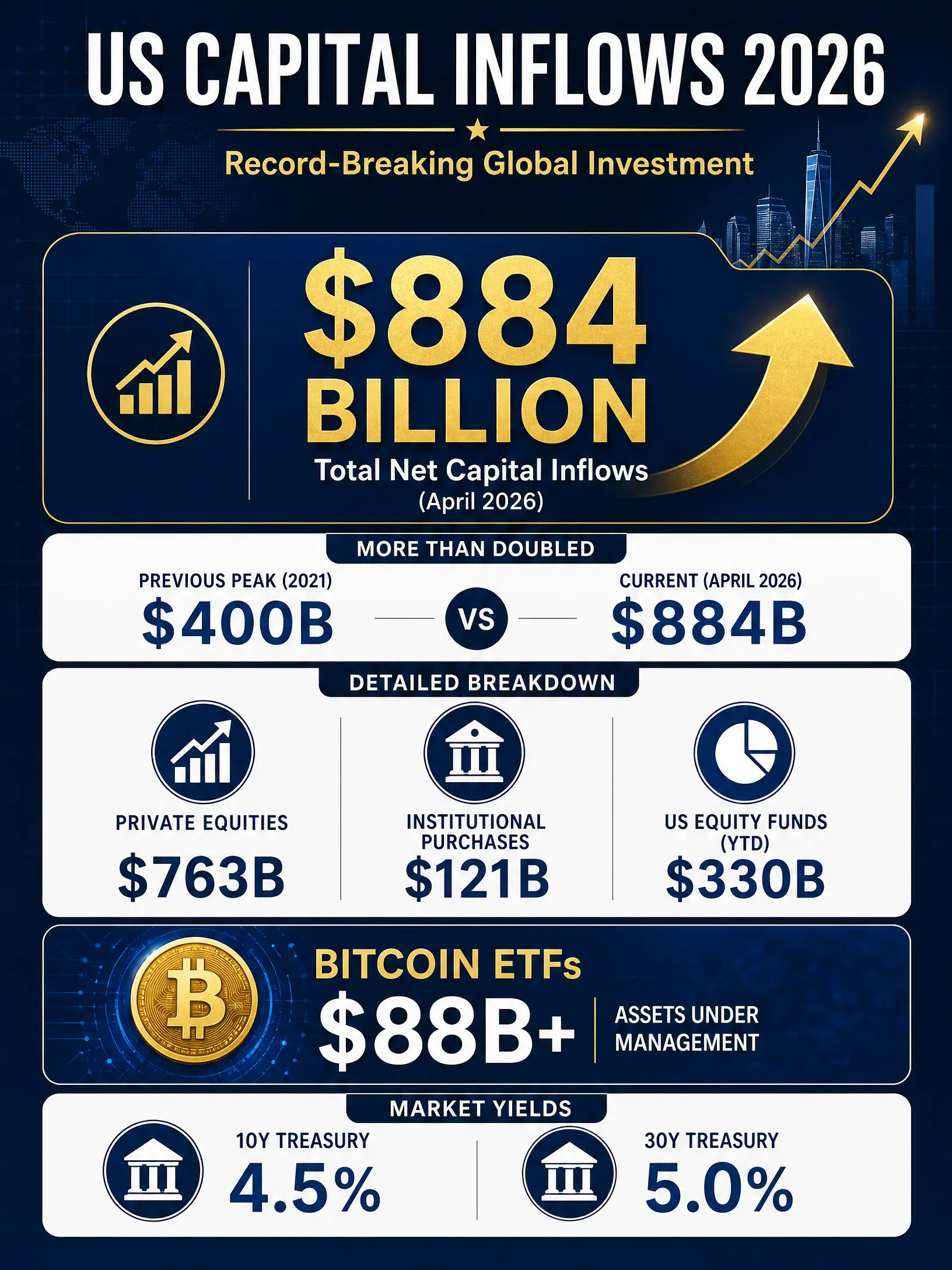
U.S. net capital inflows reached a record $884 billion over the 12 months ending April 2026. The metric reflects foreign capital entering U.S. markets through private and official purchases of American assets, having nearly tripled since early 2025. The 2021 peak of around $400 billion was less than half of current levels. Private sector purchases of U.S. stocks surged to a record $763 billion in April, deepening the global "bash by day, buy by night" pattern.

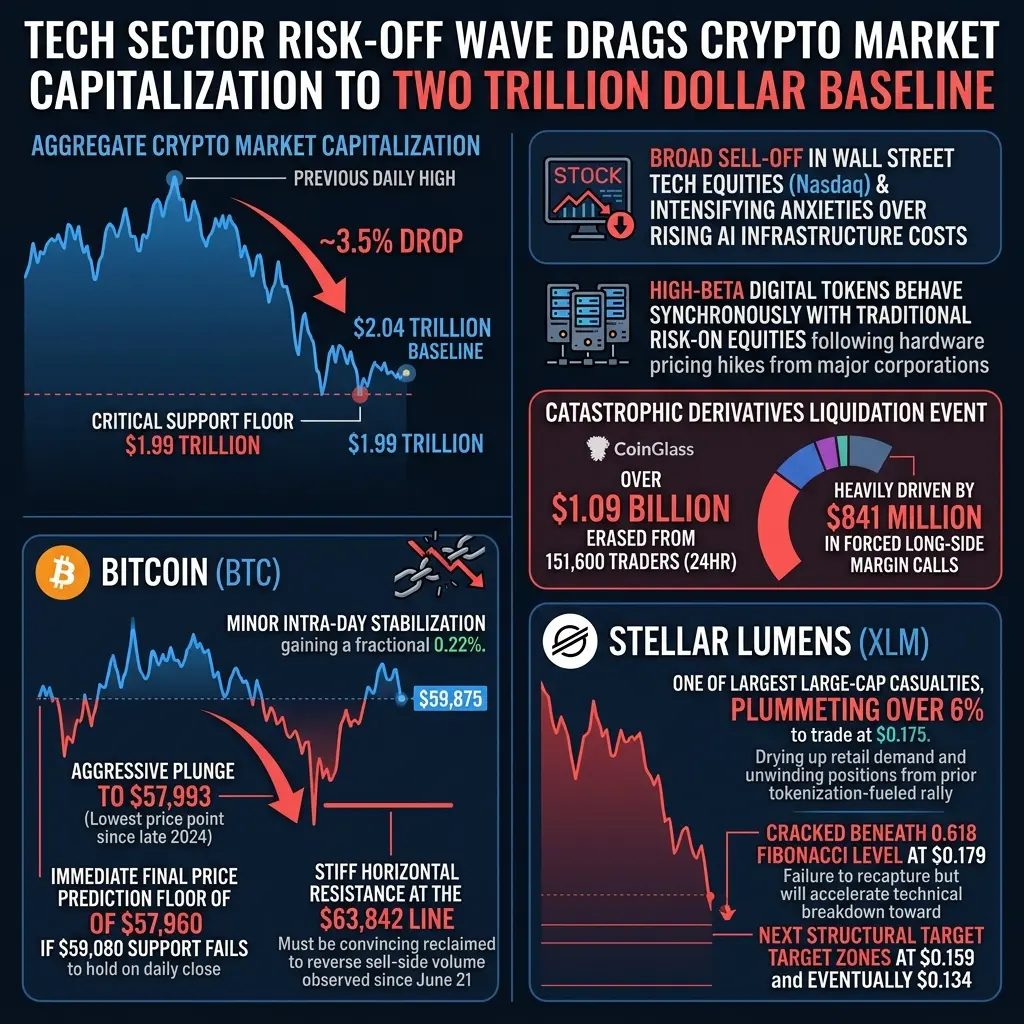
Tech Sector Risk Off Wave Drags Crypto Market Capitalization to Two Trillion Dollar Baseline
The global digital asset market experienced a sharp contraction as a broad sell-off in Wall Street technology equities and intensifying investor anxieties over rising artificial intelligence infrastructure costs spilled over into decentralized assets. The aggregate cryptocurrency market capitalization fell by approximately 3.5 percent from its previous daily high to settle around the 2.04 trillion dollar baseline, after briefly plunging to a critical support floor of 1.99 trillion dollars. This downsid
BTC-2.55%
XLM-4.65%
post-image
  • Reward
  • 3
  • Repost
  • Share
Edelweiss:
1000x Vibes 🤑
View More
#美国年度净资本流入创8840亿新高 This core data shows that the "siphoning effect" of global capital on U.S. assets has reached an unprecedented intensity, which can be understood from several dimensions:
1. The dollar system remains highly attractive. The massive capital inflows indicate sustained strong confidence among global investors in U.S. stocks, Treasury bonds, and the financial system. April TIC data shows that official sector purchases have doubled since the beginning of the year, and private sector stock purchases hit a record high, indicating that both sovereign funds and private capital are inc
BTC-2.55%
RWA1.13%
BLK-1.07%
ThisIsTranslateContent:
#美国年度净资本流入创8840亿新高 This core data shows that the "siphoning effect" of global capital on U.S. assets has reached an unprecedented intensity, which can be understood from several dimensions:
1. The dollar system remains highly attractive. The massive capital inflows indicate sustained strong confidence among global investors in U.S. stocks, Treasury bonds, and the financial system. April TIC data shows that official sector purchases have doubled since the beginning of the year, and private sector stock purchases hit a record high, indicating that both sovereign funds and private capital are increasing their allocation to U.S. assets.
2. Driven by technology and AI narratives. The strong performance of the U.S. stock market (especially AI-related tech stocks) is one of the core factors attracting capital. Global capital chases the "tech dividends" of U.S. stocks, pushing up the scale of net inflows.
3. But it also means that other global markets face capital withdrawal. The massive flow of funds to the U.S. implies that emerging markets such as Europe and Asia may face capital outflow pressure — posing downside risks to their local currency exchange rates and asset prices.
4. Potential "over-concentration" risk. Excessive concentration of capital in a single market, once the U.S. economy or policy shifts (e.g., interest rate changes, geopolitical conflicts), could trigger large-scale repatriation and a global market resonance shock.
Impact on the crypto market: Dual logic
Short-term: The siphoning effect may suppress the crypto market
The huge influx of capital into traditional U.S. stocks and Treasury bonds means that global liquidity has "preferentially chosen" traditional U.S. assets over alternative assets such as crypto. In fact, the IMF's Q1 2026 monitoring report shows that the total market cap of the global crypto market has fallen from a peak of $4.4 trillion in October 2025 to about $2.4 trillion, a decline of over 40%. Recent data also shows that institutional allocation to BTC through ETFs and futures markets has returned to the level of March 2025.
The tendency of capital to "choose stocks over coins" is particularly evident during the peak period of capital inflows.
Medium to long term: The spillover effect may again benefit crypto
Historical patterns show that after U.S. assets continue to absorb global funds, the dollar liquidity environment tends to ease, eventually generating spillover effects:
Dollar liquidity expansion → Risk appetite recovery → Capital spills along the risk curve into the crypto market
Pullback after overvaluation of U.S. stocks → Capital rotation from traditional markets to alternative assets.
Some analyses already expect that a correction in U.S. stocks in the second half of 2026 may drive liquidity back into digital assets, typically following the path of "first BTC, then large-cap altcoins, and finally more speculative assets."
Structural trend: The boundary between traditional and crypto is blurring
Notably, while $884 billion in capital inflows into the U.S., the channels between traditional finance and crypto are also accelerating:
The stablecoin market cap has reached a new historical high of $320 billion, and stablecoin trading volume reached $33 trillion in 2025.
The RWA (on-chain real-world assets) market has hit record highs for 10 consecutive months, reaching $28.9 billion in May, including $16.2 billion in tokenized U.S. Treasury bonds.
Giants such as BlackRock and Citi are building on-chain settlement infrastructure, and traditional capital is migrating on-chain in the form of tokenization.
This means that part of the capital flowing into the U.S. may ultimately operate on-chain in the form of tokenized stocks, tokenized Treasury bonds, etc. — traditional capital inflows and crypto market development are not completely opposing but are converging.
The record $884 billion capital inflow reflects the world's extreme preference for U.S. assets. In the short term, this "siphoning" suppresses the crypto market, with funds prioritizing U.S. stocks over alternative assets like BTC. But in the medium to long term, the spillover effect after liquidity expansion, capital rotation after U.S. stock valuation corrections, and the structural migration of traditional assets to on-chain tokenization could all become catalysts for the crypto market to regain capital injections.
Key observation points: when a significant pullback occurs in U.S. stocks, and whether the growth of stablecoins/RWA can continue to accelerate as a bridge for capital "onboarding" to the chain.
repost-content-media
  • Reward
  • 4
  • Repost
  • Share
discovery:
2026 GOGOGO 👊
View More
#USNetCapitalInflowsHitRecord884B
Global capital doesn't move randomly—it follows confidence, opportunity, and expectations. The latest report showing U.S. net capital inflows reaching a record $884 billion is more than an impressive statistic; it is a powerful indication of how international investors are positioning themselves in an increasingly uncertain global economy.
Capital inflows of this magnitude suggest that global institutions continue to view the United States as a primary destination for investment, despite ongoing debates surrounding inflation, interest rates, and geopolitical u
BTC-2.55%
ETH-5.22%
post-image
  • Reward
  • 8
  • Repost
  • Share
CryptoDiscovery:
To The Moon 🌕
View More
#USNetCapitalInflowsHitRecord884B
The United States has achieved an extraordinary milestone in global finance as net capital inflows surged to a record-breaking 884 billion dollars in the twelve months ending April 2026. This unprecedented figure represents foreign investment flowing into American financial markets through private investors and official institutions purchasing United States assets. The magnitude of this capital influx becomes even more striking when compared to historical data, as net capital inflows have nearly tripled since the beginning of 2025. The previous peak recorded
US500-0.55%
BTC-2.55%
post-image
post-image
post-image
post-image
  • Reward
  • 10
  • Repost
  • Share
ShainingMoon:
To The Moon 🌕
View More
#USNetCapitalInflowsHitRecord884B
The United States has achieved an extraordinary milestone in global finance as net capital inflows surged to a record-breaking 884 billion dollars in the twelve months ending April 2026. This unprecedented figure represents foreign investment flowing into American financial markets through private investors and official institutions purchasing United States assets. The magnitude of this capital influx becomes even more striking when compared to historical data, as net capital inflows have nearly tripled since the beginning of 2025. The previous peak recorded
BTC-2.55%
HighAmbition
#USNetCapitalInflowsHitRecord884B
The United States has achieved an extraordinary milestone in global finance as net capital inflows surged to a record-breaking 884 billion dollars in the twelve months ending April 2026. This unprecedented figure represents foreign investment flowing into American financial markets through private investors and official institutions purchasing United States assets. The magnitude of this capital influx becomes even more striking when compared to historical data, as net capital inflows have nearly tripled since the beginning of 2025. The previous peak recorded in 2021 stood at approximately 400 billion dollars, meaning current levels have more than doubled that previous benchmark. This massive influx of foreign capital signals robust international confidence in the American economy and its financial markets.
The composition of these capital inflows reveals important details about investor behavior and preferences. Total private purchases of United States equities jumped to 763 billion dollars in April alone, establishing an all-time high for this metric. Meanwhile, official institutional purchases rose to a record 121 billion dollars, representing more than a doubling since the start of the current year. These figures demonstrate that global appetite for American assets has reached unprecedented levels, with both individual and institutional investors seeking exposure to the world's largest economy. The diversification across equity types and the participation of official institutions underscore the broad-based nature of this capital migration.
The surge in capital inflows carries significant implications for the United States dollar and its relative strength in global currency markets. When foreign investors purchase American assets, they must first acquire dollars, creating substantial demand for the currency. This increased demand typically results in dollar appreciation, making the greenback more expensive relative to other currencies. A stronger dollar enhances purchasing power for American consumers and businesses importing goods from abroad, though it may present challenges for exporters facing reduced competitiveness. The current capital flow dynamics suggest the dollar could maintain elevated levels, supported by this continuous stream of foreign investment seeking American assets.
The bond market has experienced notable effects from this capital influx as well. Foreign purchases of United States Treasury securities have contributed to keeping yields relatively contained despite inflationary pressures. The 10-year Treasury yield has traded around 4.5 percent, while the 30-year yield touched 5 percent in recent months. These yield levels, while elevated compared to the ultra-low rates of previous years, remain attractive to international investors seeking safe-haven assets. The demand from foreign buyers helps the American government finance its substantial debt obligations while providing stability to the broader fixed-income market. However, rising yields can also create headwinds for risk assets as investors weigh the opportunity cost of holding lower-risk government debt.
Stock market performance has benefited considerably from the record capital inflows. United States equity funds have attracted approximately 330 billion dollars in year-to-date inflows, representing the highest level among all global regions. Technology sector funds have been particularly popular, with weekly inflows reaching 19.2 billion dollars at certain points. This concentration of capital in American equities has driven major indices to elevated valuations, with the S&P 500 and Nasdaq Composite reflecting strong investor optimism. The influx of foreign capital provides additional liquidity and support for equity prices, creating a positive feedback loop that can sustain market momentum.
The cryptocurrency market faces a more complex relationship with these substantial capital flows into traditional American assets. Historically, Bitcoin and other digital assets have exhibited an inverse correlation with the United States dollar, meaning dollar strength often corresponded with crypto weakness. However, recent market dynamics have shown signs of decoupling, with both assets occasionally rallying simultaneously. The record capital inflows into traditional markets could potentially divert some investment away from cryptocurrencies, as institutional investors prioritize established asset classes. Conversely, the overall expansion of liquidity and risk appetite associated with strong capital flows may eventually benefit crypto markets as well.
Bitcoin exchange-traded funds have demonstrated resilience despite these macroeconomic shifts, with total assets under management across American Bitcoin ETFs exceeding 88 billion dollars. Recent weeks have seen significant inflows of 871 million dollars into Bitcoin investment products, indicating that institutional interest in cryptocurrency exposure remains robust. The relationship between traditional capital flows and crypto investment appears increasingly nuanced, with both markets potentially benefiting from the broader trend of global capital seeking American assets. American investors have driven approximately 95 percent of recent crypto inflows, suggesting domestic appetite for digital assets continues growing alongside traditional investments.
The interplay between dollar strength, Treasury yields, and cryptocurrency prices will likely define market dynamics in the coming months. Should the dollar maintain its strength above the 100 level on the Dollar Index, Bitcoin may face continued pressure as investors favor the relative safety of cash and government bonds. However, if capital inflows moderate or the Federal Reserve signals more accommodative policy, the rotation back into risk assets including cryptocurrencies could accelerate. The current environment presents both opportunities and challenges for crypto investors navigating these complex macroeconomic crosscurrents.
Looking ahead, the sustainability of these record capital inflows will depend on several factors including American economic performance, Federal Reserve policy decisions, and global risk sentiment. The concentration of capital in American assets creates potential vulnerabilities should sentiment shift, though the depth and liquidity of United States markets provide substantial buffers. For cryptocurrency markets, the key consideration remains whether digital assets can establish themselves as legitimate alternatives within this capital allocation framework, or whether they will continue trading as speculative risk assets vulnerable to traditional market dynamics. The ongoing evolution of this relationship between traditional finance and cryptocurrency markets will shape investment outcomes for years to come.#TradFiCFDGoldMasters @Gate_Square
repost-content-media
  • Reward
  • 1
  • Repost
  • Share
HighAmbition:
To The Moon 🌕
#USNetCapitalInflowsHitRecord884B
The United States capital inflows have just reached a record eight hundred eighty four billion dollars. This is an important thing for every trader to think about because it seems good for America at first but it is actually more complicated for things like crypto.
The United States net capital inflows reaching a record eight hundred eighty four billion dollars is a big deal. To put this in perspective the April 2026 TIC data showed that foreign people bought two hundred six billion dollars in long-term United States securities in one month. This is one of th
BTC-2.55%
post-image
  • Reward
  • 6
  • Repost
  • Share
CryptoDiscovery:
To The Moon 🌕
View More
#USNetCapitalInflowsHitRecord884B
US financial markets are absorbing capital at a pace that is rewriting historical benchmarks.
According to data aggregated from the Bureau of Economic Analysis, Treasury International Capital reports, and Bank of America EPFR flow tracking, net capital inflows into the United States have reached a record $884 billion on a trailing basis through early 2026. This figure includes portfolio investment, direct investment, banking flows, and equity fund inflows, highlighting an unprecedented global reallocation of capital toward U.S. financial markets.
The drivers
US3.02%
BTC-2.55%
post-image
  • Reward
  • 7
  • Repost
  • Share
Yajing:
To The Moon 🌕
View More
#USNetCapitalInflowsHitRecord884B
**US Net Capital Inflows Hit Record 884 Billion as Foreign Investment Remains Strong**
The US Net Capital Inflows have reached a record 884 billion dollars, reflecting continued strong foreign interest in American assets. This substantial inflow underscores the enduring appeal of US markets as a destination for global capital despite shifting economic conditions.
Personally, I think this record level of inflows highlights the deep liquidity and perceived safety of US financial markets. Another important factor is how these flows can influence currency strengt
post-image
  • Reward
  • 1
  • Repost
  • Share
HighAmbition:
thnx for sharing
#美股2026展望 Why Some Crypto Projects Fade While Others Build Legacies
Launching a token takes minutes. Building something people actually care about? That's a different story.
Take Kurumi, for example. What started as another name in the meme space turned into something unexpected—a place where people show up not because they're chasing the next 100x, but because they found something worth sticking around for.
Most projects survive on hype cycles. Kurumi survived because the people behind it refused to play that game. No manufactured urgency. No fake volume pumps. Just builders—delivery drivers,
BNB-0.24%
  • Reward
  • 2
  • Repost
  • Share
Yusfirah:
To The Moon 🌕
View More
#美股2026展望 I just saw an amazing news - Filecoin has officially confirmed that it will launch the FOC platform on November 19, which is claimed to be the world's first verifiable + programmable decentralized cloud service.
How strong is this thing exactly? I summarized it simply:
It is said that storage costs can drop to 5% of traditional cloud services, which is very attractive for companies that spend money on cloud storage annually. Technically, the technology relies on automatically splitting and encrypting files, and theoretically, it is almost impossible to hack a single point. Sovereignt
FIL-3.41%
  • Reward
  • 1
  • Repost
  • Share
BeautifulDay:
To The Moon 🌕
Load More

Join 40 M users in our growing community

⚡️ Join 40 M users in the crypto craze discussion
💬 Engage with your favorite top creators
👍 See what interests you
  • Pinned