


#MinnesotaPredictionMarketBanBlocked Minnesota Blocks Prediction Market Ban: A Defining Moment for Innovation, Crypto, and the Future of Digital Finance
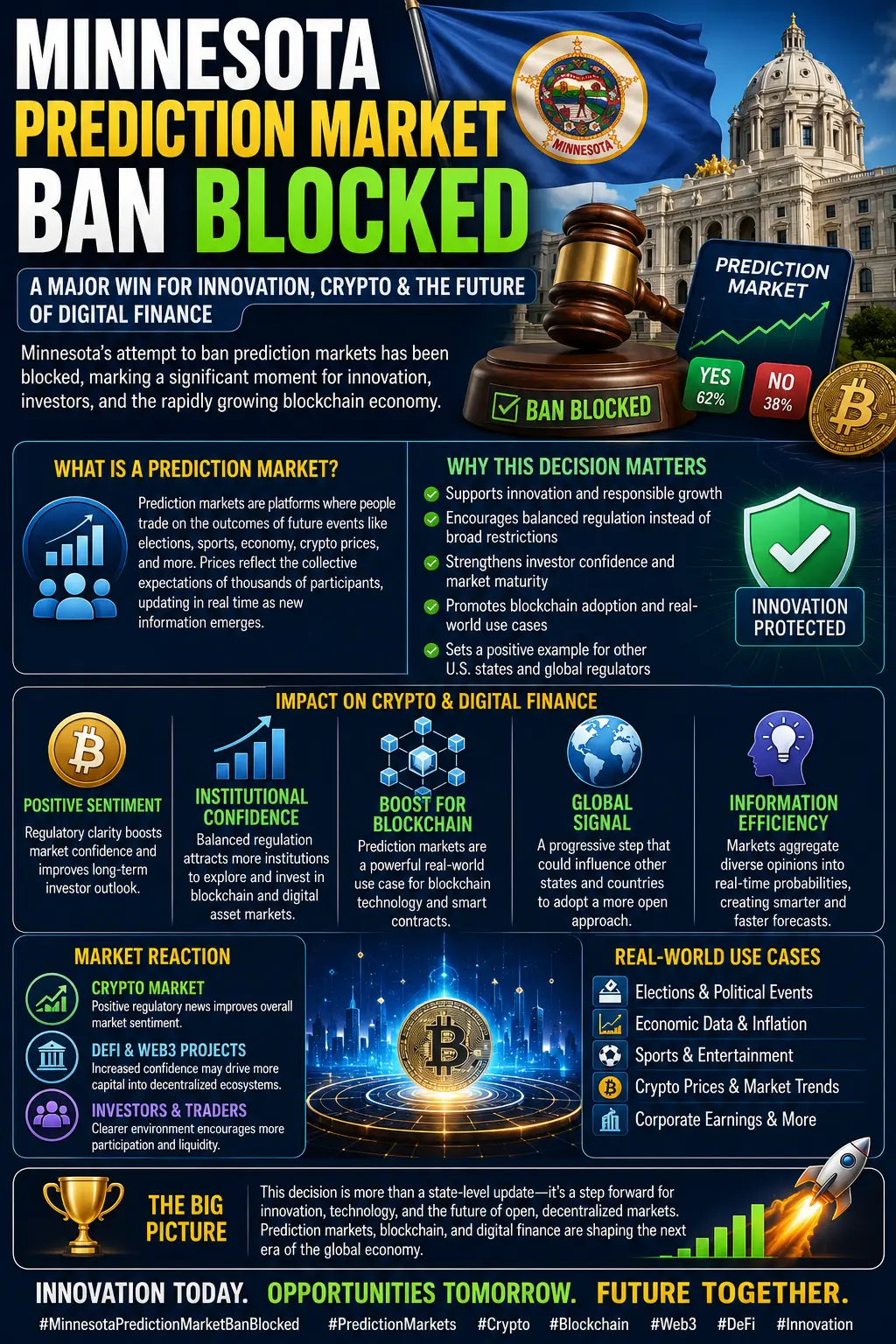
Regulatory decisions often shape the future of entire industries, and Minnesota's decision to block an attempt to ban prediction markets has quickly become one of the most important discussions across financial technology, blockchain, and cryptocurrency communities.
Although the decision applies to a single U.S.
state, its significance reaches far beyond regional borders because it reflects a broader conversation about how governments should approach innovation in the digital economy.
Rather than slowing technological progress through broad restrictions, this outcome highlights the growing importance of balanced regulation that protects market integrity while allowing innovation to continue evolving.
Prediction markets have emerged as one of the most fascinating applications of modern financial technology. Instead of relying solely on opinions or surveys, these markets allow participants to trade contracts based on the probability of future events. Elections, economic reports, inflation data, central bank policy, sporting events, technological breakthroughs, corporate earnings, and even cryptocurrency price movements can all become measurable market expectations. Every trade represents information, and every price reflects the collective expectations of thousands of participants. As new information becomes available, market probabilities adjust almost instantly, creating a dynamic forecasting system powered by continuous market participation.
The decision to block Minnesota's proposed restriction is widely viewed as a positive signal for technological development. It suggests that innovation deserves careful evaluation instead of broad limitations. This does not mean prediction markets will operate without oversight, but it demonstrates that policymakers are increasingly recognizing the importance of creating regulatory environments that encourage responsible growth rather than discouraging new ideas. Clear and balanced regulation often strengthens investor confidence, attracts technological investment, and creates healthier long-term market development.
For the cryptocurrency industry, this development carries even greater significance.
Modern prediction markets are increasingly integrated with blockchain infrastructure, decentralized protocols, smart contracts, and digital assets. Blockchain technology has evolved far beyond simple cryptocurrency transfers. Today it powers decentralized finance, tokenized assets, staking, digital identity, cross-border payments, Web3 ecosystems, artificial intelligence applications, and prediction markets. Every successful real-world use case strengthens confidence that blockchain is becoming essential digital infrastructure rather than remaining only a speculative investment sector.
Market sentiment is one of the most powerful forces driving digital assets, and regulatory clarity often plays a major role in shaping that sentiment. Positive regulatory developments may not immediately move Bitcoin or Ethereum prices by double digits, but they can significantly improve long-term investor confidence. Institutional investors closely monitor legal developments because regulatory certainty reduces uncertainty, encourages capital allocation, and supports broader participation across digital asset markets. As confidence improves, market liquidity and institutional engagement frequently become stronger.
Prediction markets also demonstrate one of the greatest strengths of open financial systems: information efficiency. Thousands of independent participants continuously evaluate new information and adjust their expectations accordingly. Rather than depending on isolated forecasts, prediction markets aggregate diverse viewpoints into transparent probability estimates that evolve in real time. While no forecasting model can guarantee future outcomes, markets often provide valuable insight into collective expectations because they reward participants for accurately interpreting changing events.
The timing of this decision is especially important as governments around the world continue evaluating digital assets, decentralized finance, stablecoins, tokenized securities, and blockchain-powered financial infrastructure.
Every regulatory decision contributes to a larger global conversation about how innovation should coexist with consumer protection and financial stability. Minnesota's approach demonstrates that constructive evaluation can sometimes replace broad restrictions, creating opportunities for technology to mature within transparent legal frameworks.
Institutional participation remains one of the strongest long-term drivers for cryptocurrency adoption. Large financial institutions typically seek regulatory certainty before committing significant capital to emerging technologies.
Developments that support innovation without creating unnecessary uncertainty often encourage institutions to continue researching blockchain applications, digital asset infrastructure, and decentralized financial services. This expanding institutional interest strengthens the overall maturity of the crypto ecosystem.
Beyond cryptocurrency, prediction markets represent an evolution in how information is processed within financial systems. Instead of treating forecasts as static opinions, these markets convert expectations into continuously updated prices influenced by global participants. This creates an ecosystem where information flows rapidly, expectations remain transparent, and probabilities evolve alongside changing economic and political conditions. Such mechanisms highlight the growing intersection between finance, technology, and decentralized digital infrastructure.
For blockchain developers and entrepreneurs, Minnesota's decision represents encouragement that innovation continues receiving serious consideration within regulatory discussions. Building new financial products requires confidence that technological progress will be evaluated fairly. Developers invest years creating decentralized applications, smart contract platforms, financial protocols, and digital infrastructure. Regulatory environments that promote responsible experimentation often accelerate innovation while maintaining necessary safeguards for participants.
The cryptocurrency market has experienced enormous transformation over the past decade.
Bitcoin evolved from an experimental digital currency into a globally recognized reserve asset. Ethereum introduced programmable smart contracts. Stablecoins now facilitate billions of dollars in daily settlement.
Decentralized finance continues expanding financial accessibility. Tokenized real-world assets are attracting institutional interest. Prediction markets now add another practical application demonstrating blockchain's expanding economic utility.
Investor psychology should never be underestimated. Financial markets frequently respond not only to economic data but also to confidence, expectations, and long-term narratives. Positive regulatory headlines often strengthen optimism because they reduce fears surrounding future policy uncertainty. Although one state-level decision cannot determine the direction of the entire cryptocurrency market, it contributes positively to the broader narrative supporting continued blockchain innovation and responsible digital finance.
Looking ahead, the importance of regulatory balance will likely continue increasing. Governments worldwide face the challenge of encouraging innovation while protecting market participants. Excessive restrictions may slow technological progress, while thoughtful regulation can create environments where responsible innovation flourishes. Minnesota's decision contributes to this evolving discussion by demonstrating that emerging financial technologies deserve careful analysis before broad limitations are introduced.
Ultimately, this is more than a story about one state or one regulatory proposal. It reflects the continuing evolution of digital finance, decentralized technology, and blockchain adoption across global markets. Every constructive regulatory development strengthens confidence that innovation and oversight can progress together. As prediction markets, decentralized finance, artificial intelligence, and blockchain infrastructure continue expanding, the digital economy moves closer to becoming an integral part of everyday financial life.
For crypto investors, blockchain builders, and long-term market participants, Minnesota's decision serves as another reminder that the future of digital finance will be shaped not only by technological breakthroughs but also by balanced regulation that supports responsible innovation. The conversation surrounding prediction markets is far from over, but one thing is becoming increasingly clear: the next generation of financial markets will be driven by transparency, technology, data, and global participation. Those who understand these evolving trends today will be better positioned to navigate the financial ecosystem of tomorrow.
@Gate_Square #SummerCreationCamp ۔
Regulatory decisions often shape the future of entire industries, and Minnesota's decision to block an attempt to ban prediction markets has quickly become one of the most important discussions across financial technology, blockchain, and cryptocurrency communities.
Although the decision applies to a single U.S.
state, its significance reaches far beyond regional borders because it reflects a broader conversation about how governments should approach innovation in the digital economy.
Rather than slowing technological progress through broad restrictions, this outcome highlights the growing importance of balanced regulation that protects market integrity while allowing innovation to continue evolving.
Prediction markets have emerged as one of the most fascinating applications of modern financial technology. Instead of relying solely on opinions or surveys, these markets allow participants to trade contracts based on the probability of future events. Elections, economic reports, inflation data, central bank policy, sporting events, technological breakthroughs, corporate earnings, and even cryptocurrency price movements can all become measurable market expectations. Every trade represents information, and every price reflects the collective expectations of thousands of participants. As new information becomes available, market probabilities adjust almost instantly, creating a dynamic forecasting system powered by continuous market participation.
The decision to block Minnesota's proposed restriction is widely viewed as a positive signal for technological development. It suggests that innovation deserves careful evaluation instead of broad limitations. This does not mean prediction markets will operate without oversight, but it demonstrates that policymakers are increasingly recognizing the importance of creating regulatory environments that encourage responsible growth rather than discouraging new ideas. Clear and balanced regulation often strengthens investor confidence, attracts technological investment, and creates healthier long-term market development.
For the cryptocurrency industry, this development carries even greater significance.
Modern prediction markets are increasingly integrated with blockchain infrastructure, decentralized protocols, smart contracts, and digital assets. Blockchain technology has evolved far beyond simple cryptocurrency transfers. Today it powers decentralized finance, tokenized assets, staking, digital identity, cross-border payments, Web3 ecosystems, artificial intelligence applications, and prediction markets. Every successful real-world use case strengthens confidence that blockchain is becoming essential digital infrastructure rather than remaining only a speculative investment sector.
Market sentiment is one of the most powerful forces driving digital assets, and regulatory clarity often plays a major role in shaping that sentiment. Positive regulatory developments may not immediately move Bitcoin or Ethereum prices by double digits, but they can significantly improve long-term investor confidence. Institutional investors closely monitor legal developments because regulatory certainty reduces uncertainty, encourages capital allocation, and supports broader participation across digital asset markets. As confidence improves, market liquidity and institutional engagement frequently become stronger.
Prediction markets also demonstrate one of the greatest strengths of open financial systems: information efficiency. Thousands of independent participants continuously evaluate new information and adjust their expectations accordingly. Rather than depending on isolated forecasts, prediction markets aggregate diverse viewpoints into transparent probability estimates that evolve in real time. While no forecasting model can guarantee future outcomes, markets often provide valuable insight into collective expectations because they reward participants for accurately interpreting changing events.
The timing of this decision is especially important as governments around the world continue evaluating digital assets, decentralized finance, stablecoins, tokenized securities, and blockchain-powered financial infrastructure.
Every regulatory decision contributes to a larger global conversation about how innovation should coexist with consumer protection and financial stability. Minnesota's approach demonstrates that constructive evaluation can sometimes replace broad restrictions, creating opportunities for technology to mature within transparent legal frameworks.
Institutional participation remains one of the strongest long-term drivers for cryptocurrency adoption. Large financial institutions typically seek regulatory certainty before committing significant capital to emerging technologies.
Developments that support innovation without creating unnecessary uncertainty often encourage institutions to continue researching blockchain applications, digital asset infrastructure, and decentralized financial services. This expanding institutional interest strengthens the overall maturity of the crypto ecosystem.
Beyond cryptocurrency, prediction markets represent an evolution in how information is processed within financial systems. Instead of treating forecasts as static opinions, these markets convert expectations into continuously updated prices influenced by global participants. This creates an ecosystem where information flows rapidly, expectations remain transparent, and probabilities evolve alongside changing economic and political conditions. Such mechanisms highlight the growing intersection between finance, technology, and decentralized digital infrastructure.
For blockchain developers and entrepreneurs, Minnesota's decision represents encouragement that innovation continues receiving serious consideration within regulatory discussions. Building new financial products requires confidence that technological progress will be evaluated fairly. Developers invest years creating decentralized applications, smart contract platforms, financial protocols, and digital infrastructure. Regulatory environments that promote responsible experimentation often accelerate innovation while maintaining necessary safeguards for participants.
The cryptocurrency market has experienced enormous transformation over the past decade.
Bitcoin evolved from an experimental digital currency into a globally recognized reserve asset. Ethereum introduced programmable smart contracts. Stablecoins now facilitate billions of dollars in daily settlement.
Decentralized finance continues expanding financial accessibility. Tokenized real-world assets are attracting institutional interest. Prediction markets now add another practical application demonstrating blockchain's expanding economic utility.
Investor psychology should never be underestimated. Financial markets frequently respond not only to economic data but also to confidence, expectations, and long-term narratives. Positive regulatory headlines often strengthen optimism because they reduce fears surrounding future policy uncertainty. Although one state-level decision cannot determine the direction of the entire cryptocurrency market, it contributes positively to the broader narrative supporting continued blockchain innovation and responsible digital finance.
Looking ahead, the importance of regulatory balance will likely continue increasing. Governments worldwide face the challenge of encouraging innovation while protecting market participants. Excessive restrictions may slow technological progress, while thoughtful regulation can create environments where responsible innovation flourishes. Minnesota's decision contributes to this evolving discussion by demonstrating that emerging financial technologies deserve careful analysis before broad limitations are introduced.
Ultimately, this is more than a story about one state or one regulatory proposal. It reflects the continuing evolution of digital finance, decentralized technology, and blockchain adoption across global markets. Every constructive regulatory development strengthens confidence that innovation and oversight can progress together. As prediction markets, decentralized finance, artificial intelligence, and blockchain infrastructure continue expanding, the digital economy moves closer to becoming an integral part of everyday financial life.
For crypto investors, blockchain builders, and long-term market participants, Minnesota's decision serves as another reminder that the future of digital finance will be shaped not only by technological breakthroughs but also by balanced regulation that supports responsible innovation. The conversation surrounding prediction markets is far from over, but one thing is becoming increasingly clear: the next generation of financial markets will be driven by transparency, technology, data, and global participation. Those who understand these evolving trends today will be better positioned to navigate the financial ecosystem of tomorrow.
@Gate_Square #SummerCreationCamp ۔