The city council of Haverhill, Massachusetts is set to consider a ban on cryptocurrency ATMs following a proposal for an ordinance introduced on March 17.
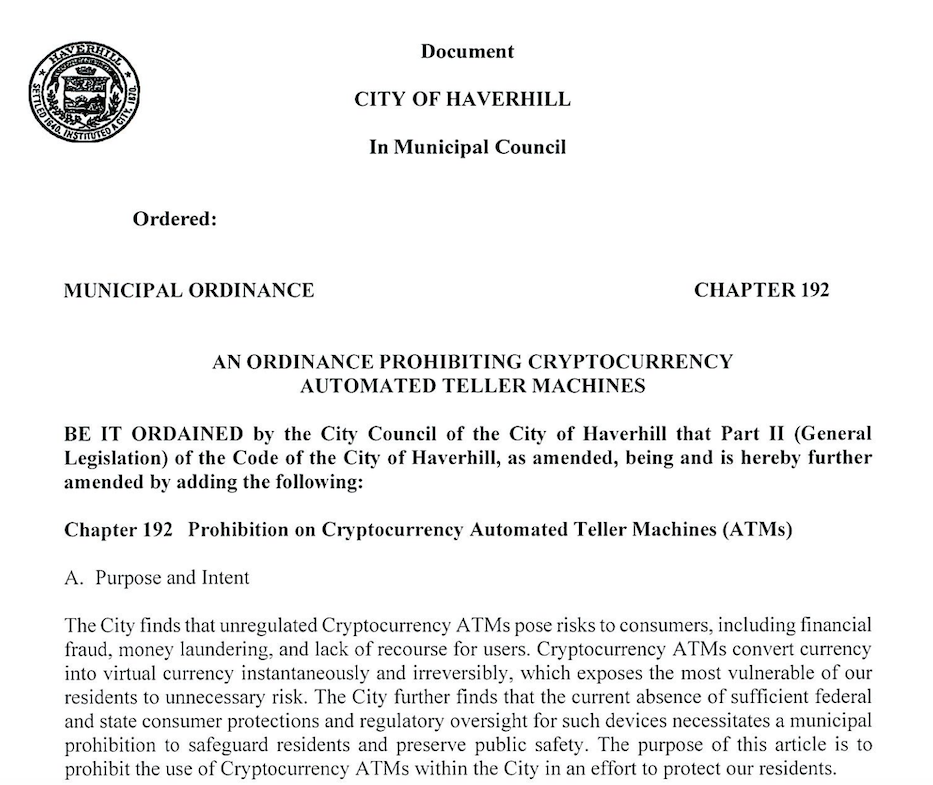
According to Haverhill City Council’s agenda, the government body is scheduled to review a crypto ATM ordinance introduced by Mayor Melinda E. Barrett. The proposal would amend the city code to prohibit cryptocurrency ATMs, an ordinance which received a unanimous 11 votes in the council’s March 17 meeting.
_Source: _Haverhill City Council
The ordinance cited potential risks to Haverhill residents due to “financial fraud, money laundering and lack of recourse” for ATM users. The city said the absence of state and federal regulations necessitated local authorities stepping in. If passed, all crypto kiosks and ATMs would need to be removed from the city within 60 days or face a $300 a day fine.
Haverhill‘s proposed action is just one of many examples of jurisdictions across the US introducing bans on crypto ATMs in response to scams and other illegal activities. In February, a Minnesota lawmaker introduced a bill that could ban crypto kiosks, building on a 2024 law that imposed restrictions on ATM operators.
**Related: **__Crypto gains political clout among 80% of UK young voters
According to data reported by CoinATMRadar and crypto ATM operator Bitcoin Depot, there could be eight or more machines in the Haverhill area. Cointelegraph reached out to Mayor Barrett’s office for comment but had not received a response at the time of publication.
Bitcoin Depot stock declines as company shakes up leadership
As one of the largest crypto ATM operators in the US, the share price of Bitcoin Depot stock (BTM) has declined since 2025, dropping by more than 90% in the past six months. As of Tuesday, the stock was trading at $2.06 on the Nasdaq.
In additional to the potential ordinance in Haverhill, Bitcoin Depot faced Connecticut banking regulators issuing a temporary cease-and-desist order in March, effectively suspending its money transmission license. Authorities in Iowa and Massachusetts have also sued the company for allegedly facilitating crypto scams.
Last week, Bitcoin Depot announced that Scott Buchanan had stepped down as CEO, having served at the role for less than three months. Board member and former MoneyGram CEO Alex Holmes replaced Buchanan as CEO and chair.
Cointelegraph reached out to Bitcoin Depot for comment on the Haverhill ordinance but had not received a response at the time of publication.
**Magazine: **__Are DeFi devs liable for the illegal activity of others on their platforms?
Cointelegraph is committed to independent, transparent journalism. This news article is produced in accordance with Cointelegraph’s Editorial Policy and aims to provide accurate and timely information. Readers are encouraged to verify information independently. Read our Editorial Policy https://cointelegraph.com/editorial-policy
- #Cryptocurrencies
- #Law
- #ATM
- #Government
- #Scams
- #Regulation
Disclaimer: The information on this page may come from third parties and does not represent the views or opinions of Gate. The content displayed on this page is for reference only and does not constitute any financial, investment, or legal advice. Gate does not guarantee the accuracy or completeness of the information and shall not be liable for any losses arising from the use of this information. Virtual asset investments carry high risks and are subject to significant price volatility. You may lose all of your invested principal. Please fully understand the relevant risks and make prudent decisions based on your own financial situation and risk tolerance. For details, please refer to
Disclaimer.
Related Articles
Pakistan Lifts an Eight-Year Ban: Central Bank Allows Banks to Serve Crypto Businesses, and the Virtual Assets Law Takes Effect
On April 14, 2026, the State Bank of Pakistan lifted its crypto-assets banking ban that has been in place since 2018, officially kicking off the Virtual Assets Act 2026. Banks may open accounts for licensed virtual asset service providers, but must establish a segregation-of-funds mechanism to ensure that customers’ funds are not affected. This policy change responds to domestic demand and demonstrates Pakistan’s growing role on the international stage.
ChainNewsAbmedia36m ago
The central bank issues a digital currency report—does it directly refute Qu Bo? If Taiwan issues a CBDC, merchants generally cannot refuse to accept it
The central bank released a report stating that Taiwan’s CBDC development will follow a phased promotion strategy. In the short term, it is not urgent to issue retail CBDC; the focus is on wholesale CBDC and the infrastructure for asset tokenization. The central bank emphasized that CBDC will not increase the money supply and will have legal standing. As a rule, merchants may not refuse to accept it, in order to prevent the payment market from becoming overly dependent on the private sector.
ChainNewsAbmedia2h ago
White House Report Challenges Stablecoin Yield Ban, CLARITY Act Advances in Senate
A White House report argues against banning stablecoin yields, highlighting minimal benefits for bank lending and reduced consumer earnings. Key officials support the CLARITY Act, but the Senate Banking Committee's timeline remains uncertain, affecting the bill's chances before summer recess.
GateNews3h ago
Criticized for freezing too slowly: USDC freezes are taking too long! Circle CEO: We will definitely wait for a court order before freezing; we refuse to freeze it on our own
Circle CEO Jeremy Allaire said the company will not proactively freeze wallet addresses unless it receives a court order or law-enforcement requirement. Even amid allegations of hacker money laundering and community backlash, Circle continues to insist on operating under the rule of law.
Jeremy Allaire sets Circle’s law-enforcement bottom line
-----------------------------
As the global cryptocurrency market surges with uncertainty, Circle’s CEO Jeremy Allaire, at a press conference in Seoul, South Korea, made a clear stance on the market’s most sensitive issue of “asset freezes.” He noted that while Circle has technical means to freeze specific wallet addresses, unless it receives a court order or an official directive from law-enforcement agencies, the company will not
CryptoCity4h ago
Can bypass FSC regulations on using credit cards to buy crypto? OdinTing introduces the Wallet Pro service for buying crypto with a U.S. debit card
The OwlPay and Wallet Pro services launched by OdinTin use stablecoin technology to enable B2B cross-border payments, and—by partnering with major international payment players—showcase its ambitions for expansion in the fintech sector. By operating from overseas, OdinTin bypasses Taiwan’s regulatory restrictions, providing fast virtual-asset trading. Meanwhile, as it faces the newly promulgated Virtual Asset Services Act, it is set to become a reference template for other foreign-invested companies entering the Taiwan market.
CryptoCity5h ago
CLARITY Act Dropped From Senate Schedule; Crypto Bill Faces May Deadline to Avoid 2030 Delay
Senate Banking Committee Chair Tim Scott has delayed advancing the CLARITY Act due to unresolved issues, including stablecoin disputes and DeFi provisions. With a critical May deadline approaching, the bill's future remains uncertain amid political challenges.
GateNews6h ago


