SaharaDreams

vip
Diamond Hands
Market Analyst
Airdrop Hunter
Homeworker
ETF Inflows Roar Back as Spot Ether Funds Pull $1.8 Billion in Six Sessions
The bid came back with size. From July 6 to July 11, 2026, U.S. spot Ether ETFs recorded $1.82 billion in net inflows, the strongest weekly print since January. The move erased three weeks of outflows and pushed combined ETH ETF holdings to 4.31 million ETH, roughly 3.6% of circulating supply. BTC ETFs added $620 million over the same stretch, but the story this week was ETH beta.
What drove the flow
Two catalysts aligned. First, a major custodian confirmed it will support ETH staking inside ETF trusts by Q4, pending
ETH-2.45%
BTC-2.46%
BLK-1.36%
CME1.02%
discovery
ETF Inflows Roar Back as Spot Ether Funds Pull $1.8 Billion in Six Sessions
The bid came back with size. From July 6 to July 11, 2026, U.S. spot Ether ETFs recorded $1.82 billion in net inflows, the strongest weekly print since January. The move erased three weeks of outflows and pushed combined ETH ETF holdings to 4.31 million ETH, roughly 3.6% of circulating supply. BTC ETFs added $620 million over the same stretch, but the story this week was ETH beta.
What drove the flow
Two catalysts aligned. First, a major custodian confirmed it will support ETH staking inside ETF trusts by Q4, pending final sign-off. The S-1 amendments hit late June, but compliance teams cleared the language this week. Second, on-chain data showed a supply squeeze: ETH on trading venues fell to 9.8 million, a 14-month low, while 28.7% of supply sits staked and illiquid. When ETF creations hit, authorized participants had to pull from thin books.
Favorite examples from the tape
1. BlackRock’s ETHA: Took in $742 million on July 9 alone, the second-largest single-day ETH ETF flow on record. The fund now holds 1.64 million ETH. Its premium to NAV stayed at 2 bps, showing smooth create-redeem mechanics. 2. Fidelity’s FETH: Added $408 million this week. The issuer’s crypto desk said 63% of the flow came from RIAs rebalancing model portfolios, not hedge funds. That suggests stickier capital. 3. Grayscale Mini Trust: Saw $116 million in inflows despite a 0.15% fee. The discount to NAV closed from -0.8% to -0.1%, implying arb desks covered shorts as redemption risk fell. 4. CME Basis: ETH futures basis on the regulated venue widened from 6.2% to 11.4% annualized. The jump signaled real spot demand, because ETF APs hedge creations by buying futures, lifting the curve.
Market structure impact
ETH/BTC broke 0.058 after stalling near 0.052 for a month. Options flow confirmed the move: $75k notional in ETH September 4k calls traded on July 10, the largest block since March. Perp funding on major venues flipped positive to 0.012% per 8h, but spot led, not leverage. On-chain, staked ETH queue jumped to 8 days as new validators entered, likely institutions prepping for ETF staking.
Risk and the road ahead
If staking inside ETFs gets delayed, part of this bid unwinds. Also, macro matters: a hot CPI on July 15 could hit duration assets and ETH with it. But flow is flow. When $1.8 billion enters in six sessions, it forces market makers to buy, slippage drops, and reflexive buyers appear. The key level is ETH’s March high at $4,090. A daily close above it with volume turns this inflow into a trend.
For allocators, the takeaway is simple. ETH now has a functioning ETF wrapper, a path to staking yield, and shrinking liquid supply. That trio pulled cash off the sidelines. In crypto, most searched topics this week were “ETH ETF inflows,” “staking ETF,” and “ETH supply.” The tape agreed.
#Ethereum #ETF #Institutional #ETH #Crypto
  • Reward
  • Comment
  • 2
  • Share
$XAUT Gold closed last week with a somewhat mixed picture, so it's useful to consider the following scenario in conjunction with actual price data.
On Friday, gold calmed around $4,100, finishing the week down about 1.5%, which paints a slightly different picture than a "strong bull close," but it's also true that it managed to stay above the $4,080 level. On Monday, the price did indeed rise to $4,200, then fell sharply to around $4,145, which aligns with the liquidity-hunting scenario at the beginning of the week.
This picture needs to be read in conjunction with the macroeconomic background
XAUT-2.05%
XAUUSD-2.52%
PAXG-2.12%
ToTheYUE
$XAUT Gold closed last week with a somewhat mixed picture, so it's useful to consider the following scenario in conjunction with actual price data.
On Friday, gold calmed around $4,100, finishing the week down about 1.5%, which paints a slightly different picture than a "strong bull close," but it's also true that it managed to stay above the $4,080 level. On Monday, the price did indeed rise to $4,200, then fell sharply to around $4,145, which aligns with the liquidity-hunting scenario at the beginning of the week.
This picture needs to be read in conjunction with the macroeconomic background. US-Iran tensions escalated throughout the week, with a two-day wave of attacks on Iran followed by reciprocal retaliations, driving up oil prices and reviving inflation concerns, which strengthened expectations that the Fed may keep its policy rate tight for longer. The market is currently pricing in a probability of a rate hike in September at over sixty percent. This type of environment normally creates two different effects for gold: both supportive and limiting. Geopolitical risk increases demand for safe-haven assets, while expectations of high interest rates put pressure on gold, a non-yielding asset.
The psychological reading presented – that is, the fact that many traders opened new short positions last week after the rejection around $4,200, relying on the low-high structure, and that the stop-loss levels of these positions accumulated above $4,200 – is a logical liquidity map from a technical perspective. Some analysts also argue that a clear bearish trend is still continuing on the weekly and daily charts, and that the rejection from the $4,200-$4,190 resistance is a highly probable signal of further downward movement, showing that the above optimistic scenario is not the only view.
The key data flow for this week is clear: the June CPI data on July 14th, the PPI and Fed Beige Book on July 15th, the Philadelphia Fed manufacturing index and weekly jobless claims on July 16th, and Michigan inflation expectations on July 17th. This data overload makes high volatility in gold this week almost inevitable, creating an environment where both an upward breakout and a downward continuation scenario are simultaneously possible.
For those tracking gold and related assets like XAUT through Gate, the real practical approach is to watch whether the $4,078-$4,116 support zone holds; a break below this level would invalidate the optimistic scenario above. However, given the heavy flow of macroeconomic data this week, it would be a healthier approach from a risk management perspective to treat any technical scenario as a possibility awaiting data confirmation, rather than a definitive outcome.
⚠️ Not financial advice.
DYOR 🔍
$XAUUSD $PAXG
  • Reward
  • Comment
  • 3
  • Share
CLSA Securities Korea data point putting it as high as 73 percent.
The mechanics behind this are worth understanding because they explain why this number got so large so fast. These single-stock leveraged and inverse ETFs, sixteen products tracking twice the daily return of Samsung and SK Hynix, only launched on May 27. Within about a month, assets under management jumped from roughly $3 billion at inception to around $9.1 billion, and 92 percent of holders are individual retail investors, known locally as "ants." Retail traders net purchased about $8.2 billion worth of these products in their
SAMSUNG-8.32%
SK Hynix-15.36%
SKHYV-0.98%
ToTheYUE
CLSA Securities Korea data point putting it as high as 73 percent.
The mechanics behind this are worth understanding because they explain why this number got so large so fast. These single-stock leveraged and inverse ETFs, sixteen products tracking twice the daily return of Samsung and SK Hynix, only launched on May 27. Within about a month, assets under management jumped from roughly $3 billion at inception to around $9.1 billion, and 92 percent of holders are individual retail investors, known locally as "ants." Retail traders net purchased about $8.2 billion worth of these products in their first month alone, representing 63 percent of all retail ETF buying across the entire market during that stretch.
The volatility amplification mechanism is genuinely mechanical and predictable. To maintain a constant 2x leverage ratio, fund managers have to buy more of the underlying stock when it rises and sell more when it falls, every single day at rebalancing. On June 23, when Samsung fell 12.31 percent and SK Hynix fell 12.47 percent in their worst single-day showing since the 2008 financial crisis, sending KOSPI down nearly 10 percent, Bloomberg Intelligence estimated fund managers mechanically sold around $6 billion worth of these two stocks just to rebalance the leveraged products, directly deepening that day's crash. The country's own volatility gauge, VKOSPI, has jumped from an average of 53 before these products launched to nearly 89 now.
There's also a structural quirk unique to the Korean market making this worse, individual stock futures in Korea keep trading until 3:45pm, fifteen minutes after the ETFs and underlying stocks themselves stop at 3:30. That gap has produced strange pricing artifacts, on one occasion SK Hynix's leveraged ETF ended up trading at a 6-7% premium to its own NAV because futures kept moving in the final minutes after the ETF itself had already stopped.
The regulatory response has been notably reactive rather than preventive so far. The Financial Supervisory Service's own governor has publicly expressed regret over what he called rushed approvals, and an opposition lawmaker has called for the products to be delisted entirely, but no concrete remedial measures have been announced yet. Fund performance has been genuinely brutal too, all fourteen of the original single-stock leveraged products are posting average losses of nearly 27 percent since launch, a reminder that leveraged products decay mathematically even in choppy, directionless markets, a stock that drops 10 percent and then rises 10 percent doesn't return to breakeven for a 2x product.
For anyone tracking Korean semiconductor exposure or leveraged product risk more broadly on Gate, the key thing to watch is whether regulators actually move beyond expressing regret into real restrictions, position limits, tighter margin rules, or delisting some products, since as it stands, this concentration means Samsung and SK Hynix's daily price action isn't just reflecting fundamentals anymore, it's being mechanically amplified by the very products built to bet on it, in both directions.
#SKHynixADRIndicativePrice149
DYOR 🔍 NFA ✅
  • Reward
  • Comment
  • 1
  • Share
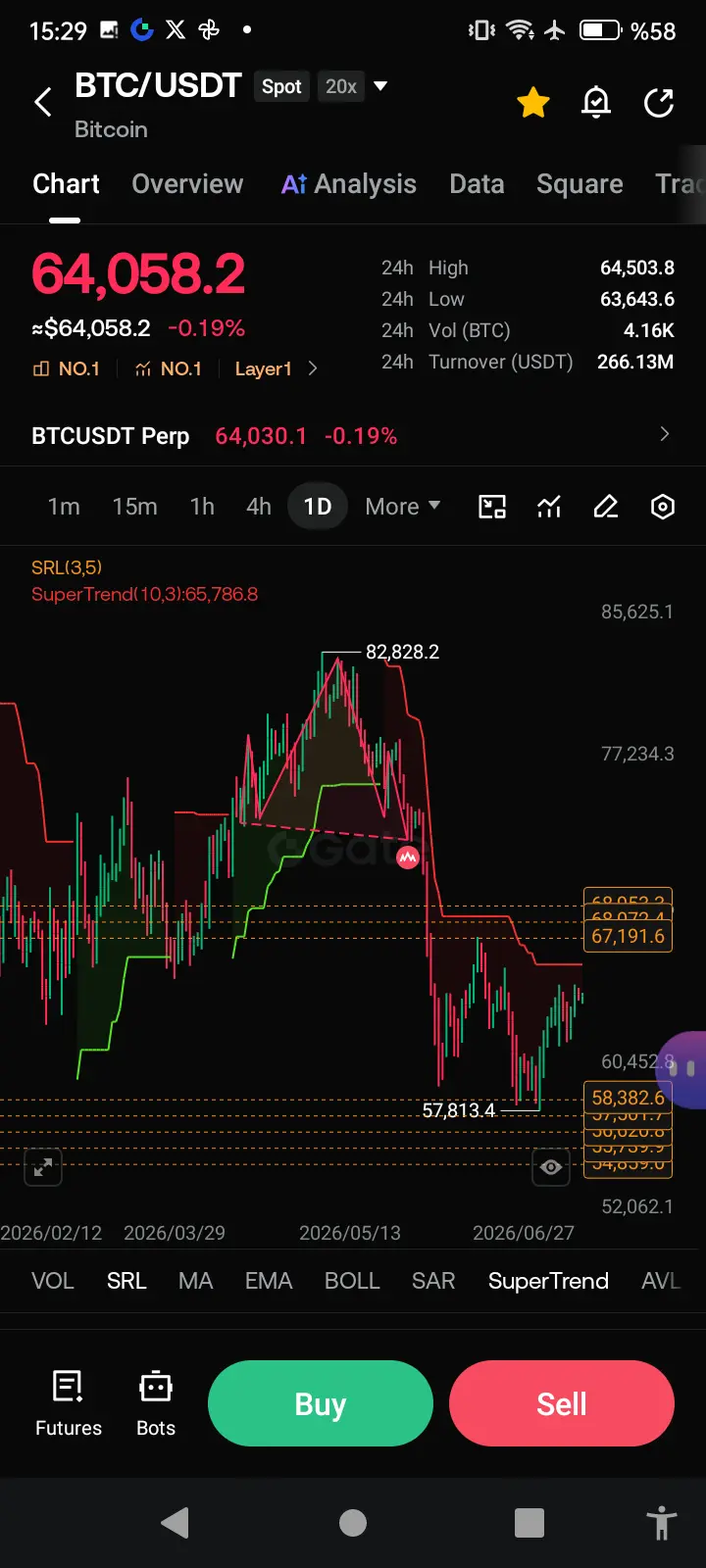
$BTC Bitcoin is currently stuck below the $64,700 resistance level, and how this level is tested appears to determine the direction of future movement.
Instead of sticking to a single scenario, considering two alternative possibilities beforehand is a sensible approach, especially during such a volatile period. Currently, the main critical area is $64,700, and how the price reacts to this level defines two different paths.
In the blue scenario, if the price fails to maintain its position above $64,700 after liquidity is taken, this could be interpreted as a rejection signal, and selling pressu
BTC-2.46%
User_any
$BTC Bitcoin is currently stuck below the $64,700 resistance level, and how this level is tested appears to determine the direction of future movement.
Instead of sticking to a single scenario, considering two alternative possibilities beforehand is a sensible approach, especially during such a volatile period. Currently, the main critical area is $64,700, and how the price reacts to this level defines two different paths.
In the blue scenario, if the price fails to maintain its position above $64,700 after liquidity is taken, this could be interpreted as a rejection signal, and selling pressure may increase. In this case, the first important level to watch is the $61,291 support. The main expectation is a test of the resistance, followed by rejection and a pullback towards $61,291.
In the red scenario, if strong buying emerges from the $61,291 region, the price could retest the $64,700 resistance. If this second attempt results in a significant breakout above the level, turning it into support, then the new liquidity zones mentioned above become targets, meaning a new upward wave after the correction remains a possibility.
The valuable aspect of this approach is that instead of trying to predict the future on the chart, it allows for planning in advance which scenario will come into play at which level. This ensures preparedness regardless of the market direction, creating a conditional plan instead of a one-way bet.
It may also be useful to consider this chart in conjunction with the current macroeconomic background, as Bitcoin is currently being influenced by external factors such as the uncertainty surrounding Iranian oil prices and the anticipation of the US CPI data on July 14th. Such macroeconomic catalysts can directly affect how quickly and in what direction technical levels like 64,700 or 61,291 are tested.
For those following these two scenarios via Gate, the key practical point is to monitor the volume above 64,700 and the time spent at that level, because whether or not this level is sustained will be the most concrete indicator that will largely determine which scenario will prevail.
This content is for informational purposes only and does not constitute financial advice.
#BTC #Bitcoin #GT #Crypto
repost-content-media
  • Reward
  • Comment
  • 1
  • Share
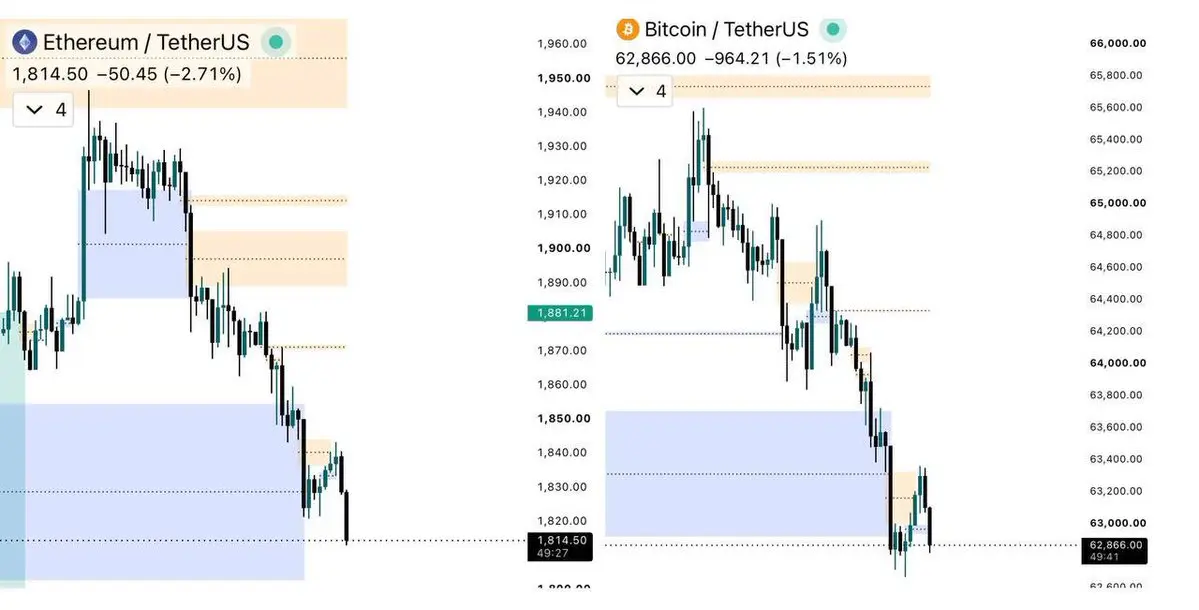
Bitcoin is currently around $63,974, slightly negative on a daily basis, and the consolidation in the $63,000-$64,000 range is indeed an accurate assessment. Last week, following the second wave of US strikes targeting approximately ninety Iranian targets, the price fell to $61,688, with the VIX index rising 4.77% to 16.90. Ethereum is around $1,805; technically, the risk of a pullback remains unless a sustained breakout above $1,850 occurs. ETH is currently seeing consecutive positive ETF inflows for the fifth day, with Fidelity's FETH alone attracting the majority of these inflows.
The ETF
BTC-2.46%
ETH-2.45%
UBS-0.19%
HSBC-0.92%
User_any
Bitcoin is currently around $63,974, slightly negative on a daily basis, and the consolidation in the $63,000-$64,000 range is indeed an accurate assessment. Last week, following the second wave of US strikes targeting approximately ninety Iranian targets, the price fell to $61,688, with the VIX index rising 4.77% to 16.90. Ethereum is around $1,805; technically, the risk of a pullback remains unless a sustained breakout above $1,850 occurs. ETH is currently seeing consecutive positive ETF inflows for the fifth day, with Fidelity's FETH alone attracting the majority of these inflows.
The ETF data chart also aligns with the actual figures, with US-based spot Bitcoin ETFs recording net inflows of approximately $197.4 million for the week ending July 11th. This is the first weekly positive result since mid-May, indicating a return of institutional buyers after a long period of outflow pressure. However, the strength of this inflow remains weak compared to outflows in previous weeks, so it's too early to say whether it has truly created a cushion to support the price.
The current technical picture also supports this assessment regarding support and resistance levels. Below, the $61,000-$61,376 band is a critical threshold as it coincides with the 61.8% Fibonacci retracement level, while $60,000 stands out as a key psychological support. Above, the $65,500 and $70,000 levels may come into play after a break above the $63,455 region, where the 50-day moving average is located.
On the oil side, the truly critical date is July 17th, the date when the US Treasury Department's temporary license for Iranian oil expires. Brent is currently experiencing uncertainty in the $70-$100 range. According to UBS's scenario, the faster Hormuz traffic normalizes, the lower the price may remain. HSBC's more pessimistic scenario suggests that if flows remain restricted for months, the price could even reach the $110-$120 range. The US June CPI data on July 14th is also critical in this equation, as it will show the state of inflationary pressure before the oil shock.
For those following Bitcoin and Ethereum through Gate, the key point to watch is that the current calm is actually due to the simultaneous expectation of three separate uncertainties: the June CPI data, the July 17th oil license expiration date, and the actual traffic situation in the Strait of Hormuz. Until these three things become clearer, it wouldn't be surprising if both Bitcoin and Ethereum continue to be stuck in their current narrow range; the increased volatility risk you mentioned towards evening also stems from the combination of these three uncertainties.
⚠️ Not financial advice.
  • Reward
  • Comment
  • 1
  • Share
$LTC
LTC is charting its own course
While the overall picture remains in a fear zone, LTC is currently up 1.18% around $45.12, stabilizing in a narrow range. The market is hesitant, but LTC is managing to hold its ground.
The key difference here is the divergence between sentiment and technical analysis. While the Fear and Greed Index hovers around 32, the RSI for LTC is at 62.2, shifting from neutral to strong. The MACD histogram is near the zero line, short-term momentum is neutral, meaning there's an upward trend but no overheating. Funding is also calm.
On-chain analysis supports this sta
LTC-2.92%
M谋ngYueZen
$LTC
LTC is charting its own course
While the overall picture remains in a fear zone, LTC is currently up 1.18% around $45.12, stabilizing in a narrow range. The market is hesitant, but LTC is managing to hold its ground.
The key difference here is the divergence between sentiment and technical analysis. While the Fear and Greed Index hovers around 32, the RSI for LTC is at 62.2, shifting from neutral to strong. The MACD histogram is near the zero line, short-term momentum is neutral, meaning there's an upward trend but no overheating. Funding is also calm.
On-chain analysis supports this stance. The Adjusted Economic Value indicator has doubled since the beginning of the year. This indicates increased economic activity on the network and suggests a slight but solid foundation for the medium to long term.
The technical framework is also stable. MA7 at 45.09 and MA30 at 44.80 are aligned upwards, while MA120 at 44.24 and MA200 at 44.42 provide support from below. The price is holding above averages; the structure remains intact.
In short, while fear prevails in the market as a whole, LTC presents a strong and balanced picture internally. The upward trend is maintained in the short term, but there is no excessive enthusiasm yet.
Do you think LTC can maintain this positive divergence while general fear persists, or will it adapt to the market trend and return to a narrow range?
This post is not investment advice; it is for informational purposes only.
  • Reward
  • Comment
  • 1
  • Share
$OG
While OG remains stuck in a narrow range, risk is accumulating on the funding side.
OG is currently trading around $2,572, with a small pullback of around 0.23% in the last 24 hours. The price has been fluctuating in a narrow range for a long time, without a clear breakout.
Technically, the RSI is at 46.24, in a region that has shifted from neutral to weak. The ADX is at 12.57, indicating a lack of a clear trend in the market. The price is holding near the lower Bollinger band, suggesting that buyers remain weak in the short term.
The main point of concern is the funding rate. The 0.31% l
OG-0.72%
SinCity
$OG
While OG remains stuck in a narrow range, risk is accumulating on the funding side.
OG is currently trading around $2,572, with a small pullback of around 0.23% in the last 24 hours. The price has been fluctuating in a narrow range for a long time, without a clear breakout.
Technically, the RSI is at 46.24, in a region that has shifted from neutral to weak. The ADX is at 12.57, indicating a lack of a clear trend in the market. The price is holding near the lower Bollinger band, suggesting that buyers remain weak in the short term.
The main point of concern is the funding rate. The 0.31% level is well above normal. This indicates that the cost of holding long positions has become excessively high, and there is a significant accumulation on the long side. If the market weakens further, this high rate could trigger mass long liquidations and increase downward pressure.
The general sentiment is cautious. The Fear and Greed Index is at 31, indicating a fear zone.
In summary, OG is trying to stabilize in a narrow band, but due to high funding, upward attempts have become quite costly. The risk of liquidation in a potential downturn should not be ignored.
Do you think long positions will continue to be held despite such high funding, or will we see a clearing first before finding direction?
This post is not investment advice; it is for informational purposes only.
  • Reward
  • Comment
  • Repost
  • Share
$HYPE This all checks out well, and the fundamentals are genuinely strong. HYPE's cumulative protocol revenue crossed $1 billion on June 30, with roughly 97-99 percent of fees routing straight into open-market buybacks, over 41 million tokens worth more than $1 billion already burned. The Bitwise 10 Crypto Index inclusion is confirmed too, dated July 9, giving HYPE roughly a 0.95 percent weight and replacing Polkadot in that fund, alongside three dedicated spot HYPE ETFs now running with combined inflows north of $170 million.
I'd lean toward the consolidation-first scenario rather than an im
HYPE-5.45%
DOT-0.88%
Yuewen
$HYPE This all checks out well, and the fundamentals are genuinely strong. HYPE's cumulative protocol revenue crossed $1 billion on June 30, with roughly 97-99 percent of fees routing straight into open-market buybacks, over 41 million tokens worth more than $1 billion already burned. The Bitwise 10 Crypto Index inclusion is confirmed too, dated July 9, giving HYPE roughly a 0.95 percent weight and replacing Polkadot in that fund, alongside three dedicated spot HYPE ETFs now running with combined inflows north of $170 million.
I'd lean toward the consolidation-first scenario rather than an immediate retest of $75. Here's why: HYPE has been forming what several chart services describe as a cup-and-handle structure since the June 16 all-time high near $76.70, dipped to the low $50s in late June, and has spent the past couple weeks pressing against a contracting triangle just under $72-76 rather than breaking it cleanly. Multiple technical writeups treat a daily close above roughly $76-77 as the actual confirmation trigger for fresh price discovery, not just touching the level intraday. Below that, the 0.236 Fibonacci retracement near $63.66 has already acted as support once, and each pullback since the June correction has been shallower than the last, which does support your read that structure remains constructive.
The complication working against an immediate breakout is supply. A 9.92 million token unlock landed July 6, worth roughly $630-645 million, and while the buyback fund is large enough to have absorbed similar tranches before, roughly 1.2 million HYPE per month continues flowing to insiders on an ongoing basis. That's a real headwind the buyback has to keep outrunning, and it's part of why forecasts on this token span such an enormous range, from the high $30s on the cautious end to $150+ on Arthur Hayes' bull case, depending almost entirely on whether buyback demand keeps outpacing unlock supply.
Given that, I'd frame the more likely near-term path as a period of consolidation testing the $60-67 zone first, rather than a straight run at $75, simply because the token hasn't yet produced the clean breakout and retest pattern that would typically confirm a move into new highs. That said, the calm funding rate and long-leaning ratio you flagged suggest there's no immediate overheating that would force a sharp reversal either, so a grind higher through consolidation seems more probable than a hard breakdown below 60 as long as the buyback and ETF inflow trends hold.
⚠️ Not financial advice.
  • Reward
  • Comment
  • 1
  • Share
The CLARITY Act is moving with serious momentum. Senator Kevin Cramer has signaled the bill could advance before the August 7 recess , and CFTC Chairman Michael Selig has publicly labeled it "must-pass legislation" to keep the US competitive . There is also a real possibility the Senate could begin procedural votes as soon as July 13 .
The political landscape is still complicated, though. While the crypto community is buzzing with optimism , some analysts think the path is narrowing . Prediction market odds have been fluctuating around the 50% mark , reflecting this uncertainty. The main roadb
SinCity
The CLARITY Act is moving with serious momentum. Senator Kevin Cramer has signaled the bill could advance before the August 7 recess , and CFTC Chairman Michael Selig has publicly labeled it "must-pass legislation" to keep the US competitive . There is also a real possibility the Senate could begin procedural votes as soon as July 13 .
The political landscape is still complicated, though. While the crypto community is buzzing with optimism , some analysts think the path is narrowing . Prediction market odds have been fluctuating around the 50% mark , reflecting this uncertainty. The main roadblocks are ethics concerns, ongoing debates over stablecoin yields and developer protections, and the sheer weight of the Senate calendar .
For context, the CLARITY Act passed the House in 2025 and cleared the Senate Banking Committee in May 2026 . It aims to create a comprehensive regulatory framework for digital assets. The bill would formally divide regulatory authority between the CFTC and the SEC, while exempting many digital commodities from traditional securities laws . It also explicitly protects the right to self-custody crypto assets .
Adding to the pressure is the upcoming August recess. If the bill doesn't clear the Senate before then, its path becomes far more difficult . The political picture is complicated further by President Trump's significant crypto income, which has made passing "ethics language" a major condition for some Democrats . This has created a delicate negotiation that could still fall apart.
  • Reward
  • Comment
  • 1
  • Share
#StakeUSD1Earn8.88%APR
Why Are More Investors Choosing Stable Returns? USD1's 8.88% APR Is Turning Heads
While headlines are often dominated by Bitcoin rallies and AI-driven tech stocks, a quieter trend is gaining momentum among experienced investors: earning consistent returns without taking on excessive market volatility. That trend is becoming increasingly visible as the USD1 Stake & Earn program now offers up to 8.88% APR, attracting users who want to make idle digital assets work more efficiently.
The timing couldn't be more relevant. Global markets remain sensitive to interest rate expe
STABLE1.32%
USD10.02%
BTC-2.46%
Yuewen
#StakeUSD1Earn8.88%APR
Why Are More Investors Choosing Stable Returns? USD1's 8.88% APR Is Turning Heads
While headlines are often dominated by Bitcoin rallies and AI-driven tech stocks, a quieter trend is gaining momentum among experienced investors: earning consistent returns without taking on excessive market volatility. That trend is becoming increasingly visible as the USD1 Stake & Earn program now offers up to 8.88% APR, attracting users who want to make idle digital assets work more efficiently.
The timing couldn't be more relevant. Global markets remain sensitive to interest rate expectations, geopolitical developments, and shifting investor sentiment. In this environment, many traders are balancing high-growth opportunities with more defensive strategies. Rather than keeping stable assets inactive, they are allocating part of their portfolios to yield-generating products that provide predictable returns while preserving liquidity.
This approach is not unique to crypto. In traditional finance, investors routinely use money market funds, Treasury bills, and high-yield savings products to generate income while waiting for new opportunities. The digital asset market is following a similar evolution. Stablecoins are no longer just a bridge between trades—they have become an important component of modern portfolio management, supporting payments, treasury operations, decentralized finance, and capital allocation.
The latest 8.88% APR offering reflects this broader shift. Instead of relying solely on price appreciation, investors are increasingly seeking ways to combine stability with passive income. This strategy can be particularly valuable during periods of heightened market uncertainty, when preserving capital is just as important as pursuing growth.
Why Does This Matter?
Professional investors understand that capital efficiency is one of the keys to long-term success. Every dollar that sits idle represents an opportunity cost. By putting stable assets to work, investors can generate additional returns while maintaining the flexibility to react quickly when market conditions change.
A simple example illustrates the difference. Imagine two investors each holding the same amount of stable assets. One leaves the funds untouched, while the other participates in a yield program. Over time, the second investor steadily increases portfolio value without relying on market rallies alone. This disciplined approach has become increasingly popular among both retail participants and institutions.
Looking Ahead
As blockchain-based financial services continue to expand, stablecoin yield products are expected to play an even larger role in the digital economy. Growing institutional adoption, increasing demand for on-chain liquidity, and continuous innovation in digital finance are transforming stable assets from simple trading tools into productive financial instruments.
The USD1 Stake & Earn program with up to 8.88% APR reflects this evolution. It highlights how the crypto industry is moving beyond speculation toward a more complete financial ecosystem one where investors can pursue growth, preserve liquidity, and earn consistent returns at the same time.
In today's market, successful investing is no longer just about finding the next asset that doubles in price. It is about building a smarter portfolio where every asset has a purpose and where even stable capital can contribute to long-term wealth creation.
  • Reward
  • Comment
  • Repost
  • Share
A special shopping opportunity has been launched in Paris this summer for Gate Card holders, a privileged package valid at the Printemps department store, a concrete example of converting crypto assets into real-world spending.
The package consists of three main benefits. First, it offers up to 16% tax rebate on eligible purchases, maximizing an existing benefit for foreign visitors shopping in Europe. Second, a 5% welcome discount is applied, providing a direct cost advantage on first purchases. Third, VIP shopping privileges, typically including elements such as personalized consulting servi
V1.81%
Sand谋3S
A special shopping opportunity has been launched in Paris this summer for Gate Card holders, a privileged package valid at the Printemps department store, a concrete example of converting crypto assets into real-world spending.
The package consists of three main benefits. First, it offers up to 16% tax rebate on eligible purchases, maximizing an existing benefit for foreign visitors shopping in Europe. Second, a 5% welcome discount is applied, providing a direct cost advantage on first purchases. Third, VIP shopping privileges, typically including elements such as personalized consulting services, priority access, or additional in-store services.
The main message behind this campaign is the wide reach of the Gate Card for everyday spending. The card is accepted at over 150 million Visa merchants in more than 200 countries and regions, meaning users holding crypto assets can spend them in the real world without any complicated conversion process.
The main practical benefit of such card-based spending products is that crypto assets function not only as an investment vehicle but also as a directly usable payment method in daily life. Offering such a privilege package in a major shopping destination like Paris creates practical value for both travelers and local shoppers.
For Gate Card holders planning to visit Paris this summer, the real practical step is to check the full terms and conditions, validity dates, and required documents for the tax refund and discount campaign on the relevant announcement page before shopping at Printemps, as these tax refund processes usually require specific minimum spending amounts and transaction steps.
https://www.gate.com/card?channel=8¤cy=USD
  • Reward
  • Comment
  • Repost
  • Share
So Empery Digital, a NASDAQ-listed company that had rebranded itself as a Bitcoin treasury play, just sold 1,400 BTC at a massive loss. They bought most of that stack at an average price of around 117,500 dollars per coin, and they sold at roughly 62,200 dollars. That is a loss of over 40 percent, which is brutal by any standard.
The sale raised about 87 million dollars, and the proceeds are going toward a 65 million dollar investment in an AI data center project, plus 10 million to pay down debt. The whole move was pushed by an activist investor named Tice P. Brown, who basically forced the c
BTC-2.46%
MARA-3.53%
User_any
So Empery Digital, a NASDAQ-listed company that had rebranded itself as a Bitcoin treasury play, just sold 1,400 BTC at a massive loss. They bought most of that stack at an average price of around 117,500 dollars per coin, and they sold at roughly 62,200 dollars. That is a loss of over 40 percent, which is brutal by any standard.
The sale raised about 87 million dollars, and the proceeds are going toward a 65 million dollar investment in an AI data center project, plus 10 million to pay down debt. The whole move was pushed by an activist investor named Tice P. Brown, who basically forced the company to abandon its Bitcoin strategy and return cash to shareholders.
After the sale, Empery still holds about 1,514 BTC, which is worth roughly 100 million at current prices. So they are not completely out, but they have significantly reduced their exposure.
Now here is the thing. This is not an isolated event. It fits into a broader pattern of crypto companies selling or reducing their Bitcoin holdings. Marathon Digital, the largest public miner, is updating its treasury policy to allow for selling reserves as part of a pivot into AI infrastructure. And publicly traded miners collectively sold over 32,000 BTC in the first quarter of 2026, which was a single-quarter record, driven by a severe profit squeeze.
What makes the Empery case particularly striking is that it is a forced, loss-making sale driven by strategic pivot and investor pressure, not a routine liquidation by a miner. It shows that even with "diamond hands," there are limits to corporate Bitcoin holding when capital needs and shareholder demands change. This is the kind of story that reinforces the bearish narrative in the short term, but it also suggests that the weak hands are being flushed out, which is usually how bottoms are formed.
repost-content-media
  • Reward
  • Comment
  • 1
  • Share
HK regulator mandates phishing-resistant login requirements for crypto platforms and online brokers within 12 months. Could raise compliance costs and push platforms toward stronger authentication, supporting security-focused narratives in crypto. $BTC ? $ETH ?
BTC-2.46%
ETH-2.45%
Bykaranteli
HK regulator mandates phishing-resistant login requirements for crypto platforms and online brokers within 12 months. Could raise compliance costs and push platforms toward stronger authentication, supporting security-focused narratives in crypto. $BTC ? $ETH ?
repost-content-media
  • Reward
  • 2
  • Repost
  • Share
ThisIsTranslateContent::
Steadfastly HODL💎
View More
So Gate is running a GT promotion that is actually pretty straightforward. The whole thing is built around two parallel tracks, holding and trading, with a total prize pool of 2,500 GT up for grabs.
The first part is the simplest. During the event, every 10 GT increase in your net holdings gets you 0.1 GT as an airdrop. The cap per person is 5 GT, and the total pool for this is 500 GT. The catch is that it is distributed on a first come basis based on who increases their holdings the most, so if you are planning to add to your position, doing it early gives you a better shot.
The second part i
GT-1.33%
GUSD-0.01%
User_any
So Gate is running a GT promotion that is actually pretty straightforward. The whole thing is built around two parallel tracks, holding and trading, with a total prize pool of 2,500 GT up for grabs.
The first part is the simplest. During the event, every 10 GT increase in your net holdings gets you 0.1 GT as an airdrop. The cap per person is 5 GT, and the total pool for this is 500 GT. The catch is that it is distributed on a first come basis based on who increases their holdings the most, so if you are planning to add to your position, doing it early gives you a better shot.
The second part is where things get interesting. You can earn GT holding bonuses by completing trading tasks, and these bonuses stack. The tasks are tiered based on trading volume. For futures, hitting 30,000 USDT gets you a 5 percent bonus, 300,000 gets you 10 percent, and 3 million gets you 15 percent. For CFD, the thresholds are 50,000, 500,000, and 5 million USDT for the same 5, 10, and 15 percent bonuses. The key is that you can combine both futures and CFD bonuses, so if you trade enough in both, you could be looking at a 30 percent boost to your effective GT holdings.
At the end of the event, they take a snapshot of your GT holdings and apply all your earned bonuses to calculate your weighted share of the 2,000 GT pool. The more GT you hold and the more bonuses you stack, the bigger your slice.
There is some context here that makes this interesting. GT just completed its Q2 2026 on-chain burn, with over 2.57 million GT destroyed, worth about 17.75 million dollars . Since 2019, nearly 190 million GT have been burned, reducing the total supply by over 63 percent from the initial 300 million . That is a significant deflationary mechanism, and it is tied to the real usage of Gate Chain as the gas token for applications like Gate Perp DEX and Gate Swap .
Also, if you are looking for yield, Gate's GUSD product is offering a 3.8 percent base yield, and when combined with Launchpool staking, the total annualized return can reach 6.38 percent . For new users, there is even a limited promotion that can push that yield up to 100 percent or more .
A few things to keep in mind. You need to click that Participate Now button to register and complete identity verification before the event ends. The rewards are all in GT and will be distributed within 14 working days after the event. Also, sub-accounts and institutional accounts are not eligible, so make sure you are using your main account.
If you are already trading futures or CFD, this is basically free bonus GT on top of your normal activity. Just make sure to register and consider front-loading your GT accumulation to secure a spot in the airdrop pool.
https://www.gate.com/campaigns/5436?ref=BVVEVQ9c&ref_type=132
https://www.gate.com/announcements/article/100564
DYOR 🔍
$GT
repost-content-media
  • Reward
  • 3
  • 1
  • Share
ThisIsTranslateContent::
DYOR 🤓
View More
#ClarityCountdown
📢 Gate Square Daily | July 9
WHY THE CLARITY ACT HAS BECOME THE MOST IMPORTANT REGULATORY DEADLINE IN THE DIGITAL ASSET MARKET
Sometimes a single legislative deadline can shape the mood of an entire market. That is exactly what is happening with the Clarity Act, after the chairman of the U.S. CFTC publicly urged Congress to pass the bill before lawmakers leave for recess on August 7. The statement immediately turned regulatory policy into one of the most closely watched topics across the digital asset industry.
For years, one of the biggest challenges facing digital assets
Venüs_
#ClarityCountdown
📢 Gate Square Daily | July 9
WHY THE CLARITY ACT HAS BECOME THE MOST IMPORTANT REGULATORY DEADLINE IN THE DIGITAL ASSET MARKET
Sometimes a single legislative deadline can shape the mood of an entire market. That is exactly what is happening with the Clarity Act, after the chairman of the U.S. CFTC publicly urged Congress to pass the bill before lawmakers leave for recess on August 7. The statement immediately turned regulatory policy into one of the most closely watched topics across the digital asset industry.
For years, one of the biggest challenges facing digital assets in the United States has been uncertainty over which assets fall under which regulatory framework. Investors, exchanges, developers and institutions have often operated without a fully consistent rulebook. The Clarity Act is designed to address that problem by providing a clearer framework for how digital assets are classified and supervised.
Professional investors understand why this matters. Markets generally reward certainty. When the rules become clearer, institutions can allocate capital with greater confidence, businesses can plan long-term strategies more effectively and infrastructure providers can expand without constantly worrying about unexpected policy shifts.
The timing is especially important because institutional participation in digital assets has already been growing rapidly. Large asset managers and corporate investors are increasingly interested in blockchain technology, but many remain cautious when regulatory expectations are unclear. A clearer legal framework could accelerate participation by reducing one of the industry's largest perceived risks.
Investor psychology also plays a major role. Positive regulatory momentum often improves sentiment because it signals that policymakers are moving from debate toward implementation. Even before a law is passed, the perception that progress is being made can strengthen confidence across the market.
Experienced traders are focusing on the secondary effects. If the Clarity Act advances before the August deadline, it could improve institutional confidence, support liquidity growth and strengthen the broader narrative that digital assets are becoming a permanent part of the financial system. If progress stalls, markets may experience renewed uncertainty as investors reassess the timeline for regulatory clarity.
From a strategic perspective, regulation is no longer a side story. It has become one of the main forces shaping the future of digital finance. Technology creates opportunities, adoption creates demand, but clear rules often determine how quickly those opportunities can scale.
As the deadline approaches, investors around the world will be watching Washington closely. The next major catalyst for the digital asset market may come not from a price chart, but from a vote.
#ClarityCountdown
repost-content-media
  • Reward
  • 3
  • Repost
  • Share
ThisIsTranslateContent::
DYOR 🤓
View More
With the full implementation of MiCA, a period of true clarity has begun in the European crypto sector, and Gate Europe has embraced this transition as an early adopter.
Gate Europe secured both its MiCA (Crypto Asset Service Provider) license and its Payment Institution license in 2025, well before the official closing of the transition period. This early move stands out as a concrete demonstration of the company's commitment to regulatory compliance, operational discipline, and user protection.
Gate's founder and CEO, Dr. Han, emphasized that this transition is not just about regulatory harm
SinCity
With the full implementation of MiCA, a period of true clarity has begun in the European crypto sector, and Gate Europe has embraced this transition as an early adopter.
Gate Europe secured both its MiCA (Crypto Asset Service Provider) license and its Payment Institution license in 2025, well before the official closing of the transition period. This early move stands out as a concrete demonstration of the company's commitment to regulatory compliance, operational discipline, and user protection.
Gate's founder and CEO, Dr. Han, emphasized that this transition is not just about regulatory harmonization, but also about creating a real foundation for fair competition in the sector. According to him, such a framework allows platforms to compete by offering users better products and services, meaning that genuine product quality is at the heart of competition, rather than exploiting regulatory loopholes.
@Dr. Han Han also stated that unilateral compliance is not enough for this system to work, and that everyone must be subject to the same rules for MiCA to truly create a fair competitive environment. In its own words, if unregulated platforms can still offer services from overseas, this doesn't mean there's a level playing field. This actually points to a real problem recently experienced in the European market: platforms with MiCA licenses are subject to strict capital, custody, and transparency rules, while unlicensed overseas platforms gain an unfair advantage by being exempt from these costs.
This concern is not unfounded, as the MiCA transition process has led to significant consolidation in the sector; while there were thousands of registered providers before, the number of those who could obtain full authorization has been far more limited. Even some large global platforms have faced hurdles in the licensing application processes in certain European countries. In this environment, being licensed early and fully becomes more than just ticking a compliance box; it becomes a real advantage that strengthens user trust and market position.
Gate continues to strengthen its compliance framework during this process, while remaining focused on providing secure, transparent, and innovative digital asset services to users worldwide. For users following the European market via Gate, the crucial point is that whether regulatory clarity will truly create a fair competitive environment will depend on how effectively supervisory authorities can take action against unlicensed offshore providers, and this is poised to be MiCA's most critical test of implementation in the coming period.
  • Reward
  • 1
  • 2
  • Share
ThisIsTranslateContent::
Get on board quickly! 🚗
#StrategySells3588BTC
Strategy, for the first time in its corporate history, conducted a truly significant bitcoin sale, a development that is both symbolically and strategically important for the market.
Between June 29 and July 5, the company sold a total of 3,588 bitcoins in two separate transactions, generating approximately $216 million in return. In the first transaction, 1,363 BTC were sold between June 29-30 at an average price of $59,256, while in the second transaction, 2,225 BTC were sold between July 1-5 at an average price of $60,773. This sale reduced the company's total bitcoin
BTC-2.46%
STRC-0.33%
MSTR-2.45%
Yuewen
#StrategySells3588BTC
Strategy, for the first time in its corporate history, conducted a truly significant bitcoin sale, a development that is both symbolically and strategically important for the market.
Between June 29 and July 5, the company sold a total of 3,588 bitcoins in two separate transactions, generating approximately $216 million in return. In the first transaction, 1,363 BTC were sold between June 29-30 at an average price of $59,256, while in the second transaction, 2,225 BTC were sold between July 1-5 at an average price of $60,773. This sale reduced the company's total bitcoin holdings to 843,775 BTC, while increasing its dollar reserves to $2.55 billion.
The significance of this sale stems not so much from its size, but from several factors. Founder Michael Saylor has publicly stated for years that he would buy bitcoin "at any price" and never sell it. Last week, the company announced its Digital Credit Capital Framework, under which it can now fund preferred stock dividends and interest payments by selling bitcoin under certain conditions. This sale was the first actual application of that framework. The proceeds were used to cover the second-quarter dividends of STRF, STRE, STRK, and STRD preferred stocks, as well as STRC's June dividend payment.
The market reaction was mixed. Following the news of the sale, MSTR shares fell by approximately 2% in pre-trading, and bitcoin also lost over 2% of its value that day, falling below the $62,000 level. However, this needs to be considered in the context of the overall picture from last week, when MSTR shares rose by over 21% in total following the Digital Credit Capital Framework announcement. Nevertheless, the stock is still trading with a significant loss of 73.7% over the last twelve months.
There is no clear consensus among analysts on what this new framework means. Some argue that this means the company can now be both a buyer and a seller, directly transforming Bitcoin's volatility into stock market volatility. Another interpretation suggests the opposite: this strong cash position, built through small, controlled sales, reduces the risk of a much larger, sudden sell-off in the future, potentially boosting market confidence for both the company and the Bitcoin price in the long run. The company still holds the world's largest institutional Bitcoin holdings with 843,775 BTC, significantly larger than its closest competitor.
For those following MSTR and Bitcoin treasury companies through Gate, the crucial question is whether this sale is a one-off liquidity need or the first sign that Saylor has permanently abandoned his long-standing "never sell" stance. How frequently the company repeats such sales in subsequent quarters will determine whether this new framework is priced by the market as a genuine risk management tool or a sign of structural weakness.
  • Reward
  • 3
  • Repost
  • Share
ThisIsTranslateContent::
DYOR 🤓
View More
Gate has launched a special live event campaign to share the excitement of the World Cup final with its users, the final taking place on July 19th and set to be the biggest night of the tournament.
Participation is limited to the first 300 people; those interested need to register early and complete the required tasks. This limited number of entries, determined by registration and task completion, offers a chance to win a World Cup Final Viewing Party Kit, which includes crayfish and beer – a classic match-watching feast.
The event is not only a chance to win a prize, but also combines the exp
Z谋谋nxcrypto
Gate has launched a special live event campaign to share the excitement of the World Cup final with its users, the final taking place on July 19th and set to be the biggest night of the tournament.
Participation is limited to the first 300 people; those interested need to register early and complete the required tasks. This limited number of entries, determined by registration and task completion, offers a chance to win a World Cup Final Viewing Party Kit, which includes crayfish and beer – a classic match-watching feast.
The event is not only a chance to win a prize, but also combines the experience of watching the live stream and exploring the Prediction Market. Participants can both follow the match live and actively participate in the prediction market before and during the final. Winners will receive the viewing party kit as well as official Gate merchandise.
There is also a $5,000 Position Coupon prize pool, which will be distributed among participants. These types of coupons are usually a bonus added to your trading account and usable on specific trades, meaning participants get both an enjoyable viewing experience and a tangible trading advantage.
In these limited-capacity events, acting early is crucial, as registrations close once the initial 300-person limit is reached. For those wishing to participate in this event via Gate, the practical step is to go to the campaign page, register immediately, and complete the specified tasks without delay, as both the viewing party kit and coupon rewards will be shared among a limited number of participants. The final night promises to be the biggest moment of the tournament, where the champion will be crowned and this special event will take place.
https://www.gate.com/campaigns/5418
  • Reward
  • 3
  • Repost
  • Share
ThisIsTranslateContent::
DYOR 🤓
View More
Trade $TTWO , $KSTR , $BSP , $CAT , $WEN and $BAC!
Gate has launched the seventh phase of its New Token Airdrop campaign to introduce newly listed stock-linked futures contracts, with a total prize pool of 50,000 USDT.
The assets available for trading under the campaign include tokenized stock contracts based on well-known names such as Take-Two Interactive, KraneShares SSE STAR Market 50 Index Fund, Bending Spoons, Caterpillar, Wendy's, and Bank of America. Take-Two, in particular, has been prominent in recent weeks due to increased investor interest in the upcoming November release of GTA 6, whi
TTWO2.07%
KSTR-4.53%
BSP-0.77%
CAT-2.19%
WEN-1.16%
Z谋谋nxcrypto
Trade $TTWO , $KSTR , $BSP , $CAT , $WEN and $BAC!
Gate has launched the seventh phase of its New Token Airdrop campaign to introduce newly listed stock-linked futures contracts, with a total prize pool of 50,000 USDT.
The assets available for trading under the campaign include tokenized stock contracts based on well-known names such as Take-Two Interactive, KraneShares SSE STAR Market 50 Index Fund, Bending Spoons, Caterpillar, Wendy's, and Bank of America. Take-Two, in particular, has been prominent in recent weeks due to increased investor interest in the upcoming November release of GTA 6, which has boosted demand for this type of futures contract.
The reward structure consists of three tiers. First, users who execute their first futures trade in any of these contracts instantly earn 5 USDT. Second, users can accumulate up to 35 USDT in additional rewards through a daily trade check-in mechanism, encouraging regular and recurring participation. The third is a trading pool open to all users, where participants can receive up to 200 USDT per person, the size of which is likely distributed proportionally to trading volume.
The logic behind this three-tiered reward structure is as follows: the first step reward encourages new users to try these specific contracts, the daily check-in reward rewards regular participation, and the general pool opens an additional earning opportunity for users who trade in larger volumes. This way, both users who trade less and those who actively participate can receive rewards commensurate with their scale.
There are some general points to consider before participating in such campaigns: registration is usually required through the campaign page, market makers and institutional accounts are generally excluded from these campaigns, and multiple accounts linked to the same verified identity are considered as a single account. It is recommended to review the relevant announcement page for the campaign duration and full participation conditions.
The third tier is a trading pool open to all users, where participants can receive up to 200 USDT per person, with the size of the pool likely distributed proportionally to trading volume. For users who want to try out these new tokenized share contracts via Gate, the practical step is to secure 5 USDT instantly by making the first transaction, then benefit from accumulating rewards by establishing a daily check-in habit, and for those planning to trade regularly, benefiting from the share in the general pool constitutes a logical strategy.
https://www.gate.com/campaigns/5413?ref=BVVEVQ9c&ref_type=132
  • Reward
  • 2
  • Repost
  • Share
ThisIsTranslateContent::
Firmly HODL💎
View More
#VitalikUnveilsLeanEthereum
The Bold Vision That Could Define Ethereum's Next Decade
Every successful technology eventually reaches a point where adding more features is no longer the priority—making the system simpler, faster, and more efficient becomes the real challenge. That is the philosophy behind Vitalik Buterin's "Lean Ethereum" vision, a proposal that is attracting widespread attention across the blockchain industry.
Rather than focusing solely on expanding Ethereum's capabilities, Vitalik is advocating for a leaner and more streamlined protocol. The objective is clear: reduce un
ETH-2.45%
Venüs_
#VitalikUnveilsLeanEthereum
The Bold Vision That Could Define Ethereum's Next Decade
Every successful technology eventually reaches a point where adding more features is no longer the priority—making the system simpler, faster, and more efficient becomes the real challenge. That is the philosophy behind Vitalik Buterin's "Lean Ethereum" vision, a proposal that is attracting widespread attention across the blockchain industry.
Rather than focusing solely on expanding Ethereum's capabilities, Vitalik is advocating for a leaner and more streamlined protocol. The objective is clear: reduce unnecessary complexity, improve efficiency, strengthen security, and make Ethereum easier to maintain as millions of users and developers continue building on the network.
Think of it this way: the world's fastest sports cars are not successful because they have the most parts—they succeed because every component has a purpose. Ethereum is entering a similar stage of development. As decentralized finance, stablecoins, tokenized assets, and Web3 applications continue to grow, the blockchain must become more efficient without compromising its core principles of decentralization and security.
This philosophy is especially important because Ethereum powers one of the largest blockchain ecosystems in the world. Billions of dollars move across the network every day through lending protocols, decentralized exchanges, tokenized real-world assets, and digital payment systems. A simpler protocol could reduce technical risks, improve developer productivity, and support more sustainable long-term growth.
For investors, the proposal highlights a broader reality: blockchain innovation is no longer measured only by speed or transaction capacity. The next phase of competition will be driven by reliability, scalability, and the ability to support global adoption without sacrificing stability.
Vitalik's latest vision is not about changing Ethereum's identity—it's about preparing the network for the next generation of digital finance. If successful, Lean Ethereum could become one of the most important architectural shifts in the blockchain industry's evolution, ensuring that the world's leading smart contract platform remains ready for the demands of tomorrow's digital economy.
repost-content-media
  • Reward
  • 3
  • Repost
  • Share
ThisIsTranslateContent::
DYOR 🤓
View More
  • Pinned