


# ContentMining

73.25K
#比特币Breaks79K
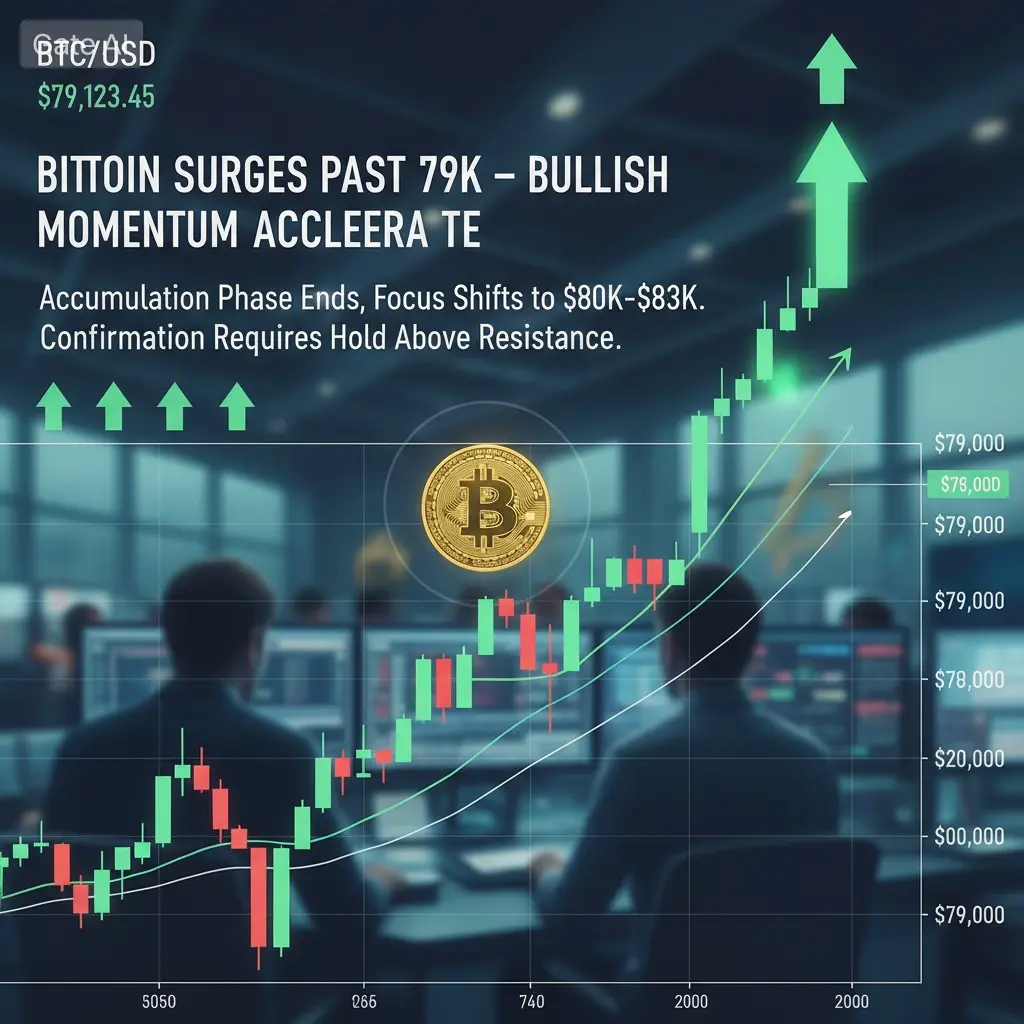
Bitcoin Breaks 79K — Current Market Update & Next Possible Move Toward $74K
Bitcoin is currently trading in a critical zone after pushing above the $79,000 area, but the market is now showing clear signs of hesitation. Price is moving around the $77K–$79K range, where strong resistance is repeatedly rejecting upward momentum. This behavior suggests that the market is no longer in a strong impulsive phase and is instead entering a decision zone where direction will soon be defined.
The recent price action shows that although buyers managed to push BTC higher, the strength of each
BTC-1,69%
post-image
post-image
  • Reward
  • 15
  • Repost
  • Share
discovery:
To The Moon 🌕
View More
#WCTCTradingKingPK
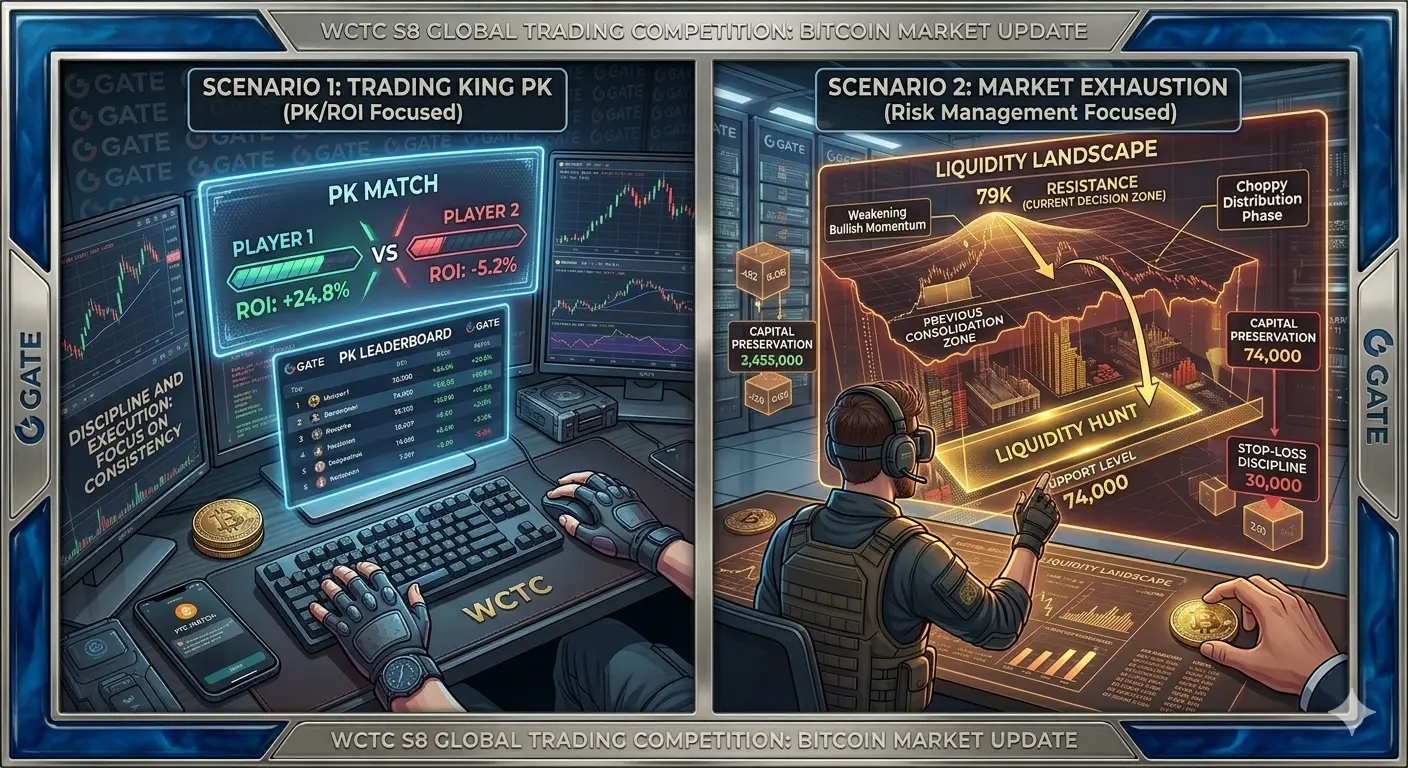
The WCTC S8 Trading King PK inside Gate’s global trading competition has become one of the most exciting battlegrounds for serious crypto traders. Organized as part of Gate’s 13th Anniversary celebration, this event is far more than a standard trading tournament—it is a direct test of precision, consistency, and psychological strength in live market conditions.
Unlike traditional competitions that often favor traders with massive capital or high-volume execution, Trading King PK introduces a much fairer and more skill-focused structure: 1v1 head-to-head battles based entire
post-image
post-image
  • Reward
  • 2
  • Repost
  • Share
Lock_433:
LFG 🔥
View More
#比特币Breaks79K
Bitcoin has now decisively moved above the $79,000 threshold, a level that carried both psychological weight and technical significance within the recent market structure. This breakout is not simply a numerical milestone—it represents a meaningful shift in short-term market control, where buyers have demonstrated the ability to overcome a well-defined resistance ceiling that had contained price action for an extended period.
For several weeks, the market remained compressed within a narrow band, with repeated rejections near the $78,000–$79,000 region and consistent demand emer
BTC-1,69%
post-image
[The user has shared his/her trading data. Go to the App to view more.]
  • Reward
  • Comment
  • Repost
  • Share
#比特币Breaks79K
Bitcoin has officially broken above the $79,000 level, marking one of the most important short-term psychological and technical shifts in the current market structure. After several weeks of tight consolidation between resistance near $78,000–$79,000 and support around $75,000–$76,500, the market has finally pushed upward with renewed momentum. This breakout reflects a clear change in short-term sentiment, where buyers have successfully absorbed selling pressure at key resistance levels and forced price discovery into a higher range.
This move above $79K is significant because i
BTC-1,69%
MrFlower_XingChen
#比特币Breaks79K
Bitcoin has officially broken above the $79,000 level, marking one of the most important short-term psychological and technical shifts in the current market structure. After several weeks of tight consolidation between resistance near $78,000–$79,000 and support around $75,000–$76,500, the market has finally pushed upward with renewed momentum. This breakout reflects a clear change in short-term sentiment, where buyers have successfully absorbed selling pressure at key resistance levels and forced price discovery into a higher range.
This move above $79K is significant because it confirms that the market was not in distribution, but rather in accumulation within a compressed volatility structure. For a long time, Bitcoin traded in a narrow band, repeatedly testing resistance without a strong rejection breakdown. Instead of collapsing, price continued forming higher lows, which often signals underlying demand. Once liquidity at the top of the range weakened, the breakout became more likely, and that is exactly what has now occurred.
A major driver behind this move is the combination of institutional demand and derivative market positioning. ETF inflows have continued to provide steady buy pressure, absorbing available supply in the market. At the same time, leveraged short positions near the resistance zone became vulnerable, triggering forced liquidations as price moved upward. This short squeeze effect amplified momentum, allowing Bitcoin to accelerate through the $79,000 level faster than typical spot-driven moves.
Another important factor is macro sentiment stabilization. Compared to earlier volatility phases driven by geopolitical uncertainty and oil market shocks, risk appetite has slightly improved. While uncertainty still exists in global markets, the immediate pressure has reduced enough to allow crypto assets to recover momentum. Bitcoin, being the most liquid digital asset, is often the first to respond when liquidity conditions improve even marginally.
From a structural perspective, Bitcoin is now approaching a critical decision zone. The breakout above $79K opens the path toward the next major resistance area between $80,000 and $83,000. This zone is extremely important because it represents both psychological resistance and historical supply levels where previous selling pressure has emerged. A clean and sustained break above this range would signal stronger bullish continuation and potentially open the door toward higher valuation zones.
However, despite this breakout, the market is still not in a fully confirmed uptrend. Bitcoin remains inside a broader macro consolidation structure that has defined price behavior for several months. This means volatility can still produce sharp reversals if momentum weakens or if external macro conditions shift unexpectedly. Breakouts in such environments often require confirmation through sustained daily closes above resistance rather than short-lived spikes.
On the downside, key support remains firmly around the $74,000–$75,000 range. This area has acted as a strong demand zone where buyers previously stepped in aggressively. If the market fails to maintain momentum above $79K–$80K, a retest of this support zone would not be surprising. The strength of this support will determine whether the breakout develops into a new trend or remains a temporary expansion within a range.
Market behavior during this phase is also heavily influenced by liquidity dynamics. Thin order books near resistance levels allow for faster price movement once momentum builds, while leverage in derivatives markets can exaggerate both upward and downward swings. This is why even small shifts in sentiment or positioning can lead to large price reactions in relatively short periods of time.
Overall, Bitcoin breaking above $79K is a clear signal of renewed bullish pressure, but it is not yet a final confirmation of a long-term trend reversal or expansion. The market is now in a transition phase where momentum is shifting upward, but confirmation still depends on whether price can hold above resistance zones and build stability at higher levels.
The next few sessions are critical. If Bitcoin can establish strong support above $79,000 and continue pushing toward the $80,000–$83,000 region, the probability of a broader bullish continuation increases significantly. If not, the market may return to consolidation, testing lower liquidity zones once again before making its next major move.
#GateSquare
#ContentMining
#CreaterCarnival
$BTC

repost-content-media
  • Reward
  • Comment
  • Repost
  • Share
#rsETHAttackUpdate
DeFi Infrastructure Breakdown, Systemic Risk & Recovery Response Analysis (April 2026)
The rsETH exploit in April 2026 represents one of the most significant stress events in decentralized finance to date. What initially appeared to be a targeted attack on a single protocol quickly expanded into a broader liquidity and trust shock across the entire DeFi ecosystem, exposing weaknesses not in smart contracts alone, but in the underlying infrastructure that supports cross-chain finance.
At the center of the incident was Kelp DAO, which suffered losses of approximately $292 mil
MrFlower_XingChen
#rsETHAttackUpdate
DeFi Infrastructure Breakdown, Systemic Risk & Recovery Response Analysis (April 2026)
The rsETH exploit in April 2026 represents one of the most significant stress events in decentralized finance to date. What initially appeared to be a targeted attack on a single protocol quickly expanded into a broader liquidity and trust shock across the entire DeFi ecosystem, exposing weaknesses not in smart contracts alone, but in the underlying infrastructure that supports cross-chain finance.
At the center of the incident was Kelp DAO, which suffered losses of approximately $292 million. This made it the largest DeFi exploit of 2026 so far. The attackers extracted around 116,500 rsETH, representing a significant portion of circulating supply, immediately destabilizing confidence in liquid restaking assets and triggering widespread concern across lending and bridging systems.
ROOT CAUSE: INFRASTRUCTURE WEAKNESS, NOT SMART CONTRACT FAILURE
Unlike traditional DeFi exploits that rely on code vulnerabilities, this attack targeted the infrastructure layer, specifically cross-chain messaging powered by LayerZero V2.
The most critical weakness was the 1-of-1 verifier design. This meant a single validator was responsible for confirming cross-chain transactions, creating a central point of failure inside a system designed to be decentralized.
The attackers exploited this structure by compromising RPC nodes and manipulating data feeds rather than directly breaking smart contracts. This shift is important because it highlights a new category of risk in DeFi: infrastructure-level manipulation.
ATTACK EXECUTION FLOW
The attack was executed in a highly coordinated sequence. It began at Ethereum block 24,908,285 and targeted the bridge between Unichain and Ethereum.
Attackers first compromised two RPC nodes and replaced legitimate infrastructure with malicious versions. Simultaneously, denial-of-service actions disabled clean nodes, forcing the system to rely on corrupted data sources.
This allowed a forged cross-chain message to pass validation, resulting in the unauthorized minting of 116,500 rsETH. These tokens were then transferred directly to attacker-controlled wallets, while logs were erased and malware self-deleted to reduce traceability.
This was not a simple exploit—it was a full infrastructure-level manipulation of trust assumptions.
LIQUIDITY EXTRACTION PHASE
After generating unbacked rsETH, attackers quickly moved to extract real value from DeFi markets. Approximately 89,567 rsETH was deposited into lending protocols, including Aave V3 across Ethereum and Arbitrum.
From these positions, attackers borrowed roughly 82,650 WETH along with additional wstETH exposure, accumulating a total borrowed value of around $236 million.
These positions were structured with extremely tight health factors near 1.01 to 1.03, making them resistant to immediate liquidation and prolonging systemic stress across lending markets.
MARKET IMPACT AND LIQUIDITY CRISIS
Although Aave itself was not directly hacked, it became the primary liquidity shock absorber for the entire system.
Multiple WETH pools reached near 100% utilization, forcing protocols to adjust borrow rates and freeze rsETH collateral across multiple deployments. Loan-to-value ratios were reduced to zero in affected markets, effectively halting further risk exposure.
This triggered a broader liquidity contraction across DeFi, with total value locked dropping by an estimated $5 billion to $10 billion. Withdrawal activity surged rapidly, resembling bank-run behavior across multiple platforms.
A significant withdrawal event of approximately $154 million further intensified panic sentiment and liquidity pressure.
PRICE IMPACT ACROSS MAJOR ASSETS
Ethereum experienced a moderate decline of roughly 2% to 3.7%, trading around the $2,300 to $2,380 range. The movement was primarily sentiment-driven rather than a reflection of protocol-level failure.
Bitcoin remained comparatively stable near $78,980, acting as a relative risk-off asset within the crypto ecosystem during the shock phase.
AAVE, however, experienced a sharp decline of 16% to 20%, reflecting direct exposure to lending market stress and perceived systemic vulnerability.
SYSTEMIC RISK AND BAD DEBT SCENARIOS
Analysts modeled multiple outcomes based on exposure levels and liquidity fragmentation.
In a distributed loss scenario, estimated bad debt reached approximately $123.7 million, implying potential rsETH depegging of around 15%. In a more severe isolated Layer 2 scenario, losses could reach $230 million, with significant shortfalls across Arbitrum, Base, and Mantle ecosystems.
Aave’s direct exposure was estimated between $177 million and $200 million, highlighting how interconnected lending systems amplify localized shocks into broader systemic risk.
EMERGENCY RESPONSE AND RECOVERY ACTIONS
Kelp DAO responded quickly by activating an emergency pause within 46 minutes of the attack. This action prevented an additional estimated $95 million to $100 million in losses by halting minting and bridging operations.
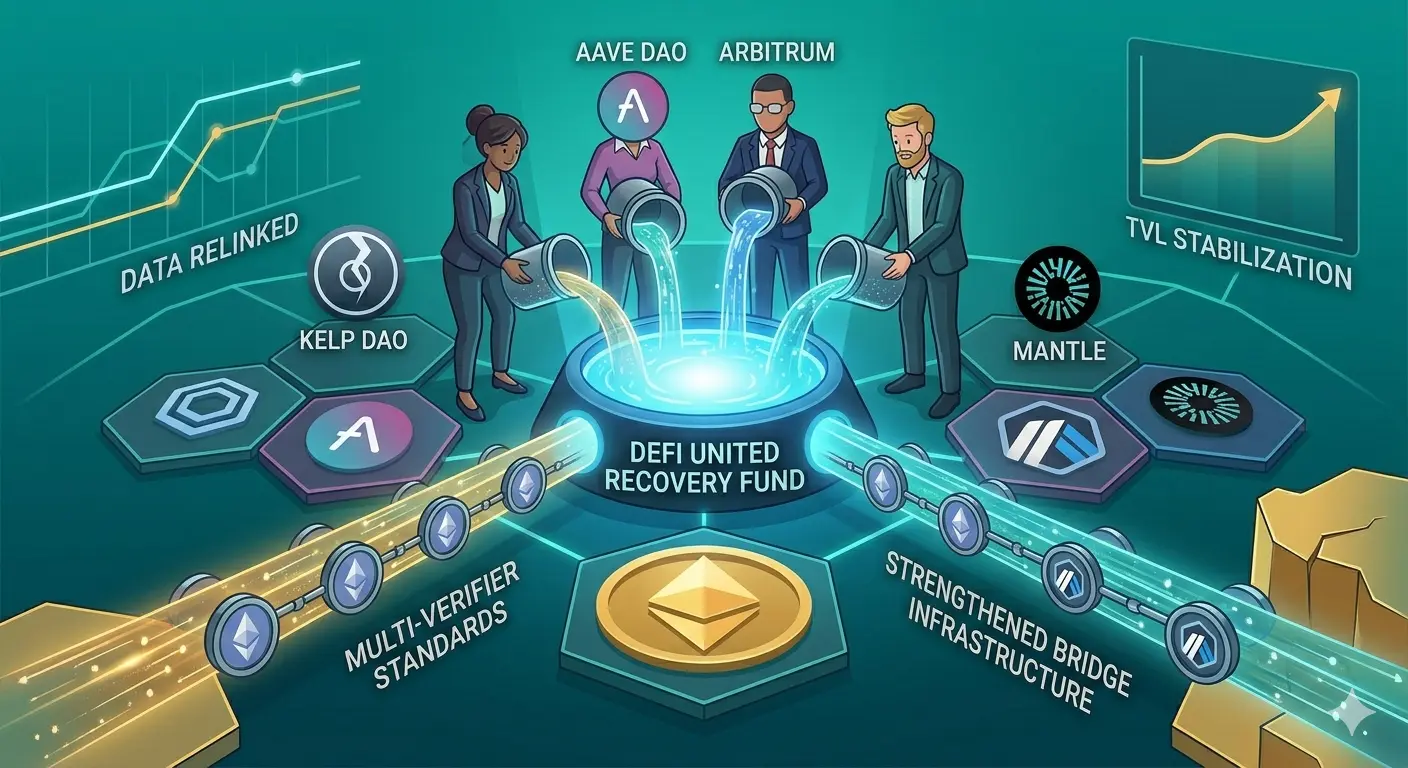
A coordinated industry response followed under what was referred to as “DeFi United,” involving multiple ecosystems working together to stabilize liquidity conditions. Contributions included ETH recovery efforts from Arbitrum, credit proposals from Mantle, and support considerations from Aave DAO, along with participation from major DeFi entities such as Lido and EtherFi.
Total pledged recovery support exceeded 43,500 ETH, valued at over $100 million.
SECURITY ATTRIBUTION AND THREAT EVOLUTION
Investigations attributed the attack with high confidence to the Lazarus Group, reinforcing a growing trend of nation-state actors targeting decentralized financial infrastructure.
This marks a shift in threat behavior from smart contract exploitation to infrastructure-level compromise, particularly RPC nodes, cross-chain bridges, and off-chain validation systems.
KEY STRUCTURAL LESSONS FOR DEFI
The rsETH incident exposed several critical vulnerabilities in the current DeFi architecture.
First, decentralization must extend beyond smart contracts into validation and infrastructure layers. A single verifier system creates systemic risk even in otherwise distributed ecosystems.
Second, RPC node security is now a primary attack surface. Manipulation of data feeds can bypass smart contract integrity entirely.
Third, cross-chain systems dramatically expand attack surfaces. As interoperability increases, so does complexity and risk exposure.
Finally, liquidity layers remain fragile. Even well-established protocols like Aave can experience severe stress under cascading liquidation conditions.
MARKET PSYCHOLOGY AND SYSTEM BEHAVIOR
The market reaction followed a structured psychological cycle.
It began with shock and immediate panic withdrawals, followed by liquidity crunch conditions across lending platforms. This was eventually followed by stabilization efforts through governance coordination and capital injections.
Importantly, no widespread retail wallet losses were recorded. The damage was primarily at the protocol level, which helped prevent deeper systemic panic among retail participants.
CURRENT STATUS AND RECOVERY PHASE
As of late April 2026, gradual unfreezing of assets is underway, with governance votes determining final loss distribution and protocol adjustments. rsETH remains partially stabilized but continues to undergo scrutiny, while security upgrades are being implemented across bridge infrastructure.
FUTURE OUTLOOK
In the short term, Ethereum-linked assets are expected to remain volatile, with tight liquidity conditions persisting across DeFi markets. Recovery in total value locked is likely to be gradual rather than immediate.
In the mid-term, the industry is expected to adopt stricter multi-verifier bridge standards, increased infrastructure audits, and higher risk premiums for restaking assets.
In the long term, this event is likely to accelerate the evolution of DeFi toward more security-focused architecture, with stronger cross-chain validation systems and improved resilience against off-chain attacks.
FINAL CONCLUSION
The rsETH exploit was not simply a DeFi hack—it was a full-scale stress test of decentralized financial infrastructure.
Despite approximately $292 million in direct losses, over $200 million in potential bad debt exposure, and billions in liquidity movement, the system did not collapse.
Instead, it coordinated, adapted, and initiated recovery mechanisms across multiple ecosystems.
The key takeaway is clear:
DeFi is not fragile in isolation—it is fragile in structure but resilient in coordination.
#GateSquare
#ContentMining
#CreaterCarnival
repost-content-media
  • Reward
  • 2
  • Repost
  • Share
discovery:
To The Moon 🌕
View More
💰 Earn real rewards with Content Mining on Gate Square!
This week's (Apr 13 - 19) rewards have been distributed — here are the Top 5 creators: 🎉
A total of 1,351 creators received 1,129.22 USDT in rewards this week. Rewards have been credited to your accounts.
🚀 Start mining now and earn up to 60% commission.
🔗 Event Details: https://www.gate.com/announcements/article/49475
#GateSquare #ContentMining #CreateToEarn
post-image
  • Reward
  • 9
  • Repost
  • Share
CryptoChampion:
To The Moon 🌕
View More
#TopCopyTradingScout
In today’s fast-evolving financial landscape, copy trading has transformed from a simple convenience tool into a sophisticated investment strategy, particularly within the cryptocurrency market. With volatility acting as both an opportunity and a risk amplifier, traders are constantly searching for ways to stay competitive without being overwhelmed by market noise, emotional decision-making, or time constraints. Copy trading addresses this gap by allowing individuals to align their capital with experienced traders who have already developed structured
post-image
  • Reward
  • 5
  • Repost
  • Share
Dubai_Prince:
great job 👏
View More
#link #CryptoAnalysis
Chainlink (LINK)
1. Project Purpose and Technical Infrastructure
Chainlink is a decentralized oracle network created to solve the fundamental limitation of blockchains: they cannot natively access data from outside their own networks. Smart contracts on Ethereum or other chains are self contained systems. Without external data, they are limited to simple peer to peer transfers and cannot execute logic based on asset prices, weather, sports results, or payment confirmations. Chainlink bridges that gap by providing a network of independent nodes that fetch, verify, and
post-image
post-image
  • Reward
  • 26
  • Repost
  • Share
Crypto_Buzz_with_Alex:
2026 GOGOGO 👊
View More
#TopCopyTradingScout
Copy trading has become one of the most widely used entry points into crypto and forex markets, especially for beginners who want exposure without building deep technical trading skills from scratch. On the surface, it looks simple: select a trader, allocate funds, and mirror their positions automatically. But in reality, successful copy trading is far more complex and depends heavily on selection quality, risk understanding, and ongoing monitoring.
The first key truth is that copy trading does not eliminate risk—it only transfers execution. The market risk remains unchan
post-image
post-image
  • Reward
  • 13
  • Repost
  • Share
ShainingMoon:
To The Moon 🌕
View More
#IntelandTexasInstrumentsSurge
#SemiconductorToCryptoConvergence The Silent Macro Engine Behind Tech Equities, AI Expansion, and the Next Phase of Digital Capital Rotation
What the market is currently mispricing is not a company, not a sector, and not even a narrative.
It is the synchronization of three systems that were never supposed to move together this tightly:
Semiconductor production cycles
AI infrastructure expansion
Crypto liquidity formation
And the uncomfortable truth is this:
Most participants are still reading a 2017 or 2021 mental model in a 2026 structural environment.
---
Semi
Dubai_Prince
#IntelandTexasInstrumentsSurge
#SemiconductorToCryptoConvergence The Silent Macro Engine Behind Tech Equities, AI Expansion, and the Next Phase of Digital Capital Rotation
What the market is currently mispricing is not a company, not a sector, and not even a narrative.
It is the synchronization of three systems that were never supposed to move together this tightly:
Semiconductor production cycles
AI infrastructure expansion
Crypto liquidity formation
And the uncomfortable truth is this:
Most participants are still reading a 2017 or 2021 mental model in a 2026 structural environment.
---
Semiconductor Strength Is Not a Rally — It Is a Capacity Expansion Signal
The rise in names like Intel and Texas Instruments is being dangerously oversimplified as “earnings recovery” or “cyclical rebound.”
That interpretation is outdated.
What is actually happening is far more structural:
Semiconductors are not reacting to demand anymore—
they are pre-building the physical ceiling of the next decade’s digital economy.
Every percentage increase in chip production capacity translates into:
Higher AI model scalability
Faster cloud deployment cycles
Lower marginal compute costs
Expanded data infrastructure density
This is not equity movement.
This is global computational infrastructure expansion pricing itself in real time.
And when that happens, markets do not behave like sectors.
They behave like systems under reconfiguration.
---
The Hidden Mechanism: Capital Is Rotating, Not Expanding
Most retail investors assume liquidity is “flowing into everything.”
That is incorrect.
Liquidity is rotating in a strict hierarchy:
1. Physical compute (semiconductors)
2. Infrastructure intelligence (AI systems)
3. Application layer monetization (tech platforms)
4. Speculative abstraction layer (crypto assets)
This is not random allocation.
This is risk cascading through complexity layers.
Semiconductors act as the first signal of institutional confidence in future digital output.
Crypto acts as the final expression of that confidence.
---
Crypto Is No Longer an Isolated Market — It Is a Beta Layer of Tech Liquidity
The outdated belief that crypto operates independently is one of the most expensive misconceptions still circulating.
In reality:
Crypto is now behaving as a leveraged reflection of macro tech sentiment.
When semiconductor equities expand, it signals:
Higher forward earnings expectations across tech
Increased institutional risk appetite
Stronger global liquidity conditions
Confidence in long-duration innovation cycles
These exact conditions historically precede:
Altcoin expansion phases
DeFi liquidity inflows
Infrastructure token repricing
Narrative-driven speculative cycles
Crypto is not disconnected.
It is downstream liquidity sensitivity disguised as an independent asset class.
---
DePIN Is Where Physical and Digital Economies Collapse Into One Layer
Decentralized Physical Infrastructure Networks are not a narrative trend.
They are a structural redefinition of resource coordination.
For the first time, compute power, storage, and bandwidth are:
Tokenized
Distributed
Incentivized
Market-coordinated
This creates a direct feedback loop with semiconductors:
More chips → more compute availability
More compute → more decentralized coordination demand
More coordination demand → higher utility for decentralized infrastructure systems
This is where the old boundary between:
“hardware companies” and “crypto protocols” disappears completely.
---
The Market’s Real Fragility: Geopolitical Compression of Supply Chains
While narratives are bullish, structure is not stable.
Semiconductors exist inside a geopolitically concentrated bottleneck system.
That means:
Small disruptions create global ripple effects
Supply concentration amplifies volatility
Policy shifts can instantly reprice entire sectors
So the current rally is not “safe growth.”
It is controlled expansion inside a structurally fragile system.
That is why volatility will not disappear—it will intensify.
---
Crypto Platforms Are Becoming Financial Operating Systems
The exchange era is over.
What is replacing it is far more aggressive:
Crypto platforms are evolving into full-stack financial ecosystems.
They now combine:
Trading infrastructure
Yield systems
Launch ecosystems
Asset issuance layers
User incentive engines
This creates a closed-loop environment where:
users are not participants—they are internal liquidity nodes.
---
Token Utility Is Quietly Becoming Institutional Infrastructure
Most tokens are still misunderstood as “assets.”
That framing is obsolete.
Modern ecosystem tokens function as:
Access keys
Fee-layer modifiers
Governance stabilizers
Liquidity retention mechanisms
And most importantly:
They create self-reinforcing demand cycles inside platforms.
More usage → more token demand
More token demand → deeper liquidity
Deeper liquidity → stronger ecosystem resilience
This is not speculation mechanics.
This is internal economic gravity formation.
---
The Real Driver of Volatility: Behavioral Liquidity
The new market does not move purely on fundamentals.
It moves on engineered participation dynamics.
Including:
Campaign-based trading surges
Incentive-driven liquidity spikes
Narrative rotation acceleration
Gamified capital deployment
This is why cycles are now:
Faster
Sharper
Less predictable
More emotionally amplified
Markets are no longer passive systems.
They are interaction-driven liquidity environments.
---
Trust Has Become the Only Non-Replaceable Asset
In a system dominated by speed, incentives, and volatility, one factor has become structurally dominant:
Trust.
Not branding. Not marketing. Not hype.
Trust in:
Reserve transparency
Asset custody security
Operational consistency
Long-term reliability
Without trust, liquidity is temporary.
With trust, liquidity becomes structural capital retention.
---
2026 Macro Reality: Everything Is Becoming One System
The separation between:
Tech equities
AI infrastructure
Semiconductor cycles
Crypto ecosystems
Digital platforms
Is collapsing.
What is forming instead is a single interconnected capital network:
Semiconductors expand compute
Compute expands AI capability
AI attracts institutional capital
Capital flows into digital assets
Digital assets reinforce infrastructure demand
This is not correlation.
This is system convergence.
---
Final Reality Check
If you still view:
Chips as “stocks”
AI as “growth sector”
Crypto as “speculation”
You are not early.
You are using an outdated map for a new financial architecture.
The market is no longer moving in cycles.
It is moving in stacked infrastructure layers of exponential dependency.
And in that structure:
Those who understand flow will survive.
Those who misunderstand layers will get compressed.
---
#GateSquare
#ContentMining
#CreatorCarnival
repost-content-media
  • Reward
  • Comment
  • Repost
  • Share
Load More