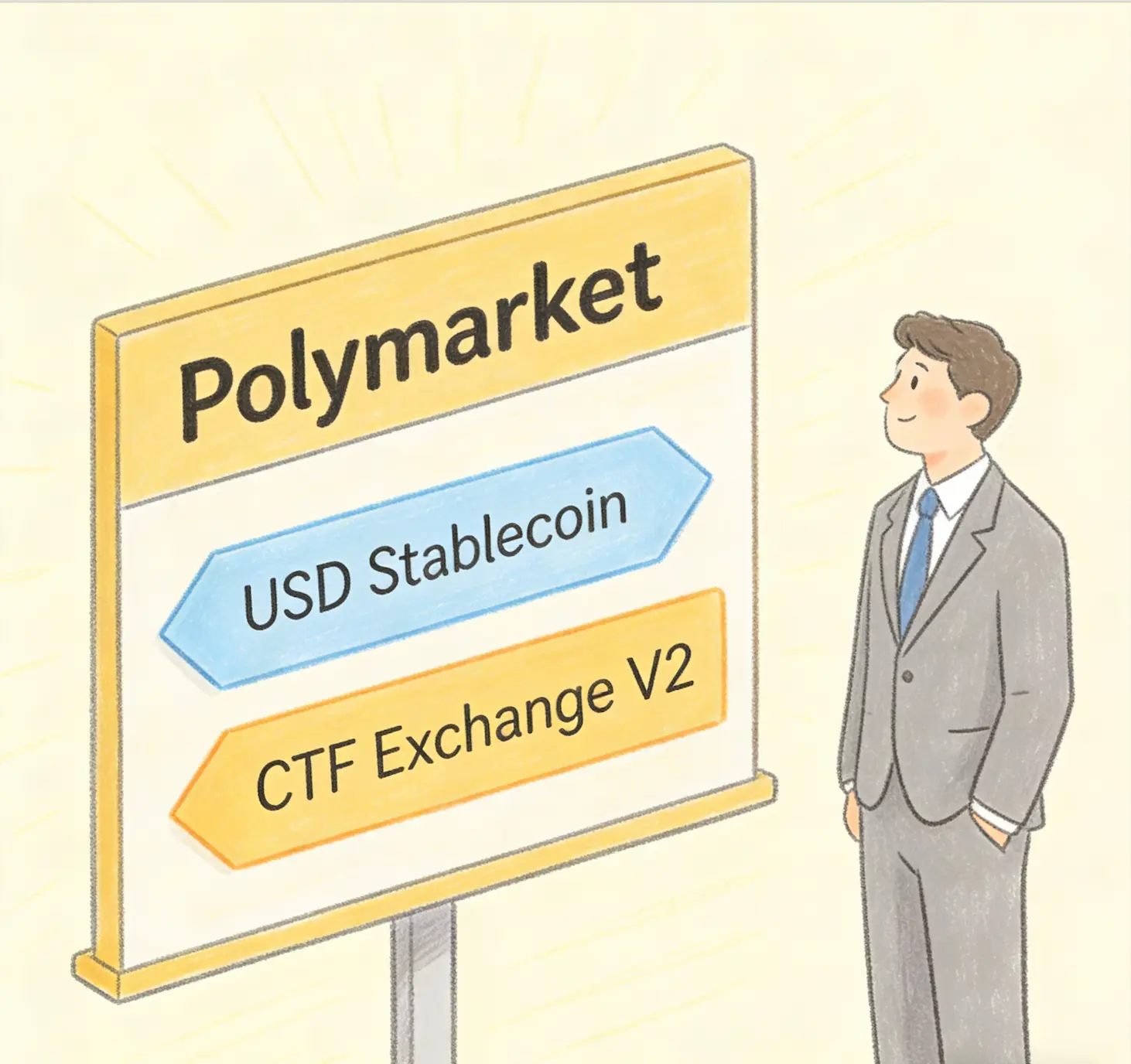
 Polymarket announced on April 6, 2026 that it will deploy a full exchange upgrade over the coming weeks, introducing a new 1:1 USDC-backed collateral token called Polymarket USD and a rebuilt trading engine under CTF Exchange V2.
The upgrade replaces the bridged USDC.e stablecoin, reduces bridge-related risk, and gives Polymarket tighter control over settlement and liquidity as the prediction market platform rebuilds its US presence following CFTC registration and a valuation above $20 billion.
Polymarket USD Replaces Bridged USDC.e as Platform Collateral
Polymarket USD is a new collateral token fully backed 1:1 by USDC, issued directly by Polymarket to replace USDC.e, the bridged version of Circle’s USDC that previously served as the platform’s primary collateral. USDC.e relies on bridge infrastructure between Ethereum and Polygon, introducing added risk and friction. By moving to its own collateralized token, Polymarket aims to eliminate dependence on bridged assets and gain direct control over settlement and liquidity.
For most users, the transition will be handled automatically through the platform’s interface, requiring only a one-time approval to wrap funds into Polymarket USD. The token is not tradable or speculative; it functions as a purpose-built stablecoin for the prediction market environment. All open orders will be canceled during a short maintenance window, with Polymarket promising at least one week of advance notice before the cutover.
CTF Exchange V2 Improves Order Matching, Gas Costs, and Wallet Compatibility
The upgrade includes CTF Exchange V2, a rebuilt trading engine that introduces a simplified and optimized order structure, faster order matching, and support for EIP-1271 signatures. EIP-1271 is an Ethereum standard that allows smart contract-based wallets such as multisigs and automated trading systems to sign transactions, expanding compatibility beyond traditional externally owned accounts.
Additional features include builder codes for onchain order attribution, improved fee collection and distribution logic, and reduced gas costs. The overhaul is designed to make trading more efficient and to make it easier for developers to connect applications and trading bots to the platform.
For API traders, bot operators, and developers, the upgrade requires updating to the latest version of the CLOB-Client SDK, available in Typescript, Python, and Go. Power users operating without the frontend will need to manually call the wrap() function on the Collateral Onramp contract to convert funds into Polymarket USD. Polymarket has opened a dedicated developer channel on Discord for early testing access.
Upgrade Follows CFTC Approval and US Expansion Plans
The infrastructure overhaul follows Polymarket’s November 2025 approval from the Commodity Futures Trading Commission (CFTC) to operate an intermediated trading platform in the United States, clearing the way for its return after previously exiting the market. The platform has since reported strong growth, with a valuation exceeding $20 billion.
Polymarket’s push to bring both trading and dispute resolution in-house aligns with its broader strategy to strengthen market integrity and align with US regulatory expectations. The platform has also taken steps to curb manipulation and insider-trading risks.
The upgrade builds on a partnership with Circle for native USDC infrastructure announced earlier in 2026, laying the groundwork for moving away from bridged assets. Community speculation about a long-rumored POLY governance token remains separate; Polymarket’s CMO confirmed in October 2025 that a POLY airdrop is planned for users contingent on completing a strong US relaunch, but today’s announcement does not address POLY, governance mechanics, or airdrop timelines.
Prediction Market Volumes Remain Strong with $25.7 Billion in March
Prediction markets recorded their second-highest notional volume over a two-year period in March 2026, with Dune Analytics data showing approximately $25.7 billion in volume across seven tracked platforms. Polymarket and Kalshi dominated the field, with Kalshi at $13 billion and Polymarket at $10 billion. Polymarket accounted for 115 million transactions in March, while Kalshi registered 88 million.
Total open interest across prediction markets stood at approximately $939.86 million as of April 6, with Kalshi leading at $487.21 million and Polymarket at $422.09 million. The two platforms represent the vast majority of positioning, with smaller platforms such as Predict.fun ($19.51 million) and Opinion ($10.38 million) trailing significantly.
Despite headwinds including controversy over markets tied to the US-Iran conflict, opposition from Democratic lawmakers, and state-level regulations conflicting with federal CFTC guidance, prediction markets have continued to see rising notional volumes and open interest.
FAQ
What is Polymarket USD and how does it differ from USDC.e?
Polymarket USD is a new collateral token backed 1:1 by USDC and issued directly by Polymarket. It replaces USDC.e, a bridged version of USDC that relied on bridge infrastructure between Ethereum and Polygon. The new token gives Polymarket direct control over settlement and reduces bridge-related risk and friction.
What changes does CTF Exchange V2 bring to Polymarket?
CTF Exchange V2 introduces a simplified order structure, faster order matching, support for EIP-1271 signatures (allowing smart contract wallets to transact), builder codes for onchain order attribution, improved fee collection, and reduced gas costs. API traders and bot operators must update to the latest SDK version.
Is the POLY governance token included in this upgrade?
No. The upgrade focuses on collateral infrastructure (Polymarket USD) and trading engine improvements (CTF Exchange V2). Polymarket’s CMO confirmed in October 2025 that a POLY airdrop is planned for users contingent on a full US relaunch, but today’s announcement does not address POLY, governance, or airdrop timelines. The two developments are separate.
Disclaimer: The information on this page may come from third parties and does not represent the views or opinions of Gate. The content displayed on this page is for reference only and does not constitute any financial, investment, or legal advice. Gate does not guarantee the accuracy or completeness of the information and shall not be liable for any losses arising from the use of this information. Virtual asset investments carry high risks and are subject to significant price volatility. You may lose all of your invested principal. Please fully understand the relevant risks and make prudent decisions based on your own financial situation and risk tolerance. For details, please refer to
Disclaimer.


