
Grayscale Research Director Zach Pandl issued a statement on April 7 saying that progress in quantum computing may advance through “discrete jumps” rather than linear progression; there is fundamental uncertainty in the timing window for technical breakthroughs. Public blockchains should immediately accelerate the deployment of post-quantum cryptography instead of waiting to act until a clear threat appears. At present, Solana and the XRP Ledger have already taken the lead in conducting experimental deployments of post-quantum cryptographic technology.
Core Warning from Google Quantum Research: The “Finish Line” Is Close at Hand
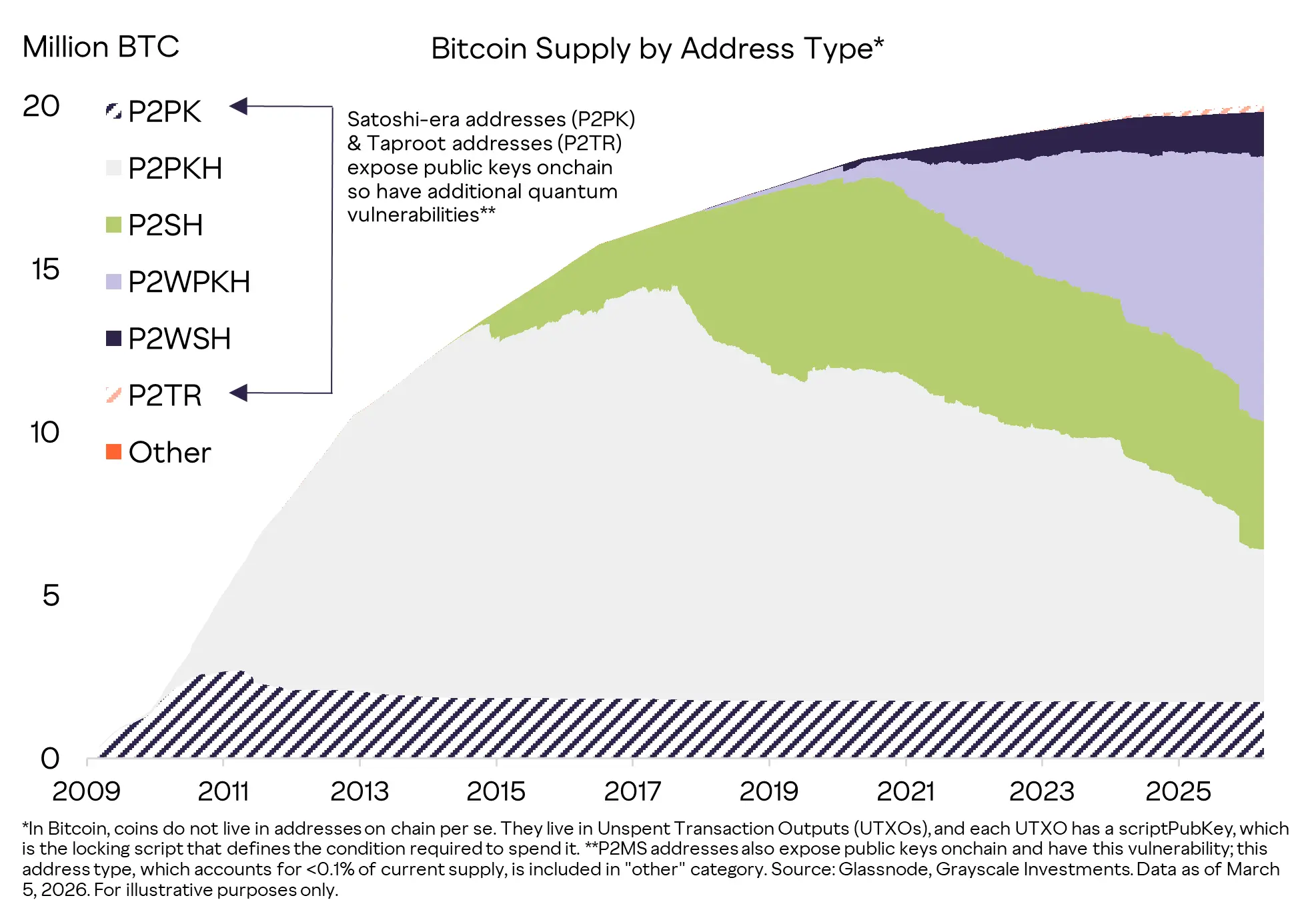 (Source: Grayscale)
Google Quantum AI’s white paper reveals the time sensitivity of post-quantum encryption issues. The paper points out that the breakthrough path for quantum computing is not a predictable linear evolution, but may occur in the form of “discrete jumps,” meaning there is a systemic risk in waiting for clear signals before taking action.
The paper also provides specific milestone references: if quantum computers reach 1,200 to 1,450 logical qubits, they would pose a substantial threat to existing cryptographic systems—though this goal has not yet been achieved, the speed of technological progress has already exceeded some expectations.
At the same time, the Google paper also conveys an optimistic message: post-quantum cryptography is a “mature field of cryptography,” whose tools have been “proposed, reviewed, implemented, and deployed.” They are currently used to protect network traffic and some blockchain transactions, and the direction for technical solutions is relatively clear.
Chain-by-Chain Differentiated Risk: Solana and XRP Ledger Lead the Way in Experiments
Grayscale’s statement outlines architectural differences among different blockchains in terms of quantum risk exposure, and notes that the level of exposure to quantum threats is not consistent. Solana and the XRP Ledger have been the first to begin experimental deployment of post-quantum cryptographic technology, making them early explorers in public blockchains’ response to the quantum era.
Key Architectural Factors That Affect the Level of Quantum Risk
Ledger model: The UTXO model (e.g., Bitcoin) has relatively lower quantum risk exposure than the account model (e.g., Ethereum)
Consensus mechanism: Proof of Work (PoW) has relatively higher quantum resistance than Proof of Stake (PoS)
Smart contracts: Chains that support native smart contracts face a broader attack surface
Configuration process: Some privacy tools have specific quantum risk exposure
Block production time: The shorter the block interval, the narrower the usable window for quantum attacks relatively
Bitcoin’s Special Situation: Lower Technical Risk, Higher Social Consensus Challenges
Grayscale notes that, from a pure engineering perspective, Bitcoin’s quantum risk is relatively low among major crypto assets: its UTXO model combined with a PoW consensus mechanism, no native smart contracts, and certain types of addresses inherently have some quantum resistance provided they are not reused.
However, Bitcoin’s core challenge is not technical, but governance. The community must reach consensus on how to handle Bitcoin when private keys are lost or cannot be accessed. Possible options include destruction, inaction, or limiting transaction speed for addresses that are more susceptible to attacks. Historically, the Bitcoin community has faced major controversy regarding protocol changes, and the difficulty of achieving broad consensus is far greater than the complexity of purely technical implementation.
Grayscale further points out that, unlike traditional institutions such as banks, technology companies, and governments, public blockchains have no Chief Technology Officer (CTO) to drive cryptographic upgrades from the top down. Post-quantum readiness work must rely on global community consensus governance to be completed—this is both a unique challenge faced by decentralized systems and will become a testing ground for verifying the resilience of decentralized technology.
Frequently Asked Questions
Why does the Shor algorithm pose a threat to existing blockchains?
The Shor algorithm (Shor’s Algorithm) was developed in 1994 by MIT mathematician Peter Shor. It can rapidly factor large integers on a quantum computer, fundamentally breaking the public-key cryptography systems that existing blockchains and the internet rely on. There is currently no quantum computer capable of running the Shor algorithm at large scale, but Google’s research shows that the breakthrough timing window contains uncertainty.
Does Grayscale’s position mean investors need to take action immediately?
Grayscale has clearly stated that, at present, quantum computers do not pose a material security threat to public blockchains, so investors do not need to panic immediately. The core recommendation is for the blockchain community to accelerate preparation for post-quantum cryptography, rather than waiting to respond after a threat becomes real. This approach also helps demonstrate the long-term adaptive resilience of decentralized technology.
What specific progress has been made in the post-quantum experiments of Solana and XRP Ledger?
According to information cited in the Google white paper, Solana and the XRP Ledger have been conducting experimental deployments of post-quantum cryptography, but specific technical details and full progress have not yet been fully disclosed. Post-quantum cryptography tools have been used to protect existing network traffic and some blockchain transactions, and relevant standards are still continuously evolving.
Disclaimer: The information on this page may come from third parties and does not represent the views or opinions of Gate. The content displayed on this page is for reference only and does not constitute any financial, investment, or legal advice. Gate does not guarantee the accuracy or completeness of the information and shall not be liable for any losses arising from the use of this information. Virtual asset investments carry high risks and are subject to significant price volatility. You may lose all of your invested principal. Please fully understand the relevant risks and make prudent decisions based on your own financial situation and risk tolerance. For details, please refer to
Disclaimer.


