As the cryptocurrency market continues to develop, meme coins have gradually moved beyond joke tokens driven purely by community culture and become an important segment of the crypto asset market.
Since Dogecoin sparked the meme coin boom, these tokens have attracted significant user interest and capital thanks to strong community consensus, social media-driven exposure, and a low barrier to entry. Although most meme coins still lack practical use cases, some projects have started building ecosystems to give their tokens more real utility, pushing meme coins from a “community narrative” toward an “ecosystem narrative.” Shiba Inu (SHIB) emerged against this market backdrop.
What Is Shiba Inu (SHIB)?
Shiba Inu (SHIB) is a decentralized meme coin project built on Ethereum. It was launched in 2020 by an anonymous developer known as Ryoshi. SHIB quickly became popular due to its “Dogecoin Killer” positioning and strong community culture, making it one of the leading representatives of the meme coin sector.

Unlike many meme coins that rely only on market sentiment, Shiba Inu is gradually building a broader blockchain ecosystem through products such as the Layer2 network Shibarium, the decentralized exchange ShibaSwap, and the governance token BONE. Today, SHIB is not only a major asset in the meme coin market, but also an important case study for understanding how community-driven crypto projects can evolve.
The Origin and Development of Shiba Inu
Shiba Inu launched in August 2020. Its founder, Ryoshi, positioned the project as a decentralized community experiment with the goal of creating a meme coin ecosystem driven entirely by its community.
In its early stage, SHIB quickly attracted market attention under the “Dogecoin Killer” label and built a large user base through social media exposure. Later, the SHIB team sent a portion of the token supply to Ethereum founder Vitalik Buterin. A large amount of those tokens was then burned, further strengthening market expectations around SHIB’s scarcity.
As its user base expanded, Shiba Inu began growing beyond a single meme token into a broader ecosystem project, launching products such as ShibaSwap, BONE, LEASH, and Shibarium. These developments gradually increased the ecosystem’s value.
What Is SHIB’s Tokenomics Model?
SHIB has a tokenomics model built around an extremely large supply and an ongoing burn mechanism. Its initial total supply was 1 quadrillion tokens. This massive supply lowered the entry price per token, making it easier for retail investors to participate.
To reduce circulating supply and strengthen expectations of deflation, the Shiba Inu ecosystem introduced token burn mechanisms, including transaction fee burns and voluntary community burns. As the number of burned tokens increases, the market often forms stronger expectations around SHIB’s scarcity.
In addition, SHIB serves as a value transfer asset within the ecosystem, while BONE is mainly used for governance and gas payments. LEASH functions as a scarce incentive asset. Together, this multi-token structure supports the operation of the Shiba Inu ecosystem.
What Are the Main Components of the Shiba Inu Ecosystem?
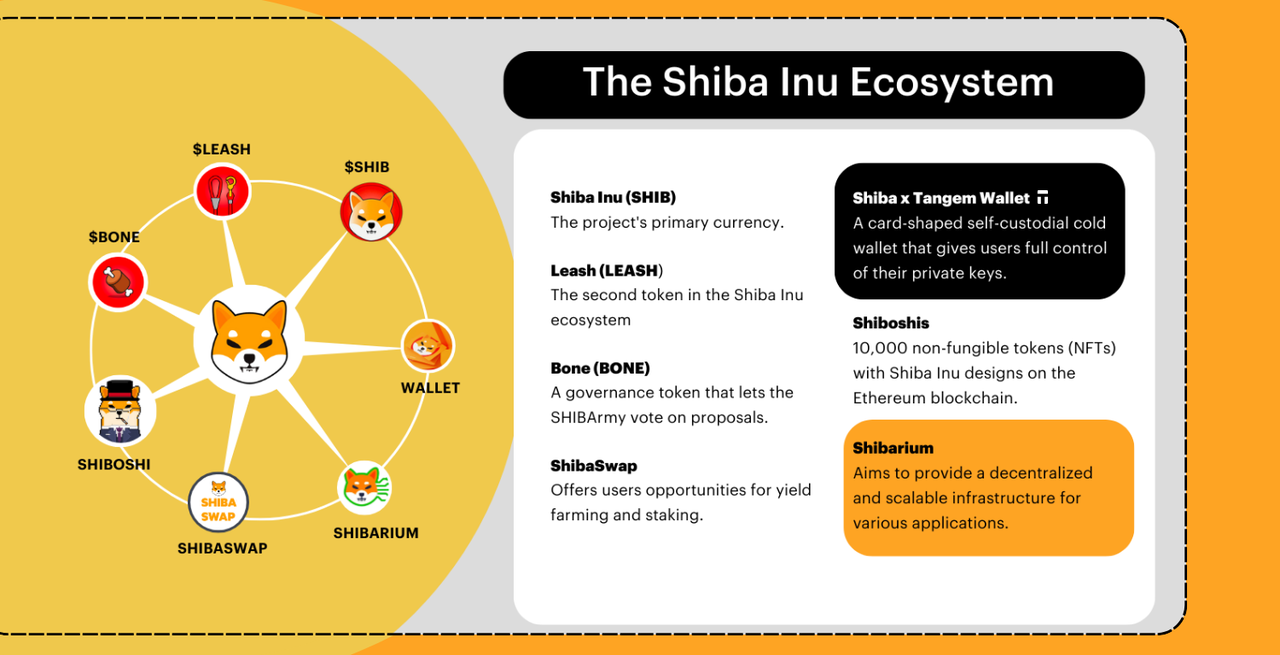
The Shiba Inu ecosystem has grown from a single token into a complete system made up of multiple products and tokens.
SHIB
SHIB is the core token of the ecosystem. It is mainly used for value transfer, payments, and community incentives, making it the foundational asset of the entire ecosystem.
BONE
BONE is the governance token and also serves as the gas token on the Shibarium network. It is used to pay transaction fees and participate in community governance.
LEASH
LEASH is a scarce asset within the ecosystem. With a limited supply, it is mainly used for premium benefits and community rewards.
ShibaSwap
ShibaSwap is the decentralized exchange launched by Shiba Inu. Users can swap tokens, provide liquidity, and stake assets on the platform.
Shibarium
Shibarium is the Layer2 network launched by Shiba Inu. It is designed to reduce transaction costs, improve processing efficiency, and create more on-chain use cases for SHIB.
How Does Shibarium Increase SHIB’s Ecosystem Value?
Shibarium is a key piece of infrastructure in the Shiba Inu ecosystem. Through Layer2 scaling technology, it reduces transaction costs for users and improves network efficiency.
On the Ethereum mainnet, high transaction fees limit high-frequency use cases for meme coins. Shibarium improves the user experience with lower gas costs and supports more DeFi, payment, and on-chain applications.
More importantly, transaction activity on Shibarium contributes to SHIB burns, linking network usage with the token’s deflationary mechanism. This shifts SHIB’s value logic from relying purely on market sentiment toward a model where ecosystem usage helps drive value growth.
What Are the Main Uses of SHIB?
As the ecosystem develops, SHIB’s use cases have expanded beyond simple trading.
First, SHIB can be used for crypto payments and community rewards. Second, in DeFi environments such as ShibaSwap, users can earn returns through staking and liquidity mining. SHIB can also function as an ecosystem asset in NFT and gaming-related applications.
These use cases increase SHIB’s practical utility, helping it move beyond a purely meme-based identity and strengthening its long-term ecosystem support.
What Factors Affect SHIB’s Price?
SHIB’s price movements are mainly influenced by community interest, burn mechanisms, ecosystem development, and overall market conditions.
Community enthusiasm is an important driver of SHIB price increases. Social media discussion and user growth often lead to higher short-term demand. The burn mechanism, meanwhile, strengthens deflationary expectations by reducing circulating supply.
In addition, the development of ecosystem products such as Shibarium and ShibaSwap affects how the market evaluates SHIB’s long-term value. Broader crypto market trends, especially Bitcoin’s price movement, can also have a significant impact on SHIB’s price.
Shiba Inu vs Dogecoin: Meme Coin Comparison and Key Differences
Shiba Inu (SHIB) and Dogecoin (DOGE) are both representative projects in the meme coin sector, but they differ significantly in technical structure, ecosystem development, and value logic. Dogecoin was created earlier and became a pioneer in the meme coin market through strong brand recognition and payment utility, while Shiba Inu has tried to build long-term growth potential through a broader ecosystem strategy.
| Comparison Dimension |
Shiba Inu (SHIB) |
Dogecoin (DOGE) |
| Network Foundation |
Built on Ethereum |
Independent public blockchain |
| Ecosystem |
Shibarium, ShibaSwap, BONE |
Mainly used for payments |
| Supply Mechanism |
Massive supply + burns |
Unlimited issuance |
| Core Value |
Ecosystem expansion |
Payment utility |
| Growth Logic |
Driven by ecosystem adoption |
Driven by community consensus |
Overall, Dogecoin has a stronger first-mover advantage and broader brand recognition in the meme coin market, while Shiba Inu is exploring a richer path of value support through ecosystem development. The two projects represent two different directions in the meme coin market: “payment-oriented assets” and “ecosystem-oriented assets.”
What Are SHIB’s Advantages and Risks?
SHIB’s main advantages lie in its strong community base and expanding ecosystem. As a well-known meme coin, SHIB has high brand recognition and an active user base, providing a solid foundation for ecosystem expansion.
However, SHIB also carries significant risks. First, its price depends heavily on market sentiment, making it far more volatile than mainstream assets. Second, although the ecosystem is expanding, SHIB’s long-term value still depends on real adoption of Shibarium and other applications.
For this reason, SHIB is more suitable for investors with higher risk tolerance who are optimistic about the development of meme coin ecosystems.
What Is SHIB’s Future Development Potential?
SHIB’s future potential mainly depends on whether ecosystem application growth and community activity can continue.
If Shibarium can attract more users and developers while continuing to drive SHIB burns, SHIB may gradually build stronger value support. At the same time, expansion in payments, DeFi, and NFT applications would increase real demand for SHIB.
However, competition in the meme coin market remains intense, and SHIB still faces challenges from other community-driven projects. Therefore, SHIB’s future value depends not only on market attention, but also on whether its ecosystem development can truly be implemented.
FAQs
Is SHIB a Meme Coin?
Yes. SHIB began as a meme coin, but it has now gradually expanded into an ecosystem that includes Layer2 infrastructure, a DEX, and governance mechanisms. It is no longer just a meme token that depends solely on community hype.
What Is the Difference Between SHIB and Dogecoin?
Dogecoin mainly exists as a payment-oriented meme coin, while SHIB has built an ecosystem that includes Shibarium and ShibaSwap, giving it broader applications in DeFi and governance.
Does SHIB Have Long-Term Investment Value?
Whether SHIB has long-term investment value depends on the pace of its ecosystem development, user adoption, and the effectiveness of its token burn mechanism. If the ecosystem continues to expand, SHIB’s long-term value support may become stronger.
What Are the Risks of SHIB?
SHIB’s main risks include sharp price volatility, high dependence on market sentiment, and uncertainty around ecosystem development. Investors should fully assess these risks before participating.