Over the past decade, the crypto industry’s core narrative has centered on “assets.” From Bitcoin to DeFi and Stablecoins, blockchain technology has established a permissionless global financial system. However, while capital now moves freely, a deeper issue has surfaced: identity remains fragmented and siloed.
Users are required to sign up and verify their identities repeatedly across platforms. This inefficiency raises barriers to adoption and presents a significant challenge for Web3’s integration with mainstream finance. Against this backdrop, the “Identity Layer” has emerged as the next foundational infrastructure, with idOS positioned as a leading project in this movement.
What Is idOS?
idOS (IDOS) is an identity operating system designed for Web3, empowering users to carry, manage, and approve their identity data across diverse applications. Unlike Web2 platforms, which centralize control over user data, idOS prioritizes data sovereignty—granting users full control of their identity information.
Within this framework, identity is no longer tied to any single platform and becomes a transferable resource. Users can reuse their identity information across multiple apps and precisely control the scope of data usage via approval mechanisms, enabling efficient verification while safeguarding privacy.
Web3’s Core Challenge: Why Is idOS Essential?
A fundamental challenge in today’s Web3 ecosystem is the gap between advanced financial infrastructure and lagging identity infrastructure. Users must repeatedly complete KYC processes across platforms, increasing time costs and causing significant drop-off during sign up.
Furthermore, user data is typically locked within platforms and lacks portability, contradicting Web3’s principles of openness and interoperability. At its core, Web3 lacks a unified identity layer to connect users, applications, and compliance frameworks—precisely the gap idOS aims to fill.
idOS Solution: Making Identity as Fluid as Assets
idOS’s central approach is to transform “identity” into a resource that flows freely across platforms. Users need only verify their identity once, allowing their KYC data to be reused across multiple applications and greatly reducing redundant verification costs.
All identity data is securely encrypted, with users controlling access permissions. Applications may access relevant information only with explicit approval, and users can choose to disclose only essential data—such as proof of “KYC completed”—without revealing their full identity. This mechanism protects privacy while meeting compliance requirements.
Technical Architecture: How Does idOS Operate?
Technically, idOS employs a layered architecture for identity management and data flow. The base layer is an encrypted data storage network for secure identity information; above it, an economic network manages data access and incentive mechanisms.
This separation of storage and usage enhances security and enables economic incentives for data circulation. idOS also supports multi-chain environments, allowing identity to move across blockchains and enabling true cross-ecosystem interoperability.
idOS and the Stablecoin Economy
Stablecoins resolve value transfer, while the identity layer addresses trust and compliance. In traditional finance, fund flows are always contingent on identity verification—making identity and finance inherently linked.
Within Web3, the absence of an identity layer means stablecoins can circulate globally but struggle to enter compliant frameworks and support large-scale financial applications. idOS bridges this gap, connecting user identity with on-chain activity and enabling stablecoins to expand within regulatory boundaries.
Real-World Value and Application Scenarios for idOS
idOS delivers substantial optimization across key use cases. In payments, it supports stablecoin transactions with integrated identity verification for cross-border compliance. In DeFi and CeFi integration, it provides institutions with essential identity infrastructure for secure entry into on-chain finance.
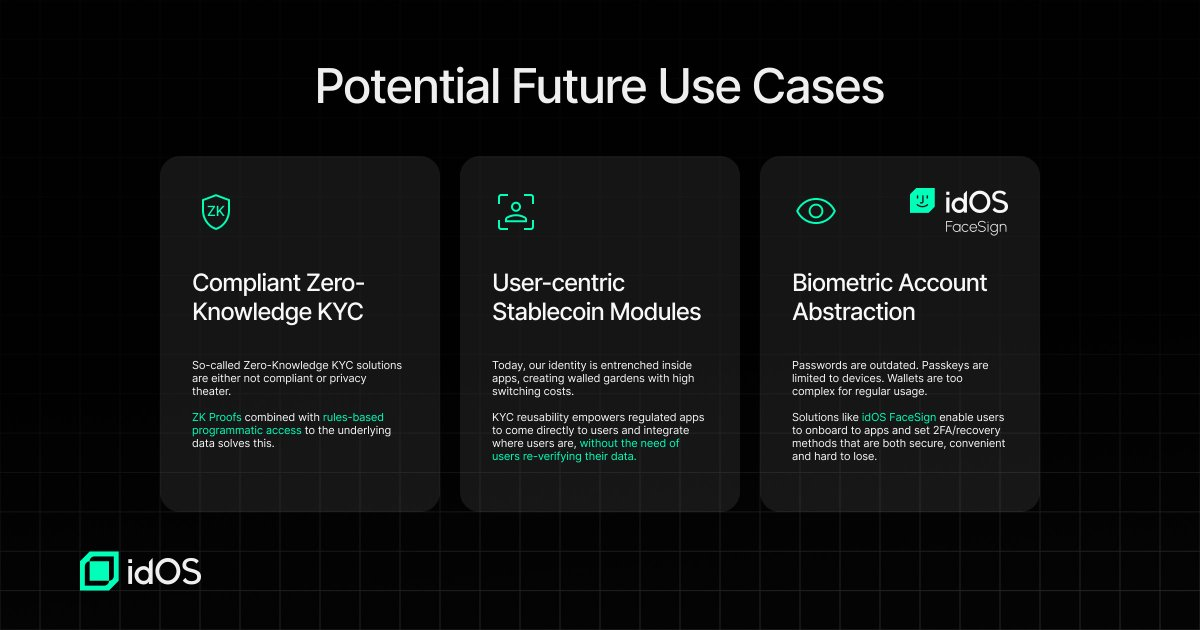
Identity verification is also indispensable for Web3 banking and RWA (real-world asset tokenization). By lowering verification costs and increasing data availability, idOS makes these applications more viable and lays the groundwork for Web3’s expansion into the real economy.
idOS Ecosystem and Adoption
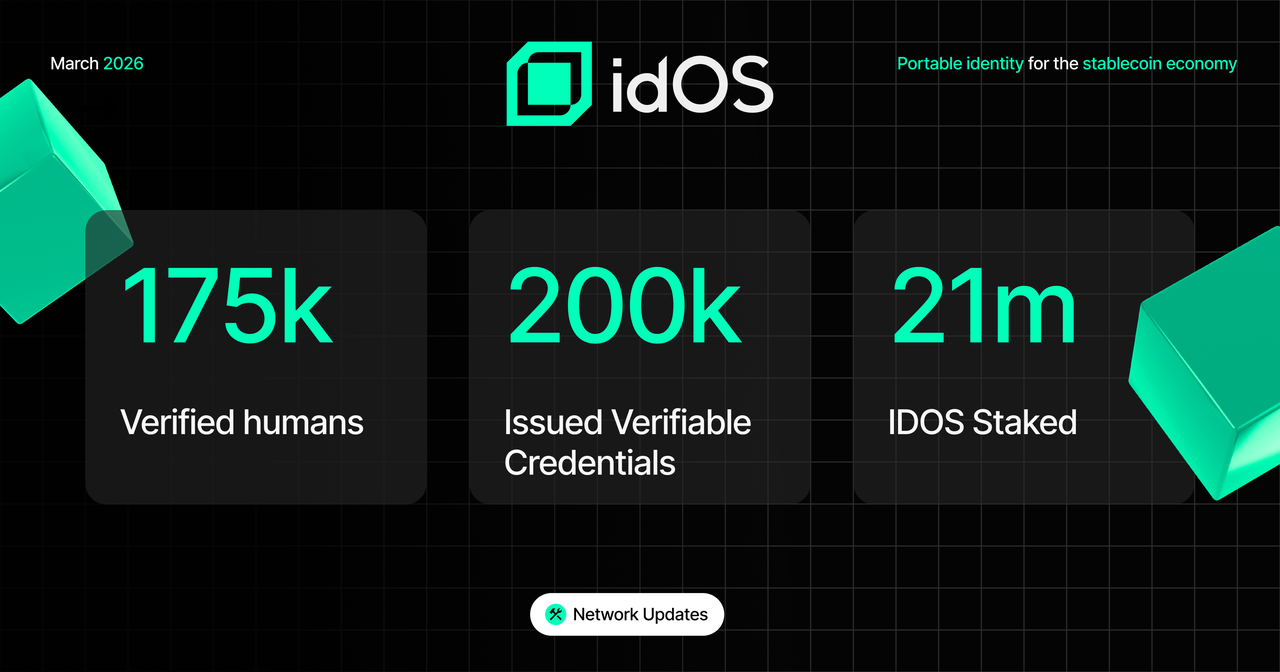
idOS has established a solid foundation in real-world deployment. Its network has verified more than 150,000 users and supports over 40 blockchains. Several large-scale applications are already adopting or integrating idOS as their identity system, signaling its transition from concept to operational infrastructure.
The Role of the IDOS Token
Within the idOS network, the IDOS token serves as a bridge between data and the economic system. It is used to pay for data access fees and forms part of the incentive mechanism, driving participants to provide and maintain services. The token also supports ecosystem governance, enabling community participation in critical decisions.
Conclusion
At a macro level, idOS signals a shift in Web3’s development trajectory—from an “asset”-centric model to one focused on “users and identity.” Identity is now a central hub connecting finance, applications, and compliance.
Data sovereignty is also becoming reality. Users are gaining true ownership and control of their data, with secure usage across diverse scenarios. This transformation will affect not only Web3 but could reshape the entire internet’s data architecture.
FAQs
What distinguishes idOS from DID?
idOS builds upon decentralized identity (DID) by integrating identity identifiers, KYC, data storage, and economic incentives—making it a more practical, deployable infrastructure.
Does idOS compromise user privacy?
Privacy protection is fundamental to idOS’s design. User data is encrypted, access is controlled via approval mechanisms, and selective disclosure prevents unnecessary exposure.
Is idOS cross-chain compatible?
Yes, idOS currently supports multiple blockchain networks and is committed to enabling seamless identity flow across chains.
Why do stablecoins require an identity layer?
Regulatory compliance mandates that financial activities are bound to identity. Without an identity layer, stablecoins cannot enter mainstream finance or achieve scalable adoption.
Who is idOS designed for?
idOS serves both general users and developers. Users benefit from streamlined identity verification, while developers gain access to integrable identity infrastructure.