Stablecoins Ranking 2025: USDT, USDC and Emerging Tokens Compared

Beginner
Quick Reads
Last Updated 2026-03-29 20:16:29
Reading Time: 1m
Stablecoins serve as a foundational tool within the Web3 ecosystem, and are widely used in DeFi, trading, cross-border payments, and hedging against volatility. This article organizes the top stablecoins by market capitalization for 2025, and analyzes their features, market credibility, and use cases.

Why Reference Stablecoin Rankings?

Within the Web3 space, stablecoins serve as essential tools for DeFi, trading, cross-border payments, and capital preservation. Keeping track of stablecoin market cap rankings and their characteristics not only helps users make informed choices, but also provides insights into which coins demonstrate stronger market confidence and longer-term viability.

Stablecoin Rankings in 2025

Based on the latest market cap data as of the editorial cutoff, here is an overview of the top stablecoins, along with analysis:

  1. USDT (Tether)
    Tether holds the top spot in the stablecoin market, with a market cap of about $160 billion and representing over 60% of the total stablecoin market. USDT is widely used in trading pairs and cross-chain asset transfers, offering high liquidity and global acceptance. However, questions around the transparency of its reserves occasionally arise.
  2. USDC (USD Coin)
    USDC has a market cap of approximately $64.3 billion. As a leading U.S.-issued and highly compliant stablecoin, its reserves primarily consist of cash and short-term U.S. Treasuries. Regular, independent audit reports provide a high level of transparency.
  3. USDe (Ethena USDe)
    Developed by Ethena, USDe ranks as the third-largest stablecoin with a market cap near $9.5 billion. As a newcomer featuring both collateralized and algorithmic stablecoin mechanisms, it has attracted interest from the market and developers.
  4. DAI (MakerDAO)
    DAI stands as the most prominent crypto-collateralized stablecoin, with a market cap close to $5.3 billion. It is primarily backed by ETH and governed by a decentralized community. While its risk management systems are mature, volatility in collateral values remains a key risk to manage.
  5. USD1 (World Liberty Financial USD)
    Issued by the U.S.-based World Liberty Financial, USD1 is an emerging fiat-backed stablecoin with a market cap of roughly $2.16 billion. It is backed by capital and branding, with reported business associations to the Trump family.
  6. FDUSD (First Digital USD)
    FDUSD, issued by First Digital, is a fiat-backed stablecoin with a roughly $1.45 billion market cap. It is primarily traded in Asian markets and is tightly integrated with blockchain platforms.
  7. PYUSD (PayPal USD)
    PayPal launched PYUSD in 2023, and it has a market cap of about $960 million. As an entry into crypto from a major payment platform, PYUSD is supported by PayPal’s brand reputation and public trust.
  8. RLUSD (Ripple USD)
    Issued by Ripple, RLUSD has a market cap of around $600 million and is used for internal transfers and cross-border settlements on the Ripple network.
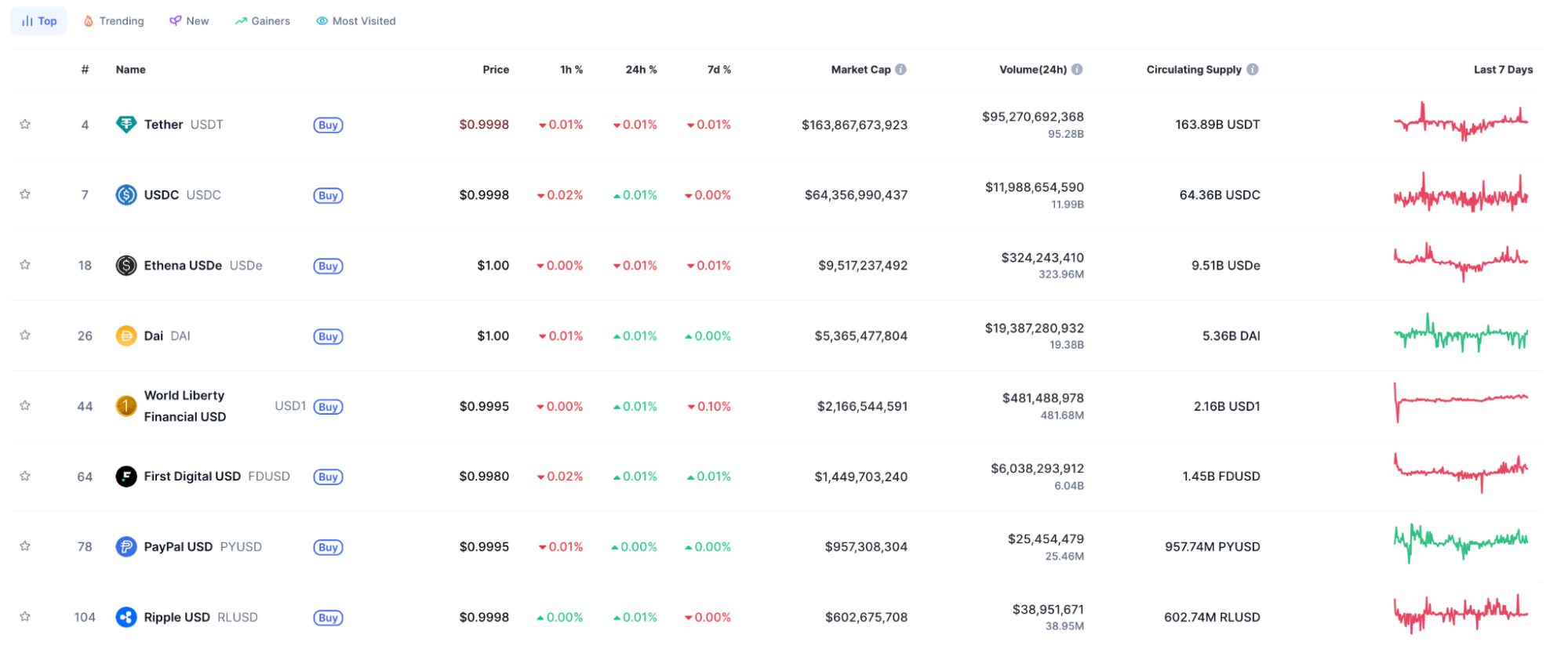

(Source: coinmarketcap)

The Importance of Stablecoin Rankings and Selection Strategies

Market Cap as a Signal of Trust

USDT and USDC consistently account for more than 70% of the stablecoin market, highlighting their high liquidity and deep trading volumes. These coins are the preferred stable assets for major market participants.

Regulatory Standing and Transparency Affect Adoption

USDC is issued by a fully regulated entity with highly transparent reserves. USDe, USD1, FDUSD, and similar coins are innovative, but their regulatory status remains to be proved over time.

Each Stablecoin Type Has Unique Strengths and Trade-Offs

  • USDC and USDT are fiat-backed, providing price stability but relying on centralized management.
  • DAI is crypto-collateralized, offering censorship resistance, but faces risks from collateral price fluctuations.
  • USDe is a hybrid or algorithmic stablecoin that is still in the experimental phase.

Common Stablecoin Use Cases

  • Market making and arbitrage on exchanges: for example, using USDT/USDC as the primary assets for trading pairs
  • Cross-chain transfers: stablecoins serve as bridges for moving funds across different platforms
  • DeFi lending and Liquidity Mining: DAI and USDC are frequently used as collateral in lending protocols and to generate yields
  • Integration with institutions and payment platforms: platforms such as PayPal and World Liberty expand stablecoin adoption through their business networks

Future Outlook

As regulations, like the GENIUS Act, move forward, more banks and corporations may launch their own stablecoins and enter the competition. New entrants such as Ethena’s USDe, PayPal’s PYUSD, and Ripple’s RLUSD could rise in the rankings as they increase user adoption and earn regulatory approvals.

To learn more about Web3, click here to register: https://www.gate.com/

Summary

The stablecoin market is still a relatively new sector. However, it now commands capital flows exceeding those of many major banking systems. By tracking stablecoin rankings, investors can identify capital preferences while also assessing transparency, trust, and regulatory compliance. When choosing a stablecoin, it is critical to consider use case, oversight, security, and ecosystem reach, rather than relying solely on market cap or current popularity.

Author: Allen
Disclaimer
* The information is not intended to be and does not constitute financial advice or any other recommendation of any sort offered or endorsed by Gate.
* This article may not be reproduced, transmitted or copied without referencing Gate. Contravention is an infringement of Copyright Act and may be subject to legal action.

Related Articles

What is Fartcoin? All You Need to Know About FARTCOIN
Intermediate

What is Fartcoin? All You Need to Know About FARTCOIN

Fartcoin (FARTCOIN) is a representative meme coin within the Solana ecosystem based on an AI-driven narrative. Its core concept originated from an experiment aimed at exploring the "boundaries between AI Agents and humor." More than just a digital asset with social attributes, the project deeply couples absurd humor culture with on-chain financial logic by integrating autonomous AI interaction models.
2026-04-04 22:01:19
Gold Price Forecast for the Next Five Years: 2026–2030 Trend Outlook and Investment Implications, Could It Reach $6,000?
Beginner

Gold Price Forecast for the Next Five Years: 2026–2030 Trend Outlook and Investment Implications, Could It Reach $6,000?

Analyze current gold price trends alongside authoritative five-year forecasts, integrating an evaluation of market risks and opportunities. This gives investors insight into the potential trajectory of gold prices and the main drivers expected to shape the market over the next five years.
2026-03-25 18:13:30
Aster vs Hyperliquid: Which Perp DEX Will Prevail?
Beginner

Aster vs Hyperliquid: Which Perp DEX Will Prevail?

Aster and Hyperliquid are the two representative protocols of the "purpose-built L1 path" within the current decentralized perpetual exchange (Perp DEX) sector. As a pioneer in the field, Hyperliquid has built a deep liquidity moat through its highly mature order book architecture and strong community consensus. Conversely, Aster, as a rising challenger, seeks to leapfrog the competition in high-performance trading through more aggressive multi-chain aggregation logic, private transaction modules, and an underlying execution environment optimized for 2026 market demands.
2026-03-24 11:58:33
AI-Native Settlement Layers: How United Stables Is Building the Next Financial Rail
Beginner

AI-Native Settlement Layers: How United Stables Is Building the Next Financial Rail

Stablecoins were originally designed as dollar substitutes within exchanges, primarily used for asset pricing and trade settlement. As on-chain financial ecosystems have matured, their role has expanded beyond simple payments to include collateral assets, cross-chain liquidity mediums, and unified settlement units. In particular, as AI systems and automated agents begin to participate directly in economic activity, demand has risen sharply for programmable value units capable of instant settlement. This shift is pushing stablecoins toward the role of foundational financial infrastructure.
2026-03-25 03:16:17
Aerodrome Tokenomics: How ve(3,3) Powers Base's Most Profitable DEX
Beginner

Aerodrome Tokenomics: How ve(3,3) Powers Base's Most Profitable DEX

AERO is the native token of Aerodrome Finance, a core decentralized exchange and liquidity protocol in the Base ecosystem. It is primarily used for liquidity incentives and ecosystem operations. veAERO is a governance NFT that users receive by locking AERO, representing both voting power and the right to share protocol revenue. Through a dual track structure of AERO as a utility token and veAERO as a governance credential, Aerodrome separates liquidity usage value from long term governance power, allowing participants to act as liquidity providers, governance decision makers, and revenue sharers within the same system.
2026-03-25 06:40:31
Hybrid Collateral Stablecoins: Inside United Stables' Stability and Yield Architecture
Beginner

Hybrid Collateral Stablecoins: Inside United Stables' Stability and Yield Architecture

In the early stages of the crypto market, traditional stablecoins mainly relied on single-reserve or single-collateral models. Their primary focus was price stability and payment convenience, which allowed them to become foundational tools for on-chain trading and capital flows. As the market has entered a more mature financial phase, however, this structure has begun to reveal limitations, including high concentration risk and the difficulty of balancing liquidity with yield. These constraints have driven the evolution toward multi-layer collateral and portfolio-based designs, such as the dual-layer hybrid collateral architecture proposed by United Stables, which seeks to redefine the underlying logic of stable assets.
2026-03-25 03:17:39