When using a Layer2 network, users often wonder why transactions are faster, why fees are lower, and how those transactions are ultimately confirmed. In high-frequency environments like DeFi, understanding the full execution path is essential for evaluating both reliability and risk.
This process generally involves three core stages: transaction submission, sequencing and execution, and final settlement. Together, these components define how Mantle operates.
How Users Enter the Mantle Network
Accessing Mantle essentially means moving from the Ethereum mainnet into a Layer2 environment.
Mechanically, users typically transfer assets from Ethereum to Mantle using a wallet or cross-chain bridge. This involves locking assets on the main chain and minting a corresponding balance on Layer2, enabling users to transact within Mantle.
Structurally, this entry process includes three key components: the wallet interface, the bridge, and network nodes. The wallet initiates requests, the bridge maps assets, and nodes receive transactions.
The purpose of this design is to let users access Layer2 without changing familiar workflows, while maintaining consistency with their Ethereum-based assets.
How Transactions Are Submitted in Mantle
Transaction submission is the starting point of the entire process.
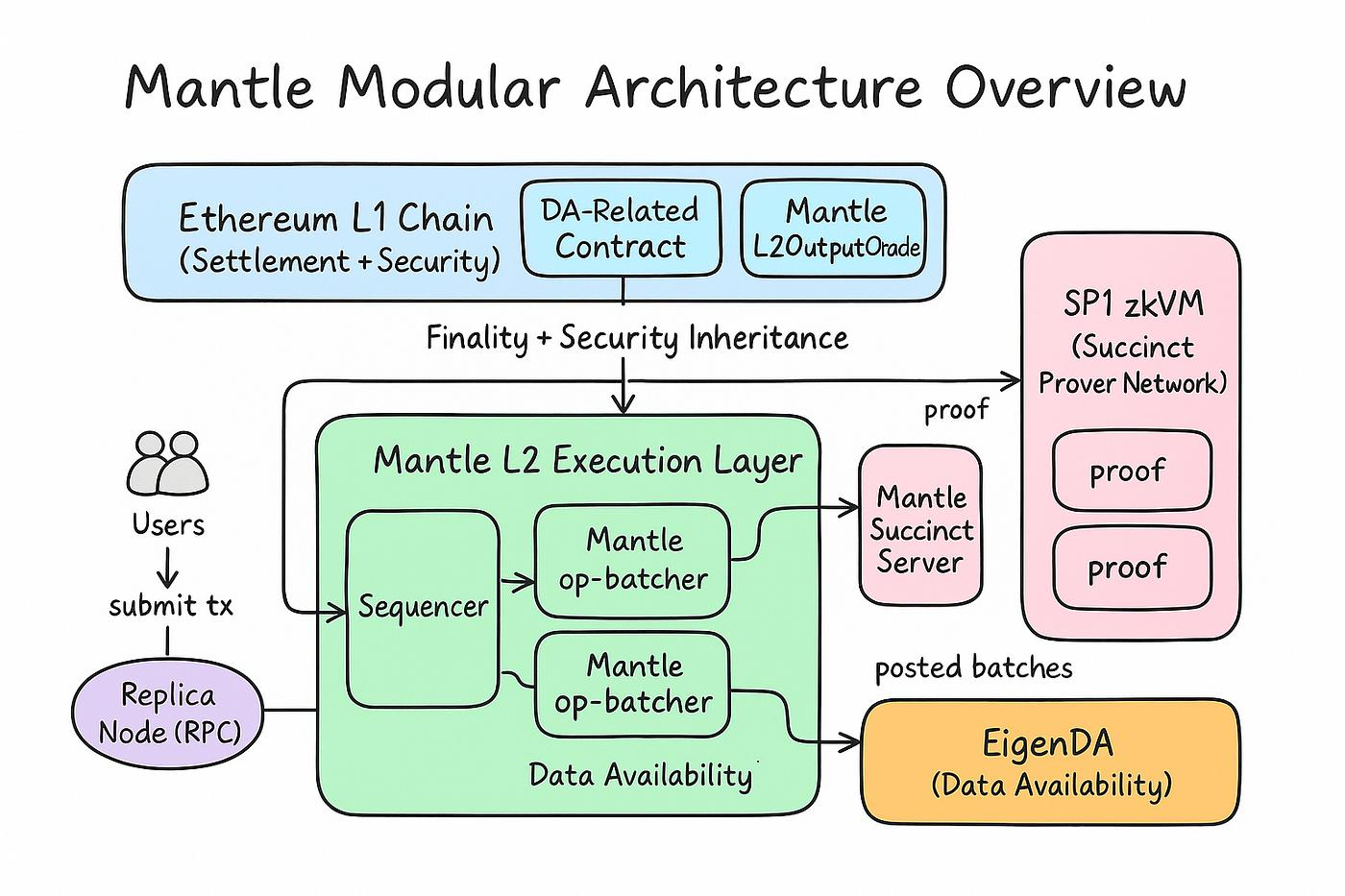
Mechanically, when a user initiates a transaction, the request is sent to nodes within the Mantle network. These nodes receive and temporarily store the transaction data. At this stage, the transaction is not yet executed and waits to be processed by the sequencer.
Structurally, transaction data includes call instructions, signatures, and fee parameters, all of which determine how the transaction will be executed. The submission process typically mirrors Ethereum’s interface, allowing developers to reuse existing tools.
This stage converts user intent into structured, executable data for further processing.
How the Sequencer Orders and Batches Transactions
The sequencer is a central component in Mantle’s execution flow.
Mechanically, the sequencer selects transactions from the pending pool, orders them based on rules such as fees, timing, or system strategy, and batches them for processing.
Structurally, the sequencer acts as a temporary consensus layer, determining transaction order before final settlement. This centralized ordering significantly improves efficiency and reduces latency.
The significance of this design is that it enables higher throughput while deferring final verification to Ethereum.
How the Execution Layer Processes State Updates
The execution layer is responsible for turning transactions into state changes.
Mechanically, batched transactions are executed within Mantle’s environment, updating account balances, smart contract states, and related data. The result is a new state root, which will later be used for verification.
Structurally, the execution layer is typically compatible with the Ethereum Virtual Machine, allowing developers to deploy existing smart contracts without modification. State updates follow deterministic rules, ensuring that all nodes can reproduce the same results.
This stage is where user actions translate into on-chain state changes, forming the core of value transfer within the system.
How Data Is Sent to the Data Availability Layer
The data availability layer determines how transaction data is stored.
Mechanically, after execution, transaction data is compressed and sent to a separate data availability layer instead of being fully written to Ethereum. This significantly reduces costs.
Structurally, separating data storage from execution allows the system to optimize storage independently. Nodes can retrieve this data when needed for verification, ensuring transparency.
This design reduces the burden on the main chain while maintaining data accessibility.
How Ethereum Finalizes Settlement
The settlement phase determines the final security of transactions.
Mechanically, Mantle submits state updates to Ethereum, where the mainnet performs final confirmation. If disputes arise, verification mechanisms can be used to validate correctness.
Structurally, Ethereum serves as the final arbitration layer within the Mantle system, ensuring that all state transitions are accurate. This allows Layer2 to achieve high performance while inheriting the security guarantees of the main chain.
This stage anchors Layer2 execution results to Ethereum, completing the balance between efficiency and security.
Summary
Mantle achieves a combination of high-performance execution and Ethereum-level security through a layered process of transaction submission, sequencing, data storage, and mainnet settlement. This makes it a representative model of modular Layer2 architecture.
FAQ
Why are Mantle transactions faster than Ethereum?
Because transactions are executed on Layer2 and processed in batches by a sequencer, reducing confirmation time.
Does Mantle require Ethereum to operate?
Yes, Ethereum serves as the settlement layer and provides final security guarantees.
What role does the sequencer play in Mantle?
It orders and batches transactions, acting as a key component in the execution process.
What is the role of the data availability layer?
It stores transaction data, reduces main chain costs, and ensures that data remains verifiable.
When is a Mantle transaction considered final?
A transaction is considered final once its state update is submitted to and confirmed on Ethereum.