Stablecoins serve as a vital bridge between crypto assets and the traditional financial system, with their core value rooted in providing a price-stable on-chain settlement unit. In practice, stablecoins facilitate not only asset transfers but also intersect with financial activities such as payments, lending, and cross-border capital flows—all of which demand higher standards for identity verification and compliance. The conventional model of anonymous on-chain interactions cannot adequately address these requirements.
Within this context, idOS is emerging as a foundational identity infrastructure for the stablecoin ecosystem. Through its decentralized identity network, idOS transforms user verification data into reusable data assets, enabling stablecoin applications to achieve compliance verification without directly storing sensitive user information. This approach not only reduces platform operating costs but also provides critical support for the scalable growth of on-chain finance.
Why Stablecoins Require Identity Layer Integration
The expanding role of stablecoins is driving their evolution from a simple transaction medium to on-chain financial infrastructure. In this transition, identity has become an essential element.
Stablecoins that involve fiat deposits or real-world assets (RWA) must comply with regulatory standards such as KYC and AML. Without a unified identity system, users are forced to undergo repeated verification across different platforms, raising barriers to adoption.
To address these challenges, the stablecoin ecosystem needs an identity solution that ensures regulatory compliance while protecting user privacy. idOS offers a practical solution to this problem.
How idOS Delivers Identity Infrastructure for Stablecoins
idOS provides identity services for stablecoin applications through a data storage + approval access model.
When a user completes identity verification on a platform for the first time, their data is encrypted and stored within the idOS network. Subsequently, when the user interacts with other stablecoin-related applications—such as trading or payments—these applications can request access to the verified identity data.
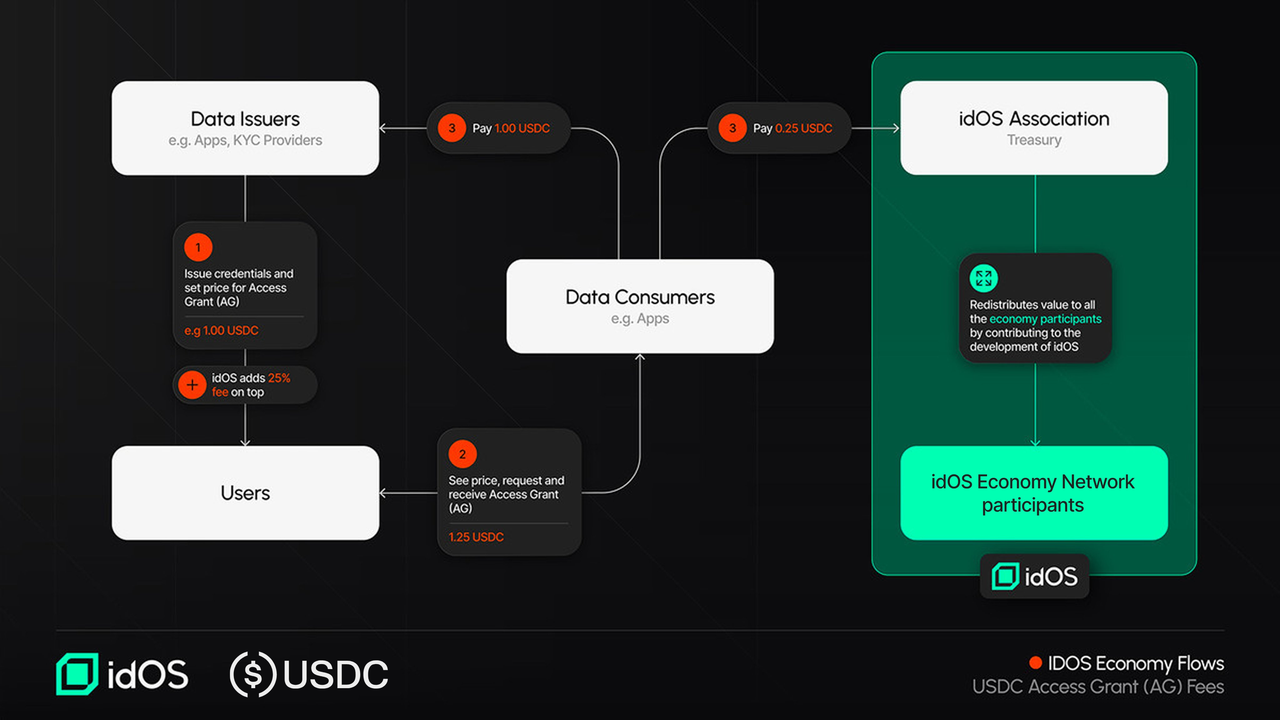
With just a single approval from the user, platforms can access the necessary verification results without the need to recollect or store sensitive data. This mechanism enables the cross-platform reuse of identity information.
For stablecoin issuers and application providers, this means that identity verification can be outsourced to the idOS network, allowing them to focus on their core business logic.
KYC Reuse: Lowering Friction and Boosting Efficiency
KYC remains one of the main friction points in the convergence of traditional and crypto finance.
By enabling identity data reuse, idOS allows users to share their verification results across multiple platforms after completing a single verification process. This reduces redundant steps and shortens the time required for users to access different applications.
For the stablecoin ecosystem, this mechanism helps decrease user attrition and improves overall liquidity, as users can move funds and engage in trading across platforms more efficiently.
Striking a Balance Between Privacy and Compliance
A central challenge for stablecoin development is meeting regulatory requirements while safeguarding user privacy.
idOS achieves this balance through encryption and approval mechanisms. Application providers typically receive only “verification results” or “proofs”—not the full underlying data. For example, a platform can confirm that a user has completed KYC without accessing detailed identity information.
This approach minimizes the risk of data exposure and reduces the platform’s compliance and data storage responsibilities.
The Expanding Role of idOS in On-Chain Finance
Beyond stablecoins, idOS’s identity infrastructure extends to a wide range of on-chain financial scenarios.
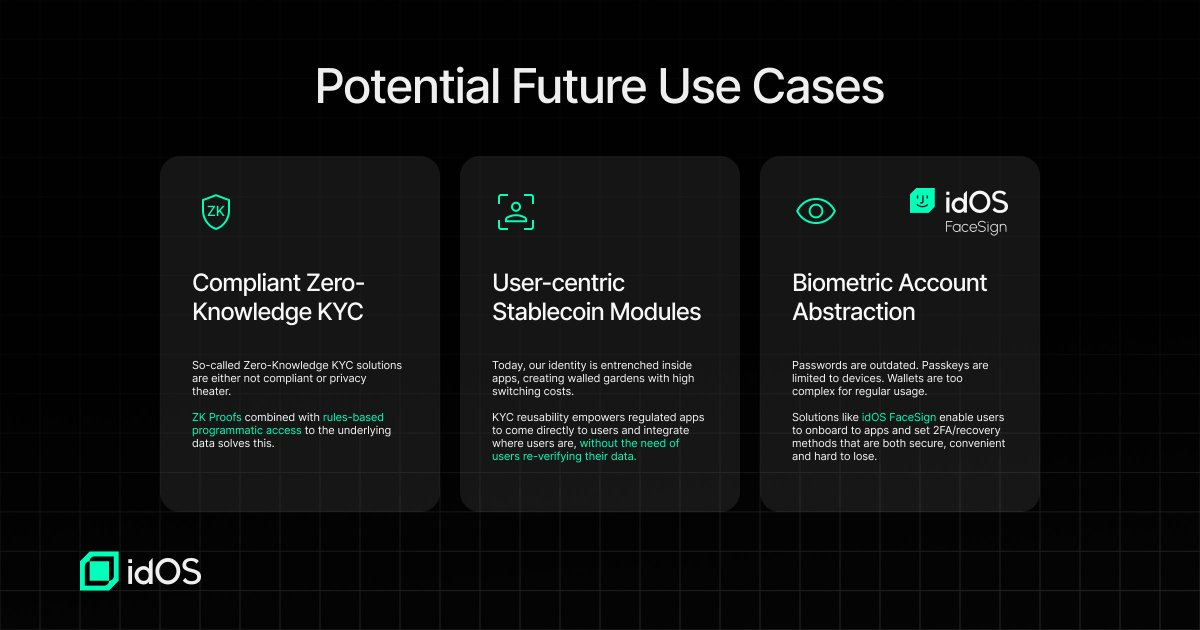
In lending protocols, identity data can be used for credit and risk assessment; in payment scenarios, it can support cross-border compliance; in the RWA sector, it connects on-chain assets with real-world legal frameworks.
These use cases further reinforce the foundational role of the identity layer in the Web3 financial system.
How idOS Differs from Traditional Identity Systems
Traditional stablecoin platforms typically manage user identity data directly, which increases operational costs and data security risks.
In contrast, idOS decouples identity management from individual platforms, creating an independent network layer. Platforms no longer need to hold user data directly and instead access required information through approval-based mechanisms.
This model aligns with decentralized architecture and is well-suited for collaborative, multi-application ecosystems.
Conclusion
idOS delivers decentralized identity infrastructure that enables the stablecoin ecosystem to balance compliance and privacy. Its primary value lies in providing a reusable identity data layer, lowering verification costs, enhancing user experience, and supporting the large-scale expansion of on-chain finance. As Web3 continues to integrate with traditional finance, the identity layer is becoming an essential component.
FAQs
Why do stablecoins need KYC?
Stablecoins are often used for fiat exchange, payments, and financial services, which require compliance with anti-money laundering and regulatory standards. KYC is a critical tool for meeting these requirements.
How does idOS minimize repeated identity verification?
By encrypting and storing verified data on the network, users can grant approval for its use across multiple platforms, eliminating the need for redundant information submissions.
Does idOS compromise user privacy?
idOS uses encrypted storage and approval-based access, so applications typically receive only verification results, not raw data—significantly reducing privacy risks.
How can stablecoin projects integrate idOS?
Stablecoin platforms can integrate idOS to request identity verification results during user operations, without the need to store user data themselves.
Beyond stablecoins, where else can idOS be applied?
idOS is also applicable to DeFi, lending, RWA, and cross-border payments—any scenario that requires identity verification and compliance support.