As the use of AI Agents in blockchain scenarios continues to expand, the efficiency of accessing on-chain data is becoming a key factor in determining how capable AI automation can be. Although blockchains offer the advantage of open and transparent data, the fragmentation of data across multi-chain ecosystems, inconsistent structures, and complex retrieval processes make it difficult for AI models to directly understand and use that information. For AI Agents that rely on real time data for analysis and decision making, these access barriers limit their efficiency in automated trading, on-chain analytics, and intelligent execution.
SkyAI was introduced in response to this challenge, offering a data infrastructure solution designed for AI Agents. Through the MCP protocol, multi-chain data services, and a Data Liquidity mechanism, SkyAI aims to build a unified data access layer that allows AI to read on-chain data more efficiently and interact automatically. From an industry positioning perspective, this is not just a data service architecture, but also an important technical approach driving on-chain data standardization in the AI + Web3 infrastructure space. Its value lies in turning on-chain data into resources that AI can truly understand, call, and circulate.
How Does SkyAI’s Technical Architecture Work?
SkyAI’s operating logic is built on three key modules: the MCP protocol, multi-chain data services, and Data Liquidity. Together, these three components form a standardized interaction framework between AI Agents and on-chain data.
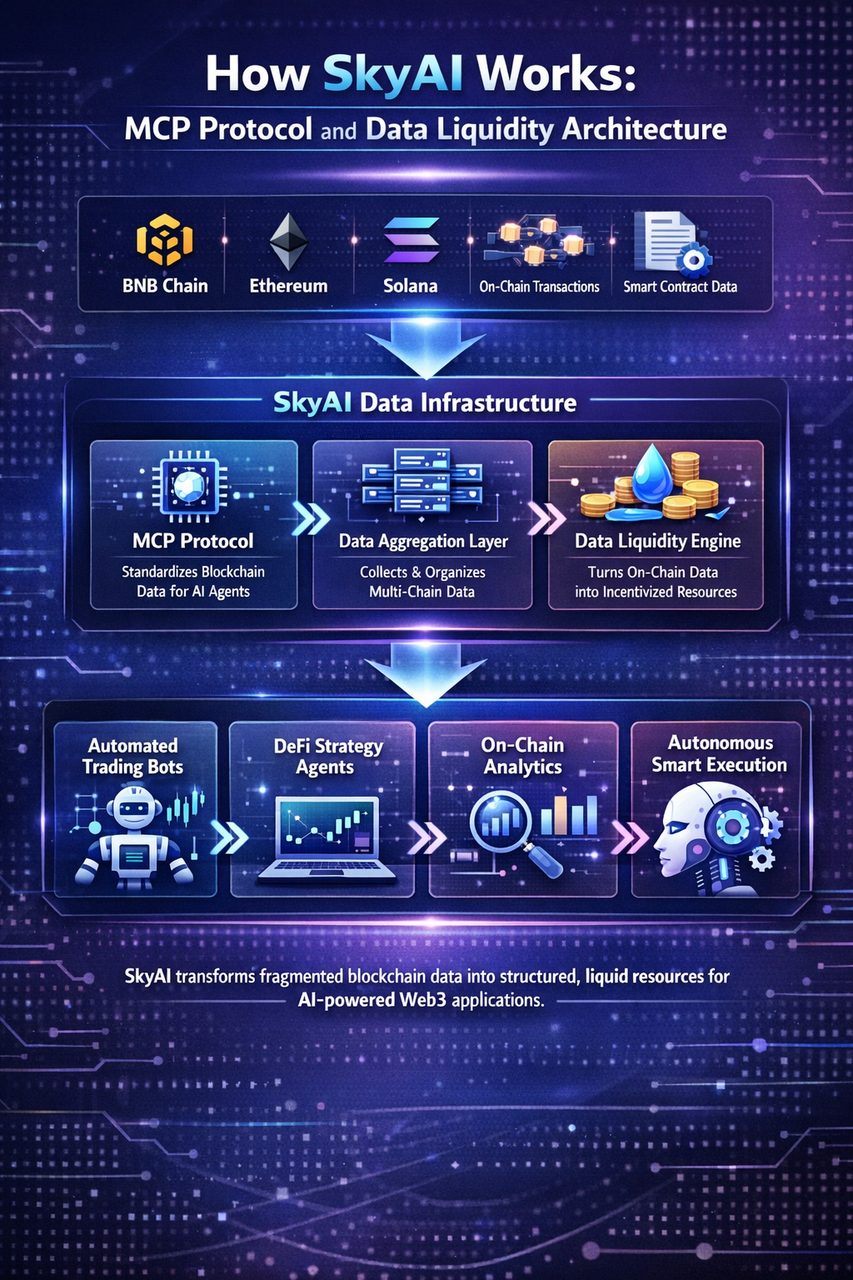
In traditional blockchain environments, data is distributed across different chains and protocols. If AI wants to use that data, it must adapt to different interfaces and formats one by one. This approach not only raises development costs, but also makes it difficult to support real time automated operations. SkyAI’s goal is to use a unified architecture to integrate this previously fragmented data into resources that AI can access quickly.
Within this architecture, the MCP protocol defines the interaction rules between AI and data, multi-chain data services aggregate and standardize on-chain data, and the Data Liquidity mechanism creates a value circulation system for data. As a result, data resources can not only be accessed, but can also form a closed loop of value exchange through the protocol.
What Is the MCP Protocol, and Why Does SkyAI Extend It?
MCP, or Model Context Protocol, can be understood as a standardized interface layer that allows AI models to access on-chain data. Its role is to help AI Agents obtain structured contextual information and make automated decisions based on that information. In scenarios where AI and blockchain intersect, simply giving AI access to raw on-chain data is not enough, because that raw data often lacks a consistent format and is difficult to use directly for model reasoning.
SkyAI’s core goal in extending the MCP protocol is to convert complex on-chain data into contextual information that AI can understand directly. For example, when an AI Agent needs to analyze asset flows on a particular chain, SkyAI can use MCP to transform raw transaction data into structured inputs, helping the AI complete its analysis more efficiently.
The value of this protocol layer is that AI does not need to understand the underlying data structures of different blockchains. Instead, it can obtain directly usable data through a unified interface. This standardization is a crucial foundation for enabling AI Agents to carry out automated execution.
How Do SkyAI’s multi-chain Data Services Improve Efficiency?
multi-chain data services are the data processing layer in SkyAI’s technical architecture. Their primary responsibility is to organize data sources from different blockchains in a unified way and output them in a standardized format. Because public blockchains differ in both data structures and interface design, developers often need to build separate data adaptation logic for each chain, which significantly increases the complexity of developing AI applications.
By creating a unified data aggregation layer, SkyAI converts multi-chain data into a standard format before delivering it to AI Agents. This means that no matter which chain the data comes from, AI can read and use it in a consistent way, lowering the barrier to development and improving operational efficiency.
For AI Agents, the importance of this kind of standardized data service is substantial. It not only reduces the cost of data preprocessing, but also allows AI to perform automated operations more efficiently in multi-chain environments, improving overall execution capability.
What Is Data Liquidity, and Why Is It SkyAI’s Core Innovation?
Data Liquidity is one of SkyAI’s most important technical innovations. Traditional on-chain data protocols usually provide only data query capabilities. Although the data itself has value, it cannot form an effective value circulation mechanism at the protocol level. SkyAI, by contrast, attempts to turn data into a resource that can be called and incentivized.
Under this mechanism, data providers are rewarded for contributing data resources, while AI Agents or developers gain access to data by paying tokens. In this way, on-chain data is no longer just static information, but becomes part of a circulating economic system.
The importance of Data Liquidity lies in the value connection it creates between data suppliers and data users. It allows the protocol to continuously incentivize contributions of data resources while also meeting AI applications’ demand for high quality data. This not only improves data utilization efficiency, but also gives SkyAI’s data service network long term scalability.
Why Is SkyAI’s Technical Architecture So Important for AI Agents?
The core strength of AI Agents lies in their ability to make decisions autonomously and execute actions based on real time data, and that capability depends heavily on data infrastructure. If AI cannot obtain high quality on-chain data quickly, it cannot perform real time analysis or automated execution effectively. In practice, then, data access efficiency determines how capable AI Agents can actually be in on-chain environments.
Through the MCP protocol and multi-chain data services, SkyAI provides AI Agents with standardized data inputs, while Data Liquidity helps ensure that data supply remains stable over time. This allows AI Agents to carry out automated on-chain tasks more efficiently.
From an infrastructure perspective, SkyAI is not simply offering a data query service. It is providing an on-chain data execution layer built for AI Agents. That gives it important value in the AI + Web3 space and positions it as a key technical support layer for on-chain automation.
What Is the Future Potential of SkyAI’s Technical Architecture?
As AI Agents see broader use in DeFi, on-chain analytics, and automated asset management, demand for on-chain data infrastructure is likely to keep growing. If SkyAI’s technical architecture can continue attracting developers and establish a stable data service network, it has the potential to become an important part of the AI + Web3 data layer.
This is especially true as multi-chain ecosystems continue to expand rapidly. In that context, unified data access protocols and mechanisms for circulating data value will become increasingly important. The MCP + Data Liquidity architecture built by SkyAI is designed around exactly this trend.
The deeper the integration between AI and blockchain becomes, the more valuable protocols like SkyAI are likely to be. Its potential, therefore, is not limited to the project itself, but also reflects the broader development trajectory of AI + Web3 infrastructure.
FAQs
What does SkyAI’s MCP protocol do?
The MCP protocol provides AI Agents with a standardized interface for on-chain data, allowing AI to obtain structured data efficiently and make automated decisions.
What is SkyAI’s Data Liquidity?
Data Liquidity is a mechanism that turns on-chain data into a resource that can be accessed and incentivized, creating a closed loop for data value circulation.
Why does SkyAI need multi-chain data services?
Because different blockchains use different data structures, multi-chain data services unify data formats and improve data access efficiency for AI Agents.
What is SkyAI’s core technical value?
SkyAI’s core value lies in building a standardized connection layer between AI and on-chain data, making on-chain data a resource that AI can understand and that can circulate freely.