Against the backdrop of rapid growth in the Solana DeFi ecosystem, liquidity has become a critical factor influencing both protocol stability and trading efficiency. Traditional liquidity protocols typically rely on fixed distribution models, which often result in underutilized capital. Meteora addresses this by introducing dynamic liquidity management and flexible yield mechanisms, forming a new layer of liquidity infrastructure.
From a broader digital asset perspective, Meteora is more than just a liquidity protocol. It is evolving into a foundational component that connects trading, token issuance, and yield management. Built around its dynamic liquidity pool mechanism and its role as Solana liquidity infrastructure, Meteora’s ecosystem continues to expand into a comprehensive liquidity product suite.
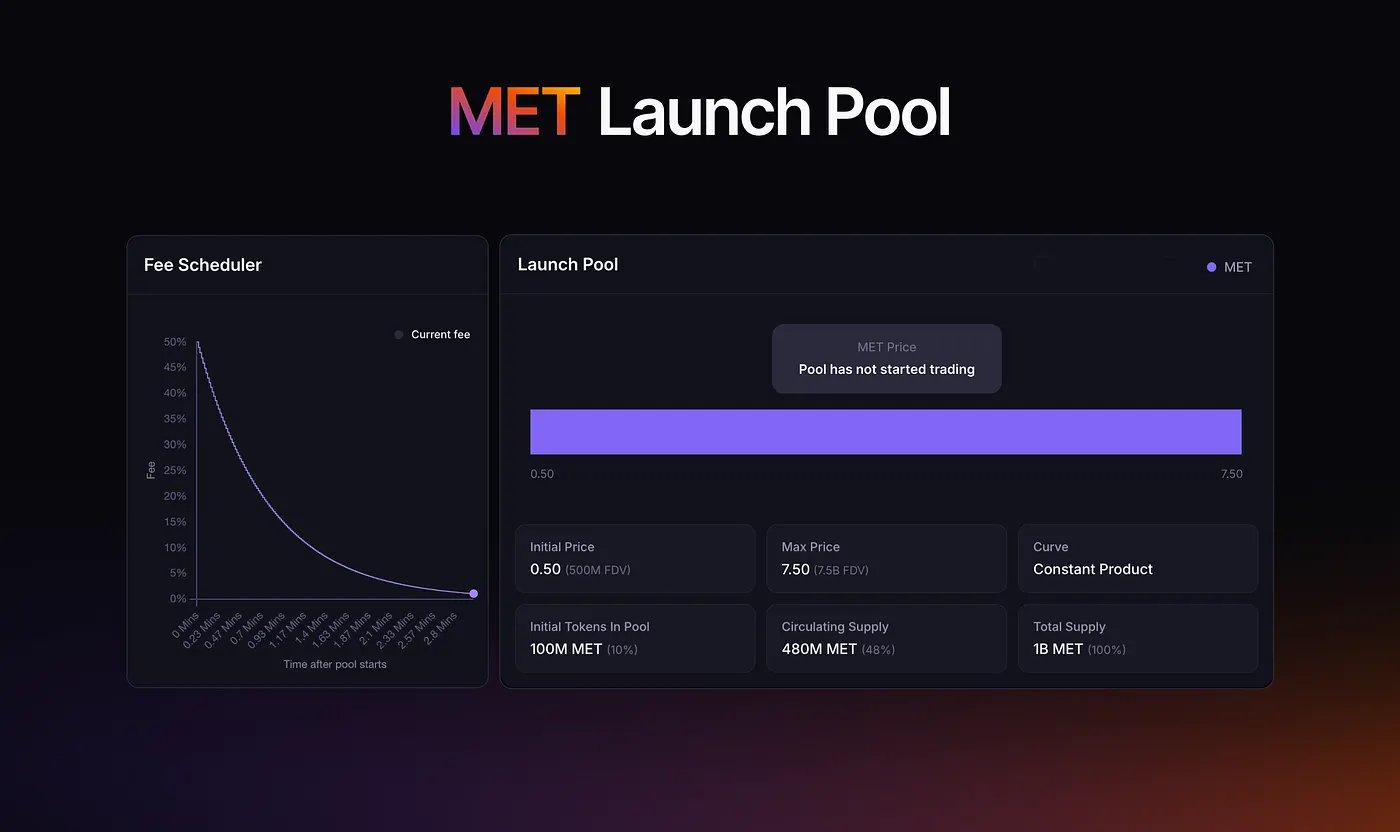
Source: meteora.ag
Project Background and Origins of Meteora (MET)
As DeFi has evolved, liquidity has become the backbone of blockchain-based financial systems. Whether for decentralized exchanges, stablecoin protocols, or new token launches, liquidity pools serve as essential infrastructure. Meteora was developed to address inefficiencies in traditional liquidity models.
In early DeFi, most liquidity pools relied on constant product models. While simple, these models often suffer from low capital efficiency. For example, when price fluctuations remain within a narrow range, a large portion of liquidity remains idle, reducing overall yield efficiency. As the DeFi market expanded, optimizing liquidity became a key innovation focus.
Meteora introduced the concept of dynamic liquidity pools, allowing capital to be automatically allocated based on market demand. This marks a clear departure from traditional models and lays the groundwork for its DLMM (Dynamic Liquidity Market Maker) mechanism.
At the same time, as the Solana ecosystem has grown, so has the number of new tokens and projects, increasing demand for efficient liquidity bootstrapping. Meteora addresses this need by providing token liquidity launch mechanisms, further expanding its ecosystem role.
Meteora’s Positioning in the Solana DeFi Ecosystem
Within the Solana DeFi ecosystem, Meteora is positioned as a liquidity infrastructure layer rather than a standalone trading protocol. Its primary function is to provide liquidity support across multiple applications, improving overall market efficiency.
Many protocols within the ecosystem require independent liquidity pools, which often leads to fragmentation. Meteora mitigates this by enabling shared liquidity and dynamic allocation, improving capital utilization.
This structure allows Meteora to act as a bridge across DeFi applications. For example:
-
New projects can bootstrap liquidity through Meteora
-
DeFi protocols can access deeper trading liquidity
-
Users can participate in structured yield strategies
As this model matures, Meteora’s role as a Solana liquidity layer becomes more defined, alongside the expansion of its ecosystem collaboration framework.
Why Meteora Is Considered a Liquidity Optimization Protocol
Meteora is classified as a liquidity optimization protocol due to its dynamic liquidity design and yield optimization framework.
Traditional liquidity pools distribute capital evenly across price ranges. Meteora, by contrast, concentrates liquidity in areas with higher trading activity, improving capital efficiency and reducing idle funds.
It also incorporates a dynamic fee mechanism, allowing trading fees to adjust based on market conditions. This enables liquidity providers to earn higher returns during periods of increased volatility.
At the center of this system is the Dynamic Liquidity Market Maker (DLMM), which serves as a core innovation. Combined with dynamic fees and yield optimization strategies, it creates a more adaptive and efficient liquidity model.
This structure clearly differentiates Meteora from traditional AMM designs.
Key Differences Between Meteora and Traditional AMM Protocols
The main distinction between Meteora and traditional automated market makers lies in how liquidity is managed.
Traditional AMMs rely on fixed capital distribution, while Meteora uses dynamic allocation. This directly impacts both capital efficiency and yield outcomes.
Additionally, traditional AMMs are primarily focused on facilitating trades, whereas Meteora emphasizes both liquidity management and yield optimization. In other words, Meteora functions not just as trading infrastructure but also as a liquidity management layer.
| Comparison Dimension |
Traditional AMM |
Meteora |
Key Advantage (Meteora) |
| Liquidity Management |
Fixed distribution |
Dynamic distribution |
Higher efficiency with real-time adjustments |
| Capital Efficiency |
Lower, often idle capital |
Higher, optimized allocation |
Reduced waste, improved returns |
| Core Function |
Trade execution |
Trading + liquidity management |
Expanded functional scope |
| Fee Mechanism |
Fixed fees |
Dynamic fees |
Adaptive to market volatility |
| Yield Optimization |
Basic, fee-driven |
Advanced optimization strategies |
Enhanced returns and risk control |
| Overall Positioning |
Trading infrastructure |
Liquidity optimization layer |
Differentiated role in Solana DeFi |
At the mechanism level, Meteora introduces several innovations:
These features contribute to evolving trends in liquidity protocol design within Solana DeFi.
Core Products and Functional Architecture
Meteora offers a range of liquidity products that form its core architecture:
DLMM (Dynamic Liquidity Market Maker)
DLMM is one of Meteora’s primary products. It allows liquidity providers to adjust capital allocation based on market conditions and supports dynamic fees.
This model enables providers to choose strategies based on volatility, improving yield efficiency. It is the foundation of Meteora’s dynamic liquidity pool mechanism.
DAMM v1 / DAMM v2
DAMM represents Meteora’s dynamic automated market maker models:
These options provide flexibility for different types of liquidity providers and create a layered liquidity structure.
Dynamic Bonding Curve (DBC)
DBC enables projects to launch tokens using dynamic pricing curves, with liquidity transitioning into pools once certain conditions are met.
This mechanism supports:
-
Token launches
-
Liquidity creation
-
Market formation
It strengthens Meteora’s role in token launch infrastructure within DeFi.
Meteora’s Role and Impact in the Solana Ecosystem
As the Solana DeFi ecosystem grows, Meteora’s importance continues to increase.
First, it provides liquidity infrastructure that lowers the barrier for new projects to enter the market. Second, it improves capital efficiency, which enhances overall trading performance.
It also supports stablecoin liquidity and cross-asset trading, contributing to a more competitive ecosystem.
Through these functions, Meteora’s role within the Solana DeFi landscape continues to expand as a core liquidity layer.
Future Development and Ecosystem Expansion
As DeFi evolves, Meteora continues to expand its capabilities. This includes:
Meteora has also introduced products such as:
-
Alpha Vault
-
Stake2Earn
-
Dynamic Vault
These additions further extend its liquidity ecosystem and strengthen its infrastructure capabilities.
As more projects integrate with Meteora, its ecosystem is gradually forming a more complete and interconnected structure.
Conclusion
Meteora is a liquidity optimization protocol within the Solana ecosystem that enhances capital efficiency through dynamic liquidity pools and yield optimization. As the ecosystem continues to grow, Meteora is increasingly establishing itself as a key liquidity infrastructure layer in DeFi.
FAQ
What is Meteora (MET)?
Meteora is a liquidity optimization protocol built on Solana, offering dynamic liquidity pools and yield optimization mechanisms.
How is Meteora different from traditional AMMs?
Meteora uses a dynamic liquidity model, while traditional AMMs rely on fixed liquidity distribution.
What are Meteora’s core products?
Its main products include DLMM, DAMM v1/v2, and Dynamic Bonding Curve.
What role does Meteora play in the Solana ecosystem?
It provides liquidity infrastructure and supports the development of DeFi applications.
Is Meteora a decentralized exchange?
Meteora is better understood as a liquidity infrastructure layer rather than a traditional DEX.