Gate DEX Gas-Free Campaign Explained: How Zero-Gas Trading Lowers On-Chain Barriers

Beginner
Quick Reads
Last Updated 2026-03-25 00:29:47
Reading Time: 1m
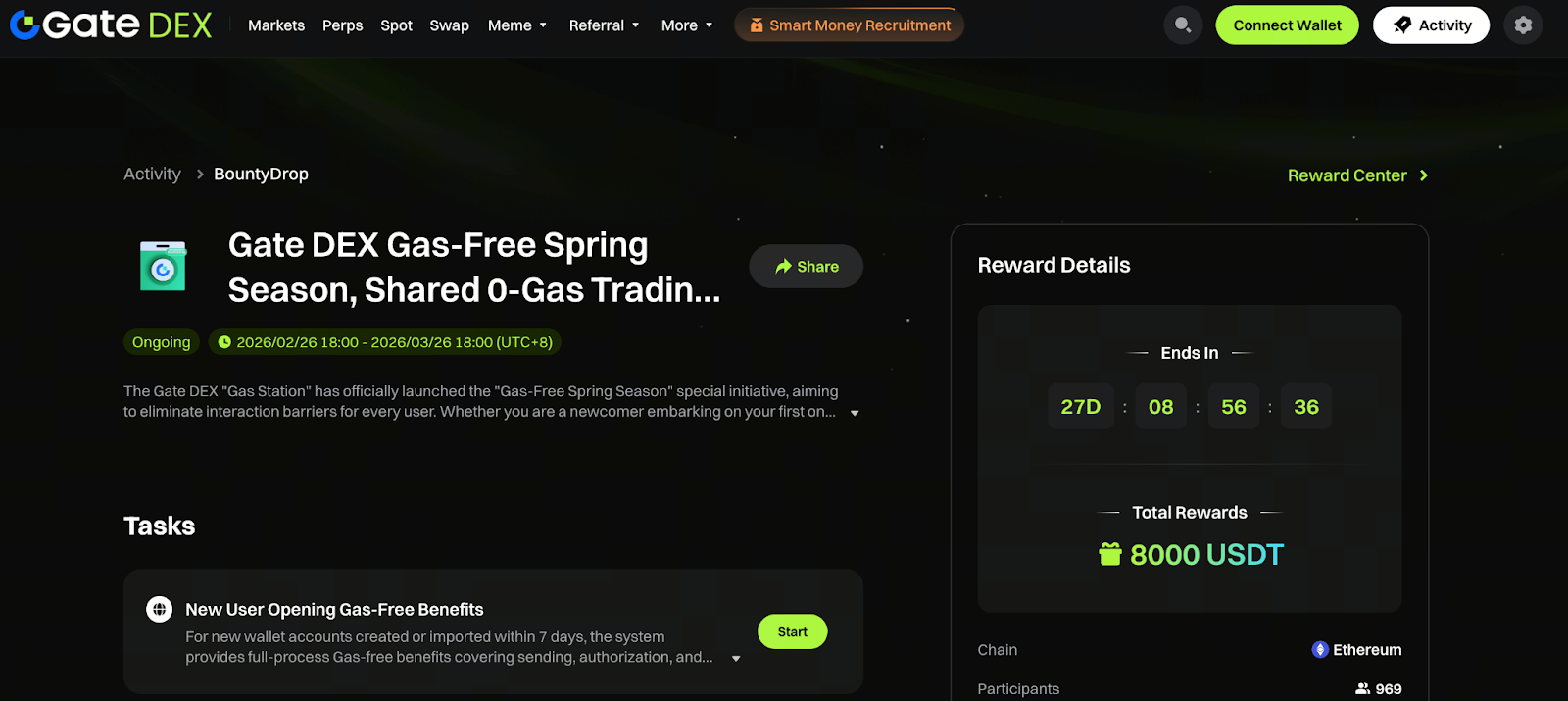
Gate DEX has introduced the "Zero Gas Spring Promotion," granting both new and existing users access to zero gas trading and deposit fee coverage. This article outlines the event rules, how to participate, and the key benefits of the zero gas mechanism.

Gate DEX Zero Gas Event Explained: How 0 Gas Transactions Lower On-Chain Barriers?
Image: https://www.gatedex.com/activity/detail?id=577&network=EVM

As on-chain transaction activity accelerates, gas fees have emerged as a critical factor shaping user experience. During periods of network congestion or frequent authorization and transaction operations, gas costs not only drive up operational expenses but also raise the entry threshold for users.

To address this challenge, Gate DEX has launched the Zero Gas Spring Event. Leveraging the Gas Station mechanism, Gate DEX offers phased 0 gas transaction support to both new and existing users, significantly reducing the cost of on-chain interactions.

This article examines the event from three angles: event rules, mechanism logic, and user impact.

What Is the Gate DEX Zero Gas Spring Event?

The Zero Gas Spring Event is a special benefit program from Gate DEX, available during a designated timeframe. Its primary objectives are:

  • Reduce on-chain transaction costs
  • Enhance the initial experience for new users
  • Increase usage frequency among existing users
  • Lower the requirement to hold native gas in wallets

Event period: February 26, 2026, 10:00 UTC — March 26, 2026, 10:00 UTC.

What Zero Gas Benefits Are Available for New Users?

For wallet accounts created or imported within seven days, the system grants three zero gas benefits:

  • One zero gas token transfer
  • One zero gas token authorization
  • One zero gas transaction

This structure covers the three most common on-chain operations, allowing new users to explore the platform without worrying about network fees during their initial experience.

Device Restriction Mechanism

To prevent repeated benefit claims, the event uses a physical device ID binding mechanism:

  • Each device is permanently limited to a single new wallet account eligible for new user benefits
  • Even if the wallet is deleted and recreated, benefits cannot be reclaimed

This mechanism ensures fairness and prevents bulk registration for arbitrage.

Monthly Zero Gas Benefits for Existing Users

For users with existing wallets, the system provides two zero gas benefits per month:

  • One zero gas token authorization
  • One zero gas transaction

Important notes:

  • Each device ID is limited to one wallet account per month
  • The account that triggers the first zero gas benefit in the month is the only eligible account

This means users should plan their usage to maximize benefit efficiency.

First-Time Gas Top-Up Subsidy Mechanism

During the event, when users top up the Gas Station with $5–$100 for the first time:

  • No on-chain gas fees required
  • Top-up can be completed even if the wallet lacks native gas assets
  • All relevant network fees are covered by the platform

This approach solves the “no gas, no top-up” cycle, allowing users to prepare funds seamlessly.

Why Is the 0 Gas Mechanism Crucial for On-Chain Transactions?

In traditional on-chain workflows, users must:

  1. Hold native tokens to pay for gas
  2. Authorize signatures multiple times
  3. Switch frequently between different protocols

These steps increase the learning curve and heighten psychological barriers to trading.

The zero gas event delivers key value by:

  • Lowering the psychological barrier for first-time transactions
  • Improving the fluidity of high-frequency trading
  • Optimizing the authorization process
  • Reducing asset fragmentation

For newcomers, it’s an opportunity to learn on-chain processes at minimal cost. For frequent traders, it’s a chance to reduce expenses during the event period.

Gate DEX Gas Station: Long-Term Significance

From a product perspective, the Gas Station is more than a short-term marketing tool—it’s integral to enhancing the on-chain transaction experience.

By:

  • Centralizing gas management
  • Offering phased subsidy mechanisms
  • Ensuring fair allocation at the device level

Gate DEX is building a sustainable support system for on-chain transactions.

As Web3 adoption accelerates, reducing interaction costs and improving user experience will become key competitive factors for DEX platforms.

Risk Warning

Virtual asset trading is subject to multiple influences, including market and policy changes. Price volatility can be significant. Please fully understand the associated risks and make informed decisions before participating in trading.

Author: Max
Disclaimer
* The information is not intended to be and does not constitute financial advice or any other recommendation of any sort offered or endorsed by Gate.
* This article may not be reproduced, transmitted or copied without referencing Gate. Contravention is an infringement of Copyright Act and may be subject to legal action.

Related Articles

AI-Native Settlement Layers: How United Stables Is Building the Next Financial Rail
Beginner

AI-Native Settlement Layers: How United Stables Is Building the Next Financial Rail

Stablecoins were originally designed as dollar substitutes within exchanges, primarily used for asset pricing and trade settlement. As on-chain financial ecosystems have matured, their role has expanded beyond simple payments to include collateral assets, cross-chain liquidity mediums, and unified settlement units. In particular, as AI systems and automated agents begin to participate directly in economic activity, demand has risen sharply for programmable value units capable of instant settlement. This shift is pushing stablecoins toward the role of foundational financial infrastructure.
2026-03-25 03:16:17
Gold Price Forecast for the Next Five Years: 2026–2030 Trend Outlook and Investment Implications, Could It Reach $6,000?
Beginner

Gold Price Forecast for the Next Five Years: 2026–2030 Trend Outlook and Investment Implications, Could It Reach $6,000?

Analyze current gold price trends alongside authoritative five-year forecasts, integrating an evaluation of market risks and opportunities. This gives investors insight into the potential trajectory of gold prices and the main drivers expected to shape the market over the next five years.
2026-03-25 18:13:30
Aster vs Hyperliquid: Which Perp DEX Will Prevail?
Beginner

Aster vs Hyperliquid: Which Perp DEX Will Prevail?

Aster and Hyperliquid are the two representative protocols of the "purpose-built L1 path" within the current decentralized perpetual exchange (Perp DEX) sector. As a pioneer in the field, Hyperliquid has built a deep liquidity moat through its highly mature order book architecture and strong community consensus. Conversely, Aster, as a rising challenger, seeks to leapfrog the competition in high-performance trading through more aggressive multi-chain aggregation logic, private transaction modules, and an underlying execution environment optimized for 2026 market demands.
2026-03-24 11:58:33
DePIN Identity Network and Real World Applications: How Humanity Protocol Brings on-chain Identity Into the Physical World
Beginner

DePIN Identity Network and Real World Applications: How Humanity Protocol Brings on-chain Identity Into the Physical World

Most Web3 identity systems remain confined to on-chain environments and struggle to achieve meaningful adoption in real world settings. Through a DePIN architecture and physical verification hardware, Humanity Protocol aims to bring decentralized identity into access control systems, hospitality, public services, and offline events, allowing on-chain identity to function not just as a digital credential, but as foundational infrastructure for real world access.
2026-03-25 07:40:53
Aerodrome Tokenomics: How ve(3,3) Powers Base's Most Profitable DEX
Beginner

Aerodrome Tokenomics: How ve(3,3) Powers Base's Most Profitable DEX

AERO is the native token of Aerodrome Finance, a core decentralized exchange and liquidity protocol in the Base ecosystem. It is primarily used for liquidity incentives and ecosystem operations. veAERO is a governance NFT that users receive by locking AERO, representing both voting power and the right to share protocol revenue. Through a dual track structure of AERO as a utility token and veAERO as a governance credential, Aerodrome separates liquidity usage value from long term governance power, allowing participants to act as liquidity providers, governance decision makers, and revenue sharers within the same system.
2026-03-25 06:40:31
The ve(3,3) Flywheel Explained: How AERO Tokenomics Powers Aerodrome’s DeFi Economy
Beginner

The ve(3,3) Flywheel Explained: How AERO Tokenomics Powers Aerodrome’s DeFi Economy

In the competition for DeFi liquidity, high-inflation mining alone is no longer enough to build lasting advantages. Aerodrome applies the ve(3,3) economic model to redesign token emissions, voting mechanisms, and revenue distribution, creating a liquidity flywheel centered on governance and cash flow. This article examines AERO tokenomics, the veAERO locking mechanism, and protocol revenue models to explain how Aerodrome builds a sustainable DeFi economic system.
2026-03-25 06:41:58





