Meme tokens originally emerged from internet culture and community-driven virality, forming a unique asset category within the crypto market. Dogecoin, as one of the earliest examples, introduced meme culture into blockchain, while later projects like Shiba Inu and Floki expanded beyond community narratives toward broader ecosystem development.
As the blockchain industry has evolved, meme tokens have shifted from purely consensus-driven digital assets into projects with multiple functional layers. Floki, Dogecoin, and Shiba Inu represent three distinct evolutionary paths within the meme asset sector, focusing respectively on payments, DeFi ecosystems, and multi-chain application frameworks.
Overview and Positioning Differences: Dogecoin vs Shiba Inu vs Floki
As one of the earliest meme-based crypto assets, Dogecoin was created during a wave of internet culture and designed to highlight the openness and accessibility of digital currencies in a lighthearted way. It operates on its own independent blockchain and is primarily positioned as a peer-to-peer value transfer system.
Structurally, Dogecoin maintains a relatively simple functional scope. Its primary use cases are payments and transfers, with limited ecosystem expansion. This design reflects its focus as a community-driven payment asset rather than a multi-functional platform.
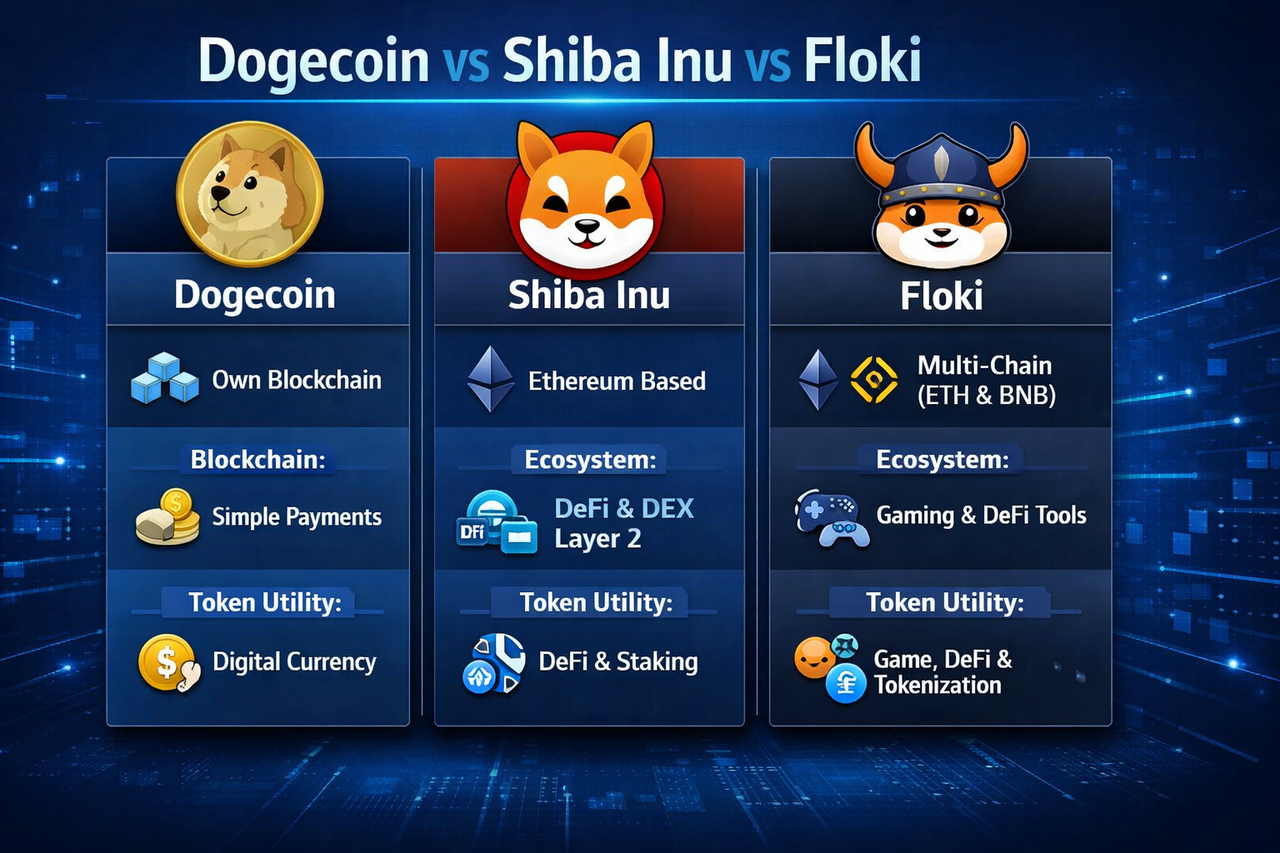
Built on Ethereum, Shiba Inu also originated from meme culture but has gradually expanded into a broader ecosystem that includes decentralized exchanges, NFTs, and Layer2 infrastructure.
Compared with Dogecoin, Shiba Inu places greater emphasis on ecosystem development. By introducing multiple tokens and infrastructure layers, it has evolved from a single meme asset into a more complex on-chain system with stronger functional extensibility.
As a multi-chain meme asset deployed on Ethereum and BNB Chain, Floki combines community-driven growth with functional ecosystem development. Through modules such as Valhalla, FlokiFi, and TokenFi, it builds real application scenarios, emphasizing a hybrid model of community engagement and utility-driven design.
Core Differences Across the Three Meme Projects
| Comparison Dimension |
Dogecoin |
Shiba Inu |
Floki |
| Underlying Architecture |
Independent blockchain |
Ethereum |
Ethereum + BNB Chain |
| Core Positioning |
Payment token |
Meme + DeFi ecosystem |
Meme + multi-scenario ecosystem |
| Ecosystem Modules |
Limited |
DEX, Layer2 |
Gaming, DeFi, tokenization |
| Scalability |
Moderate |
High |
High |
| Token Utility |
Payments |
Payments + DeFi |
Ecosystem functionality |
From a structural perspective, Dogecoin remains focused on payments, Shiba Inu emphasizes DeFi expansion, while Floki highlights multi-chain integration and modular coordination.
How Do Their Underlying Architectures Differ?
Dogecoin operates on its own native blockchain, meaning its functionality depends on its independent consensus mechanism. Shiba Inu, by contrast, is issued on Ethereum and relies on its infrastructure for security and scalability.
Floki adopts a dual-chain deployment across Ethereum and BNB Chain, enhancing interoperability and enabling broader ecosystem integration.
These architectural differences directly influence scalability and ecosystem compatibility. Dogecoin’s standalone structure offers independence, while Shiba Inu and Floki benefit from the extensibility of established blockchain ecosystems.
How Do Their Ecosystems Compare?
Dogecoin has relatively limited ecosystem functionality, with use cases primarily centered on payments and community tipping. Shiba Inu expands on this by incorporating decentralized exchanges and Layer2 solutions, forming a more layered ecosystem.
Floki goes further by integrating blockchain gaming, DeFi tools, and asset tokenization into its ecosystem. Compared with Dogecoin’s payment focus and Shiba Inu’s DeFi orientation, Floki emphasizes multi-scenario coordination across different application layers.
How Do Their Token Utilities Differ?
The primary function of Dogecoin is as a payment medium for transfers and transactions. Shiba Inu extends beyond payments to support DeFi interactions and ecosystem participation.
Floki positions its token as a functional asset within its ecosystem, supporting gaming interactions, DeFi tools, and tokenization services.
These differences reflect distinct design philosophies. Dogecoin prioritizes value transfer, Shiba Inu emphasizes financial ecosystem participation, and Floki focuses on enabling interconnected application scenarios.
Conclusion
Although Floki, Dogecoin, and Shiba Inu all fall under the category of meme tokens, they differ significantly in architecture, ecosystem structure, and token utility. Dogecoin represents a payment-focused model, Shiba Inu demonstrates expansion into DeFi ecosystems, and Floki illustrates the transition toward multi-chain, application-driven ecosystems.
FAQs
Are Floki, Dogecoin, and Shiba Inu all meme coins?
Yes, all three are considered meme coins, but they differ significantly in ecosystem development and functional scope.
What is the biggest difference between Dogecoin and Shiba Inu?
Dogecoin primarily functions as a payment token, while Shiba Inu has developed a broader ecosystem including decentralized exchanges and Layer2 solutions.
How is Floki different from Shiba Inu?
Shiba Inu focuses on DeFi ecosystem expansion, whereas Floki emphasizes blockchain gaming, DeFi tools, and multi-chain application scenarios.
Why does Floki use a multi-chain architecture?
A multi-chain approach improves interoperability and allows expansion across different blockchain ecosystems.
Which project has the most complex ecosystem?
Both Shiba Inu and Floki have relatively complex ecosystems, though their focus differs, Shiba Inu leans toward DeFi, while Floki emphasizes multi-scenario applications.
Why does Dogecoin have limited ecosystem expansion?
Dogecoin was designed primarily as a payment-focused digital asset, which limits its emphasis on broader ecosystem functionality.