DePIN Spotlight: Decentralized Energy Network Daylight Raises $75M Led by Framework Ventures

Beginner
Quick Reads
Last Updated 2026-03-28 09:51:14
Reading Time: 1m
The DePIN sector continues to advance. Decentralized energy network Daylight has secured $75 million in funding, led by Framework Ventures with participation from a16z crypto, Lerer Hippeau, and M13. This development signals the integration of electricity infrastructure with blockchain technology.

What Is the DePIN Sector?
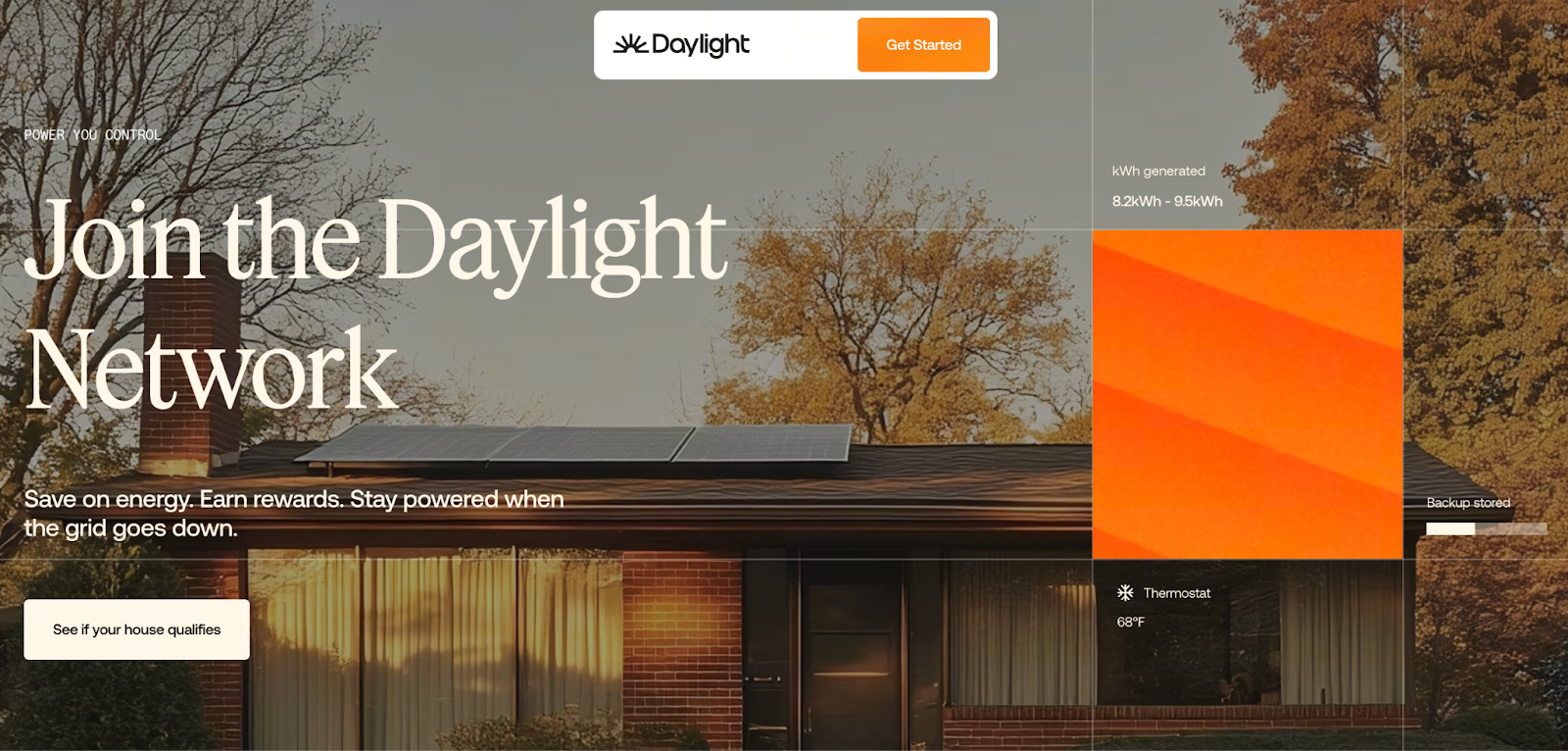

Image source: https://godaylight.com/

DePIN, or Decentralized Physical Infrastructure Networks, refers to leveraging blockchain and DeFi (Decentralized Finance) systems to build and operate real-world infrastructure—such as energy, connectivity, and transportation—in a decentralized manner. Unlike traditional models dominated by large corporations or government entities, the DePIN sector enables individual participation, asset tokenization, and revenue sharing. For example, residential solar panels and energy storage systems can be networked and incentivized using tokens, creating a decentralized physical infrastructure network.

This concept has recently drawn significant attention from both the crypto community and infrastructure investors, as it extends the Web3 paradigm into the physical world.

In energy, a typical scenario involves homeowners installing solar and storage systems connected to a network. During periods of high grid demand, these home devices can be integrated to support the grid, effectively acting as part of a “virtual power plant.” Participants not only reduce their electric bills but may also earn network tokens or other rewards. This model exemplifies the convergence of decentralized technology and physical infrastructure within the DePIN sector.

Daylight: Funding Overview and Key Stakeholders

Recently, Daylight Energy—a U.S. company specializing in decentralized energy networks—secured $75 million in funding. The round was split into two segments: $15 million in equity financing led by Framework Ventures, and $60 million in project development financing managed by Turtle Hill Capital.

  • Additional participants included a16z crypto, Lerer Hippeau, M13, Room40 Ventures, EV3, Crucible Capital, Coinbase Ventures, and Not Boring Capital.
  • Daylight’s business model transforms home solar and battery installations into “distributed power stations,” allowing users to subscribe for reduced electricity costs and provide energy storage to the grid during peak times for revenue. Additionally, the company has launched the DayFi protocol, connecting electricity infrastructure yields to the DeFi marketplace.

What Does This Funding Signal?

  • DePIN’s energy sector has hit a key milestone: Daylight’s funding demonstrates that decentralized infrastructure networks are moving beyond concept stage and gaining capital traction. As a core component of infrastructure, decentralized and on-chain energy solutions are attracting serious investor interest.
  • From hardware to monetization: Traditional solar-plus-storage models are expensive and slow to yield returns. By integrating residential devices into a network and introducing DeFi revenue mechanisms, Daylight is turning electricity into an investable asset. In short, hardware, services, and finance are converging.
  • Major institutional endorsement: Backing from leading investors like Framework Ventures and a16z crypto signals that “crypto and real-world infrastructure” is now on the mainstream capital radar, providing direction for future projects.
  • Significant commercial expansion potential: Daylight is currently piloting in Illinois and Massachusetts. With this funding, it can rapidly scale to new regions and upgrade the DayFi protocol, facilitating new connections between DeFi and the energy market.

Future Outlook and Risk Considerations

Key areas to watch:

  • Daylight’s global expansion strategy: With rising energy demand, more households may opt into distributed systems.
  • Evolution of the DayFi protocol: Can it enable mainstream investors to participate in the returns from residential generation and storage networks through digital channels?
  • Policy and regulatory environment: Subsidies are being reduced in many regions, and both traditional and distributed energy policies are shifting rapidly.

Potential risks include:

  • Market adoption remains uncertain: Will homeowners embrace the idea of treating their rooftops and batteries as “power plants” and participate?
  • Challenges persist around grid support capabilities, equipment maintenance costs, and return cycles.
  • The combination of crypto financial mechanisms with physical infrastructure is complex. It may encounter regulatory, technical, and security risks.
  • Local adaptation and operational costs for regional expansion could exceed expectations.
Author: Max
Disclaimer
* The information is not intended to be and does not constitute financial advice or any other recommendation of any sort offered or endorsed by Gate.
* This article may not be reproduced, transmitted or copied without referencing Gate. Contravention is an infringement of Copyright Act and may be subject to legal action.

Related Articles

What is Fartcoin? All You Need to Know About FARTCOIN
Intermediate

What is Fartcoin? All You Need to Know About FARTCOIN

Fartcoin (FARTCOIN) is a representative meme coin within the Solana ecosystem based on an AI-driven narrative. Its core concept originated from an experiment aimed at exploring the "boundaries between AI Agents and humor." More than just a digital asset with social attributes, the project deeply couples absurd humor culture with on-chain financial logic by integrating autonomous AI interaction models.
2026-04-04 22:01:19
Gold Price Forecast for the Next Five Years: 2026–2030 Trend Outlook and Investment Implications, Could It Reach $6,000?
Beginner

Gold Price Forecast for the Next Five Years: 2026–2030 Trend Outlook and Investment Implications, Could It Reach $6,000?

Analyze current gold price trends alongside authoritative five-year forecasts, integrating an evaluation of market risks and opportunities. This gives investors insight into the potential trajectory of gold prices and the main drivers expected to shape the market over the next five years.
2026-03-25 18:13:30
Aster vs Hyperliquid: Which Perp DEX Will Prevail?
Beginner

Aster vs Hyperliquid: Which Perp DEX Will Prevail?

Aster and Hyperliquid are the two representative protocols of the "purpose-built L1 path" within the current decentralized perpetual exchange (Perp DEX) sector. As a pioneer in the field, Hyperliquid has built a deep liquidity moat through its highly mature order book architecture and strong community consensus. Conversely, Aster, as a rising challenger, seeks to leapfrog the competition in high-performance trading through more aggressive multi-chain aggregation logic, private transaction modules, and an underlying execution environment optimized for 2026 market demands.
2026-03-24 11:58:33
AI-Native Settlement Layers: How United Stables Is Building the Next Financial Rail
Beginner

AI-Native Settlement Layers: How United Stables Is Building the Next Financial Rail

Stablecoins were originally designed as dollar substitutes within exchanges, primarily used for asset pricing and trade settlement. As on-chain financial ecosystems have matured, their role has expanded beyond simple payments to include collateral assets, cross-chain liquidity mediums, and unified settlement units. In particular, as AI systems and automated agents begin to participate directly in economic activity, demand has risen sharply for programmable value units capable of instant settlement. This shift is pushing stablecoins toward the role of foundational financial infrastructure.
2026-03-25 03:16:17
Aerodrome Tokenomics: How ve(3,3) Powers Base's Most Profitable DEX
Beginner

Aerodrome Tokenomics: How ve(3,3) Powers Base's Most Profitable DEX

AERO is the native token of Aerodrome Finance, a core decentralized exchange and liquidity protocol in the Base ecosystem. It is primarily used for liquidity incentives and ecosystem operations. veAERO is a governance NFT that users receive by locking AERO, representing both voting power and the right to share protocol revenue. Through a dual track structure of AERO as a utility token and veAERO as a governance credential, Aerodrome separates liquidity usage value from long term governance power, allowing participants to act as liquidity providers, governance decision makers, and revenue sharers within the same system.
2026-03-25 06:40:31
Hybrid Collateral Stablecoins: Inside United Stables' Stability and Yield Architecture
Beginner

Hybrid Collateral Stablecoins: Inside United Stables' Stability and Yield Architecture

In the early stages of the crypto market, traditional stablecoins mainly relied on single-reserve or single-collateral models. Their primary focus was price stability and payment convenience, which allowed them to become foundational tools for on-chain trading and capital flows. As the market has entered a more mature financial phase, however, this structure has begun to reveal limitations, including high concentration risk and the difficulty of balancing liquidity with yield. These constraints have driven the evolution toward multi-layer collateral and portfolio-based designs, such as the dual-layer hybrid collateral architecture proposed by United Stables, which seeks to redefine the underlying logic of stable assets.
2026-03-25 03:17:39





