Bitcoin Developer Proposes Wallet Recovery Mechanism for Future Quantum Threats

Last Updated 2026-04-10 09:47:27
Reading Time: 2m
As quantum computing technology continues to attract growing attention, the Bitcoin community has long debated how to safeguard the blockchain from potential quantum attacks in the future. Olaoluwa Osuntokun, Chief Technology Officer at Lightning Labs, recently introduced a new technical prototype designed to address a critical concern: if Bitcoin were to initiate a “quantum emergency defense mechanism,” many users could lose access to their assets. This prototype leverages an innovative mathematical verification method, enabling users to prove wallet ownership and recover their funds under exceptional circumstances.

Challenges Brought by Quantum Computers

At present, Bitcoin's security relies primarily on cryptographic algorithms. While these encryption methods are generally highly secure, theoretically, quantum computers with sufficient power could potentially break these mechanisms.

Potential risks include:

  • Attackers could deduce Private Keys from public blockchain data

  • If Private Keys are exposed, Wallet Assets could be stolen

Although such attacks remain theoretical for now, Developers have already begun working on defensive solutions.

BIP-360: Quantum Defense Upgrade Proposal

A significant proposal from the Bitcoin Group is BIP-360. The central idea is to introduce quantum-resistant Wallets, enabling users to proactively transfer Assets before quantum threats arise. Users can move BTC from old addresses to new, quantum-secure addresses. However, this approach has one drawback: not all users will transfer their Assets in time.

Side Effects of the Emergency Brake Mechanism

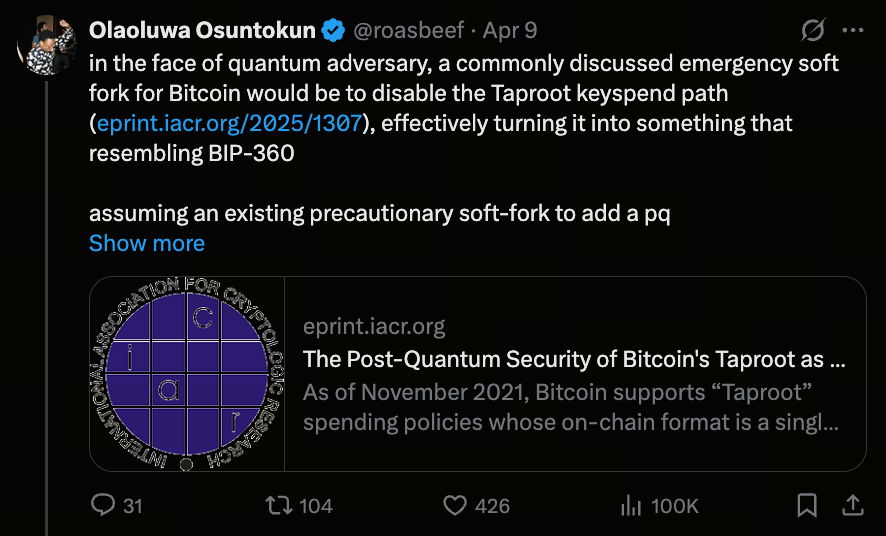
To counter quantum attacks, Developers have also considered a more Aggressive solution known as the Emergency Brake. This mechanism would shut down the network's digital Signature system upon detection of a quantum threat.

Because Bitcoin Trades depend on digital Signatures to prove ownership, disabling this system prevents attackers from forging Trades—but it also creates a major issue: many Wallets would lose the ability to spend funds. Taproot Wallets, widely adopted since 2021 and typically relying on a single Signature, would be especially impacted. If the Signature system is suspended, users can't prove ownership of their addresses, and their Wallet Assets could be permanently Frozen.

New Prototype: Proving Ownership with Seed Phrases

To address this challenge, Lightning Labs CTO Olaoluwa "Roasbeef" Osuntokun developed a new technical prototype that alters the method of ownership verification.

  1. Traditional approach: Digital Signatures prove Asset ownership

  2. New solution: Users mathematically prove they are the Wallet creator

The verification hinges on the Wallet seed phrase.

Every Bitcoin Wallet is generated from a unique seed. This system enables users to prove their Wallet was created from their own seed—without revealing the seed itself. As a result, even if this mechanism is used to recover Assets, other addresses generated from the same seed remain unaffected.
(Source: roasbeef)

Prototype System Test Results

Osuntokun has completed a functional technical prototype.

During testing:

  • Generating proof took about 55 seconds

  • Verification took less than 2 seconds

  • Proof file size was approximately 1.7 MB

This is similar to the size of a high-resolution image.

Developers emphasized that this is currently a side project and has not yet been optimized for performance.

Ongoing Debate Over Quantum Threats

The Bitcoin Group remains divided on the quantum computer threat. Some research suggests that most quantum breakthroughs are still in the theoretical or experimental phase, and attacking the entire Bitcoin network faces significant technical barriers. On the other hand, some Developers argue that, even if the risk is not immediate, preparing defensive measures in advance is essential.

Why This Prototype Is Significant

While not yet a formal proposal, this technical prototype addresses a critical gap. Previous discussions about Bitcoin's quantum defense always faced a dilemma: upgrades could protect the network but might also lock user Assets. Osuntokun's solution offers a balanced approach—enabling users to prove Wallet ownership and recover Assets in extreme scenarios.

Conclusion

Whether quantum computers pose a threat to Bitcoin remains controversial, but research into defensive mechanisms has persisted for years. The Wallet recovery prototype proposed by Lightning Labs' CTO presents an alternative for future emergency upgrades. If similar technology is integrated into the Bitcoin protocol, it could help protect network security while preventing the permanent freezing of large volumes of user Assets.

Author:  Allen
Disclaimer
* The information is not intended to be and does not constitute financial advice or any other recommendation of any sort offered or endorsed by Gate.
* This article may not be reproduced, transmitted or copied without referencing Gate. Contravention is an infringement of Copyright Act and may be subject to legal action.

Related Articles

In-depth Explanation of Yala: Building a Modular DeFi Yield Aggregator with $YU Stablecoin as a Medium
Beginner

In-depth Explanation of Yala: Building a Modular DeFi Yield Aggregator with $YU Stablecoin as a Medium

Yala inherits the security and decentralization of Bitcoin while using a modular protocol framework with the $YU stablecoin as a medium of exchange and store of value. It seamlessly connects Bitcoin with major ecosystems, allowing Bitcoin holders to earn yield from various DeFi protocols.
2026-03-24 11:55:44
The Future of Cross-Chain Bridges: Full-Chain Interoperability Becomes Inevitable, Liquidity Bridges Will Decline
Beginner

The Future of Cross-Chain Bridges: Full-Chain Interoperability Becomes Inevitable, Liquidity Bridges Will Decline

This article explores the development trends, applications, and prospects of cross-chain bridges.
2026-04-08 17:11:27
Solana Need L2s And Appchains?
Advanced

Solana Need L2s And Appchains?

Solana faces both opportunities and challenges in its development. Recently, severe network congestion has led to a high transaction failure rate and increased fees. Consequently, some have suggested using Layer 2 and appchain technologies to address this issue. This article explores the feasibility of this strategy.
2026-04-06 23:31:03
Sui: How are users leveraging its speed, security, & scalability?
Intermediate

Sui: How are users leveraging its speed, security, & scalability?

Sui is a PoS L1 blockchain with a novel architecture whose object-centric model enables parallelization of transactions through verifier level scaling. In this research paper the unique features of the Sui blockchain will be introduced, the economic prospects of SUI tokens will be presented, and it will be explained how investors can learn about which dApps are driving the use of the chain through the Sui application campaign.
2026-04-07 01:11:45
Navigating the Zero Knowledge Landscape
Advanced

Navigating the Zero Knowledge Landscape

This article introduces the technical principles, framework, and applications of Zero-Knowledge (ZK) technology, covering aspects from privacy, identity (ID), decentralized exchanges (DEX), to oracles.
2026-04-08 15:08:18
What is Tronscan and How Can You Use it in 2025?
Beginner

What is Tronscan and How Can You Use it in 2025?

Tronscan is a blockchain explorer that goes beyond the basics, offering wallet management, token tracking, smart contract insights, and governance participation. By 2025, it has evolved with enhanced security features, expanded analytics, cross-chain integration, and improved mobile experience. The platform now includes advanced biometric authentication, real-time transaction monitoring, and a comprehensive DeFi dashboard. Developers benefit from AI-powered smart contract analysis and improved testing environments, while users enjoy a unified multi-chain portfolio view and gesture-based navigation on mobile devices.
2026-03-24 11:52:42





