ADA Plunges 16% Overnight: When AI-Generated Trading Triggers a Cardano Chain Split

Last Updated 2026-03-27 07:47:02
Reading Time: 1m
In November 2025, Cardano faced an unexpected chain split when an AI-generated malformed transaction led to a temporary chain split. This incident caused ADA prices to plummet by 16% and resulted in significant concern within the crypto community.

What Was This Chain Split Incident?
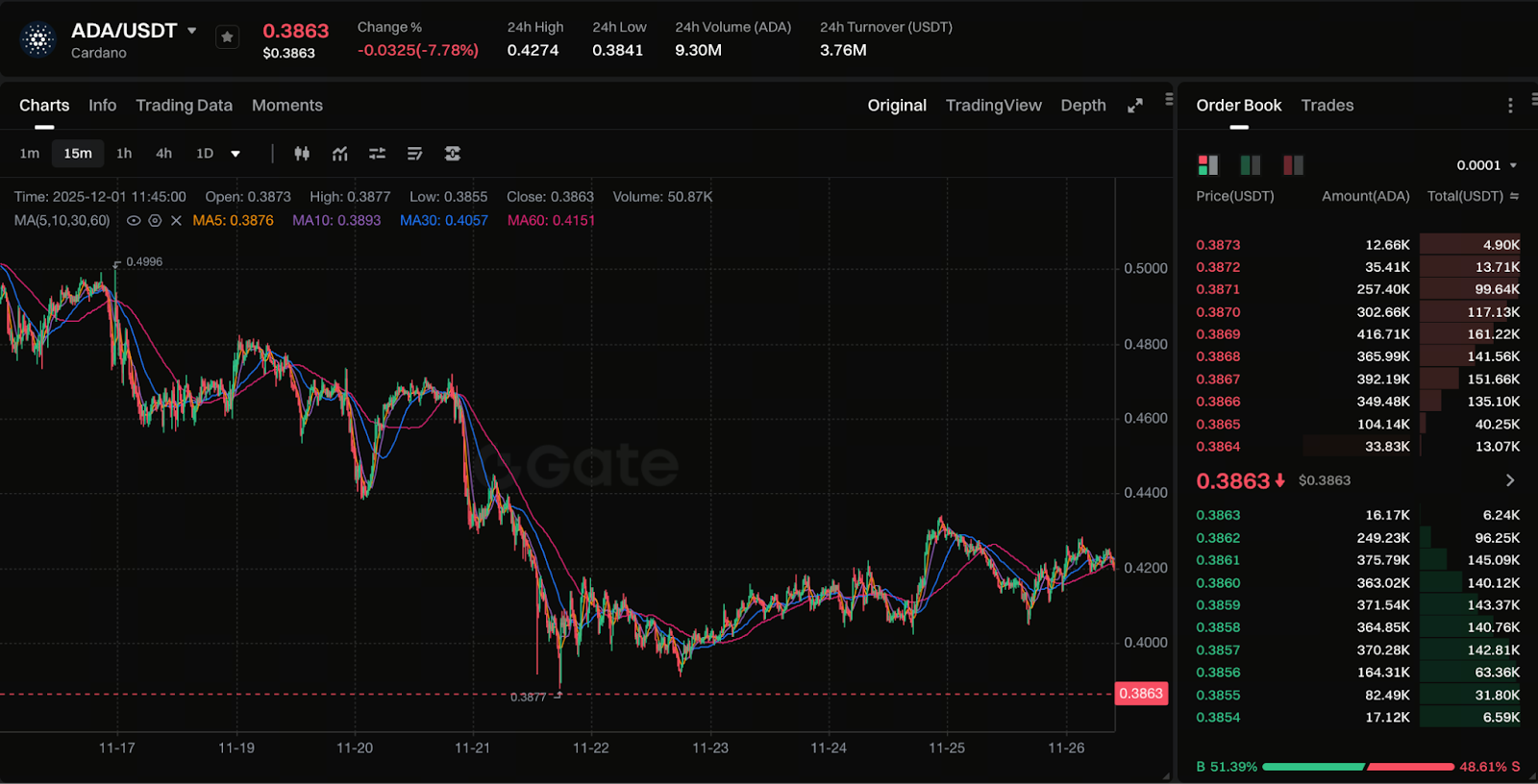

Image source: https://www.gate.com/trade/ADA_USDT

On November 21, the Cardano network suffered its most severe chain split since its 2017 launch. A “delegation transaction” with a malformed format was accepted by some nodes but rejected by others running older versions. This split the network into two conflicting ledgers.

During the incident, some nodes continued to add blocks to the forked chain (which included the faulty transaction), while others maintained the canonical chain (which excluded the abnormal transaction). As a result, two parallel chains emerged, causing disruptions in transaction confirmations, block explorers, and DeFi protocols.

How Did the “AI-Generated Transaction” Spark the Incident?

Reports indicate that the malformed transaction wasn’t manually entered. Instead, a developer used an AI tool to generate a script, which was then executed on the mainnet. The goal was to replicate a previous testnet anomaly, but running it on the mainnet triggered the vulnerability. Some developers described this as a “careless experiment,” while Cardano co-founder Charles Hoskinson publicly labeled it a “premeditated attack.”

Afterward, the user known as “Homer J” admitted responsibility on social media, stating the intent was to challenge and test the network, but the consequences were clearly underestimated.

ADA Price Movements and Market Response

News of the chain split triggered market volatility. ADA plunged about 16% at one point, reaching a low near $0.41.

Meanwhile, major exchanges including Coinbase, Upbit, and Kraken suspended ADA deposits and withdrawals to prevent double-spending or data inconsistencies during the split.

This event also raised doubts among investors about Cardano’s security and stability. Market confidence was undermined.

Community and Developer Response: Patches, Node Upgrades, and Restoring Consensus

The Cardano ecosystem responded swiftly to the split. The development team released node software updates to versions 10.5.2 and 10.5.3 within hours and coordinated stake pool operators to upgrade their nodes. By November 22, the network was reunited and normal operations resumed through the Ouroboros consensus protocol.

Officials also stressed that despite the seriousness of the incident, all wallet funds remained safe and asset safety was confirmed.

Long-Term Impact on Cardano’s Confidence and Risk

This split exposed several issues and long-term risks:

  • Bugs in node software had gone undetected for years, suggesting that core codebase review and testing may be insufficient.
  • A single AI-generated transaction destabilized the entire chain, highlighting new risks associated with integrating AI into blockchain systems.
  • Even with a swift recovery, the incident could have lasting effects on community trust, institutional adoption, and exchange confidence.

On the positive side, Cardano’s rapid response and patch deployment demonstrated strong emergency capabilities and team coordination. Enhanced code audits and improved security mechanisms may help the team manage these risks in the future.

Author: Max
Disclaimer
* The information is not intended to be and does not constitute financial advice or any other recommendation of any sort offered or endorsed by Gate.
* This article may not be reproduced, transmitted or copied without referencing Gate. Contravention is an infringement of Copyright Act and may be subject to legal action.

Related Articles

What is Fartcoin? All You Need to Know About FARTCOIN
Intermediate

What is Fartcoin? All You Need to Know About FARTCOIN

Fartcoin (FARTCOIN) is a representative meme coin within the Solana ecosystem based on an AI-driven narrative. Its core concept originated from an experiment aimed at exploring the "boundaries between AI Agents and humor." More than just a digital asset with social attributes, the project deeply couples absurd humor culture with on-chain financial logic by integrating autonomous AI interaction models.
2026-04-04 22:01:19
Gold Price Forecast for the Next Five Years: 2026–2030 Trend Outlook and Investment Implications, Could It Reach $6,000?
Beginner

Gold Price Forecast for the Next Five Years: 2026–2030 Trend Outlook and Investment Implications, Could It Reach $6,000?

Analyze current gold price trends alongside authoritative five-year forecasts, integrating an evaluation of market risks and opportunities. This gives investors insight into the potential trajectory of gold prices and the main drivers expected to shape the market over the next five years.
2026-03-25 18:13:30
Aster vs Hyperliquid: Which Perp DEX Will Prevail?
Beginner

Aster vs Hyperliquid: Which Perp DEX Will Prevail?

Aster and Hyperliquid are the two representative protocols of the "purpose-built L1 path" within the current decentralized perpetual exchange (Perp DEX) sector. As a pioneer in the field, Hyperliquid has built a deep liquidity moat through its highly mature order book architecture and strong community consensus. Conversely, Aster, as a rising challenger, seeks to leapfrog the competition in high-performance trading through more aggressive multi-chain aggregation logic, private transaction modules, and an underlying execution environment optimized for 2026 market demands.
2026-03-24 11:58:33
AI-Native Settlement Layers: How United Stables Is Building the Next Financial Rail
Beginner

AI-Native Settlement Layers: How United Stables Is Building the Next Financial Rail

Stablecoins were originally designed as dollar substitutes within exchanges, primarily used for asset pricing and trade settlement. As on-chain financial ecosystems have matured, their role has expanded beyond simple payments to include collateral assets, cross-chain liquidity mediums, and unified settlement units. In particular, as AI systems and automated agents begin to participate directly in economic activity, demand has risen sharply for programmable value units capable of instant settlement. This shift is pushing stablecoins toward the role of foundational financial infrastructure.
2026-03-25 03:16:17
ASTER Tokenomics: Buybacks, Burns, and Staking as the Value Foundation of ASTER in 2026
Beginner

ASTER Tokenomics: Buybacks, Burns, and Staking as the Value Foundation of ASTER in 2026

ASTER is the native equity and governance token of the Aster ecosystem, with its core value built upon a radical "Deflationary Engine." Beyond serving as a governance tool, ASTER integrates multiple utilities including staking rewards, trading fee discounts, and liquidity incentives. Through its deep integration with the upcoming dedicated Layer 1 mainnet, it enables direct value capture from protocol cash flow to token holders.
2026-03-25 07:38:07
Hybrid Collateral Stablecoins: Inside United Stables' Stability and Yield Architecture
Beginner

Hybrid Collateral Stablecoins: Inside United Stables' Stability and Yield Architecture

In the early stages of the crypto market, traditional stablecoins mainly relied on single-reserve or single-collateral models. Their primary focus was price stability and payment convenience, which allowed them to become foundational tools for on-chain trading and capital flows. As the market has entered a more mature financial phase, however, this structure has begun to reveal limitations, including high concentration risk and the difficulty of balancing liquidity with yield. These constraints have driven the evolution toward multi-layer collateral and portfolio-based designs, such as the dual-layer hybrid collateral architecture proposed by United Stables, which seeks to redefine the underlying logic of stable assets.
2026-03-25 03:17:39