2026 IBIT ETF Price Trends and Market Dynamics: A Complete Analysis

Beginner
Quick Reads
Last Updated 2026-03-26 03:39:44
Reading Time: 1m
A thorough breakdown of the latest IBIT ETF price movements, market trends, and institutional fund flows, designed to give you clear insight into Bitcoin ETF investment opportunities, associated risks, and evolving market sentiment.

What Is the IBIT ETF?

IBIT, short for iShares Bitcoin Trust ETF, is an exchange-traded fund launched by BlackRock, the world’s largest asset manager. This ETF tracks the price of Bitcoin and offers exposure through a regulated security structure, rather than direct Bitcoin ownership. IBIT is listed on exchanges like Nasdaq, allowing traditional investors to access Bitcoin markets. Its price moves in tandem with spot Bitcoin prices.

IBIT: Latest Price and Market Performance
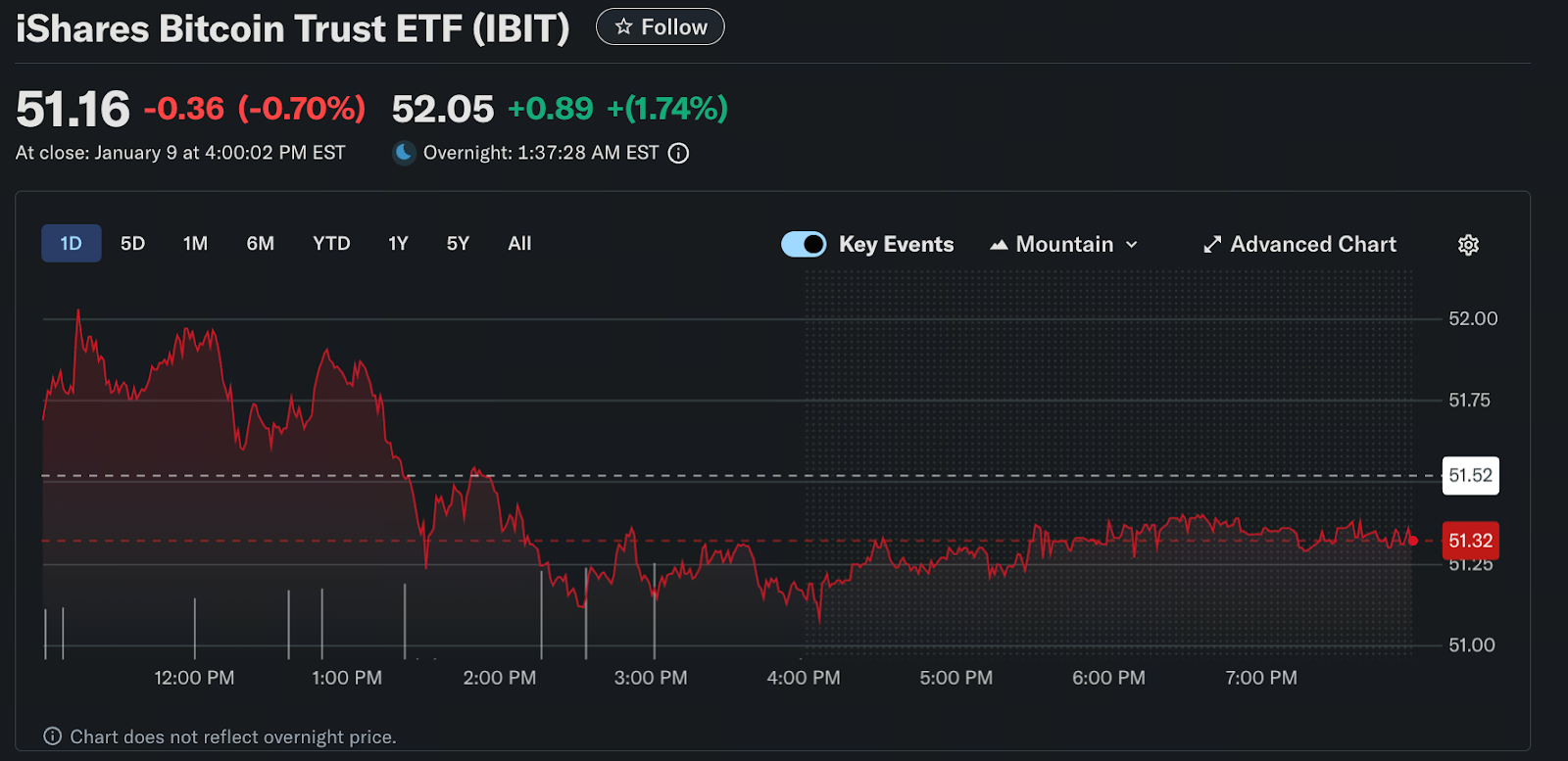

Chart: https://finance.yahoo.com/quote/IBIT/

As of early January, IBIT traded at approximately $53, showing a period of consolidation. While Bitcoin itself hovered around $90,000, IBIT’s price reflected the spot market, influenced by tracking error and liquidity conditions unique to the ETF structure.

Trading activity in IBIT has picked up recently. On November 22, for example, IBIT’s daily trading volume hit $8 billion—a record since its inception—highlighting robust institutional participation.

Analysis of Capital Inflows and Outflows

Capital flows in IBIT serve as a barometer for institutional interest. Despite Bitcoin’s volatility, IBIT has seen consistent inflows during certain periods. In mid-October, for instance, IBIT recorded consecutive days of net inflows, signaling that institutions remain cautiously optimistic about Bitcoin’s long-term prospects.

However, capital movement is not always one-directional. The market has witnessed significant outflows at times, with some reports noting historic withdrawals from IBIT in certain months. These trends often correlate with Bitcoin price swings, macroeconomic shifts, and short-term profit taking. Overall, IBIT’s capital flows are cyclical and should be evaluated alongside Bitcoin’s broader market trajectory.

IBIT: Market Sentiment and Options Volatility

Market sentiment analysis shows that IBIT’s options market has exhibited a bearish tilt during certain periods. This suggests traders are buying protective options amid uncertainty, reflecting skepticism about near-term upside potential.

At the same time, options activity has increased IBIT’s market dominance. Reports indicate a substantial portion of IBIT’s assets under management involves options strategies, further solidifying its influence in the Bitcoin ETF sector.

Key Risks for IBIT Investors

ETF investors should consider the following risks:

  • Tracking error: IBIT’s price may not perfectly mirror spot Bitcoin, leading to discrepancies.
  • Market volatility: Bitcoin’s sharp price swings directly impact IBIT’s performance.
  • Liquidity risk: Periods of capital outflow can affect both liquidity and market expectations.

These risks are inherent when traditional ETFs intersect with the crypto market.

Summary: IBIT’s Outlook

As one of the largest Bitcoin ETFs, IBIT has significantly broadened access for both institutional and retail investors. In the short term, its price will remain sensitive to Bitcoin spot prices, macroeconomic policy, and institutional flows. Over the medium to long term, as the crypto market matures, IBIT may attract even greater investor participation.

For those seeking Bitcoin exposure without the complexities of direct ownership, IBIT offers a regulated and convenient alternative. However, prospective investors should thoroughly understand its risks and structural characteristics before investing.

Author: Max
Disclaimer
* The information is not intended to be and does not constitute financial advice or any other recommendation of any sort offered or endorsed by Gate.
* This article may not be reproduced, transmitted or copied without referencing Gate. Contravention is an infringement of Copyright Act and may be subject to legal action.

Related Articles

What is Fartcoin? All You Need to Know About FARTCOIN
Intermediate

What is Fartcoin? All You Need to Know About FARTCOIN

Fartcoin (FARTCOIN) is a representative meme coin within the Solana ecosystem based on an AI-driven narrative. Its core concept originated from an experiment aimed at exploring the "boundaries between AI Agents and humor." More than just a digital asset with social attributes, the project deeply couples absurd humor culture with on-chain financial logic by integrating autonomous AI interaction models.
2026-04-04 22:01:19
Gold Price Forecast for the Next Five Years: 2026–2030 Trend Outlook and Investment Implications, Could It Reach $6,000?
Beginner

Gold Price Forecast for the Next Five Years: 2026–2030 Trend Outlook and Investment Implications, Could It Reach $6,000?

Analyze current gold price trends alongside authoritative five-year forecasts, integrating an evaluation of market risks and opportunities. This gives investors insight into the potential trajectory of gold prices and the main drivers expected to shape the market over the next five years.
2026-03-25 18:13:30
AI-Native Settlement Layers: How United Stables Is Building the Next Financial Rail
Beginner

AI-Native Settlement Layers: How United Stables Is Building the Next Financial Rail

Stablecoins were originally designed as dollar substitutes within exchanges, primarily used for asset pricing and trade settlement. As on-chain financial ecosystems have matured, their role has expanded beyond simple payments to include collateral assets, cross-chain liquidity mediums, and unified settlement units. In particular, as AI systems and automated agents begin to participate directly in economic activity, demand has risen sharply for programmable value units capable of instant settlement. This shift is pushing stablecoins toward the role of foundational financial infrastructure.
2026-03-25 03:16:17
Aster vs Hyperliquid: Which Perp DEX Will Prevail?
Beginner

Aster vs Hyperliquid: Which Perp DEX Will Prevail?

Aster and Hyperliquid are the two representative protocols of the "purpose-built L1 path" within the current decentralized perpetual exchange (Perp DEX) sector. As a pioneer in the field, Hyperliquid has built a deep liquidity moat through its highly mature order book architecture and strong community consensus. Conversely, Aster, as a rising challenger, seeks to leapfrog the competition in high-performance trading through more aggressive multi-chain aggregation logic, private transaction modules, and an underlying execution environment optimized for 2026 market demands.
2026-03-24 11:58:33
Aerodrome Tokenomics: How ve(3,3) Powers Base's Most Profitable DEX
Beginner

Aerodrome Tokenomics: How ve(3,3) Powers Base's Most Profitable DEX

AERO is the native token of Aerodrome Finance, a core decentralized exchange and liquidity protocol in the Base ecosystem. It is primarily used for liquidity incentives and ecosystem operations. veAERO is a governance NFT that users receive by locking AERO, representing both voting power and the right to share protocol revenue. Through a dual track structure of AERO as a utility token and veAERO as a governance credential, Aerodrome separates liquidity usage value from long term governance power, allowing participants to act as liquidity providers, governance decision makers, and revenue sharers within the same system.
2026-03-25 06:40:31
Hybrid Collateral Stablecoins: Inside United Stables' Stability and Yield Architecture
Beginner

Hybrid Collateral Stablecoins: Inside United Stables' Stability and Yield Architecture

In the early stages of the crypto market, traditional stablecoins mainly relied on single-reserve or single-collateral models. Their primary focus was price stability and payment convenience, which allowed them to become foundational tools for on-chain trading and capital flows. As the market has entered a more mature financial phase, however, this structure has begun to reveal limitations, including high concentration risk and the difficulty of balancing liquidity with yield. These constraints have driven the evolution toward multi-layer collateral and portfolio-based designs, such as the dual-layer hybrid collateral architecture proposed by United Stables, which seeks to redefine the underlying logic of stable assets.
2026-03-25 03:17:39





