Porque é que a rotação sectorial está a acelerar?
No mercado atual, a “rotação rápida” deixou de ser apenas uma perceção para se tornar um facto estrutural. Existem pelo menos três motores principais:
-
A informação circula agora em tempo real: Redes sociais, KOL e ferramentas de monitorização on-chain reduziram o tempo de “detetar setores em alta” para apenas alguns minutos. Tendências que antes proporcionavam uma janela de meia fase são agora, muitas vezes, negociadas antecipadamente.
-
Os fluxos de capital são cada vez mais de curto prazo: A fatia de capital proveniente de futuros, fundos quant e estratégias orientadas por eventos está a crescer, originando movimentos de preços cada vez mais frequentes do tipo “subidas rápidas — divergências abruptas — rotação célere”.
-
A duração das narrativas está a encurtar: Projetos com conceitos semelhantes são lançados em rápida sucessão, fragmentando constantemente a atenção do mercado. Narrativas que antes dominavam durante semanas ou meses agora duram muito menos, provocando rotações pulsadas dentro de zonas específicas.
Resultado: Existem mais oportunidades, mas a “janela de participação segura” é muito mais curta.
Os quatro erros mais comuns dos investidores de retalho
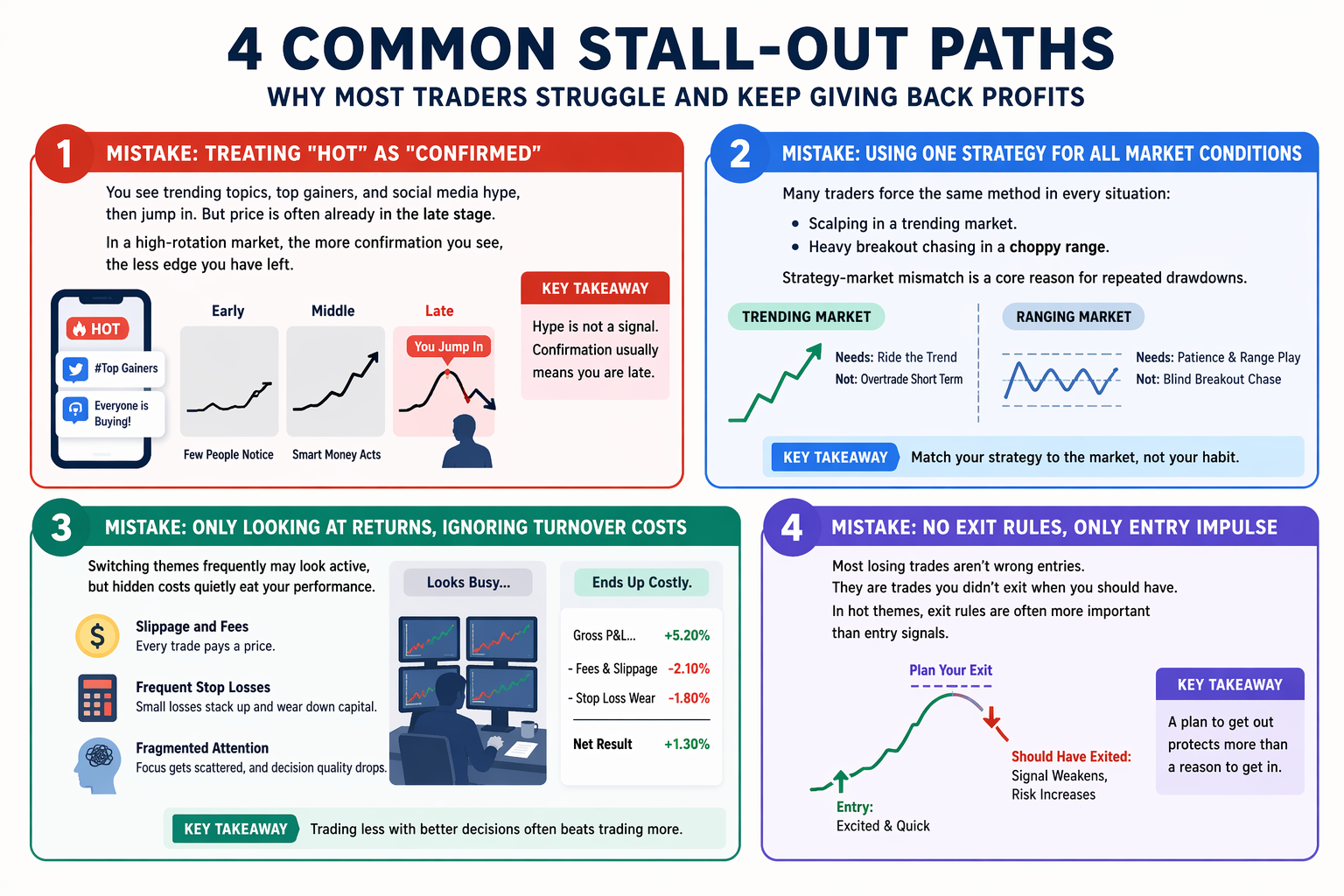
1. Confundir “detetar um setor em alta” com “confirmar uma oportunidade”
Entrar apenas após identificar pesquisas em tendência, maiores altas ou burburinho nas redes sociais significa, na maioria das vezes, chegar tarde à negociação.
Num ambiente de rotação acelerada, quanto mais confirmação se procura, menor é a vantagem no preço.
2. Aplicar uma única estratégia a todos os ciclos de mercado
Muitos negociadores aplicam o mesmo manual a todas as situações:
3. Focar-se nos retornos e ignorar os custos de rotação
Trocar frequentemente de setor pode “parecer produtivo”, mas os custos ocultos são elevados:
-
Derrapagens e taxas de negociação;
-
Erosão de capital por stop-losses frequentes;
-
Atenção dispersa reduz a qualidade das decisões.
4. Ter impulsos de entrada mas sem regras de saída
A maioria das negociações perdedoras não resulta de comprar o ativo errado, mas sim de não sair quando é necessário.
Na negociação de setores em alta, as regras de saída são normalmente mais importantes do que os sinais de entrada.
Estratificar o mercado antes de agir
O primeiro passo para não ficar para trás não é colocar ordens mais rápido — é perceber “em que camada de mercado se está”.
Utilizar uma estrutura de três camadas:
-
Camada principal (Beta): Impulsionada pela liquidez macro e tendências dos principais ativos. Pergunta: O mercado está em modo ofensivo ou defensivo?
-
Camada de rotação sectorial: Narrativas que rodam abaixo da principal, como RWA, DePIN, L2, Meme, etc. Pergunta: Que tipo de ativos está o capital a valorizar neste momento?
-
Camada de moedas individuais (Execução): Entradas e saídas em ativos específicos. Pergunta: Estão definidos os pontos de probabilidade e de invalidação para esta negociação?
Muitos erros resultam de “saltar as duas primeiras camadas e ir diretamente para a terceira”. Quando a camada principal está defensiva, até as moedas mais fortes tendem a disparar e recuar de seguida.
Estrutura executável de gestão de ritmo: 24 h - 72 h - 7 d
Este é o modelo de execução mais prático para investidores de retalho. O princípio fundamental: passar de um ritmo de negociação “emocional” para um ritmo “baseado em janelas temporais”.
24 h: Observação e filtragem
O objetivo não é negociar, mas sim filtrar o ruído.
Fazer apenas três tarefas diárias:
-
Confirmar se as entradas de capital no setor se mantêm;
-
Verificar se o líder do setor está a romper em volume ou a subir e recuar;
-
Observar padrões de “divergência em topo + retransmissão em base” no mercado.
Resultado: Manter apenas 2–3 direções candidatas, sem pressa para entrar.
72 h: Confirmação e posições de teste
Num horizonte de três dias, validar se a narrativa é sustentável.
Foco em:
-
Existe uma segunda linha de ativos a acompanhar?
-
O recuo do líder do setor está a ser suportado?
-
Notícias negativas causam danos estruturais?
Princípios de execução:
-
Iniciar com pequenas posições de teste, adicionar só após validação;
-
Não aumentar o limite de posição por causa de uma subida num dia;
-
Se os critérios de invalidação forem atingidos, cortar posições mecanicamente.
7 d: Atribuição e ajuste
A revisão semanal define o ritmo para a semana seguinte.
Foco em quatro perguntas:
-
Os lucros resultaram de bom julgamento ou de sorte e volatilidade?
-
As perdas foram por erro de direção ou de execução?
-
Que negociações foram “erros dentro do plano” e quais foram “erros fora da disciplina”?
-
Que tipos de negociações devem ser reduzidas na próxima semana?
A rentabilidade consistente resulta, geralmente, de “cometer menos erros repetidos” — não de “apanhar todos os setores em alta”.
Dimensionamento de posição e controlo de risco: sobreviver primeiro à rotação rápida
Em mercados de rotação acelerada, o maior risco não é um erro isolado — é manter posições excessivas após perdas sucessivas.
Considerar um “modelo escalonado de dimensionamento de posições”:
-
Posição base (Defensiva): 40%–60% em caixa e ativos de elevada liquidez, evitando perseguir máximos.
-
Posição de oportunidade (Ofensiva): 20%–40% alocados apenas a oportunidades setoriais confirmadas — nunca negociações emocionais.
-
Posição de teste (Exploratória): 10%–20% para narrativas em fase inicial, com stop-losses rigorosos.
Regras de controlo de risco:
-
Fixar o orçamento de risco por negociação; não aumentar só porque uma negociação “parece forte”;
-
Se houver perdas consecutivas até um certo limite, reduzir automaticamente a frequência de negociação;
-
Reduzir proativamente a exposição líquida antes de grandes eventos.
Em fases de elevada volatilidade, a própria gestão de posições é Alpha.
Estas proporções são apresentadas como exemplo educativo para ilustrar o raciocínio de gestão de risco em mercados de rotação rápida. Não constituem aconselhamento de investimento nem garantem retorno. O capital, a tolerância ao risco, a experiência de negociação e a liquidez variam muito entre negociadores. Cada um deve avaliar de forma independente a sua abordagem e dimensionar sempre as posições dentro da sua tolerância à perda. Em mercados voláteis, os preços podem abrir gaps e a liquidez deteriorar-se rapidamente. Estratégias de stop-loss podem também sofrer derrapagem e risco de execução incompleta.
Como distinguir uma “nova camada principal” de “ruído de curto prazo”
Para avaliar se um setor em alta pode passar de “notícia de trading” a “verdadeira camada principal”, utilizar estes cinco filtros:
-
Sustentabilidade: Há suporte de capital durante 3–5 dias de negociação consecutivos?
-
Difusão: O impulso está a espalhar-se de um líder para ativos semelhantes?
-
Qualidade da redução: O recuo é uma consolidação de baixo volume ou um colapso de alto volume?
-
Densidade de catalisadores: Existem catalisadores fundamentais ou políticos contínuos, ou apenas eventos pontuais?
-
Saturação de negociação: Se financiamento, taxas de financiamento e indicadores de sentimento estão todos sobreaquecidos, atenção ao risco de fase final.
Uma camada principal negociável cumpre, normalmente, os primeiros quatro critérios sem sobreaquecimento no quinto.
Processo anti-FOMO: proteger contra negociação emocional
Para investidores de retalho, o mais difícil não é a análise, mas sim o autocontrolo no momento. Criar um processo de decisão de cinco minutos; confirmar cada ponto antes de negociar:
-
A que camada lógica pertence esta negociação (principal / setor / moeda individual)?
-
A entrada baseia-se em dados ou em sentimento das redes sociais?
-
Qual é o gatilho de invalidação e será executado se for atingido?
-
O tamanho da posição está dentro do orçamento de risco pré-definido?
-
Se estiver errado, é possível recuperar a perda na próxima semana?
Se não for possível responder claramente a algum ponto, optar por não negociar.
Em mercados de alta velocidade, “perder oportunidades” normalmente custa menos do que “cometer erros”.
Conclusão: a negociação está a passar de “perseguir setores em alta” para “gerir o ritmo”
A aceleração da rotação de setores em alta não vai terminar em breve — é simultaneamente um desafio e um ponto de viragem.
O modelo antigo focava-se em “encontrar o próximo grande vencedor”; o novo modelo consiste em “manter execução consistente em ambientes de alta frequência”.
Para investidores de retalho, a vantagem sustentável resume-se a três pontos:
-
Avaliação estratificada: Analisar o estado geral do mercado antes de se focar em oportunidades específicas;
-
Execução baseada em regras: Substituir o impulso por uma estrutura fixa;
-
Revisão contínua: Transformar cada oscilação do mercado num passo para maior disciplina.
O mercado não abranda por falta de preparação, mas com um sistema estável de gestão de ritmo, é possível alcançar um objetivo fundamental:
Mesmo que não se apanhe todos os setores em alta, não se será eliminado em todas as rotações.