MHuy_HCCVenture

vip
Age 1 Year
Peak Tier 3
No content yet
Signs of an upcoming uptrend #crypto:
"Vietnam's social network X is starting to have more self-proclaimed experts showing off their trading signals and battle with each other."
Calm down everyone !
post-image
  • Reward
  • Comment
  • Repost
  • Share
Hey Short-er,
Are you oke ? I hope you come to hospital soon !
Bullish season todamon !!!
📈📈📈
  • Reward
  • Comment
  • Repost
  • Share
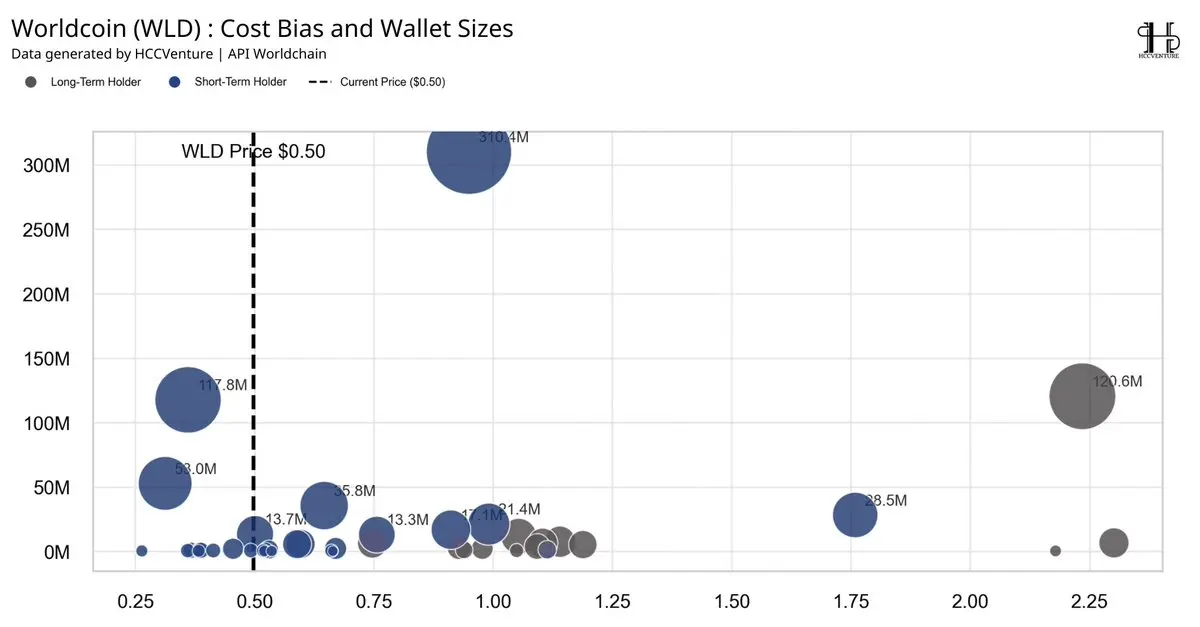
ethereum:0x163f8c2467924be0ae7b5347228cabf260318753 suggests that the redistribution of supply may be complete.
The largest portion of the ecosystem's supply is no longer held by long-term (LTH) holders, but has shifted to short-term (STH) holders with significantly lower cost.
- The largest cluster of supply is currently located at $0.95, where STH holds approximately 310.4 million ethereum:0x163f8c2467924be0ae7b5347228cabf260318753.
- Other key support zones include:
• 117.8 million ethereum:0x163f8c2467924be0ae7b5347228cabf260318753 at $0.36
• 53 million ethereum:0x163f8c2467924be0ae7b534
WLD-1.21%
post-image
  • Reward
  • Comment
  • Repost
  • Share
Hey short-er, are you oke ???
post-image
  • Reward
  • Comment
  • Repost
  • Share
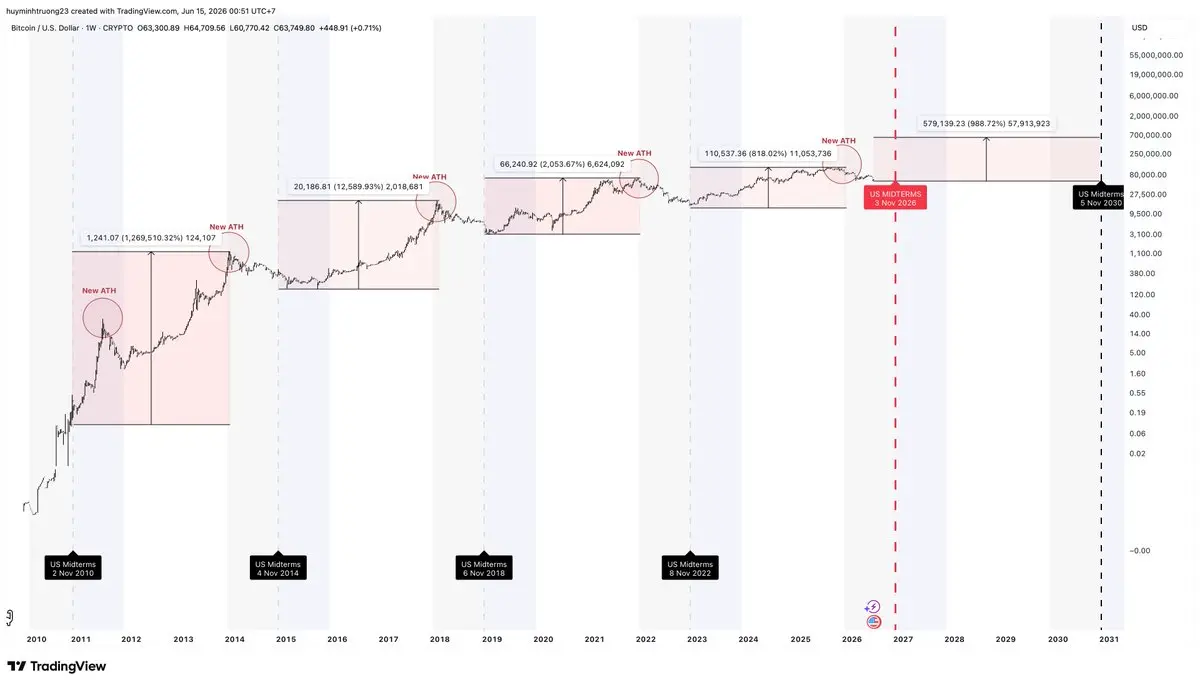
The simplest yet most effective strategy in Bitcoin history ? Buy after the US Midterms.
Looking back at #Bitcoin's entire history, a nearly perfect pattern has repeated itself for four consecutive cycles:
- Midterms 2010 → $BTC increased by +273,924%
- Midterms 2014 → $BTC increased by +7,574%
- Midterms 2018 → $BTC increased by +2,088%
- Midterms 2022 → $BTC increased by +689%
The interesting point isn't the absolute increase, but the fact that the peak of the cycle usually occurs 12–24 months after the US midterm elections.
The reason may stem from liquidity cycles and policy:
- After the M
BTC-3.00%
post-image
  • Reward
  • Comment
  • Repost
  • Share
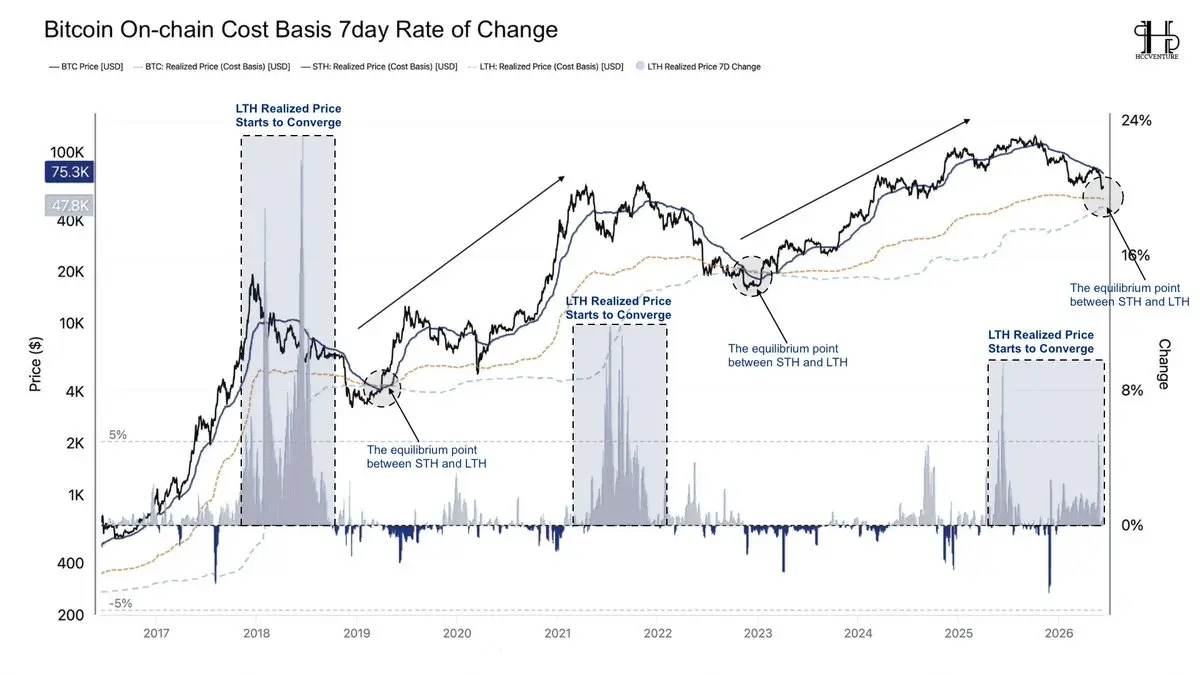
📊 #Bitcoin is approaching a crucial equilibrium point in its cycle.
The chart shows that the LTH Realized Price (the cost basis of long-term holders) is beginning to converge towards the STH Realized Price (the cost basis of short-term holders), a phenomenon that has appeared at major transitions in previous cycles.
- 2018-2019: LTH Cost Basis began to accelerate and converge -> the market completed accumulation, opening a new bull cycle.
- 2022-2023: A similar process occurred after the FTX bottom -> #Bitcoin entered a bull market in 2023-2025.
- Currently in 2026: The 7-day rate of change o
BTC-3.00%
post-image
  • Reward
  • Comment
  • Repost
  • Share
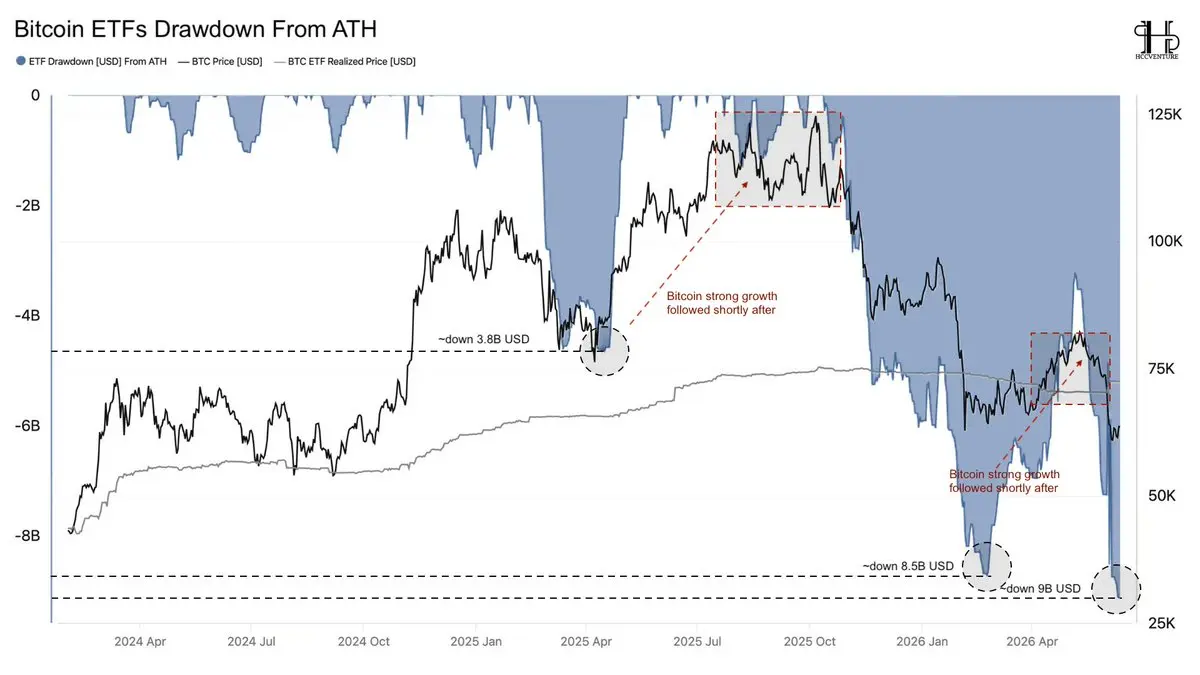
Does the market always go against the trend when #Bitcoin ETFs enter their most painful phase ?
- History has coincided three times since the ETF Spot was approved.
The unrealized loss (drawdown from ATH) has now reached nearly $9 billion, surpassing the previous low of around $8.5 billion.
This has happened in all three instances:
- Drawdown of approximately $4 billion → #Bitcoin surged immediately afterward.
- Drawdown of approximately $8.5 billion → #Bitcoin continued its strong recovery.
- Currently, the drawdown is nearly $9 billion → a new extreme point in the cycle.
At the same time, th
BTC-3.00%
post-image
  • Reward
  • Comment
  • Repost
  • Share
There's some confusion regarding the decrease in user wallet demand. I'd like to reassess the situation as follows:
Although the number of wallets receiving the first grant has dropped sharply from a peak of over 50,000 wallets/day to below 10,000 wallets/day, it's important to note that World has repeatedly adjusted its incentive mechanism and reward distribution methods during the 2025–2026 period.
Previously:
- Users verifying Orb -> directly receive WLD grant.
- The “First Grant” index increased significantly because all new users received tokens immediately.
Afterward:
- World shifted to
WLD-1.21%
  • Reward
  • Comment
  • Repost
  • Share
I will dip alot at time !
  • Reward
  • Comment
  • Repost
  • Share
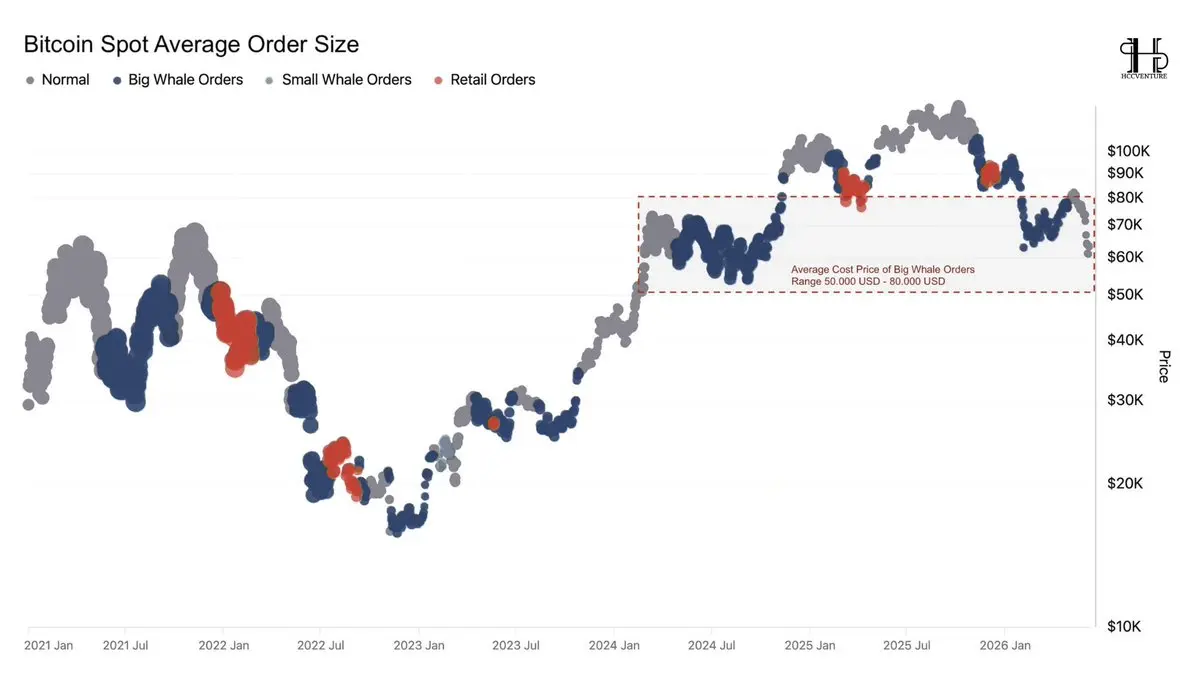
Whale capital flows continue to dominate the market structure, with the $50,000-$80,000 price range becoming a crucial capital base for the cycle.
Data from #HCCVenture shows that #Bitcoin is still being led by Big Whale Orders, while the trading volume of retail investors continues to decline significantly.
- The $50,000 to $80,000 price range is emerging as the main accumulation area for large-scale orders, forming a crucial cost of capital base for the entire current market structure.
Institutional capital participation has become the main driver of the market, significantly replacing the r
BTC-3.00%
post-image
  • Reward
  • Comment
  • Repost
  • Share
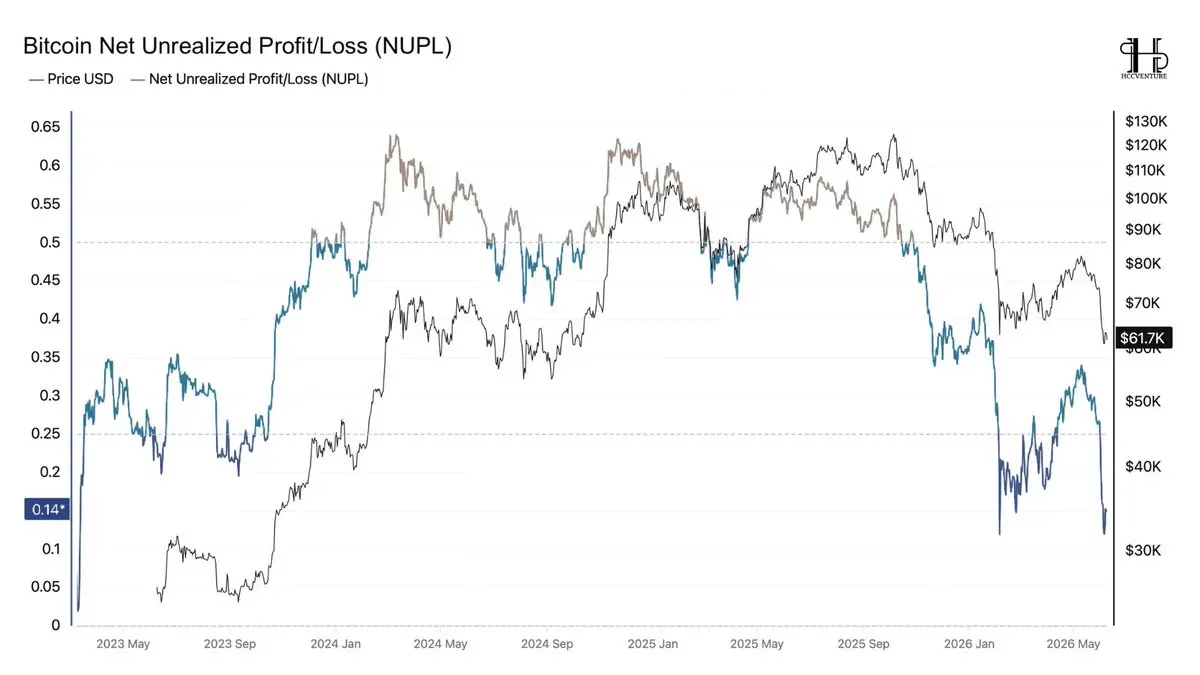
Net Unrealized Profit/Loss (NUPL) reflects the sharp decline of Bitcoin to 0.14.
- A 77% decrease in value compared to the most recent cycle (0.62 - 0.63)
Observing the historical trend on the chart shows that the period from Q4/2023 to Q3/2025 was the strongest profit expansion period of the current cycle. During this time, NUPL consistently fluctuated above 0.50 and repeatedly approached the 0.60-0.63 range.
- This area typically reflects a state where a large portion of the #Bitcoin supply holds significant unrealized profits.
Historical statistics from #HCCVenture show that whenever NUPL e
BTC-3.00%
post-image
  • Reward
  • Comment
  • Repost
  • Share
I hope can I get 10k follow soon ! 😅😅😅
post-image
  • Reward
  • Comment
  • Repost
  • Share
#Bitcoin has swept away almost all of the long liquidity below the current price in the recent period!
Currently, the area containing the largest amount of liquidity is no longer below the price but above, densely concentrated in the $80,000 – $100,000 range.
According to liquidation data from @coinglass_com , billions of USD in short positions are waiting to be swept at these price levels.
#Bitcoin hasn't reacted much to the information as in history:
- Global M2 just reached a new historical peak above $101 trillion
- Mt.Gox continues to move $BTC but doesn't create significant selling press
BTC-2.94%
  • Reward
  • Comment
  • Repost
  • Share
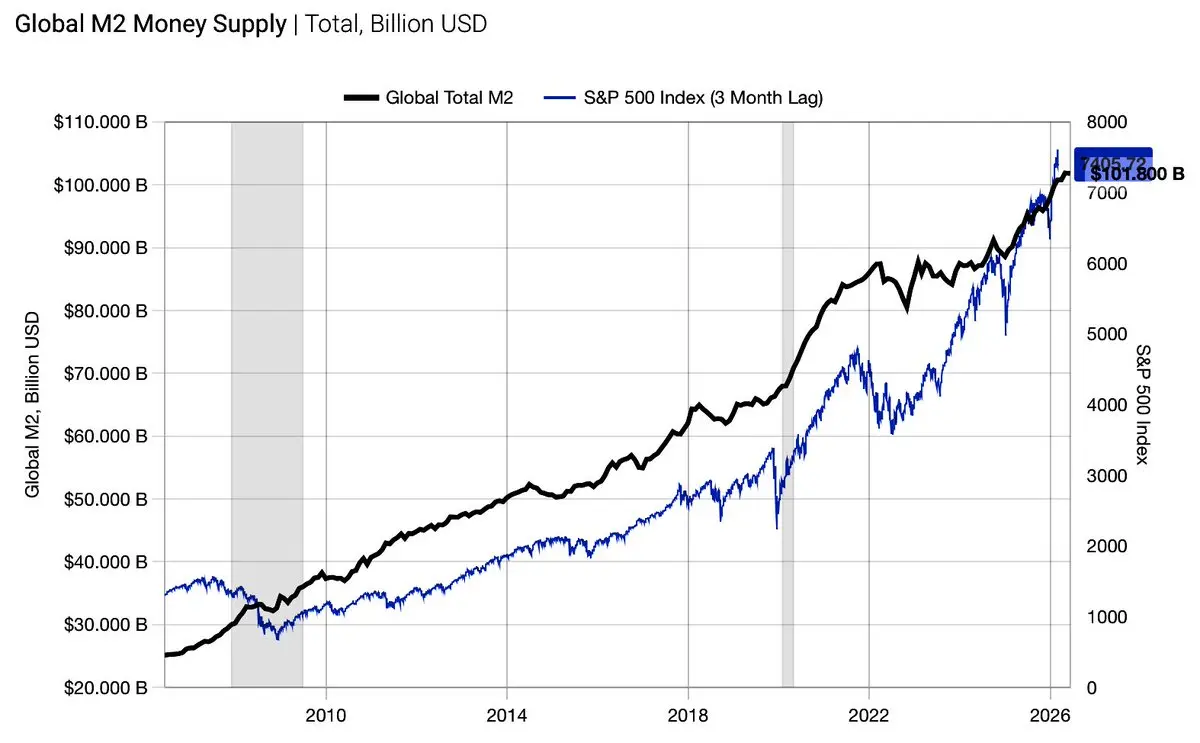
The S&P 500 is reflecting the global M2 money supply.
The chart shows an incredible correlation between Global M2 and the S&P 500 with a lag of approximately 3 months.
Over the past 15 years, almost every major growth cycle in US stocks has been driven by the expansion of global liquidity:
• 2009–2021: M2 surged -> S&P entered its longest bull market in history.
• 2022: M2 contracted for the first time in decades -> bear market.
• 2023–2026: M2 recovered and continuously reached new highs -> S&P 500 also returned to its all-time high.
The Fed may still keep interest rates high. Bonds may sig
SPX13.06%
BTC-3.00%
post-image
  • Reward
  • Comment
  • Repost
  • Share
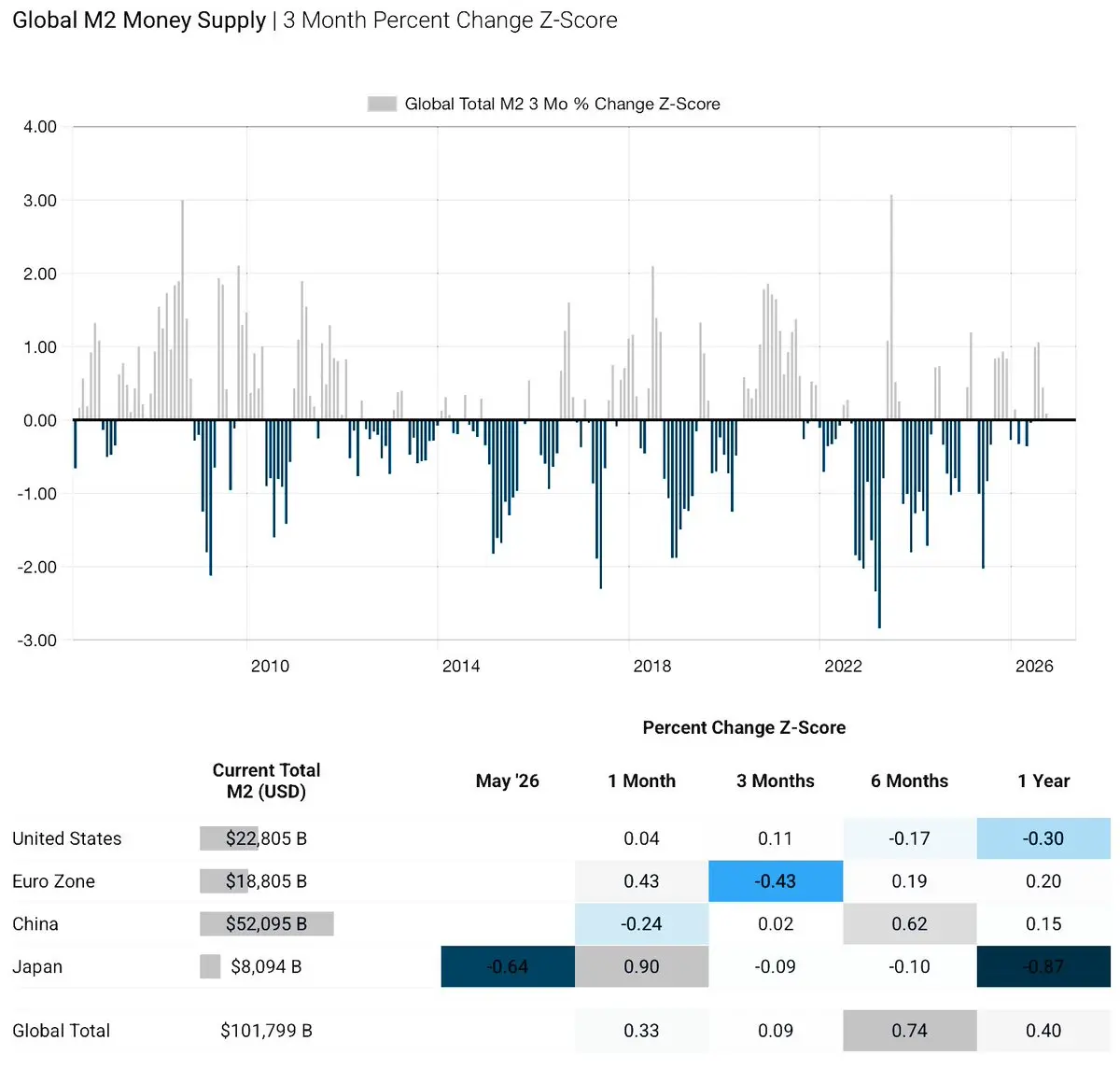
Global M2 money supply reached $101.8 billion, an all-time high.
• Global M2 Z-score (1 year): +0.40
• Global M2 Z-score (6 months): +0.74
• Payment momentum is accelerating again after the tightening period of 2022–2024.
Breakthrough by region:
🇨🇳 China remains the global liquidity engine with M2 exceeding $52 billion, more than double that of the US.
🇺🇸 The US is beginning to return to short-term M2 growth (+0.11 in the last 3 months), although 1-year momentum remains negative.
🇪🇺 The Eurozone weakened slightly in the recent quarter but maintains an expanding liquidity trend on the lon
BTC-3.00%
post-image
  • Reward
  • Comment
  • Repost
  • Share
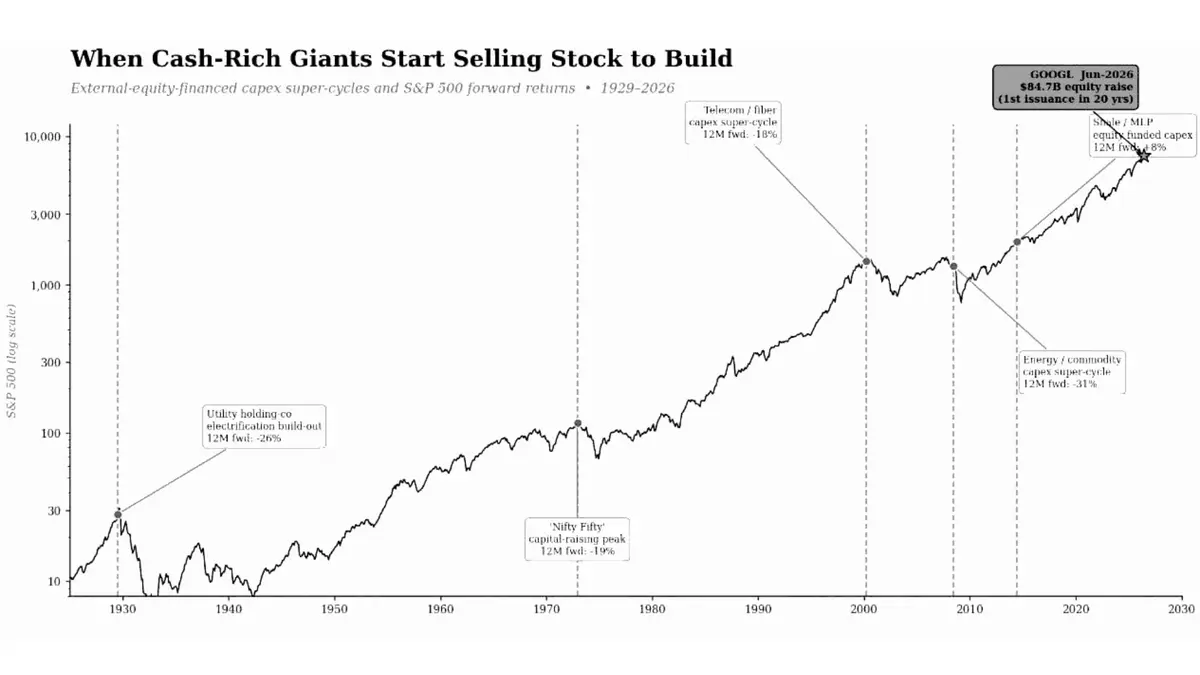
When the world's cashiest companies begin selling shares to raise capital, investors should pay attention.
- Google just announced plans to issue $8.4 billion worth of shares, its first fundraising round in nearly 20 years.
Looking back at the history of the US market from 1929 to the present, periods when large corporations begin issuing additional shares to finance investment cycles (capex super-cycles) often occur very close to the market peak.
• 1929: Electrification cycle → S&P 500 subsequently plummeted.
• 1972: Nifty Fifty capex boom → market enters bear market.
• 2000: Telecom & Fiber
US5000.20%
post-image
  • Reward
  • Comment
  • Repost
  • Share
Debt is becoming the world's true reserve asset, and that's why #Bitcoin exists!
The chart shows that the total debt/GDP ratio of developed economies has been steadily increasing for over two decades.
🇯🇵 Japan: 357% GDP
🇫🇷 France: 325% GDP
🇺🇸 USA: 250% GDP
🇦🇺 Australia: 227% GDP
🇬🇧 UK: 219% GDP
🇩🇪 Germany: 197% GDP
-> Even after the period of highest interest rates in decades, the debt ratio has hardly decreased significantly.
The major problem lies in the fact that governments cannot repay their debts, central banks find it difficult to maintain high interest rates for too long, a
BTC-3.00%
  • Reward
  • Comment
  • Repost
  • Share
  • Pinned