IntoTheBlock

vip
Age 2.3 Year
Peak Tier 0
No content yet
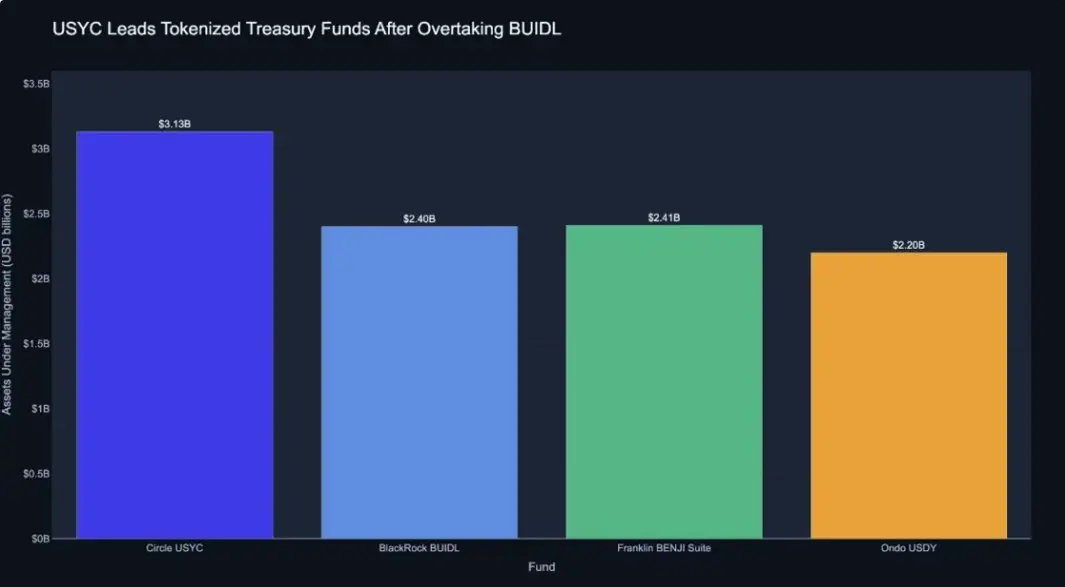
Circle's USYC is now the largest tokenized U.S. Treasury fund: $3.13B vs $2.40B.
The main driver of this growth is collateral plumbing: ~86% of USYC supply sits on BNB Chain as off-exchange margin.
CRCL-14.42%
BNB-1.10%
post-image
  • Reward
  • Comment
  • Repost
  • Share
BlackRock's BUIDL spans 8 chains and Franklin Templeton's BENJI suite covers 9, yet Circle's USYC leads on AUM while concentrated on one.
In tokenized Treasuries, where a token plugs into collateral and liquidity rails matters more than how many chains it touches.
BLK1.24%
BENJI-2.92%
CRCLX-10.98%
  • Reward
  • Comment
  • Repost
  • Share
Weekly DeFi liquidations are rising: $22.4M, up $17M from the prior week.
Yet, they are still well below the ~$102M spike from early June.
⚠️ Higher money-market stress is worth watching.
  • Reward
  • Comment
  • Repost
  • Share
BUIDL is still on eight networks. It still holds $2.40B. It still has a $5M minimum and daily wire settlement.
It lost the top spot because that structure does not fit fast collateral rotation.
Product quality and distribution fit are different things.
  • Reward
  • Comment
  • Repost
  • Share
Tokenized U.S. Treasuries on public chains: ~$15B, average yield ~3.35%.
The same T-bill exposure can now sit in lending, perps, or structured yield without waiting for banking hours.
Idle cash equivalent was the old framing. Productive collateral is the new one.
  • Reward
  • Comment
  • Repost
  • Share
In 2025, the average US savings account paid 0.4% APY.
$20K in savings returned $80. A yield-bearing stablecoin strategy would've returned $800 to $1,6K. And the difference accrued to the depositor, not the bank.
There's a new economy taking shape.
  • Reward
  • Comment
  • Repost
  • Share
USYC passed BUIDL in tokenized Treasury AUM.
$3.13B vs $2.40B.
Both hold short-duration Treasuries. Both yield ~3.1–3.4%. But ~86% of USYC supply sits on BNB Chain as off-exchange derivatives collateral. That is the entire story.
Collateral rails beat issuer brand.
BNB-1.10%
  • Reward
  • Comment
  • Repost
  • Share
DeFi protocols operate block by block. The risk teams overseeing them run on group chats, conference calls, and signatures collected one by one.
That mismatch is a structural risk, and it compounds as vault complexity grows.
Read more:
  • Reward
  • Comment
  • Repost
  • Share
DeFi concentration rose as the market fell.
Capital that left the market withdrew from smaller venues first and stayed with the largest. The market contracted and concentrated in the same motion.
Dominance can increase through attrition alone:
  • Reward
  • Comment
  • Repost
  • Share
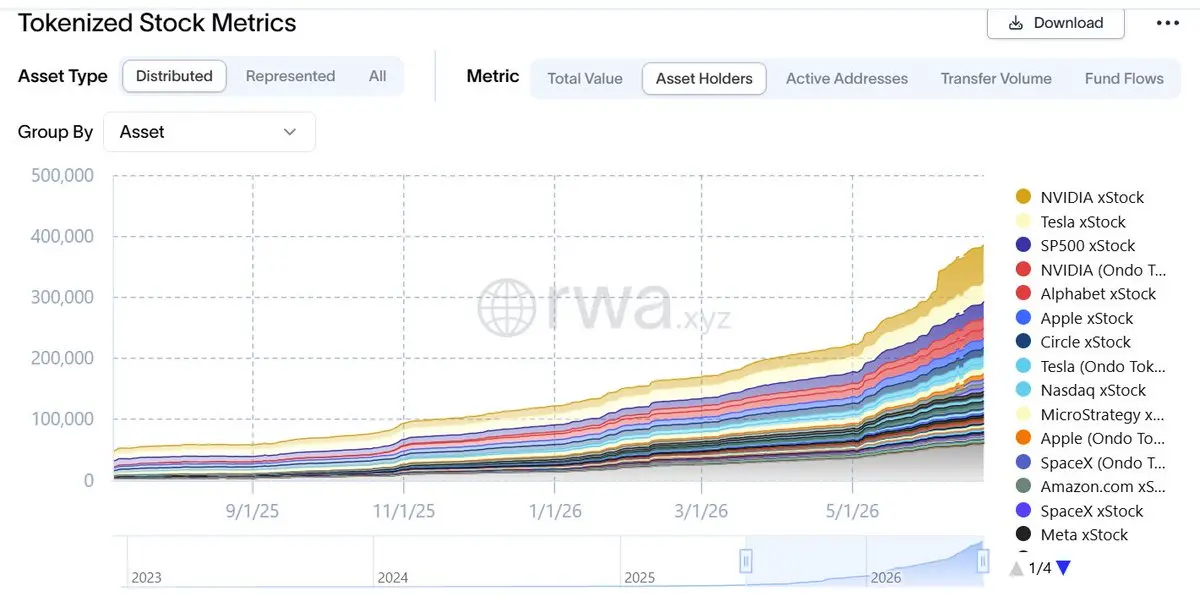
While aggregate value in tokenized stocks has remained relatively stable, holder growth tells a different story.
The number of addresses holding tokenized equities has increased by nearly 30% over the past month, suggesting adoption is still positive.
What do you think has to change before tokenized stocks can scale further?
source: @RWA_xyz
RWA-2.56%
post-image
  • Reward
  • Comment
  • Repost
  • Share
As AI-powered tools expand, the attack surface for credential exposure grows with them.
Legitimate integrations operate through delegated permissions and scoped API access. They do not require private keys.
Any workflow that does should be treated as a material security risk.
  • Reward
  • Comment
  • Repost
  • Share
Disciplined vault curation leaves an evidence trail: nearly 22,000 report files, 458 alert thresholds, 40+ protocols monitored block by block.
See what that infrastructure looks like in practice:
  • Reward
  • Comment
  • Repost
  • Share
Institutions will not navigate protocol interfaces. Retail users will not manage their own DeFi positions.
Both will tap a button inside an app they already trust. That is how the next wave of capital lands on DeFi.
Here's how that happens:
  • Reward
  • Comment
  • Repost
  • Share
Sentora's principle is simple: return of capital comes before return on capital.
In modular DeFi, that holds only when monitoring keeps pace with the market.
Our new report explains how.
  • Reward
  • Comment
  • Repost
  • Share
Revolut is worth $75B.
PayPal's stablecoin grew 600% last year.
Stripe paid $1.1B for Bridge.
None of this is a crypto experiment anymore. These platforms are rebuilding their roadmaps around the rails DeFi already runs on.
Here's where that leads:
  • Reward
  • Comment
  • Repost
  • Share
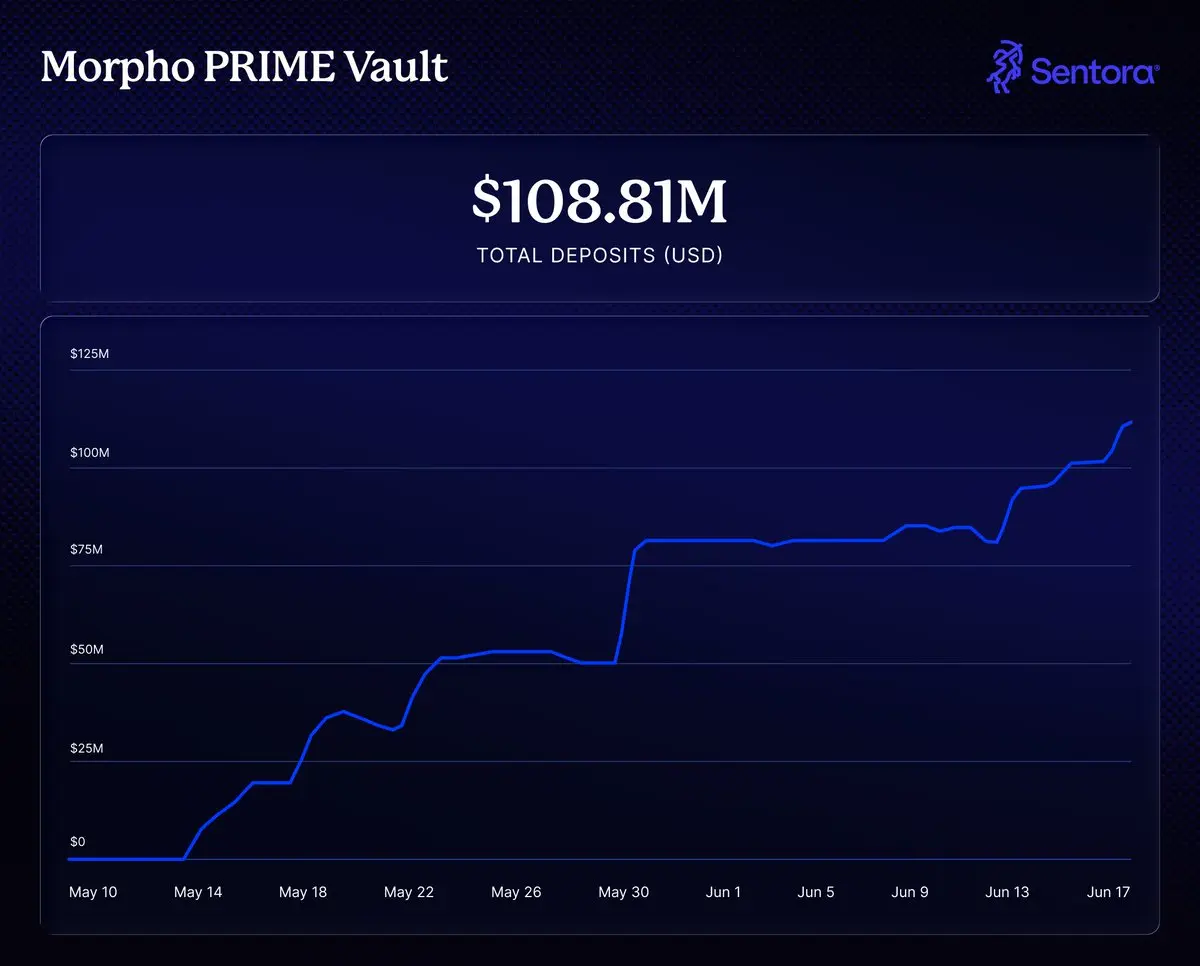
$100M+ deposited and counting. The Sentora PRIME vault on @morpho continues to grow.
Want to understand what's under the hood? Read our full asset risk report:
PRIME-4.75%
MORPHO5.49%
post-image
  • Reward
  • Comment
  • Repost
  • Share
Vault risk is often viewed as a single onboarding checkpoint, but the real risk analysis emerges after deployment.
Our new report shows how Sentora turns due diligence into live, continuous monitoring.
  • Reward
  • Comment
  • Repost
  • Share
We're live.
🎙️ When Crypto Markets Break: Modeling Tail Risk in DeFi
  • Reward
  • Comment
  • Repost
  • Share
Tail Risk in DeFi
  • Reward
  • Comment
  • Repost
  • Share
🚨 1 hour to go.
Join us to learn where standard risk models break down and what it takes to model DeFi extremes properly.
🗓️ Today, 12:00 PM ET
Last chance to attend:
  • Reward
  • Comment
  • Repost
  • Share