PCE Inflation Data
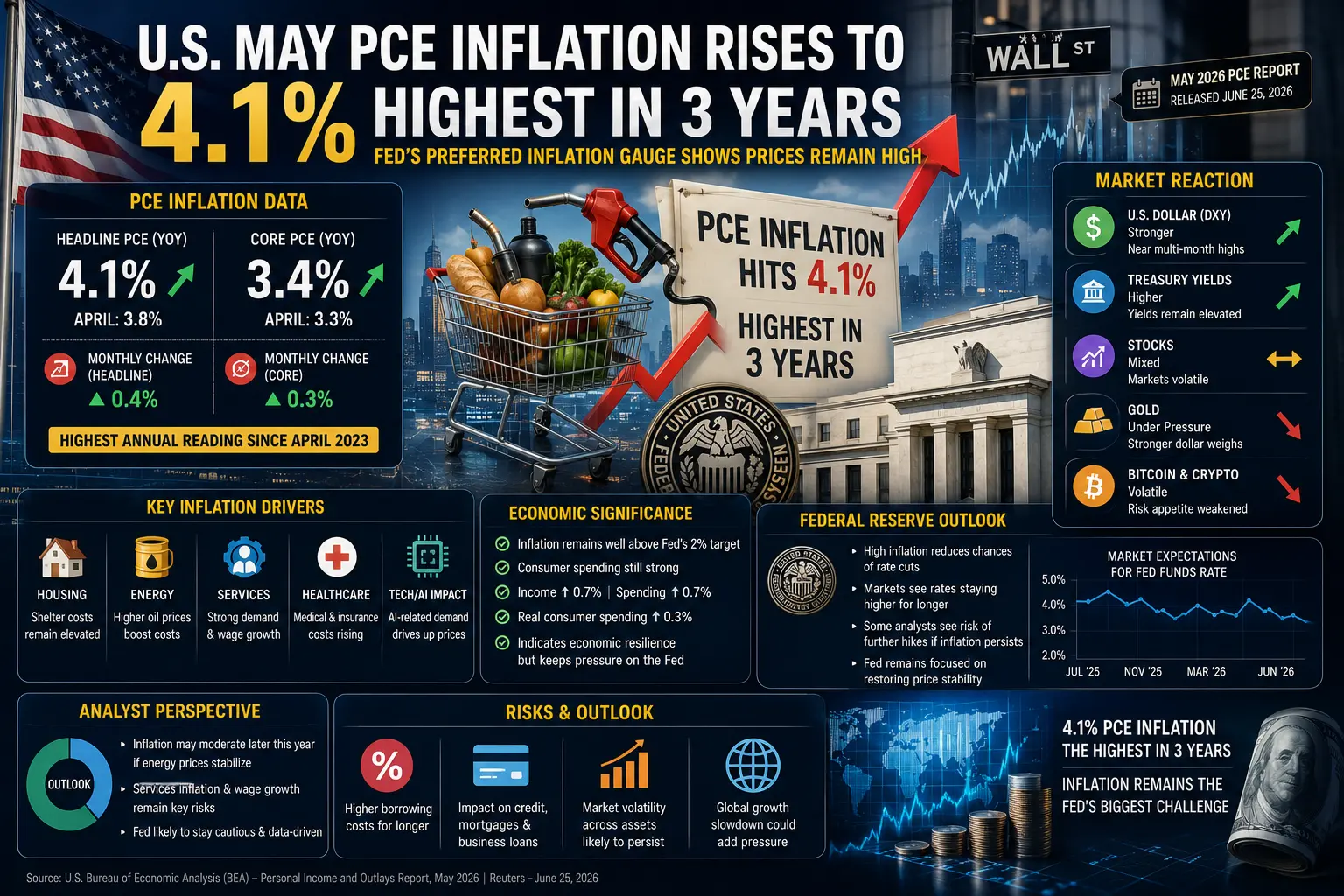
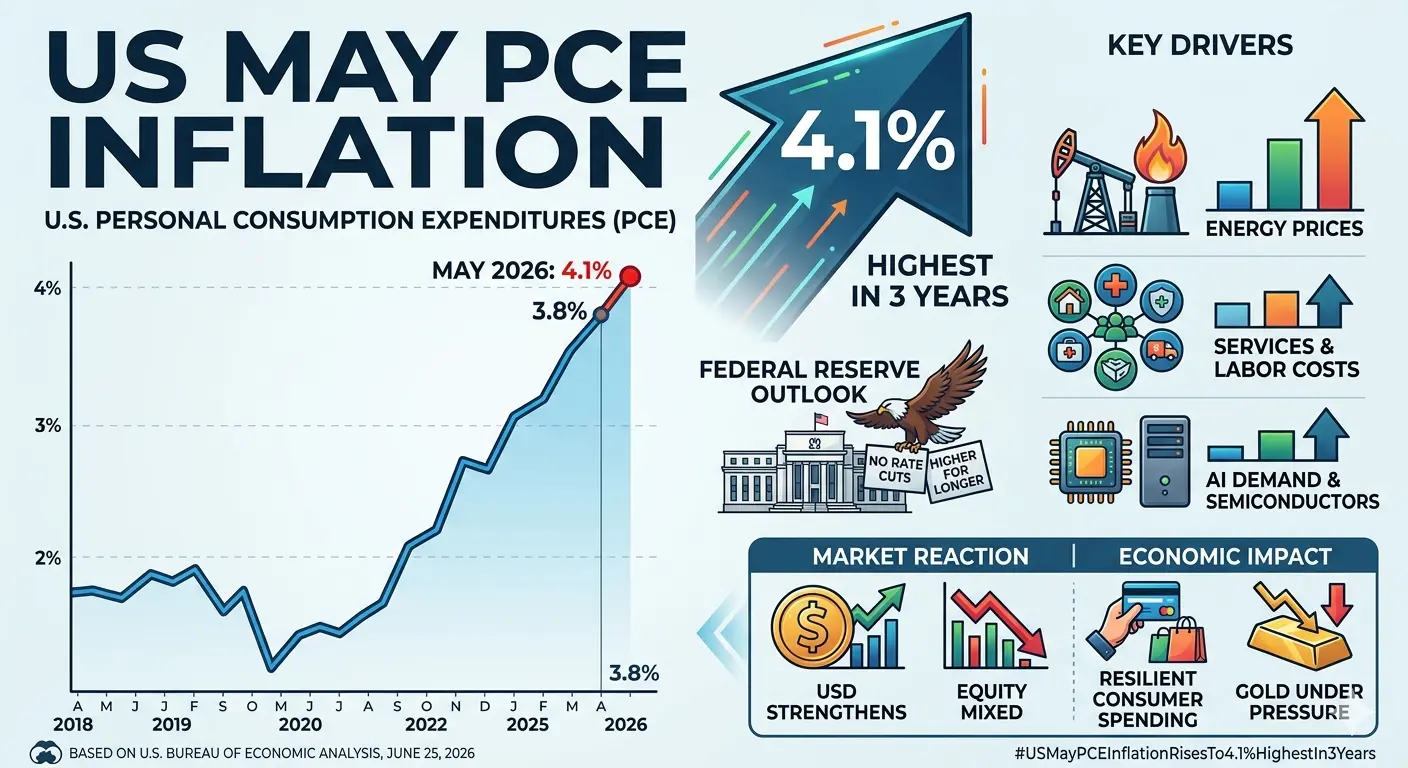
The #USMayPCEInflationRisesTo4.1%HighestIn3Years is trending after the U.S. Bureau of Economic Analysis released its latest Personal Consumption Expenditures (PCE) report on June 25, 2026. The Federal Reserve's preferred inflation gauge showed headline PCE inflation rising to 4.1% year-over-year in May, up from 3.8% in April and marking the highest annual reading since April 2023. On a monthly basis, headline PCE increased 0.4%, while core PCE, which excludes food and energy, rose 0.3% month-over-month and 3.4% year-over-year, compared with 3.3% in April. The report confirms that inflationary pressures remain well above the Federal Reserve's long-term 2% target.
Key Inflation Drivers
Several categories contributed to the stronger inflation reading.
Energy prices remained one of the largest drivers following earlier disruptions in global oil markets, while services inflation continued accelerating through higher housing, healthcare, insurance, transportation, and labor costs. AI-related demand also contributed to higher prices for semiconductor and technology products, while food inflation remained relatively modest compared with previous months. Wage growth and resilient consumer spending continued supporting overall price pressures across the broader economy.
Federal Reserve Outlook
The latest PCE data has significantly influenced expectations for Federal Reserve policy.
With inflation reaching a three-year high, financial markets have largely shifted away from expecting near-term interest-rate cuts. Instead, many economists now believe the Fed could maintain restrictive monetary policy for longer, while some analysts even consider the possibility of additional rate hikes if inflation remains persistent during the second half of 2026. Policymakers continue emphasizing that restoring price stability remains their primary objective before considering any meaningful easing cycle.
Market Reaction
Financial markets reacted cautiously following the inflation report.
The U.S. Dollar Index (DXY) remained supported near multi-month highs as higher interest-rate expectations strengthened demand for the dollar. Treasury yields stayed elevated, while equity markets experienced mixed performance as investors reassessed corporate valuations under a higher-rate environment.
Gold remained under pressure from the stronger dollar, while Bitcoin and the broader cryptocurrency market traded with elevated volatility as risk appetite weakened. Although consumer spending remained resilient, markets continue balancing economic strength against the possibility of tighter monetary policy.
Economic Significance
A 4.1% PCE inflation reading carries important implications for the U.S. economy.
It signals that inflation remains considerably above the Federal Reserve's target despite previous tightening measures. At the same time, the report showed personal income increasing 0.7%, consumer spending rising 0.7%, and real consumer spending advancing 0.3%, indicating that household demand remains relatively resilient even as borrowing costs stay elevated.
Strong consumer activity continues supporting economic growth, but it also increases the challenge of bringing inflation back toward target levels without slowing the broader economy too aggressively.
Analyst Perspective
Many economists believe inflation could gradually moderate later this year if energy prices continue stabilizing and supply-chain conditions improve.
However, persistent services inflation, resilient labor markets, and continued wage growth suggest that underlying inflation pressures may remain sticky. As a result, analysts generally expect the Federal Reserve to maintain a cautious policy stance until clearer evidence of sustained disinflation emerges.
Risks & Outlook
Looking ahead, inflation remains one of the most important variables influencing financial markets.
Higher borrowing costs could continue affecting consumer credit, mortgage demand, business investment, and corporate financing conditions. Investors will closely monitor upcoming inflation reports, labor-market data, and future Federal Reserve meetings for additional guidance on interest-rate policy.
While the U.S. economy continues demonstrating resilience, persistent inflation above target means volatility across equities, bonds, commodities, and digital assets is likely to remain elevated throughout the coming months.
Bottom Line
The latest 4.1% May PCE inflation reading represents the highest level in three years and reinforces the view that inflation remains the Federal Reserve's biggest economic challenge.
Strong consumer spending, resilient labor markets, and persistent services inflation continue supporting economic growth, but they also reduce the likelihood of near-term policy easing. For investors, the report highlights the importance of monitoring inflation trends, interest-rate expectations, and macroeconomic developments as they continue shaping global financial markets.
#USMayPCEInflationRisesTo4.1HighestIn3Years
@Gate_Square
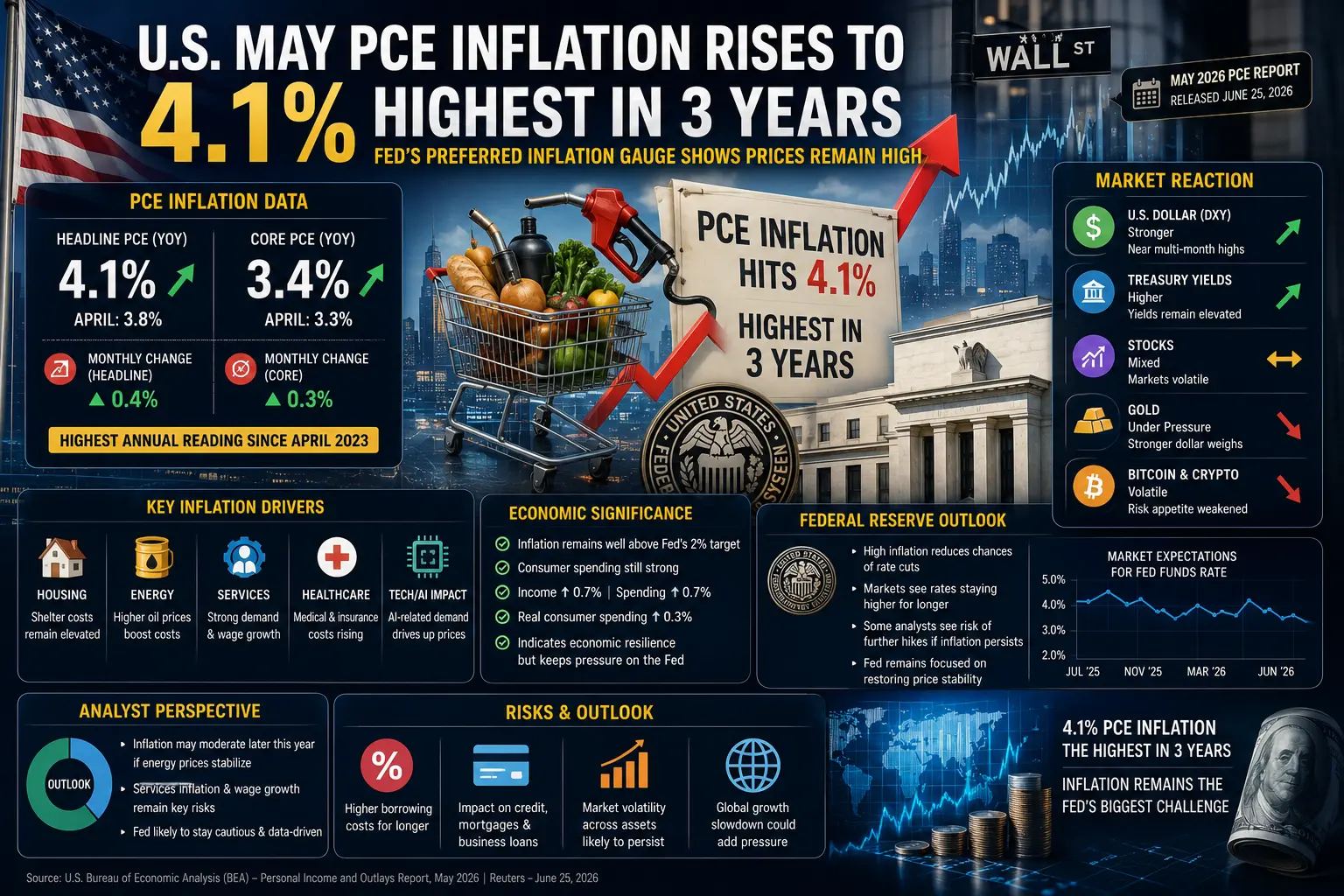
The #USMayPCEInflationRisesTo4.1%HighestIn3Years is trending after the U.S. Bureau of Economic Analysis released its latest Personal Consumption Expenditures (PCE) report on June 25, 2026. The Federal Reserve's preferred inflation gauge showed headline PCE inflation rising to 4.1% year-over-year in May, up from 3.8% in April and marking the highest annual reading since April 2023. On a monthly basis, headline PCE increased 0.4%, while core PCE, which excludes food and energy, rose 0.3% month-over-month and 3.4% year-over-year, compared with 3.3% in April. The report confirms that inflationary pressures remain well above the Federal Reserve's long-term 2% target.
Key Inflation Drivers
Several categories contributed to the stronger inflation reading.
Energy prices remained one of the largest drivers following earlier disruptions in global oil markets, while services inflation continued accelerating through higher housing, healthcare, insurance, transportation, and labor costs. AI-related demand also contributed to higher prices for semiconductor and technology products, while food inflation remained relatively modest compared with previous months. Wage growth and resilient consumer spending continued supporting overall price pressures across the broader economy.
Federal Reserve Outlook
The latest PCE data has significantly influenced expectations for Federal Reserve policy.
With inflation reaching a three-year high, financial markets have largely shifted away from expecting near-term interest-rate cuts. Instead, many economists now believe the Fed could maintain restrictive monetary policy for longer, while some analysts even consider the possibility of additional rate hikes if inflation remains persistent during the second half of 2026. Policymakers continue emphasizing that restoring price stability remains their primary objective before considering any meaningful easing cycle.
Market Reaction
Financial markets reacted cautiously following the inflation report.
The U.S. Dollar Index (DXY) remained supported near multi-month highs as higher interest-rate expectations strengthened demand for the dollar. Treasury yields stayed elevated, while equity markets experienced mixed performance as investors reassessed corporate valuations under a higher-rate environment.
Gold remained under pressure from the stronger dollar, while Bitcoin and the broader cryptocurrency market traded with elevated volatility as risk appetite weakened. Although consumer spending remained resilient, markets continue balancing economic strength against the possibility of tighter monetary policy.
Economic Significance
A 4.1% PCE inflation reading carries important implications for the U.S. economy.
It signals that inflation remains considerably above the Federal Reserve's target despite previous tightening measures. At the same time, the report showed personal income increasing 0.7%, consumer spending rising 0.7%, and real consumer spending advancing 0.3%, indicating that household demand remains relatively resilient even as borrowing costs stay elevated.
Strong consumer activity continues supporting economic growth, but it also increases the challenge of bringing inflation back toward target levels without slowing the broader economy too aggressively.
Analyst Perspective
Many economists believe inflation could gradually moderate later this year if energy prices continue stabilizing and supply-chain conditions improve.
However, persistent services inflation, resilient labor markets, and continued wage growth suggest that underlying inflation pressures may remain sticky. As a result, analysts generally expect the Federal Reserve to maintain a cautious policy stance until clearer evidence of sustained disinflation emerges.
Risks & Outlook
Looking ahead, inflation remains one of the most important variables influencing financial markets.
Higher borrowing costs could continue affecting consumer credit, mortgage demand, business investment, and corporate financing conditions. Investors will closely monitor upcoming inflation reports, labor-market data, and future Federal Reserve meetings for additional guidance on interest-rate policy.
While the U.S. economy continues demonstrating resilience, persistent inflation above target means volatility across equities, bonds, commodities, and digital assets is likely to remain elevated throughout the coming months.
Bottom Line
The latest 4.1% May PCE inflation reading represents the highest level in three years and reinforces the view that inflation remains the Federal Reserve's biggest economic challenge.
Strong consumer spending, resilient labor markets, and persistent services inflation continue supporting economic growth, but they also reduce the likelihood of near-term policy easing. For investors, the report highlights the importance of monitoring inflation trends, interest-rate expectations, and macroeconomic developments as they continue shaping global financial markets.
#USMayPCEInflationRisesTo4.1HighestIn3Years
@Gate_Square