
Futures
Access hundreds of perpetual contracts
TradFi
Gold
One platform for global traditional assets
Options
Hot
Trade European-style vanilla options
Unified Account
Maximize your capital efficiency
Demo Trading
Introduction to Futures Trading
Learn the basics of futures trading
Futures Events
Join events to earn rewards
Demo Trading
Use virtual funds to practice risk-free trading
Launch
CandyDrop
Collect candies to earn airdrops
Launchpool
Quick staking, earn potential new tokens
HODLer Airdrop
Hold GT and get massive airdrops for free
Launchpad
Be early to the next big token project
Alpha Points
Trade on-chain assets and earn airdrops
Futures Points
Earn futures points and claim airdrop rewards


More




Market share leader, 100 million in revenue: Optical chip unicorn Xizhi Technology files for listing in Hong Kong with a "fire and ice" approach
The rapid rise of AI large models has changed the development logic of many industries.
Optical chips are one of the most typical examples. Recently, Nvidia spared no expense, announcing that it would inject $2.0 billion each into optical technology leaders Lumentum and Coherent, while also locking in tens of billions of dollars in long-term procurement commitments and future capacity rights in advance.
With big players fueling the momentum, the capital markets’ pursuit of optical technology has nearly turned frenzied. Take Source Photonics Technology as an example: although its 2025 revenue was only around RMB 600 million, it has already strongly entered the “1,000-yuan stock” club, and on April 2 the trailing P/E ratio (TTM) reached a staggering 473 times.
It is precisely amid this almost boiling wave of industry heat that China’s optical chip unicorns have begun making a push toward the capital markets.
Recently, Shanghai Xizhi Technology Co., Ltd. (hereinafter “Xizhi Technology”) submitted its listing prospectus to the Hong Kong Stock Exchange.
Xizhi Technology mainly provides optical interconnect and optical computing solutions.
As an independent Scale-up optical interconnect solutions provider in China, Xizhi Technology ranks first in the domestic market by 2025 revenue, capturing an overwhelming 88.3% market share, with major backers including investment institutions such as Tencent and Baidu standing behind it.
For this IPO, Xizhi Technology plans to use the proceeds raised to continue expanding its optical interconnect hardware and solutions, and to further invest in cutting-edge areas such as optical computing products.
But even after stripping away the spotlight from big-name backers and the dazzling halo of “No. 1 market share,” Xizhi Technology’s business scale is still relatively limited. In full-year 2025, its revenue was only RMB 106 million, while its net loss for the same period was as high as RMB 1.342 billion.
What’s more, nearly 80% of its revenue comes from its top five customers.
When the light of computing power comes into reality, Xizhi Technology’s commercialization “big exam” has only just begun.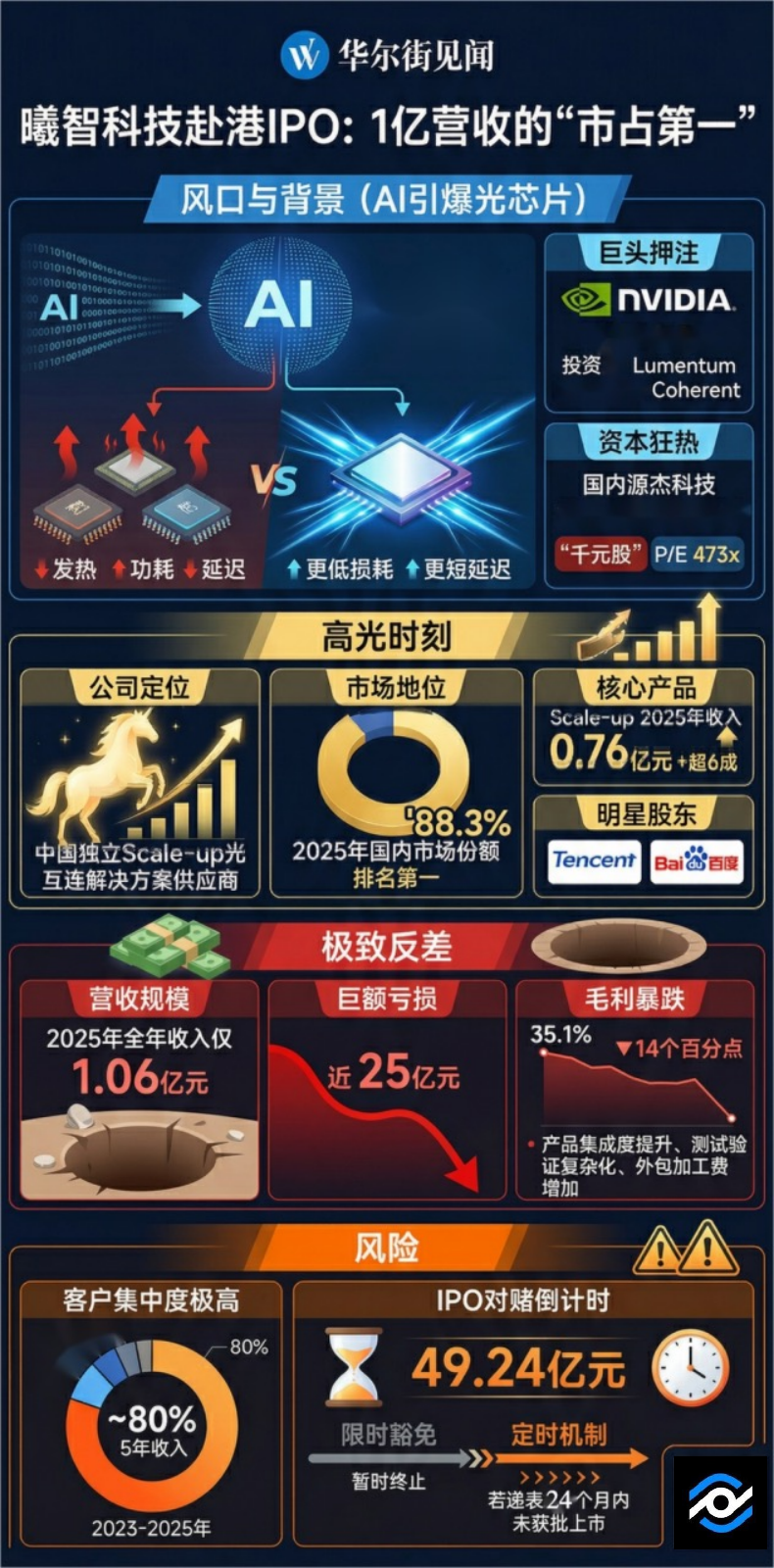
Accumulation and industry surge
For many years, the spotlight in the computing world has been on microelectronic chips.
Microelectronic chips transmit information using current signals; however, as chip process nodes continue shrinking, issues such as heat generation and power consumption have started to become bottlenecks restricting the development of microelectronic chips.
By comparison, optical chips can use higher-frequency light waves as the information carrier to convert optical and electrical signals, offering advantages such as lower transmission loss and shorter time latency—prompting the market to focus on this area.
But for a time, the application scenarios of optical chips were largely concentrated in areas such as sensing VCSE in consumer electronics and EML in communications, leaving limited market room.
Back then, investment institutions also had some reservations about optical chips.
“Looking globally, there are currently no optical-chip companies that are as big and dominant as integrated circuit players. Lumentum’s revenue in fiscal year 2019 was only around $1.5 billion. For startups, it is also extremely difficult to achieve what Lumentum has done—spanning the three major areas of high-power, communications, and sensing. Of course, Lumentum itself gradually arrived at this through acquisitions over a long period of development. This is also the awkward part of investing in optical chips: technology barriers are extremely high, and the space in any single market is relatively limited.” Fang Hong, a partner at Delian Capital, said publicly in 2020.
But the arrival of AI has changed the development trajectory of the optical chip industry chain.
AI large models create globally exponential demand for computing power, magnifying the shortcomings of traditional electronic chips in power consumption and latency when handling large-scale parallel computing—turning into an opportunity for the optical chip industry chain.
Against this backdrop, the performance of a number of optical chip companies’ in the industry chain, including Xizhi Technology, saw explosive growth.
In 2025, Xizhi Technology’s revenue was RMB 106 million, up more than 70% year over year.
Judging by product performance, the main driver behind the sharp revenue surge at Xizhi Technology is Scale-up, which is mainly deployed in AI infrastructure (especially data centers), used to build high-performance “supernodes.”
Among them, a supernode refers to a large tightly interconnected cluster configured as a single computing unit, composed of dozens to hundreds of GPUs, and used specifically for cutting-edge AI tasks such as training and inference of large models.
According to Xizhi Technology, because these AI tasks require synchronized communication while thousands of devices process massive amounts of data, its Scale-up products effectively break through the physical limits of traditional electrical interconnects in terms of transmission distance, bandwidth, and power consumption by using optical interconnect technology.
In 2025, Scale-up generated revenue of RMB 76 million, up more than 60%.
Although its revenue performance is impressive, Xizhi Technology’s growth momentum in this new optical chip track still faces challenges.
On the one hand, Xizhi Technology’s growth rate is not particularly fast within the industry. For example, Source Photonics, another company in the optical chip industry chain, saw its 2025 revenue increase by as much as 138.5% year over year; it is now pushing for a listing in Hong Kong, aiming to achieve “A+H” listings across two locations.
On the other hand, with product volume increasing, Xizhi Technology’s gross margin has actually “declined rather than increased.” The gross margin of optical interconnect products including Scale-up and others was 35.1% in 2025, down 14 percentage points year over year.
According to Xizhi Technology’s explanation, the main reasons are that higher product integration, increased testing and validation, and higher outsourced manufacturing costs all push up expenses.
Compared with the prior-generation products, Scale-up EPS not only needs the same optical interconnect modules, but before delivery it also must be tested and validated using software independently developed by Xizhi Technology related to the supernode solution, which adds more pressure to costs.
Relying on major customers
At present, Xizhi Technology’s customers mainly include research institutions, internet companies, GPU and server manufacturers, system integrators, as well as computing infrastructure builders and operators.
As commercialization advances, the number of Xizhi Technology’s customers has increased. From 2023 to 2025, the number of new customers was 11, 10, and 22, respectively.
But behind the rapid growth is an extremely high customer concentration.
From 2023 to 2025, the total revenue from the top five customers accounts for roughly around 80% of Xizhi Technology’s revenue.
Objectively speaking, heavy reliance on major customers is not unique to Xizhi Technology.
Based on industry conditions, even Lumentum, a global optical technology leader, faces similar issues—its revenue is also highly dependent on a small number of customers such as Nvidia.
However, this strong customer stickiness and high concentration also hide commercial risks that cannot be ignored.
If leading customers reduce procurement due to their own strategic adjustments or the end of project cycles, Xizhi Technology’s revenue will directly face the risk of volatility.
Over-reliance on major customers can also put Xizhi Technology at a disadvantage in price negotiations, further squeezing gross margin, which is already under pressure. For example, considering the top five customers G, in 2025 its gross margin was only 23.4%, down 13 percentage points year over year.
Under the dual pressure of gross margin decline and soaring costs, from 2023 to 2025, Xizhi Technology’s total net losses have already approached RMB 2.5 billion.
The “B side” of massive losses is that the IPO timetable has become a sword hanging over Xizhi Technology’s head.
From 2018 to 2025, Xizhi Technology completed multiple pre-IPO financing rounds from Series A to C4, and signed buyback/exit wager agreements with investors—including terms with redemption rights—regarding the timing of the listing and other matters.
To advance its plan to list in Hong Kong, Xizhi Technology revised its investment agreements with investors in September 2025, agreeing not to trigger the redemption rights and other wager provisions for the time being.
But this is only a “time-limited waiver.”
Under the agreement, if Xizhi Technology is not approved for listing within 24 months from the date it submits the listing application documents to the Hong Kong Stock Exchange, the previously suspended wager arrangements and so on will automatically regain effect and will have retroactive force.
By the end of 2025, the amount of financial instruments issued by Xizhi Technology to investors had already reached RMB 4.924 billion.
With no way out, this Hong Kong IPO is destined to be a race against time.
Risk warning and disclaimer