As AI technology transitions from the digital realm into the physical world, robots, autonomous devices, and automated systems are becoming essential components of next-generation AI infrastructure. From humanoid robotics to autonomous machines, a growing number of AI systems now possess physical-world execution capabilities, drawing increased capital and technological attention to the robot economy.
However, the traditional robotics industry has long been plagued by high financing barriers, capital centralization, and low liquidity. Robotic equipment is typically a heavy-asset business with lengthy R&D cycles and high deployment costs, making it difficult for ordinary users to directly benefit from the industry's growth. RCM was designed to address this challenge by leveraging Web3 infrastructure.
What Are Robotics Capital Markets
Proposed by XMAQUINA as an on-chain capital coordination mechanism for the robot economy, Robotics Capital Markets (RCM) aims to govern, finance, and allocate resources for robot assets and automated infrastructure within an open network.
While traditional capital markets serve stocks, bonds, and corporate financing, RCM shifts select capital logic from the robotics industry to an on-chain environment. Its core purpose is not simply "trading robot assets," but rather building a new collaborative framework around the robot economy.
RCM typically involves:
- Robotic equipment
- Automated infrastructure
- Autonomous machines
- AI-driven hardware systems
- Physical AI networks
- Robot-related treasury and governance structures
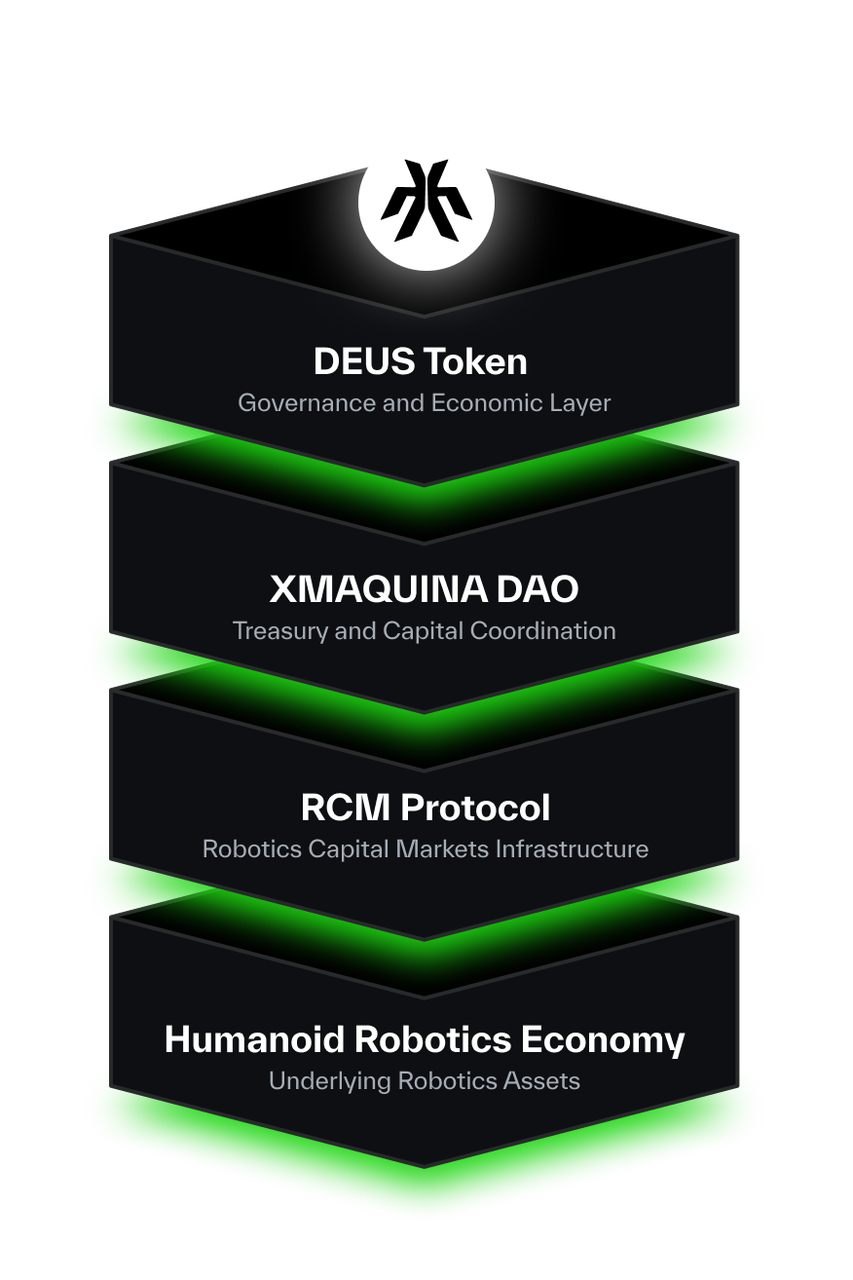
Within the XMAQUINA ecosystem, RCM acts as a critical module linking DAO governance, robot assets, and on-chain capital.
Why the Robotics Industry Needs On-Chain Capital Markets
Unlike the traditional internet sector, the robotics industry demands substantial hardware investment and long-term capital for R&D and operations.
For example:
- Humanoid robots require complex hardware manufacturing
- Automated systems need ongoing maintenance
- AI robotics involves high hashrate and equipment costs
- Autonomous machines require continuous upgrades and deployment
The traditional robotics industry typically relies on venture capital, corporate financing, and institutional capital, yet this model presents several clear drawbacks:
| Issue |
Impact |
| High financing barriers |
Ordinary users cannot easily participate |
| Low liquidity |
Robot assets are difficult to trade |
| Capital centralization |
Decision-making power rests with a few institutions |
| Limited collaboration efficiency |
Open ecosystems struggle to form |
RCM addresses these issues by using on-chain governance and DAO coordination to lower participation thresholds and build a more open capital structure for the robot economy.
How RCM Brings Robot Assets On-Chain
On-chaining robot assets goes beyond simply "issuing tokens." It leverages on-chain governance, asset mapping, and capital coordination to enable partial resources of the robot economy to collaborate within the Web3 network.
RCM typically consists of several core components:
DAO Governance Structure
The DAO coordinates governance and decision-making in the robot economy, including treasury management, protocol upgrades, and resource deployment.
In XMAQUINA, DEUS and xDEUS are used for governance and voting.
Asset Coordination Mechanism
Since robot assets often have real-world attributes, on-chain protocols are needed to establish governance and coordination logic.
This process may include:
- Asset mapping
- Yield coordination
- Treasury management
- Capital deployment
- SubDAO collaboration
On-Chain Financing Mechanism
RCM seeks to create a new financing model for the robot economy through community governance and an open capital structure.
Compared to traditional private funding, on-chain governance emphasizes community participation and transparent collaboration.
Physical AI Infrastructure
RCM addresses not only financial aspects but also the underlying robot and AI infrastructure.
How RCM Differs from Traditional RWA
RCM shares some similarities with Real World Assets (RWA), as both involve combining real-world resources with on-chain structures.
However, their focus differs significantly:
| Dimension |
RCM |
Traditional RWA |
| Core object |
Robots and Physical AI |
Real estate, bonds, etc. |
| Governance model |
DAO-driven |
Financial asset mapping |
| Asset attribute |
Dynamic infrastructure |
Static financial assets |
| Goal |
Machine economy collaboration |
Financial asset liquidity |
| Network structure |
Autonomous networks |
Financial product structure |
Traditional RWA emphasizes on-chain representation of financial assets, whereas RCM stresses collaboration, governance, and infrastructure expansion within the robot economy.
How RCM Differs from Traditional Robotics Financing Models
The traditional robotics industry relies on equity financing, VC investment, or corporate capital.
RCM attempts to establish a different collaboration logic through DAOs and on-chain capital structures.
Key differences include:
| Dimension |
RCM |
Traditional Robotics Financing |
| Participation method |
DAO governance |
Institutional investment |
| Capital structure |
Open on-chain network |
Private capital |
| Liquidity |
Higher |
Lower |
| Governance method |
Community collaboration |
Corporate decision-making |
| Accessibility |
More open |
Higher barrier to entry |
This model does not replace traditional financing but explores new capital coordination methods within the robot economy.
What Role Does DEUS Play in RCM?
DEUS is the governance token of the XMAQUINA ecosystem and a key coordination tool within the RCM structure.
Its main functions include:
- DAO governance
- Treasury management
- Proposal voting
- SubDAO coordination
- Ecosystem resource allocation
Users can stake DEUS to obtain xDEUS and participate in governance.
This mechanism transforms RCM from a simple asset market into a governance network centered on the robot economy.
What Potential Challenges Does RCM Face?
Although RCM offers a novel approach to on-chaining the robot economy, this direction remains in its early stages.
Potential challenges include:
- Complex valuation of robot assets
- High difficulty in governing real-world assets
- Immaturity of the Physical AI industry
- Uncertainty in DAO coordination efficiency
- Still-developing regulatory and compliance frameworks
Moreover, the robotics industry itself has high technical barriers and requires long-term investment. Therefore, RCM's development is closely tied to the overall maturity of the Physical AI sector.
Summary
Robotics Capital Markets (RCM) is an on-chain capital market mechanism built around the robot economy and Physical AI. Through DAOs, tokenization, and on-chain governance, it creates new financing and collaboration models for robot assets and automated infrastructure.
Compared to traditional robotics financing, RCM emphasizes open participation, community governance, and on-chain capital coordination. Its goal is not only to improve robot asset liquidity but also to drive the machine economy toward an open network evolution.
FAQs
What is the difference between RCM and traditional RWA?
Traditional RWA focuses on bringing financial assets on-chain, while RCM centers on governance collaboration for robot assets, Physical AI, and the machine economy.
Why does the robotics industry need on-chain capital markets?
The robotics industry often faces high financing barriers, low liquidity, and capital centralization. On-chain capital markets offer a more open collaboration framework.
What role does DEUS play in RCM?
DEUS is the governance token of XMAQUINA, used for DAO voting, treasury management, and ecosystem resource coordination.
What is Physical AI?
Physical AI refers to AI systems capable of interacting with the physical world, including robots, autonomous devices, and automated machines.
Does RCM belong to DePIN?
RCM and DePIN share some common ground, but RCM is more focused on robot capital markets and machine economy governance, while DePIN emphasizes infrastructure networks.