With the rapid expansion of the global ETF market, ETF CFDs have become a major force in online derivatives trading. Unlike traditional long-term ETF investing, ETF CFDs focus squarely on capitalizing on market volatility, making them a go-to for short-term trades, index trend plays, and risk hedging strategies.
As index investing continues its global ascent, ETF CFDs have emerged as a vital link between the conventional ETF space and the leveraged derivatives market.
What Assets Can You Trade with ETF CFDs?
The underlying assets for ETF CFDs are typically exchange-traded funds (ETFs).
Popular ETF CFD products include those tracking the S&P 500, Nasdaq 100, gold, crude oil, the technology sector, and semiconductors.
For instance, traders can gain exposure to U.S. stock indices, the tech sector, or gold price movements by trading CFDs on well-known ETFs like SPY, QQQ, or GLD.
Compared to single-stock CFDs, ETF CFDs reflect the overall performance of a basket of assets, making their prices more aligned with macro market trends.
How Do ETF CFDs Work?
The core mechanism of an ETF CFD is still "settlement by difference."
Consider a trader who expects the Nasdaq ETF to rise. They open a long position in the corresponding ETF CFD. If the ETF price goes up and they close the position, the profit is the difference between the entry and exit prices.
Throughout the process, the trader never owns any ETF shares; they are simply trading the price movement.
If a trader believes the market will drop, they can open a short position and profit from the price decline.
Because ETF CFDs support both long and short positions, trading opportunities exist in both rising and falling markets.
How Is an ETF CFD Different from Traditional ETF Investing?
The key difference is whether you actually own the ETF asset.
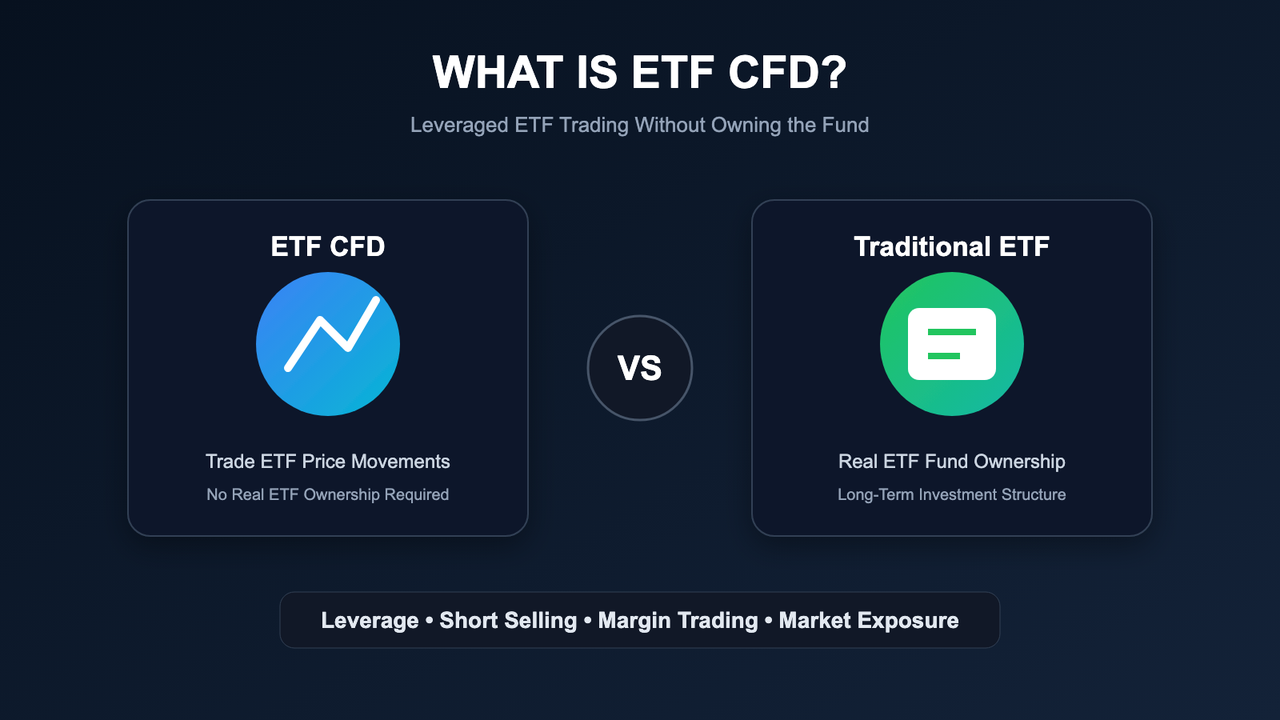
In traditional ETF investing, buying fund shares gives you ownership rights and potential dividend payouts.
With an ETF CFD, you're trading a derivative. You only participate in the price movement; you don't hold the ETF itself.
Here's a quick comparison:
| Dimension |
ETF CFD |
Traditional ETF Investing |
| Ownership of Real ETF |
No |
Yes |
| Leverage |
Usually available |
Partially supported |
| Short Selling |
Supported |
Restricted in some markets |
| Fund Rights |
Typically none |
Yes |
| Core Logic |
Settlement by difference |
Holding fund shares |
Compared to long-term index investing, ETF CFDs are more geared toward short-term trading and capturing market volatility.
Why Are ETF CFDs Good for Index Trading?
Since most ETFs track an index or sector, ETF CFDs are a natural fit for macro market trend trading.
For example, an S&P 500 ETF CFD lets you trade the broad U.S. stock market. A Nasdaq ETF CFD focuses on tech stocks. A gold ETF CFD reflects safe-haven demand.
Because their volatility is often more diversified than single-stock CFDs, many traders use ETF CFDs for broader market plays.
ETF CFDs are also popular in sector rotation and thematic trading strategies.
What Is the Leverage Mechanism in ETF CFDs?
ETF CFDs typically use margin trading.
For instance, with 5x leverage, you only need to put up a fraction of the notional value to open a larger position.
The leverage calculation generally works as follows:
Leverage boosts capital efficiency, but it also amplifies both gains and losses.
While ETFs are usually less volatile than high-growth individual stocks, ETF CFD prices can still swing sharply during periods of extreme macro volatility.
What Fees Come with ETF CFDs?
The main costs for ETF CFDs are the spread, commission, and overnight financing fees.
The spread is the gap between the bid and ask prices. Overnight fees depend on how long you hold a leveraged position.
For long-term holders, these financing costs can add up and eat into profits.
That's why ETF CFDs are better suited for short-to-medium-term trading rather than long-term asset allocation.
What Are the Main Risks of ETF CFDs?
ETF CFDs are high-risk leveraged derivatives. Key risks include leverage risk, forced liquidation risk, market volatility risk, liquidity risk, and financing cost risk.
Although ETFs themselves are diversified, combining them with leverage can amplify market swings.
For example, during a global market crash, index ETF CFD prices can drop rapidly, leading to significant account equity erosion.
How Are ETF CFDs Different from Index CFDs?
Both track overall market movements, but their underlying structures differ:
- ETF CFDs are based on the price of a specific ETF.
- Index CFDs track the index itself.
For instance:
- SPY ETF CFD mirrors the price of the SPY fund.
- The S&P 500 Index CFD directly follows the index level.
ETF CFDs can also be affected by the ETF's management fees, fund structure, and tracking error.
The Role of ETF CFDs in Global Markets
ETF CFDs offer a way to trade global indices without owning fund shares.
Traders use them for index trend trading, sector rotation, leveraged exposure, hedging, and macro market plays.
As the global ETF market expands, ETF CFDs are becoming a cornerstone of the modern online derivatives landscape.
Summary
An ETF CFD is a financial derivative that settles on the price difference of an ETF, letting traders profit from market movements without holding the actual ETF.
Compared to traditional ETF investing, ETF CFDs emphasize leverage, two-way trading, and short-term participation—but also carry higher risks, including forced liquidation, financing costs, and market volatility.
As index investing and online trading continue to grow, ETF CFDs have become a key bridge between the ETF and derivatives markets.
FAQs
Do You Need to Actually Hold the ETF for an ETF CFD?
No. ETF CFDs are derivatives settled on the price difference; no actual fund shares are involved.
What Markets Can You Trade with ETF CFDs?
Common markets include stock index ETFs, sector ETFs, gold ETFs, and commodity ETFs.
Why Do ETF CFDs Support Short Selling?
Because CFDs are all about price movement, you can profit from both uptrends and downtrends.
How Is an ETF CFD Different from Traditional ETF Investing?
Traditional investing means owning fund shares. ETF CFDs only settle on the price difference.
Why Are ETF CFDs Considered High Risk?
Because leverage is typically used, which can magnify both gains and losses from market moves.
Are ETF CFDs Suitable for Long-Term Holding?
Generally no, because overnight financing fees accumulate, making them more appropriate for short-to-medium-term trading.







