The U.S. stock market is one of the world’s largest and most liquid capital markets. From Apple and Microsoft to Nvidia and Amazon, countless global leaders choose to list on U.S. exchanges. For investors aiming to tap into global economic growth and tech innovation, U.S. equities have long been a cornerstone of international portfolio diversification. Therefore, opening a U.S. brokerage account is often the first step into American capital markets.
Beyond traditional brokerage accounts, the convergence of digital asset platforms with traditional finance is forging new market access routes. Whether through a conventional securities account or an emerging digital asset account for stock trading, understanding account opening requirements, account structures, and market rules is essential for investors entering the U.S. stock market.
What Is a U.S. Stock Account?
Opening a U.S. stock account is the process of setting up a brokerage account that enables trading on U.S. securities exchanges, granting the ability to buy and sell U.S. stocks, ETFs, and other assets.
Think of a stock account as the gateway to the U.S. capital market. Only after completing account registration, identity verification, and compliance checks can investors execute trades, manage portfolios, and allocate assets.
For international investors, opening a U.S. stock account is more than a procedural step—it’s a vital link to global capital markets.
What Does a Stock Account Do?
A stock account records an investor’s securities holdings and trading activity.
It allows you to buy and sell stocks, ETFs, and other securities, while providing visibility into positions, transaction history, and asset value changes.
Why Can’t You Trade U.S. Stocks Directly?
The U.S. securities market is heavily regulated. All trades must be executed through licensed financial intermediaries.
That’s why investors must first open an account to gain market access.
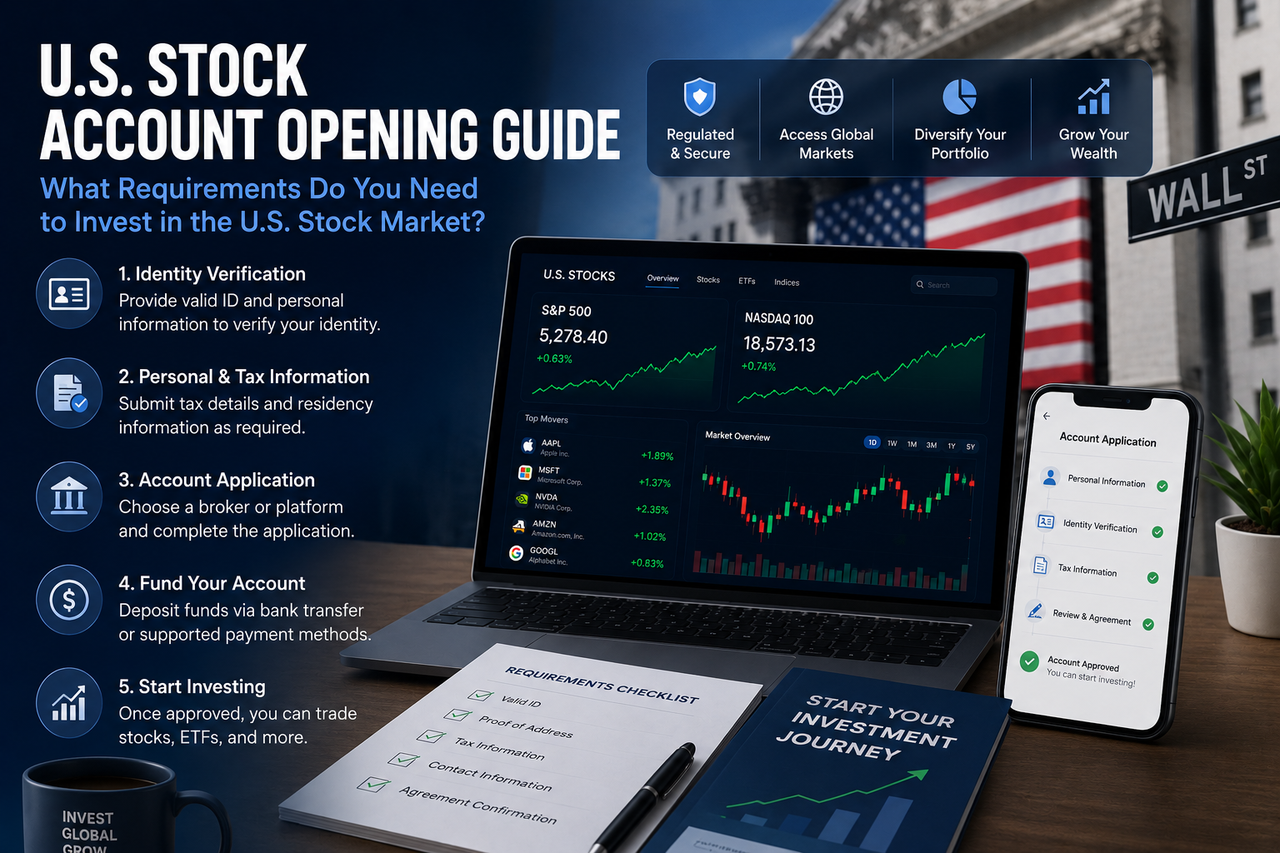
What Are the Basic Requirements to Trade U.S. Stocks?
While requirements vary across platforms and providers, most U.S. stock account openings share a few common prerequisites.
Identity Verification
Identity verification is a critical step in the account opening process.
Platforms must confirm your real identity to meet anti-money laundering (AML) and Know Your Customer (KYC) compliance standards.
Age Requirement
Most trading services require account holders to meet the legal age of majority in their jurisdiction.
This is a standard gatekeeping measure for financial market participation.
Regional Eligibility
Some services restrict availability based on local laws and regulations.
You’ll need to verify that stock trading services are supported in your country or region.
Risk Disclosure Acknowledgment
Stock investing carries market risk. As part of the process, you’ll be asked to read and accept risk disclosures and service agreements.
What Documents Are Typically Required to Open a U.S. Stock Account?
To complete identity verification and account approval, you’ll generally need to provide certain personal documents.
Proof of Identity
Commonly accepted documents include:
- Passport
- National ID card
- Other government-issued photo ID
Specific requirements vary by provider.
Contact Information
During account opening, you’ll typically need to provide:
- Mobile phone number
- Email address
- Country or region of residence
This information is used for verification and ongoing communications.
Tax Information
Some U.S. securities services may require you to complete tax forms to confirm your identity attributes and tax status.
Security Verification
To protect your account, some platforms also require enabling security features like two-factor authentication (2FA).
How Do You Open a U.S. Stock Account with a Traditional Brokerage?
Traditional brokerages remain one of the most common routes for international investors to access U.S. stocks.
Create a Securities Account
Start by registering a securities account and filling in your personal details.
Submit Identity Documents
Then upload the required identification documents and await verification.
Wait for Account Approval
Once your application is approved, you’ll gain trading access.
Fund Your Account
Traditional brokerages typically require bank transfers in U.S. dollars.
Start Trading
With your account funded, you can begin buying and selling stocks and ETFs.
How Can Digital Asset Users Trade U.S. Stocks?
The growth of digital assets has spurred convergence between traditional finance (TradFi) and crypto.
Today, crypto exchanges like Binance and Gate offer stock trading, allowing users to access U.S. equities through a unified account. With Gate Stocks, you can manage both digital assets and stocks on one platform.

Fund with USDT
Gate Stocks supports using stablecoins like USDT to invest in stocks. This reduces the complexity of cross-border fund transfers and improves capital efficiency.
Unified Multi-Asset Management
You can hold stocks and ETFs alongside digital assets, enabling seamless cross-market portfolio allocation.
What Assets Can You Trade After Opening a U.S. Stock Account?
Once your account is open, a wide range of U.S. market products become available.
Individual Stocks
Buy shares of companies listed on U.S. exchanges across sectors like technology, finance, healthcare, energy, and consumer services.
ETFs
ETFs are among the most popular U.S. market instruments. You can invest in the S&P 500, Nasdaq, tech sectors, high-dividend funds, and global themes through ETFs.
Thematic Assets
The U.S. market offers rich sector opportunities spanning AI, renewable energy, semiconductors, biotech, and more.
What’s the Difference Between a U.S. Stock Account and a Hong Kong Stock Account?
Both involve securities investing, but they differ in market structure and investment focus.
Market Size
The U.S. market is the world’s largest, with the most listed companies.
The Hong Kong market bridges China and global capital markets, offering unique regional advantages.
Investment Focus
The U.S. market is known for global tech and innovative companies.
Hong Kong features many Chinese enterprises and regional leaders.
Product Range
The U.S. market offers a broader selection of ETFs, index funds, and sector-specific products.
What Should You Keep in Mind After Opening a U.S. Stock Account?
Opening an account is just the beginning.
Trading Hours
Know the regular trading session as well as pre-market and after-hours trading rules.
Earnings Reports
Corporate earnings are key indicators of company performance and stock movement.
Macroeconomic Data
Federal Reserve rate decisions, CPI inflation, and non-farm payrolls all influence market sentiment and asset prices.
Risk Management
Whether trading stocks or ETFs, always align your asset allocation with your risk tolerance.
Today’s investors have multiple paths to U.S. stocks.
Funding Source
Traditional brokerages rely on bank accounts and USD.
Digital asset platforms may accept stablecoins like USDT.
Account Structure
Traditional accounts keep stocks and digital assets separate.
Digital platforms offer unified account management.
Investment Scope
Beyond stocks and ETFs, some digital platforms also support crypto and other digital financial products.
Why Are More Investors Focusing on U.S. Stock Accounts?
Global capital market growth has made U.S. stocks a key target for international investors.
Advances in AI, semiconductors, cloud computing, and renewable energy have further boosted interest.
As account opening and market access improve, participating in the U.S. stock market is becoming more accessible.
Conclusion
Opening a U.S. stock account is a fundamental step into American securities markets. Whether through a traditional broker or a digital asset platform, you’ll need to complete identity verification, application, and funding. Once set up, you can access U.S. stocks, ETFs, and a variety of thematic investments, participating in global capital market opportunities.
With TradFi and Crypto converging, the pathways into U.S. stocks are expanding. From conventional securities accounts to using USDT for stock trading, diverse access models are making global investing more open and efficient.
FAQs
What Does “Opening a U.S. Stock Account” Mean?
It means setting up a brokerage account that allows trading on U.S. exchanges and buying assets like stocks and ETFs.
What Are the Requirements?
Typically, identity verification, meeting age requirements, regional eligibility, and accepting risk disclosures and service terms.
What Documents Are Needed?
Usually a government-issued ID, contact information, and tax details. Exact requirements vary by platform.
Can Non-U.S. Residents Open an Account?
Many brokerages accept international investors, but eligible regions depend on the provider’s policies.
Can You Trade ETFs After Opening a U.S. Stock Account?
Yes. ETFs are widely traded on U.S. exchanges and are generally available after account activation.
Is USD Required?
Traditional brokerages typically require USD, but newer platforms may accept USDT or other stablecoins.
Can You Trade U.S. Stocks with USDT?
Some platforms that offer stock trading allow using USDT as the funding asset.
How Long Until You Can Trade After Opening an Account?
Timing depends on the platform’s review speed. Once the account is approved and funded, trading can begin.