As AI Agent becomes a major trend in the crypto industry, an increasing number of projects are exploring the role of autonomous agents in the digital economy. Singularry and Virtuals Protocol represent two distinct paths: DeFAI infrastructure and Agent Economy infrastructure, respectively. Understanding their differences provides a clearer framework for thinking about AI agents.
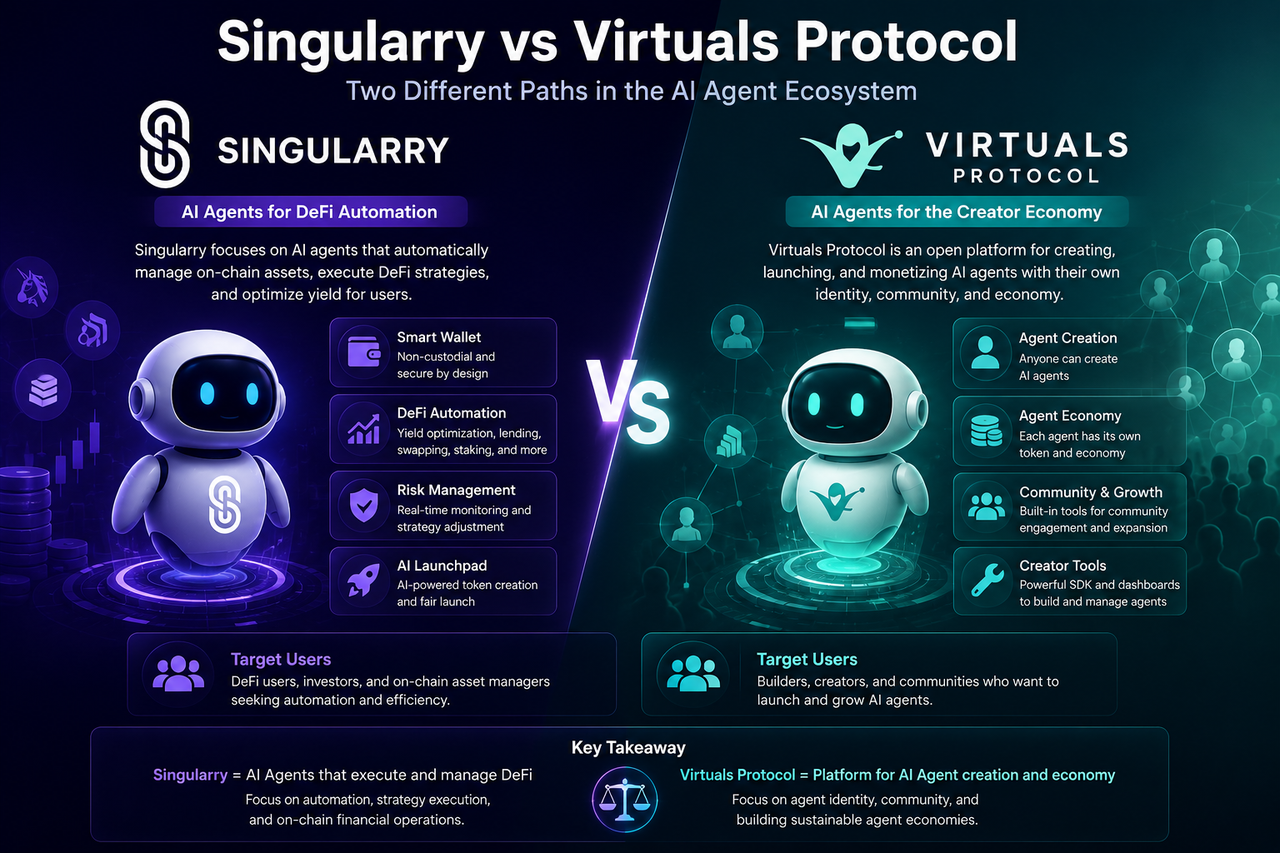
Singularry vs. Virtuals Protocol: A Quick Overview
Singularry’s core mission is to make AI agents act as users’ on-chain financial assistants. Users set goals in natural language, and the agent—once authorized—automatically handles yield optimization, lending management, risk monitoring, and asset allocation.
The system is built around Smart Wallets, an Agent Framework, an automated execution engine, and a Launchpad, all designed to reduce the complexity of DeFi operations.
Virtuals Protocol, meanwhile, is an open platform focused on creating and commercializing AI agents. It enables any developer or community to build agents with their own identity, token economy, and governance model.
In the Virtuals ecosystem, AI agents are treated as digital economic entities. Each agent can have its own tokens, community, revenue streams, and evolving business model.
How Do Their Product Positioning Differ?
Product positioning is one of the most fundamental differences.
Singularry tackles the asset management challenges that DeFi users face. The value of its AI agent lies in helping users execute financial strategies and on-chain operations.
Virtuals Protocol addresses the creation and commercialization of AI agents. It helps developers launch agents, build communities, and design economic models.
In short, Singularry focuses on how agents help users get work done, while Virtuals Protocol focuses on how to create new agents.
How Do AI Agent Capabilities Differ?
Both platforms use AI agent architectures, but the capabilities of their agents differ significantly.
Singularry agents are built as on-chain financial execution assistants. Their core value comes from automating DeFi tasks. After user authorization, agents can execute yield optimization, lending management, asset rebalancing, and cross-protocol operations based on market data and risk preferences. The emphasis is on capital management efficiency and on-chain execution, making them closer to automated asset management tools.
In Virtuals Protocol, agents emphasize digital identity and autonomous operation. Agents typically have their own brand, community, and economic model. Their main tasks include content creation, community engagement, marketing, and operating business activities. While Singularry focuses on financial scenarios, Virtuals focuses on how an agent can become a digital entity that continuously creates value.
So, although both are AI agents, one specializes in financial execution, the other in digital economic activity.
How Do Use Cases Differ?
Use cases are a key differentiator.
Singularry’s primary use cases are in DeFi. Users leverage AI agents to automatically handle asset allocation, yield management, and risk monitoring, lowering the barrier to complex financial activities. For those managing on-chain assets long-term, Singularry acts like a 24/7 digital asset management assistant.
Virtuals Protocol serves a different need. It allows developers, creators, and communities to quickly create their own AI agents and then build communities, issue tokens, and run business activities around those agents. In this model, the agent itself becomes the core product and economic activity.
From a user perspective, Singularry solves “how to manage assets,” while Virtuals Protocol solves “how to create and operate agents.”
How Do Agent Economic Models Compare?
The economic models reflect each platform’s view of agents.
Singularry’s economy is built around platform functions. The SINGULARRY token is used for governance, staking, ecosystem incentives, and access to advanced agent services.
Virtuals Protocol’s economy revolves around the agents themselves. Each agent can have its own token and community, creating multiple agent economic networks.
Structurally:
- Singularry: One platform, one core economic system.
- Virtuals: One platform supporting many agent economic systems.
This difference directly shapes how each ecosystem expands.
How Do Launchpad Concepts Differ?
Both have Launchpads, but with different purposes.
Singularry Launchpad
The Singularry Launchpad focuses on AI-driven token creation and community launches. It lowers the entry barrier for projects and connects them with the DeFAI ecosystem.
Virtuals Launchpad
The Virtuals Launchpad emphasizes AI agent issuance. An agent is more than a token project—it’s a digital entity capable of ongoing operations.
Thus, the Virtuals Launchpad is about the Agent Economy, not just token issuance.
Singularry vs. Virtuals Protocol: Core Comparison
| Dimension |
Singularry |
Virtuals Protocol |
| Core Positioning |
DeFAI Infrastructure |
Agent Economy Infrastructure |
| Primary Users |
DeFi Users |
Agent Developers |
| Agent Function |
Financial Execution |
Digital Identity & Operations |
| Smart Wallet |
Supported |
Supported |
| Yield Optimization |
Strong |
Limited |
| Automated Execution |
Strong |
Moderate |
| Agent Issuance |
Supported |
Core Function |
| Agent Commercialization |
Limited |
Strong |
| Ecosystem Structure |
Single-Platform Ecosystem |
Multi-Agent Ecosystem |
| Core Direction |
AI-Managed Assets |
AI-Created Economies |
Summary
Singularry and Virtuals Protocol both ride the AI agent wave, but they tackle different problems. Singularry is focused on DeFAI—using AI agents to automatically manage on-chain assets, execute yield strategies, and handle financial operations. Virtuals Protocol focuses on the Agent Economy—helping developers create, launch, and run AI agents with independent economic systems.
From an industry standpoint, Singularry represents the execution layer infrastructure for AI agents, while Virtuals Protocol represents the issuance and economic layer infrastructure. Together, they push AI agents from simple tools toward autonomous digital entities, but they follow two distinct paths in product logic and application.
FAQs
What is the biggest difference between Singularry and Virtuals Protocol?
Singularry focuses on DeFi automation—helping users manage assets and execute on-chain financial strategies. Virtuals Protocol focuses on creating, launching, and commercializing AI agents. Their target users and product positioning are different.
What are Virtuals Protocol’s core functions?
Virtuals Protocol’s core functions are creating and launching AI agents, and equipping them with token economies, community governance, and commercialization capabilities.
How do Singularry Agents and Virtuals Agents differ?
Singularry Agents emphasize on-chain financial execution like yield optimization and asset management. Virtuals Agents emphasize digital identity, autonomous operation, and community interaction.
Do both platforms support an Agent Launchpad?
Yes. But Singularry’s Launchpad is more geared toward AI-driven project launches, while Virtuals’ Launchpad focuses on AI agent creation and economic system building.







