As the Ethereum ecosystem expands rapidly, network congestion and high Gas fees have become critical bottlenecks to blockchain mass adoption. Layer 2 scaling solutions improve network performance by moving transaction execution off the main chain while maintaining Ethereum's security. Among these, Optimistic Rollup has emerged as one of the most mature and widely used scaling technology approaches.
Optimism and Arbitrum are the two most prominent Optimistic Rollup networks today. Both are built on Ethereum and boast extensive developer communities and ecosystem applications. However, they have gradually developed distinct characteristics in technical architecture, governance models, multi-chain strategies, and ecosystem development directions, making them the most frequently compared projects in the Layer 2 space.
What Is Optimism?
Optimism is an Ethereum Layer 2 network built on the Optimistic Rollup architecture, designed to improve user experience by lowering transaction costs and improving transaction efficiency.
Optimism's core mission extends beyond merely scaling Ethereum—it aims to build a multi-chain ecosystem driven by open standards. To achieve this, Optimism launched the OP Stack modular development framework and is using it to construct the Superchain network alliance.
In addition to technical scaling, Optimism has introduced Retro Funding, bicameral governance, and public goods funding mechanisms, seeking to explore a more sustainable model for blockchain ecosystem development.
What Is Arbitrum?
Arbitrum is an Ethereum Layer 2 network developed by Offchain Labs, also leveraging Optimistic Rollup technology for scaling.
Arbitrum's design prioritizes high compatibility and developer convenience. Developers can migrate Ethereum applications to the Arbitrum network with minimal code changes.
Beyond its mainnet, Arbitrum One, Arbitrum has launched Arbitrum Nova for gaming and enterprise use cases, as well as Arbitrum Orbit, which supports custom chain deployment, forming a multi-layer scaling ecosystem.
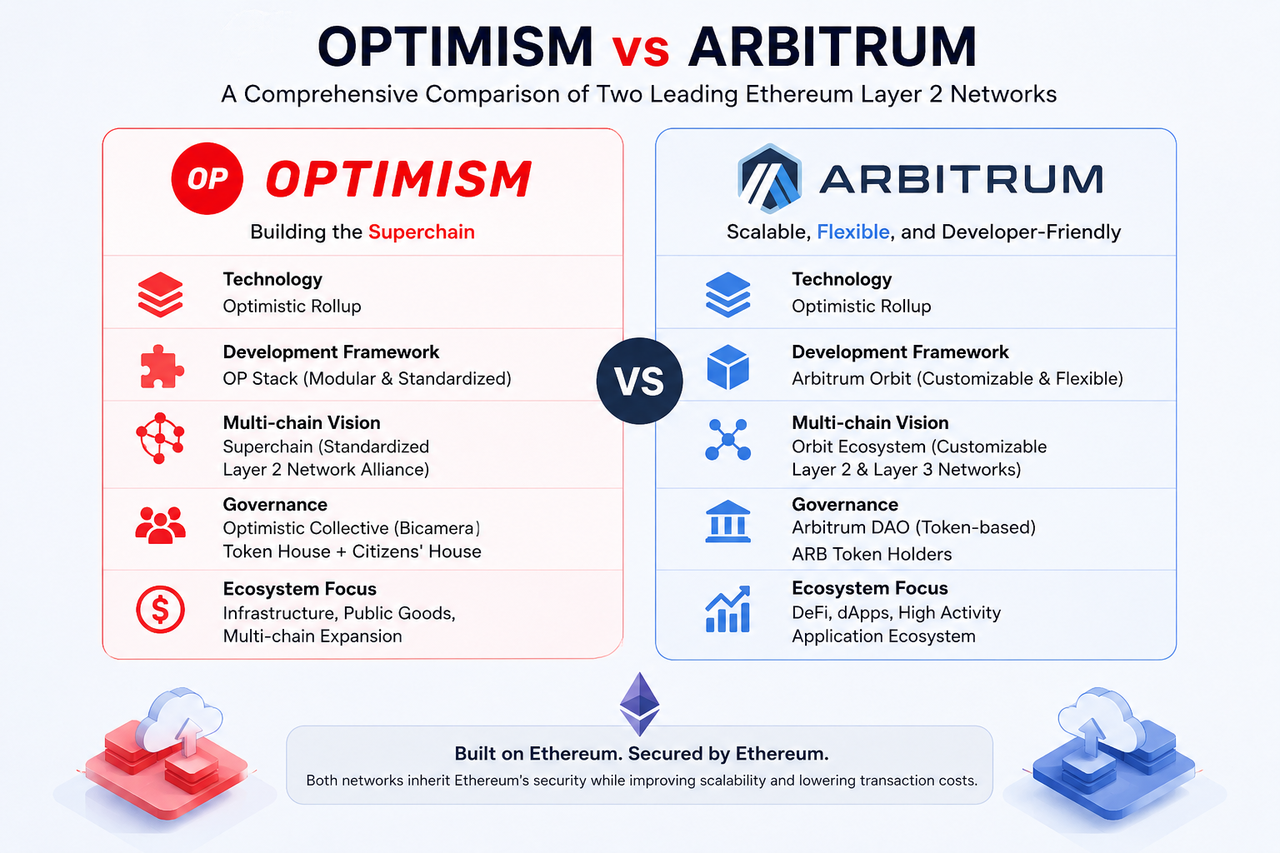
How Do Optimism and Arbitrum Differ in Technical Architecture?
While both are Optimistic Rollups, their underlying implementations are not identical.
Optimism initially adopted a simpler Rollup design, emphasizing consistency and standardization with Ethereum. With the introduction of OP Stack, Optimism further modularized its network, laying the groundwork for a large-scale multi-chain ecosystem.
Arbitrum, on the other hand, employs a more complex fraud proof system with a multi-round interactive verification mechanism. This design reduces Layer 1 computational costs during disputes and improves verification efficiency.
From a development perspective, Optimism prioritizes standardization, while Arbitrum focuses on flexibility and extensibility.
What Is the Difference Between OP Stack and Arbitrum Orbit?
OP Stack and Arbitrum Orbit represent the expansion strategies of their respective ecosystems.
OP Stack
OP Stack is a modular blockchain development framework launched by Optimism.
Development teams can quickly build Layer 2 networks using standardized components and join the Superchain ecosystem.
Networks such as Base, World Chain, and Ink are all built on OP Stack.
Arbitrum Orbit
Arbitrum Orbit allows developers to create Layer 2 or Layer 3 networks.
Orbit chains can customize Gas tokens, permission mechanisms, and data availability solutions according to specific needs, offering a high degree of autonomy.
Core Differences
OP Stack emphasizes standard unification and ecosystem synergy.
Arbitrum Orbit emphasizes network autonomy and high customizability.
How Do Superchain and Orbit Ecosystems Differ?
Optimism and Arbitrum hold distinctly different views on the future of multi-chain development.
Optimism's Superchain aims to connect multiple Layer 2 networks through unified technical standards, enabling shared infrastructure, upgrade mechanisms, and development tools across chains.
Arbitrum's Orbit is more of a modular network collection. Each Orbit chain can operate independently and choose different configurations based on its own requirements.
In simple terms:
- Superchain emphasizes unified standards;
- Orbit emphasizes chain independence;
- Superchain resembles an alliance network;
- Orbit resembles a modular ecosystem.
This is one of the most fundamental strategic differences between the two Layer 2 networks.
How Do Optimism and Arbitrum Differ in Governance?
Both adopt a DAO governance model, but their specific designs vary.
Optimism Governance
The Optimism Collective uses a bicameral governance model:
- Token House: Handles protocol governance.
- Citizens' House: Handles public goods funding.
This design aims to balance capital interests with public interests.
Arbitrum Governance
The Arbitrum DAO primarily revolves around the ARB token for governance.
ARB holders decide protocol upgrades, fund allocation, and ecosystem policies through proposals and voting.
In comparison, Arbitrum's governance structure is more conventional, while Optimism emphasizes governance experimentation and institutional innovation.
How Do the Ecosystems of Optimism and Arbitrum Differ?
Both networks host rich ecosystem applications.
Optimism Ecosystem Characteristics
Optimism focuses more on infrastructure development and Superchain expansion.
Key ecosystem components include:
- Base
- World Chain
- Ink
- OP Mainnet
As more projects adopt OP Stack, Optimism's ecosystem boundaries continue to expand.
Arbitrum Ecosystem Characteristics
Arbitrum has long maintained high DeFi activity.
Many decentralized exchanges, lending protocols, and derivatives platforms are deployed preferentially on Arbitrum.
As a result, Arbitrum is widely regarded as one of the most active Layer 2 networks in the DeFi ecosystem.
Key Differences Between Optimism and Arbitrum
| Comparison Dimension |
Optimism |
Arbitrum |
| Technical Approach |
Optimistic Rollup |
Optimistic Rollup |
| Development Framework |
OP Stack |
Arbitrum Orbit |
| Multi-Chain Strategy |
Superchain |
Orbit Ecosystem |
| Governance Model |
Bicameral Governance |
DAO Governance |
| Public Goods Mechanism |
Retro Funding |
DAO Grants |
| Network Expansion Direction |
Standardized Synergy |
Custom Expansion |
| Ecosystem Focus |
Infrastructure & Multi-Chain |
DeFi & Application Ecosystem |
| Representative Token |
OP |
ARB |
Conclusion
Optimism and Arbitrum are both Ethereum's most critical Layer 2 networks, using Optimistic Rollup technology for scaling. However, their development priorities differ significantly. Optimism builds a standardized multi-chain ecosystem through OP Stack and Superchain, continuously exploring governance innovation and public goods funding. Arbitrum drives network expansion through the Orbit framework and a mature DeFi ecosystem, emphasizing flexible customization.
From a long-term perspective, the two represent different scaling philosophies in the Layer 2 space. Optimism prioritizes unified standards and ecosystem collaboration, while Arbitrum emphasizes open expansion and independent innovation.
FAQs
Do Optimism and Arbitrum use the same technology?
Both use Optimistic Rollup, but their implementations differ. Optimism emphasizes standardized architecture, while Arbitrum uses an interactive fraud proof mechanism.
Which is more important: OP Stack or Arbitrum Orbit?
The two have different purposes. OP Stack is a standardized development framework from Optimism, while Arbitrum Orbit focuses on custom network deployment. Each serves a different ecosystem strategy.
What is the difference between Superchain and Orbit?
Superchain aims to connect multiple Layer 2 networks through unified standards, while Orbit allows developers to create highly autonomous Layer 2 or Layer 3 networks. They differ in governance and architectural philosophy.
Which has a larger ecosystem: Optimism or Arbitrum?
Both are among Ethereum's largest Layer 2 ecosystems. Arbitrum has long maintained high DeFi activity, while Optimism has grown rapidly through OP Stack and Superchain expansion.