With the ongoing evolution of stablecoins, RWA, AI Agents, and on-chain finance, blockchain’s need for reliable data continues to grow. An increasing number of protocols require not just access to data, but also the ability to verify its origin, prove computation processes, and preserve user privacy. Traditional Oracles primarily handle data transmission, whereas Orochi Network aims to build a full-stack infrastructure for data acquisition, storage, computation, and verification through VDI. In this architecture, ON is not only a payment medium but also plays a critical role in incentivizing network operations.
Looking at blockchain economic model trends, the value of infrastructure tokens is shifting from a simple medium of exchange to a tool for pricing protocol resources. For Orochi Network, as products like zkDatabase, Orocle, and Orand expand their use cases, ON is evolving from an ecosystem token into a key vehicle for network resource access, governance rights, and protocol value capture. The design of its economic model has become a crucial lens through which to assess Orochi Network’s long-term development.
Core Functions and Use Cases of the ON Token
ON is the sole native token of the Orochi Network ecosystem. Its role extends far beyond trading and circulation — it is embedded in every aspect of the data network’s operation.
ON serves as the payment medium for network resources. Developers must pay ON as a service fee when using zkDatabase to store data, querying Orocle for on-chain proof data, generating random numbers with Orand, or requesting zero-knowledge proof computations. As data request volumes rise, so does the demand for ON.
ON is also a cornerstone of network security. Node operators must stake ON to participate in verification, taking on responsibilities such as maintaining security, generating proofs, and executing computational tasks. The network uses economic incentives to reward honest behavior and penalize malicious actions, ensuring stable system operations.
Additionally, ON powers ecosystem incentives and governance, serving as a vital bridge connecting developers, nodes, and the community.
ON Token Distribution and Release Mechanism
For infrastructure projects, token distribution directly affects network stability. A healthy token model typically balances several key areas:
- Team and core contributor incentives
- Community and ecosystem development funds
- Validator node rewards
- Allocations for institutional investors and early supporters
- Long-term reserve fund
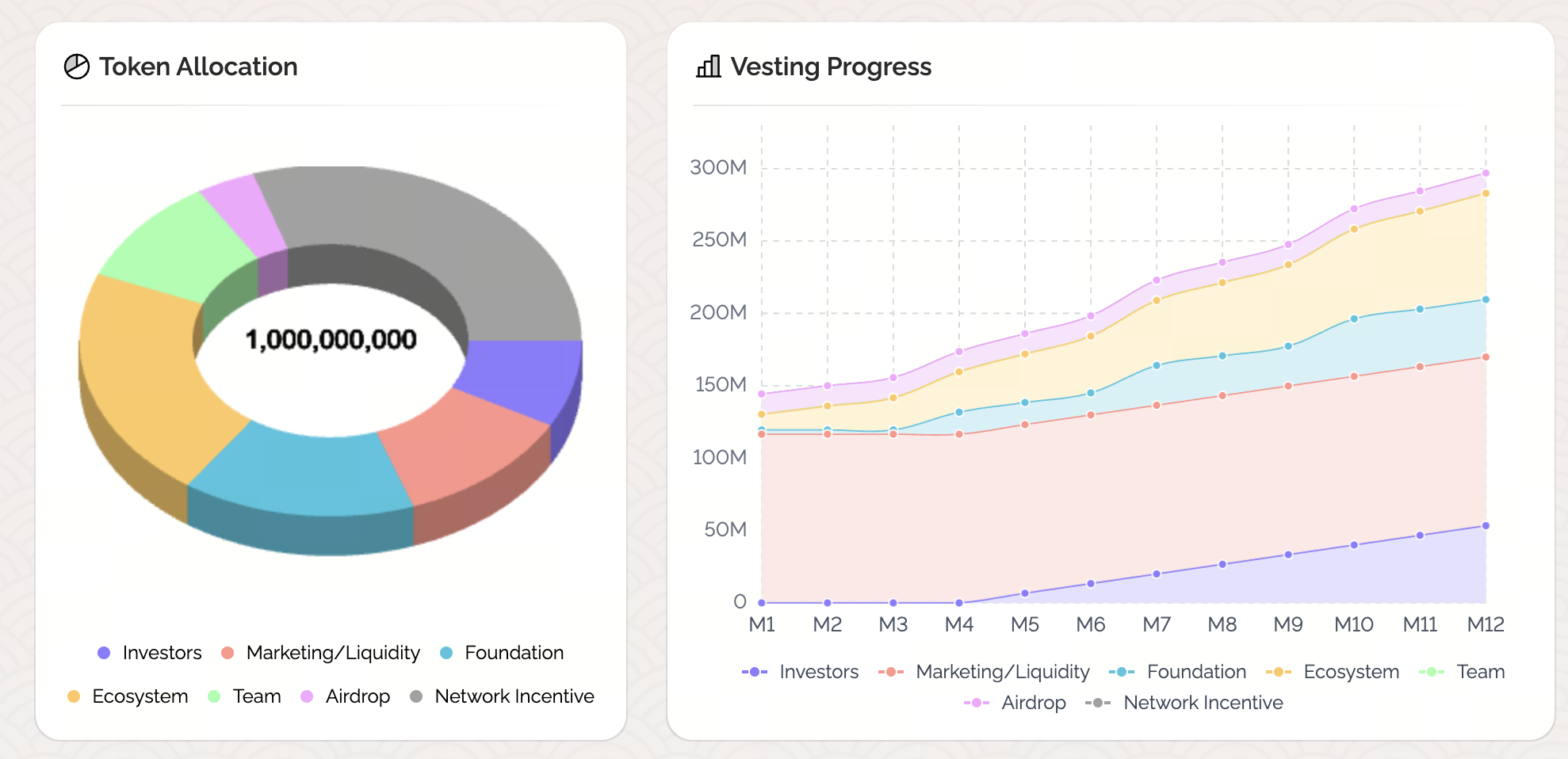
Orochi Network’s token design emphasizes ecosystem growth and network security. As more nodes join and demand for data services increases, ON circulation is gradually shifting from being driven by early-stage financing to real-world usage. The token release schedule is another key market focus. Long lock-up periods, linear releases, and ecosystem incentive programs can help reduce short-term selling pressure and align the long-term interests of network participants.
For infrastructure projects, token value must ultimately be backed by genuine protocol usage, not just market sentiment.
How ON Incentivizes Validators and ZK Sequencers
A zero-knowledge network requires significant computing power. In Orochi Network, validator nodes generate and verify zero-knowledge proofs, while ZK Sequencers handle the ordering, aggregation, and processing of proof requests.
These nodes perform tasks such as data verification, proof generation, state updates, computation execution, and data synchronization. ON is therefore designed as the core asset of the entire incentive system.
When users request data proofs, they pay ON as a fee. This fee is then distributed proportionally to the nodes and Sequencers involved in the computation.
This creates a self-sustaining loop: Users pay ON → Nodes provide computing resources → Network generates proofs → Nodes earn ON rewards → Nodes continue maintaining the network. As data requests grow, node revenue increases, further strengthening network security.
This design shares similarities with traditional PoS networks, but Orochi focuses on verifying data and computation — not transactions.
The Role of ON in Distributed Storage
Orochi Network is not a conventional Oracle network. Its architecture includes a verifiable database, zkDatabase. In traditional database systems, users must trust administrators or third parties. In Orochi’s design, data must be both stored and verifiable.
zkDatabase operations involve multiple steps: data upload, state updates, proof generation, and historical record storage. These processes require nodes to provide computing and storage resources, with ON serving as the medium for paying these resource costs. For example, a developer storing on-chain financial data pays ON for storage; when other applications call that data, they pay ON again to obtain the data proof.
As the database scales, ON’s use cases in the storage layer expand. This model mirrors a data infrastructure fee system in Web3, linking network value to data volume.
How ON Captures Protocol Value
One of the most critical questions for infrastructure projects is whether the value generated by the protocol can flow back to the token itself.
ON captures value through three main channels:
Service Fees
Products like zkDatabase, Orocle, and Orand generate fees paid in ON. As network usage grows, token demand theoretically increases.
Node Staking Requirements
To participate in the network, validators and Sequencers must lock a certain amount of ON. This reduces circulating supply and strengthens the alignment of interests between nodes and the protocol.
Governance Value
As the protocol expands, ON holders can participate in network governance, including protocol upgrades, economic parameter adjustments, and ecosystem fund management.
When an infrastructure project has usage demand, staking demand, and governance demand simultaneously, its value capture logic becomes more robust.
ON’s Role in Governance
Governance is a vital component of Web3 infrastructure.
Orochi Network aims to build a community-driven governance system through ON, where ecosystem participants collectively decide the network’s direction.
ON holders can participate in:
- Network upgrade proposals
- Parameter adjustments
- Node incentive programs
- Ecosystem fund allocation
- Decisions on new product launches
As the ecosystem grows, governance becomes increasingly important. In the data infrastructure space, protocols must continuously adjust proof mechanisms, privacy strategies, and resource pricing. Governance capability is often a key determinant of long-term competitiveness.
Key Factors Influencing ON Token Value
ON’s market performance is shaped by multiple factors:
Ecosystem Adoption Rate: As more projects adopt zkDatabase, Orocle, or Orand, real demand for ON is expected to rise.
Development Speed of ZKP Technology: Zero-knowledge proofs are a critical blockchain trend, but the cost of proof generation, computational efficiency, and tooling maturity will influence the industry’s pace.
Growth of RWA and Stablecoin Markets: Growing demand for on-chain asset transparency and reserve proofs presents opportunities. If Orochi captures these use cases, ON’s ecosystem value could increase.
Broader market conditions, including liquidity, competition, and macroeconomic factors, also affect token price.
Risks to Consider When Investing in ON
While Orochi Network is innovative in verifiable data infrastructure, ON remains a high-risk crypto asset.
Technical Risks: ZK proofs, verifiable databases, and privacy computing are complex. The project’s ability to improve performance and lower costs over time requires long-term observation.
Ecosystem Competition: The data infrastructure track is increasingly competitive, with traditional Oracles, ZK data networks, and new data layer projects vying for developers and market share.
Additionally, as a crypto asset, ON is subject to:
- Market cycle volatility
- Liquidity changes
- Macroeconomic conditions
- Regulatory shifts
These factors can cause significant price fluctuations. Therefore, while evaluating the project’s technical merits, it is also essential to rationally assess potential risks and market uncertainties.
Summary
ON is the core value carrier of Orochi Network’s verifiable data infrastructure, linking data storage, zero-knowledge proofs, node incentives, and community governance. As zkDatabase, Orocle, and Orand expand their application scope, ON’s role has evolved beyond a mere payment medium to become a fundamental element for network resource pricing, protocol value capture, and ecosystem governance.
Against the backdrop of accelerating developments in RWA, stablecoins, AI Agents, and on-chain finance, trustworthy data is emerging as a key direction for Web3 infrastructure. For Orochi Network, the long-term value of ON depends not only on the token model itself but also on the growth rate of the verifiable data ecosystem and the sustained expansion of real-world application scenarios.







