In-Depth Guide to Gate Futures Points System: Enhanced Trading Experience and Exclusive User Benefits

Beginner
Quick Reads
Last Updated 2026-03-28 10:05:09
Reading Time: 1m
The Gate Contract Points System is now live, offering contract traders exclusive growth privileges. Users can easily redeem Cash Tokens and trial funds to enhance their trading experience.

Introduction


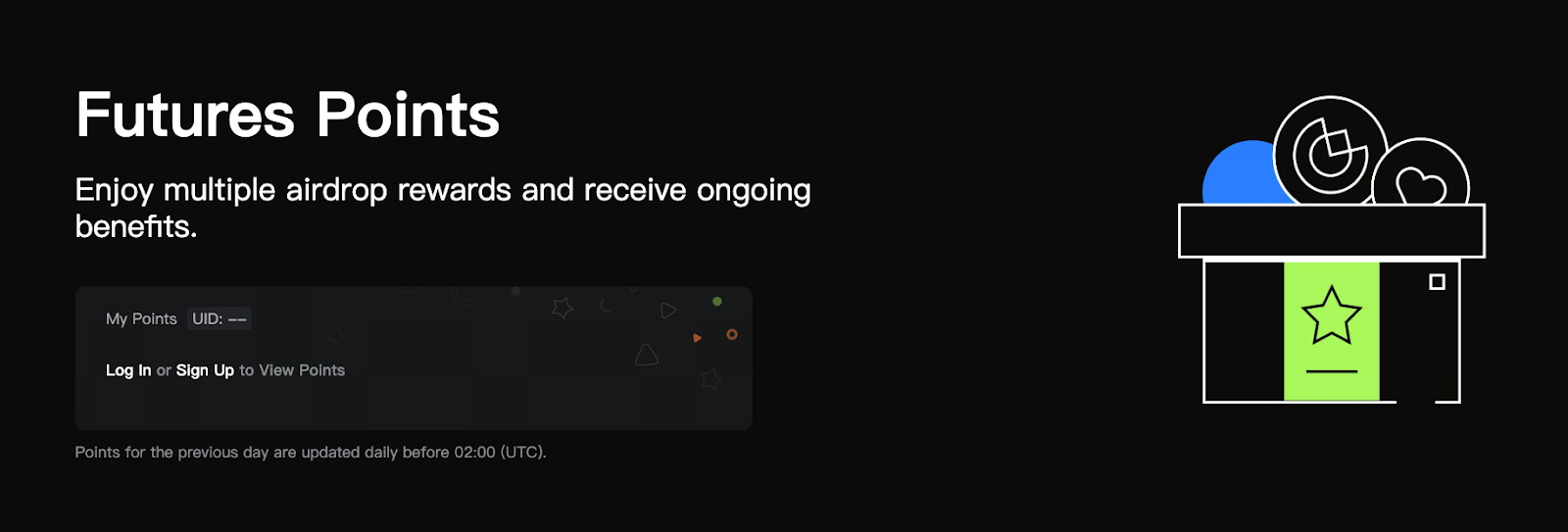
Image: https://www.gate.com/futures/points

With the launch of Gate’s Futures Points System, contract traders are set to experience a new era of growth and rewards. This system is designed to incentivize active participation in futures trading, enhance user engagement, and strengthen platform loyalty through a structured points-based program.

What Are Futures Points?

Futures Points are exclusive loyalty points introduced by Gate for futures trading users. By engaging in futures trading, maintaining qualifying account balances, and participating in designated activities, users earn points that can be redeemed on the points page for cash tokens, position experience coupons, and trial funds. This approach increases user involvement and enhances trading flexibility.

How Can You Earn Futures Points?

Futures Points can be earned through the following channels:

  • Futures Trading Points: Users accrue points based on their daily futures trading volume, awarded according to tiered thresholds. Higher daily trading volumes result in more points. Both opening and closing positions count toward the total trading volume for points calculation.
  • Account Balance Points: Gate takes daily snapshots of users’ USDT and BTC balances, issuing points based on asset brackets. Greater asset balances yield more points. For instance, users with balances between $1,000 and $10,000 receive 2 points per day.
  • Invitation Points: Users earn additional points by inviting new participants to the platform. Each successful invitation generates 1 point, with multiple invitations increasing the total points awarded.

How Can You Use Futures Points?

Once credited, points are available for immediate use. Users can redeem points for cash tokens, position experience coupons, and trial funds. Detailed redemption rules are provided on the activity page, with specific terms and ratios for each type of reward.

Points Validity and Expiration Policy

Each point remains valid for 15 days from the date of issuance. Points not used within this period will automatically expire. The system deducts points with the earliest expiration first, so users should redeem points promptly to avoid forfeiture.

Notes

  • Futures Points calculations exclude copy trading and bot trading activities.
  • Sub-account and API trading volumes do not qualify, and sub-accounts are ineligible for this program.
  • Futures Points operate independently from other points systems (such as Alpha Points), with separate rules and no mutual impact.

For further information, please refer to the official announcement: https://www.gate.com/announcements/article/47608

Summary

The introduction of Gate’s Futures Points System delivers a comprehensive rewards program for contract traders, enhancing the overall trading experience. By participating in futures trading, managing account balances, and inviting new users, traders earn exclusive points that can be redeemed flexibly for various benefits. Transparent rules and effective validity management ensure users can maximize the value of this system and access greater growth opportunities.

Author: Max
Disclaimer
* The information is not intended to be and does not constitute financial advice or any other recommendation of any sort offered or endorsed by Gate.
* This article may not be reproduced, transmitted or copied without referencing Gate. Contravention is an infringement of Copyright Act and may be subject to legal action.

Related Articles

AI-Native Settlement Layers: How United Stables Is Building the Next Financial Rail
Beginner

AI-Native Settlement Layers: How United Stables Is Building the Next Financial Rail

Stablecoins were originally designed as dollar substitutes within exchanges, primarily used for asset pricing and trade settlement. As on-chain financial ecosystems have matured, their role has expanded beyond simple payments to include collateral assets, cross-chain liquidity mediums, and unified settlement units. In particular, as AI systems and automated agents begin to participate directly in economic activity, demand has risen sharply for programmable value units capable of instant settlement. This shift is pushing stablecoins toward the role of foundational financial infrastructure.
2026-03-25 03:16:17
The ve(3,3) Flywheel Explained: How AERO Tokenomics Powers Aerodrome’s DeFi Economy
Beginner

The ve(3,3) Flywheel Explained: How AERO Tokenomics Powers Aerodrome’s DeFi Economy

In the competition for DeFi liquidity, high-inflation mining alone is no longer enough to build lasting advantages. Aerodrome applies the ve(3,3) economic model to redesign token emissions, voting mechanisms, and revenue distribution, creating a liquidity flywheel centered on governance and cash flow. This article examines AERO tokenomics, the veAERO locking mechanism, and protocol revenue models to explain how Aerodrome builds a sustainable DeFi economic system.
2026-03-25 06:41:58
Aerodrome Tokenomics: How ve(3,3) Powers Base's Most Profitable DEX
Beginner

Aerodrome Tokenomics: How ve(3,3) Powers Base's Most Profitable DEX

AERO is the native token of Aerodrome Finance, a core decentralized exchange and liquidity protocol in the Base ecosystem. It is primarily used for liquidity incentives and ecosystem operations. veAERO is a governance NFT that users receive by locking AERO, representing both voting power and the right to share protocol revenue. Through a dual track structure of AERO as a utility token and veAERO as a governance credential, Aerodrome separates liquidity usage value from long term governance power, allowing participants to act as liquidity providers, governance decision makers, and revenue sharers within the same system.
2026-03-25 06:40:31
How Does PAXG Work? In-Depth Overview of the Physical Gold Tokenization Mechanism
Beginner

How Does PAXG Work? In-Depth Overview of the Physical Gold Tokenization Mechanism

PAXG (Pax Gold) is a tokenized asset backed by physical gold, issued by the fintech company Paxos and traded on the Ethereum blockchain as an ERC-20 token. The core concept is to tokenize physical gold on-chain, with each PAXG token representing ownership of a certain amount of gold. This structure enables investors to hold and trade gold in the form of a digital asset.
2026-03-24 19:12:51
How is the price of PAXG determined? Pegging mechanism, trading depth, and influencing factors
Beginner

How is the price of PAXG determined? Pegging mechanism, trading depth, and influencing factors

PAXG (Pax Gold) is a tokenized asset backed by physical gold reserves, launched by fintech firm Paxos and issued as an ERC-20 token on the Ethereum blockchain. The core concept is to digitally represent real-world gold assets, allowing investors to hold and trade gold via the blockchain network. Because each PAXG token corresponds to a specific quantity of physical gold, its price is theoretically expected to closely track the global gold market.
2026-03-24 19:11:40
DePIN Identity Network and Real World Applications: How Humanity Protocol Brings on-chain Identity Into the Physical World
Beginner

DePIN Identity Network and Real World Applications: How Humanity Protocol Brings on-chain Identity Into the Physical World

Most Web3 identity systems remain confined to on-chain environments and struggle to achieve meaningful adoption in real world settings. Through a DePIN architecture and physical verification hardware, Humanity Protocol aims to bring decentralized identity into access control systems, hospitality, public services, and offline events, allowing on-chain identity to function not just as a digital credential, but as foundational infrastructure for real world access.
2026-03-25 07:40:53





