À medida que o mercado DeFi se expande da Negociação à vista para um ecossistema complexo de derivados, os Futuros perpétuos tornaram-se um dos maiores setores de negociação on-chain. Ao contrário dos mercados tradicionais de criptomoedas à vista, os futuros perpétuos permitem que os utilizadores negociem long ou short com alavancagem e participem nos movimentos de preços do mercado sem deter o ativo subjacente.
A TradeXYZ é uma plataforma de negociação de futuros perpétuos on-chain construída sobre a infraestrutura Hyperliquid HIP-3 Builder. Os seus mercados abrangem criptoativos como BTC e ETH, expandindo-se para ações, produtos de base e índices. Através de um Livro de Ordens on-chain, de um mecanismo de Taxa de financiamento e de um sistema de oráculo, a TradeXYZ pretende construir um mercado global de futuros perpétuos multi-ativos, disponível 24/7.
Quais são os componentes do sistema de negociação da TradeXYZ?
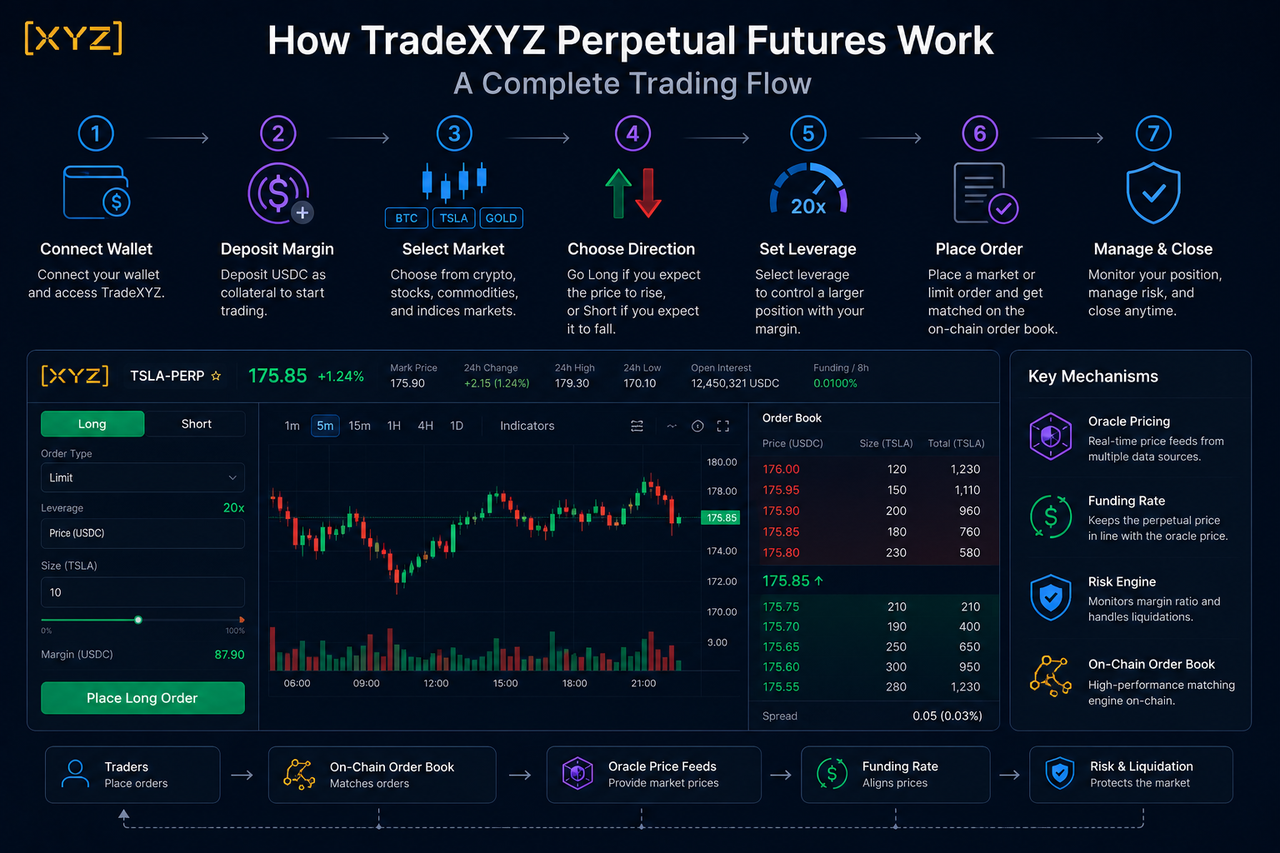
O mercado de futuros perpétuos da TradeXYZ é composto principalmente por um livro de ordens, oráculo, taxa de financiamento e Sistema de controlo de risco.
O livro de ordens on-chain combina ordens de compra e venda, permitindo que os utilizadores coloquem ordens limite ou ordens de mercado diretamente, de forma semelhante às plataformas de negociação tradicionais. O sistema de oráculo fornece continuamente preços de referência externos para ações, produtos de base, índices e criptoativos, influenciando o preço de marcação, a taxa de financiamento e os cálculos de liquidação.
Além disso, a plataforma gere posições alavancadas através do seu Sistema de Margem e Motor de Risco.
| Módulo principal |
Função principal |
| Livro de Ordens On-Chain |
Combina ordens de compra e venda |
| Sistema de Oráculo |
Fornece referências de preços externas |
| Taxa de financiamento |
Equilibra os preços do mercado |
| Sistema de Margem |
Gere posições alavancadas |
| Motor de Risco |
Controla o risco de liquidação |
Em conjunto, estes componentes formam a base operacional do mercado de futuros perpétuos on-chain.
Como começam os utilizadores a negociar na TradeXYZ?
Os utilizadores participam nos mercados da TradeXYZ diretamente através de uma carteira on-chain.
Primeiro, os utilizadores ligam a sua carteira e depositam USDC como margem. Podem depois selecionar entre vários mercados, incluindo BTC, ETH, Tesla, Ouro ou mercados de índices.
Após selecionar um mercado, os utilizadores escolhem ir long ou short e definem a alavancagem e o tamanho da posição. Assim que a ordem é executada, o sistema calcula a taxa de margem, o risco da posição e o PnL não realizado em tempo real.
A liquidez, a volatilidade e os limites de alavancagem variam consoante os diferentes mercados.
| Tipo de mercado |
Exemplos de ativos |
| Criptoativos |
BTC, ETH |
| Mercado de Ações |
Tesla, SpaceX |
| Mercado de Produtos de base |
Ouro, Petróleo |
| Mercado de Índices |
S&P500 |
Como funciona a alavancagem?
A alavancagem permite que os utilizadores controlem uma posição maior com menos margem.
Por exemplo, um utilizador com 1000 USDC e alavancagem de 10x pode, teoricamente, negociar uma posição no valor de 10 000 USDC.
Embora isto melhore a eficiência do capital, também amplifica as potenciais perdas. Quando o mercado se move desfavoravelmente, a taxa de margem do utilizador diminui progressivamente. Se a margem já não conseguir cobrir a perda, o sistema pode acionar uma liquidação.
A TradeXYZ ajusta dinamicamente os limites de alavancagem com base na volatilidade do mercado, na liquidez do ativo e no tamanho da posição, para mitigar o risco do sistema.
Como calcula a TradeXYZ o risco de liquidação?
A TradeXYZ utiliza um motor de risco para monitorizar continuamente as posições dos utilizadores.
Os indicadores principais incluem a Taxa de margem, o Preço de marcação, o nível de alavancagem e a volatilidade do mercado. A plataforma não utiliza diretamente o último preço de negociação para a liquidação; em vez disso, calcula o risco usando o Preço de marcação.
Esta abordagem reduz a probabilidade de liquidações anómalas causadas por flutuações instantâneas do mercado.
Quando a taxa de margem de um utilizador cai abaixo do valor exigido pelo sistema, a plataforma aciona uma liquidação para evitar o risco de saldo negativo.
| Indicador de risco |
Função |
| Taxa de margem |
Avalia a segurança da posição |
| Preço de marcação |
Evita liquidação a preços anómalos |
| Nível de Alavancagem |
Controla o risco da posição |
| Volatilidade do Mercado |
Ajusta os parâmetros de risco |
Porque utiliza a TradeXYZ o modelo de livro de ordens?
A TradeXYZ utiliza um livro de ordens on-chain em vez do modelo tradicional de pool de liquidez AMM.
O modelo de livro de ordens está mais próximo das plataformas de negociação profissionais e oferece tipicamente uma profundidade de mercado mais transparente, menor derrapagem e uma descoberta de preços mais precisa.
Para mercados complexos como ações, produtos de base e índices, a estrutura de livro de ordens é mais adequada para negociação de alta frequência e mercados profissionais de derivados.
No entanto, este modelo também requer liquidez contínua e participação ativa de criadores de mercado.
Qual é a diferença entre a TradeXYZ e os mercados de futuros tradicionais?
Embora os futuros perpétuos e os futuros tradicionais sejam ambos derivados, existem diferenças notáveis.
Os futuros tradicionais têm datas de validade fixas e exigem renovação e liquidação periódicas, enquanto os futuros perpétuos operam continuamente através de um mecanismo de taxa de financiamento.
Além disso, os mercados de futuros perpétuos on-chain suportam geralmente negociação global 24/7.
| Comparação |
Futuros perpétuos |
Futuros tradicionais |
| Tem data de validade? |
Não |
Sim |
| Exige renovação? |
Não |
Sim |
| Utiliza taxa de financiamento? |
Sim |
Não |
| Suporta 24/7? |
Sim |
Geralmente não |
| Ambiente de operação |
Mercado on-chain |
Bolsa tradicional |
Uma das inovações centrais da TradeXYZ é transformar os mercados tradicionais de derivados num mercado global 24/7 através de infraestrutura on-chain.
Resumo
A TradeXYZ construiu um mercado de futuros perpétuos multi-ativos que suporta ações, produtos de base, índices e criptoativos, utilizando um livro de ordens on-chain, feeds de preços de oráculo, mecanismo de taxa de financiamento e sistema de controlo de risco.
Os utilizadores podem negociar long ou short, aplicar alavancagem e participar na descoberta de preços on-chain com margem em USDC, num mercado global disponível 24/7.
À medida que a infraestrutura de derivados on-chain amadurece, os futuros perpétuos estão a tornar-se um dos instrumentos financeiros centrais na DeFi. No entanto, devido à alavancagem, volatilidade do mercado e taxas de financiamento, a negociação de futuros perpétuos continua a ser de alto risco. Os utilizadores devem compreender completamente os mecanismos e a estrutura de risco antes de participar.
Perguntas Frequentes
Os futuros perpétuos da TradeXYZ têm data de validade?
Não. Uma das características definidoras dos futuros perpétuos é a ausência de uma data de validade fixa.
Os utilizadores precisam de deter as ações ou produtos de base reais?
Não. Os utilizadores negociam futuros perpétuos on-chain com base no preço do ativo, e não no próprio ativo.
Porque é que a taxa de financiamento muda?
A taxa de financiamento ajusta-se dinamicamente com base na oferta e procura do mercado, para manter o preço de mercado alinhado com o preço de referência.
Porque é que a alavancagem aumenta o risco?
A alavancagem amplifica tanto os ganhos como as perdas, o que significa que mesmo pequenas oscilações de preço podem resultar em perdas significativas ou liquidação.
Qual é o papel do preço de marcação?
O preço de marcação é utilizado para o controlo de risco e os cálculos de liquidação, reduzindo o risco de liquidações erróneas causadas por preços de negociação anómalos.
Porque utiliza a TradeXYZ o modelo de livro de ordens?
O modelo de livro de ordens oferece uma profundidade de mercado mais transparente, menor derrapagem e uma descoberta de preços mais eficiente, sendo ideal para mercados profissionais de derivados.