A medida que el sector de IA evoluciona desde la competencia entre modelos únicos hacia la innovación basada en ecosistemas, los proyectos cripto de IA afrontan el reto de la centralización de recursos y buscan crear un sistema económico de IA abierto con arquitectura Web3. Este modelo potencia la participación conjunta de desarrolladores, empresas y usuarios en la construcción de redes de IA.
La Artificial Superintelligence Alliance (ASI) se articula en tres componentes principales: agente de IA, una red de servicios de IA y potencia de hash descentralizada. Fetch.ai lidera la infraestructura de agentes de IA, SingularityNET opera el Mercado de IA y la capa de servicios, y CUDOS suministra potencia de hash de GPU y recursos de computación distribuida. En conjunto, estos elementos forman una red colaborativa de IA dentro de ASI, permitiendo que los agentes de IA descubran recursos, invoquen modelos y coordinen operaciones on-chain de forma autónoma.
¿Cómo funciona el agente de IA en ASI?
El agente de IA es un pilar esencial del ecosistema ASI, actuando como una inteligencia de software capaz de realizar tareas de manera autónoma. Estos agentes operan sin supervisión humana constante, toman decisiones, buscan recursos y se comunican según sus objetivos. Por ejemplo, en logística automatizada, un agente de IA puede identificar rutas óptimas y coordinar almacenamiento, pagos y entregas con otros agentes. En la red Fetch.ai, los agentes gestionan consultas de datos, emparejamiento de servicios, trading automático, programación de recursos y llamadas de inferencia de IA. A diferencia de los sistemas tradicionales, los agentes de IA están diseñados para colaborar de forma autónoma.
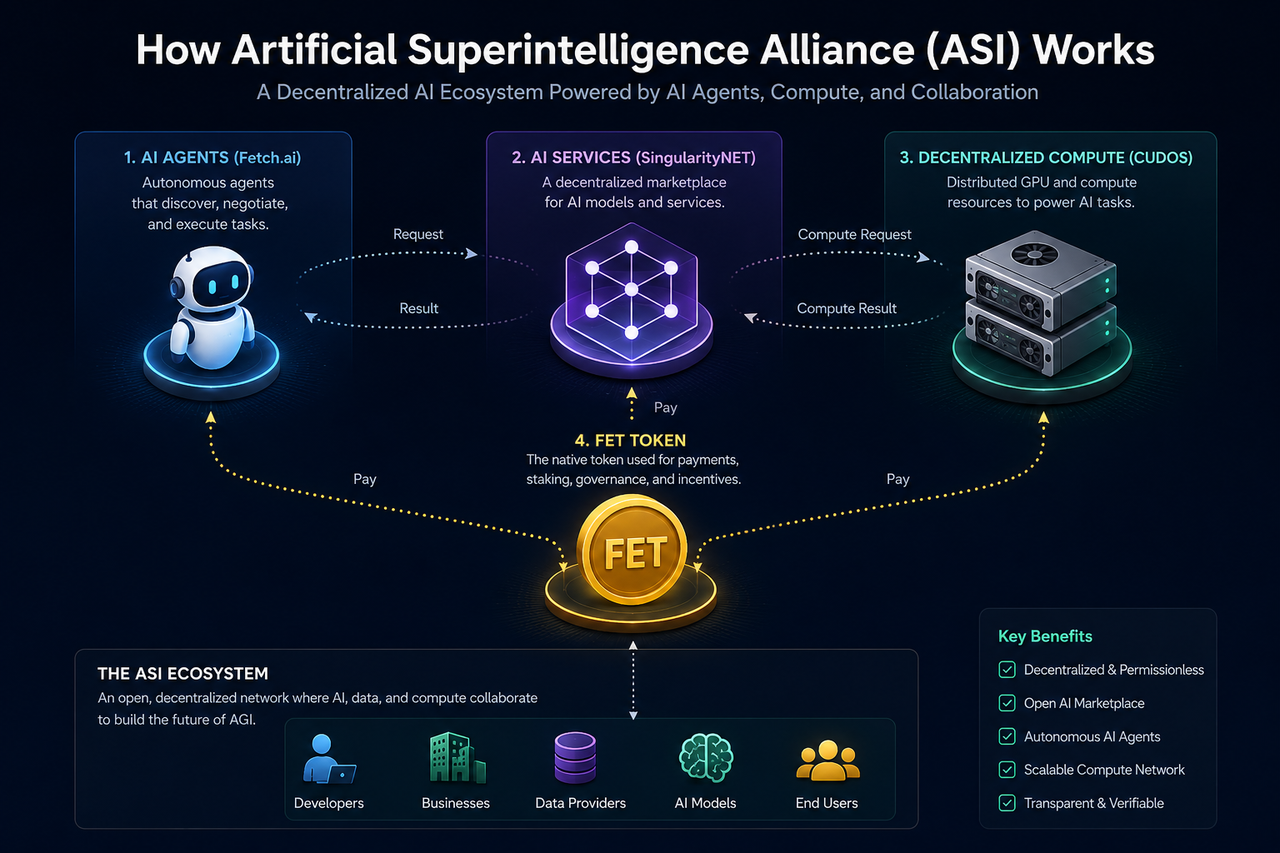
Agentverse, la plataforma de Fetch.ai, facilita el desarrollo de agentes de IA. Los desarrolladores pueden crear agentes rápidamente y desplegarlos en redes descentralizadas. Una vez desplegados, los agentes descubren servicios, se comunican con otros agentes, ejecutan transacciones on-chain e invocan modelos de IA de forma autónoma.
¿Cómo contribuyen SingularityNET y CUDOS al ecosistema ASI?
En ASI, SingularityNET actúa como un mercado abierto de servicios de IA. Los desarrolladores pueden subir modelos de IA y permitir el acceso a otros usuarios para tareas como reconocimiento de imágenes, procesamiento de lenguaje natural, análisis de datos y servicios API de IA. Así, las capacidades de IA circulan libremente en una red abierta, sin depender de una plataforma centralizada. Frente a las plataformas tradicionales de IA en la nube, SingularityNET prioriza la colaboración abierta, lo que le ha dado notoriedad en el ámbito AGI y de IA descentralizada.
CUDOS, por su parte, suministra recursos críticos de computación. Los modelos de IA requieren gran potencia de hash de GPU, aún concentrada entre los grandes actores tecnológicos. CUDOS utiliza una red distribuida de GPU para ofrecer a los desarrolladores acceso abierto a recursos de inferencia y entrenamiento de IA. Dentro de ASI, CUDOS gestiona la programación de GPU, computación en la nube distribuida e inferencia de IA de alto rendimiento, asegurando servicios de IA robustos y capacidades de computación integrales.
El rol de FET en el ecosistema ASI
FET es el token principal y el medio de liquidación de ASI. Los usuarios utilizan FET para acceder a servicios de IA, desplegar agentes o emplear potencia de hash de GPU. Además, FET facilita transacciones entre agentes, gobernanza de la red, staking e incentivos del ecosistema. Por ejemplo, cuando un agente de IA completa una tarea, el sistema gestiona automáticamente el pago y la asignación de recursos con FET.
La mayoría de las actividades en ASI dependen de FET como medio de intercambio de valor, por lo que FET es más que un token: es la herramienta esencial de la economía de IA.
¿Cómo es el proceso operativo completo de ASI?
Un flujo de trabajo típico en ASI comienza con una solicitud de usuario, como una empresa que busca análisis de mercado impulsado por IA y estrategias de trading automatizado. Tras recibir la solicitud, el agente de IA busca recursos disponibles, como modelos de IA, servicios de datos y potencia de hash de GPU. El agente invoca servicios de IA de SingularityNET y obtiene recursos de computación de CUDOS para ejecutar la tarea.
Al finalizar la tarea, los resultados se entregan automáticamente al usuario y FET gestiona la liquidación de pagos. Este proceso opera sin coordinación de una plataforma centralizada, apoyándose en redes blockchain y automatización de agentes de IA. Este modelo representa una dirección clave para la infraestructura de IA Web3, reduciendo la dependencia de plataformas únicas y aumentando la apertura de la red.
Las plataformas de IA tradicionales están dominadas por grandes empresas tecnológicas, con modelos, datos y potencia de hash concentrados en servidores centralizados. ASI apuesta por la apertura, la colaboración comunitaria y el intercambio de recursos. Los desarrolladores acceden a modelos de IA, potencia de hash de GPU y datos sin depender de los grandes actores tecnológicos.
Este enfoque descentralizado permite que los servicios de IA fluyan libremente en redes abiertas, con usuarios participando en la gobernanza y asignación de recursos. ASI es una iniciativa relevante en la infraestructura de IA Web3, orientada a construir redes de IA y una economía de IA abierta.
¿Qué desafíos enfrenta ASI?
Aunque cuenta con una base técnica sólida, la IA descentralizada está en una etapa temprana. La industria exige alta potencia de hash de GPU y las redes distribuidas necesitan mayor desarrollo. La colaboración masiva entre agentes de IA enfrenta retos de eficiencia y estabilidad. Además, la regulación de IA, privacidad de datos y seguridad de modelos pueden afectar el crecimiento a largo plazo de la IA descentralizada.
ASI compite con OpenAI, Google DeepMind y otros proyectos cripto de IA. Alcanzar un equilibrio entre ecosistemas abiertos y viabilidad comercial será clave para su futuro.
Resumen
ASI impulsa la infraestructura abierta de AGI integrando agentes de IA, potencia de hash descentralizada y un mercado de IA. Fetch.ai potencia la red de agentes de IA, SingularityNET gestiona el mercado de servicios de IA y CUDOS aporta potencia de hash de GPU. Juntos, crean un ecosistema integral de IA Web3, donde modelos de IA, datos y recursos de computación colaboran en una red descentralizada.
Con la evolución de los agentes de IA, AGI y los conceptos de IA Web3, ASI se posiciona como plataforma fundamental para la economía de IA del futuro.
Preguntas frecuentes
¿Cuáles son las funciones principales de ASI?
ASI construye una red descentralizada de IA, permitiendo la colaboración libre entre agentes de IA, recursos de potencia de hash y servicios de IA.
¿Qué función cumple el agente de IA en ASI?
Los agentes de IA ejecutan tareas de forma autónoma, buscan recursos, invocan servicios de IA y completan interacciones on-chain.
¿Por qué es importante Fetch.ai?
Fetch.ai proporciona la infraestructura de agentes de IA y es un componente técnico clave en ASI.
¿Cómo se utiliza el token FET?
FET se utiliza para pagos por servicios de IA, transacciones entre agentes, gobernanza de la red e incentivos del ecosistema.
¿Qué gestiona CUDOS en ASI?
CUDOS aporta potencia de hash de GPU y recursos de computación distribuida para el funcionamiento de los modelos de IA.
¿Cuál es la diferencia principal entre ASI y las plataformas de IA tradicionales?
ASI prioriza redes de IA abiertas y el intercambio descentralizado de recursos, mientras que las plataformas tradicionales suelen estar controladas por empresas centralizadas.