Ethereum, sebagai salah satu jaringan Smart Contract paling terkemuka di dunia, telah lama mengandalkan Gas Market untuk mengalokasikan sumber daya transaksi on-chain. Setiap kali pengguna melakukan transaksi, mereka wajib membayar Gas untuk bersaing dengan transaksi lain demi memperoleh ruang blok yang terbatas. Mekanisme ini memang menjaga efisiensi jaringan, namun juga berpotensi menimbulkan biaya perdagangan lebih tinggi dan waktu konfirmasi yang tidak stabil saat terjadi kemacetan.
Pertumbuhan pesat DeFi, blockchain gaming, dan aplikasi on-chain real-time telah menantang performa model bidding instan Gas Market Ethereum tradisional secara real-time. Dalam konteks ini, ETHGas hadir sebagai solusi infrastruktur Ethereum real-time terbaru. Berbeda dari Gas Market tradisional, ETHGas menitikberatkan pada koordinasi ruang blok, pre-confirmation, dan eksekusi real-time, guna mengoptimalkan interaksi on-chain melalui logika penjadwalan sumber daya inovatif.
Ikhtisar Gas Market Ethereum Tradisional vs. ETHGas
Gas Market Ethereum tradisional merupakan mekanisme yang digunakan jaringan Ethereum dalam mengalokasikan sumber daya ruang blok.
Pada jaringan Ethereum, setiap transaksi harus membayar Gas. Gas berfungsi sebagai tolok ukur sumber daya komputasi on-chain dan menentukan prioritas transaksi.
Setelah pengguna mengirimkan transaksi, transaksi tersebut masuk ke pending pool (Mempool). Validator atau Builder biasanya memprioritaskan transaksi dengan bid Gas tertinggi, sehingga pengguna seringkali harus meningkatkan biaya Gas untuk memperoleh konfirmasi lebih cepat.
Inti logika mekanisme ini antara lain:
- Ruang blok terbatas
- Pengguna bersaing memperebutkan sumber daya melalui bidding
- Gas lebih tinggi berarti prioritas transaksi lebih tinggi
- Kemacetan jaringan menyebabkan biaya perdagangan meningkat
ETHGas, sebagai protokol infrastruktur Ethereum berbasis Realtime Blockspace, bertujuan meningkatkan efisiensi eksekusi transaksi dan mengoptimalkan koordinasi sumber daya on-chain.
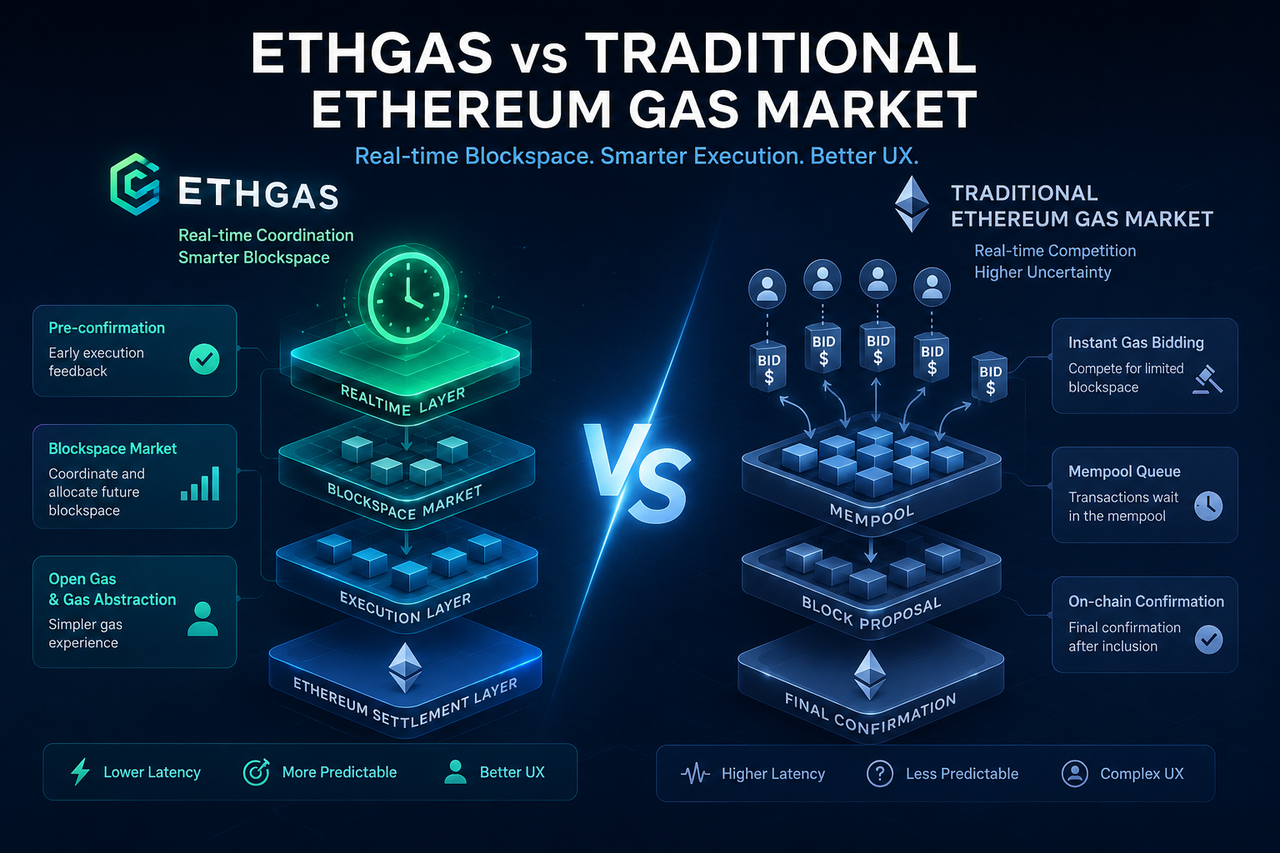
Berbeda dengan Gas Market Ethereum tradisional, ETHGas menitikberatkan pada koordinasi ruang blok masa depan, pre-confirmation, dan eksekusi real-time. Model tradisional lebih berfokus pada “kompetisi sumber daya instan.”
Apa Perbedaan Utama ETHGas dan Gas Market Tradisional?
Perbedaan paling mendasar antara ETHGas dan Gas Market Ethereum tradisional terletak pada pendekatan terhadap “ruang blok.”
Ethereum tradisional memperlakukan ruang blok sebagai sumber daya yang diperebutkan secara instan, sehingga pengguna wajib melakukan bidding real-time demi mendapatkan prioritas transaksi. ETHGas, sebaliknya, memperlakukan ruang blok sebagai sumber daya yang dapat dikoordinasikan dan dijadwalkan terlebih dahulu, dengan tujuan meningkatkan efisiensi eksekusi melalui marketplace ruang blok real-time.
Perbedaan ini juga memengaruhi logika konfirmasi transaksi.
Ethereum tradisional menekankan konfirmasi final on-chain, sedangkan ETHGas menghadirkan mekanisme pre-confirmation yang memungkinkan sebagian transaksi mendapatkan umpan balik eksekusi lebih awal sebelum dicatat resmi on-chain.
Dari sisi pengalaman pengguna dan dukungan lapisan aplikasi pun berbeda. ETHGas memprioritaskan penyederhanaan manajemen Gas bagi pengguna ritel, serta mendukung Gas abstraction dan interaksi real-time.
Bagaimana Mekanisme Penetapan Harga Gas Berbeda?
Gas Market Ethereum tradisional mengandalkan bidding instan.
Saat jaringan mengalami kemacetan, pengguna perlu terus menaikkan bid Gas untuk memperoleh urutan transaksi lebih cepat. Meski pendekatan berbasis pasar ini mengalokasikan sumber daya secara dinamis, efek sampingnya adalah biaya perdagangan yang sangat fluktuatif.
ETHGas, sebaliknya, berfokus pada koordinasi ruang blok dan penjadwalan sumber daya secara real-time. Tujuannya bukan sekadar menaikkan biaya Gas demi bersaing, melainkan mengoptimalkan jalur eksekusi transaksi melalui marketplace ruang blok.
Dibandingkan Gas Market tradisional, ETHGas menonjolkan:
- Mengurangi dampak kemacetan real-time
- Meningkatkan kepastian eksekusi transaksi
- Mengoptimalkan pengalaman trading real-time
- Pra-koordinasi sumber daya blok
Dengan pendekatan ini, ETHGas berfungsi sebagai “layer koordinasi sumber daya,” bukan sekadar sistem bidding Gas.
Bagaimana Perbedaan Mekanisme Konfirmasi Transaksi?
Jaringan Ethereum tradisional mengandalkan konfirmasi final on-chain.
Begitu pengguna mengirimkan transaksi, mereka harus menunggu hingga transaksi dimasukkan ke blok dan dikonfirmasi jaringan untuk memperoleh status final. Cara ini memang menjamin keamanan, namun kecepatan konfirmasi tetap rentan terhadap kemacetan jaringan.
ETHGas memperkenalkan mekanisme pre-confirmation.
Dalam ETHGas, beberapa transaksi dapat memperoleh umpan balik eksekusi lebih awal sebelum secara resmi dicatat ke blok. Pengguna pun bisa mengetahui status transaksi lebih cepat, sehingga pengalaman interaksi real-time menjadi lebih baik.
Perbedaan kedua model dapat dirangkum sebagai berikut:
| Dimensi Perbandingan |
ETHGas |
Ethereum Tradisional |
| Model Ruang Blok |
Koordinasi real-time |
Kompetisi instan |
| Konfirmasi Transaksi |
Mendukung pre-confirmation |
Konfirmasi final on-chain |
| Manajemen Gas |
Mendukung Gas abstraction |
Mandiri oleh pengguna |
| Pengalaman Pengguna |
Fokus pada interaksi real-time |
Fokus pada settlement final |
| Logika Eksekusi |
Penjadwalan ruang blok |
Urutan bid Gas |
ETHGas tidak menggantikan proses konfirmasi di mainnet Ethereum, melainkan menambahkan layer eksekusi real-time sebelum proses settlement final.
Mengapa ETHGas Menekankan Realtime Blockspace?
Seiring meningkatnya kompleksitas aplikasi on-chain, kebutuhan akan lingkungan eksekusi berlatensi rendah dan real-time terus bertambah.
Dalam skenario seperti blockchain gaming, Order Book on-chain, serta trading Frekuensi Tinggi, waktu konfirmasi transaksi sangat memengaruhi pengalaman dan hasil eksekusi pengguna. Model bidding instan Ethereum tradisional memang mendorong kompetisi sumber daya terbuka, tetapi pada skenario interaksi real-time rawan kendala efisiensi.
Pendekatan realtime blockspace dari ETHGas bertujuan melakukan pra-koordinasi sumber daya blok, menekan ketidakpastian selama kemacetan, dan menyediakan lingkungan eksekusi yang lebih stabil untuk aplikasi.
Arah ini juga selaras dengan infrastruktur modular Ethereum, pasar MEV, dan ekosistem account abstraction.
Apakah ETHGas Akan Menggantikan Gas Market Ethereum Tradisional?
Saat ini, ETHGas merupakan ekstensi infrastruktur Ethereum, bukan pengganti langsung Gas Market tradisional.
Gas Market mainnet Ethereum tetap menjadi komponen inti jaringan, dengan model bidding instan yang mendukung kompetisi sumber daya terbuka sekaligus menjaga keamanan.
ETHGas berperan sebagai layer koordinasi sumber daya real-time tambahan di atas infrastruktur yang sudah ada, untuk memenuhi kebutuhan interaksi Frekuensi Tinggi dan aplikasi real-time.
Ke depan, kedua model diproyeksikan akan berjalan berdampingan:
- Mainnet Ethereum menangani settlement final
- ETHGas menyediakan eksekusi real-time dan koordinasi ruang blok
Struktur ini sejalan dengan proses modularisasi berkelanjutan di ekosistem Ethereum.
Ringkasan
ETHGas dan Gas Market Ethereum tradisional sama-sama berfokus pada sumber daya ruang blok, namun menawarkan perbedaan signifikan pada aspek alokasi sumber daya, konfirmasi transaksi, dan logika eksekusi.
Ethereum tradisional menonjolkan bidding Gas instan dan konfirmasi final on-chain, sedangkan ETHGas mengedepankan koordinasi ruang blok real-time, pre-confirmation, serta Gas abstraction, guna meningkatkan efisiensi interaksi on-chain melalui layer eksekusi real-time.
Seiring infrastruktur Ethereum berevolusi menuju modularisasi dan real-time, konsep Realtime Ethereum yang diusung ETHGas menjadi sorotan utama dalam inovasi penjadwalan sumber daya on-chain.
FAQ
Apakah ETHGas Akan Menggantikan Gas Market Ethereum Asli?
Tidak. Saat ini ETHGas difokuskan pada eksekusi real-time dan koordinasi sumber daya, sedangkan settlement final tetap ditangani oleh mainnet Ethereum.
Apa Perbedaan Utama ETHGas dan Ethereum Tradisional?
Perbedaan utamanya terletak pada alokasi sumber daya ruang blok. Ethereum tradisional mengandalkan bidding Gas instan, sedangkan ETHGas menitikberatkan pada koordinasi ruang blok real-time.
Apakah ETHGas Mengubah Mekanisme Konsensus Ethereum?
Tidak. ETHGas berjalan di atas infrastruktur Ethereum yang ada dan tidak menggantikan konsensus mainnet.
Apa Itu Realtime Blockspace?
Realtime blockspace adalah struktur sumber daya blok yang dapat dikoordinasikan, dijadwalkan, dan dioptimalkan terlebih dahulu sebelum eksekusi.
Mengapa ETHGas Mendukung Pre-confirmation?
Pre-confirmation mempercepat waktu tunggu transaksi serta meningkatkan pengalaman interaksi on-chain secara real-time.
Apakah ETHGas Berkaitan dengan MEV?
Ya, dalam batas tertentu. Koordinasi ruang blok, pengurutan Builder, dan mekanisme eksekusi transaksi memiliki keterkaitan dengan ekosistem MEV Ethereum.