ETH Price Prediction 2050: Can Ethereum Break $200,000?

Beginner
Quick Reads
Last Updated 2026-03-29 05:45:30
Reading Time: 1m
This report provides a comprehensive analysis of ETH price forecasts for 2050 and thoroughly evaluates Ethereum's future potential, from technological advancements to institutional adoption. It helps newcomers understand the reasons for investing and the related risks.

ETH Price Outlook for 2050: A Comprehensive Panorama
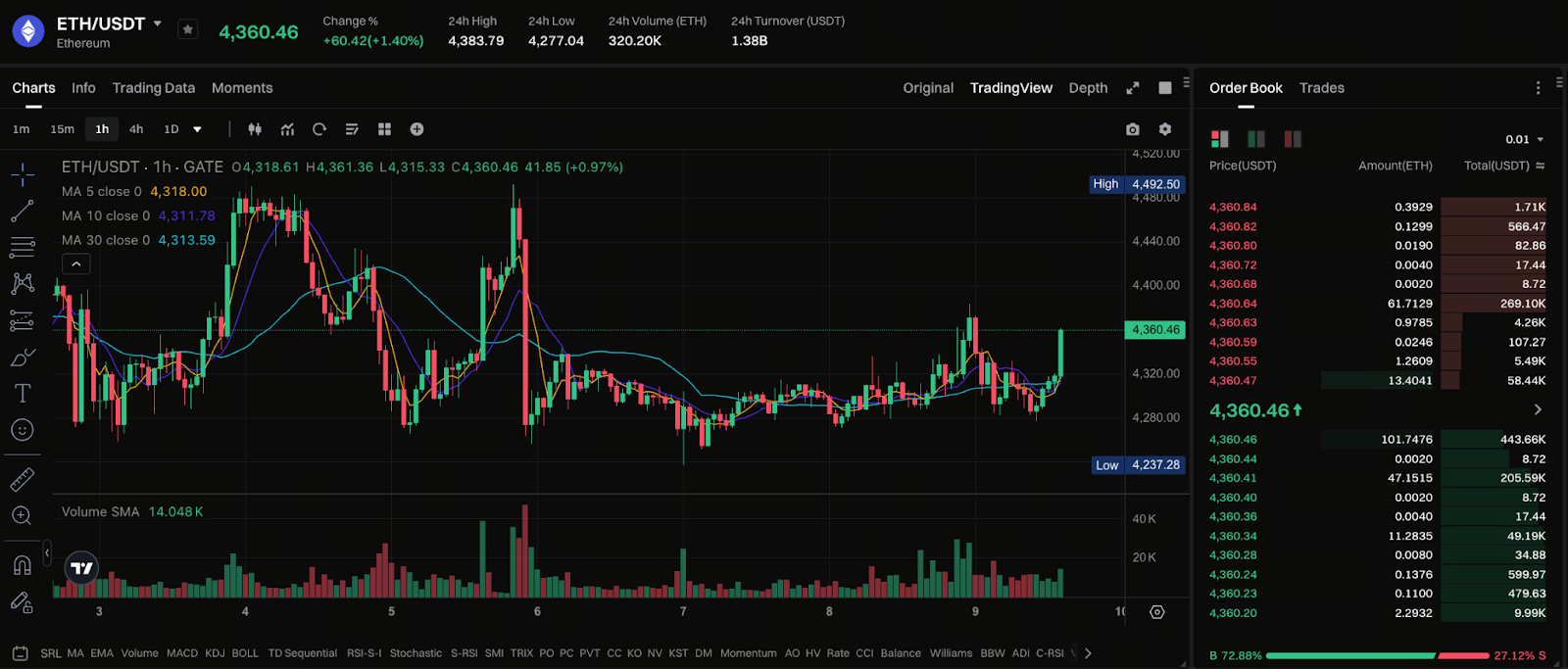

Source: https://www.gate.com/trade/ETH_USDT

Forecasts for ETH’s price in 2050 diverge significantly. Some analyses predict that ETH could break through $200,000 or even higher; more conservative models forecast a range between $20,000 and $50,000. Certain optimistic institutions project an average ETH price of $100,000 to $150,000, and some of the most bullish outlooks anticipate ETH exceeding $250,000.

These discrepancies arise from differences in model assumptions. Some forecasts presume the crypto market will sustain its rapid growth, while others opt for caution, factoring in only moderate expansion rates.

Main Drivers of Long-Term Growth

Several core drivers underpin ETH’s long-term appreciation.

First, scalability within the Ethereum ecosystem is crucial. Key applications across DeFi, NFTs, and GameFi rely almost exclusively on the ETH network, establishing it as the “core infrastructure” of the blockchain space. Second, the combination of the EIP-1559 burn mechanism and staking has amplified ETH’s scarcity, imbuing it with increasingly deflationary characteristics. Third, Ethereum’s continual technical upgrades—such as sharding and layer-2 scaling solutions—have significantly boosted network efficiency and long-term viability. Furthermore, the influx of institutional capital and the launch of ETFs have integrated ETH into mainstream investment portfolios, providing robust price support.

Contrasts Between Optimistic and Conservative Scenarios

If the market maintains rapid growth, ETH could reach $200,000 to $250,000 in 2050—an outcome reflecting an extremely bullish scenario. Under a more neutral outlook, ETH’s price may range between $50,000 and $100,000, seen as a more attainable estimate. Conservative models contend that, even if the market continues to develop, ETH might stay in the $20,000 to $30,000 lower-mid band. These divergent forecasts do not contradict one another—they reflect distinct sets of assumptions.

How Investors Can Interpret Price Forecasts

New investors should avoid getting bogged down by any single price target and instead focus on overarching trends. Over the long term, Ethereum demonstrates substantial growth potential, but every projection carries inherent assumptions and uncertainties. When considering ETH price forecasts for 2050, it’s wise to use a range-based mindset: the optimistic range illustrates the upside, while conservative estimates highlight risk. Investors should pay close attention to core variables affecting price, including developments in network upgrades, macroeconomic trends, and changes in crypto regulations.

Summary and Outlook

ETH price projections for 2050 span a wide spectrum, ranging from tens of thousands to several hundred thousand dollars. For newcomers, understanding the logic behind these forecasts is far more important than focusing on a singular number. While Ethereum’s long-term potential is immense, risks persist. The prudent strategy is to continuously monitor market dynamics and maintain realistic investment expectations.

Author: Max
Disclaimer
* The information is not intended to be and does not constitute financial advice or any other recommendation of any sort offered or endorsed by Gate.
* This article may not be reproduced, transmitted or copied without referencing Gate. Contravention is an infringement of Copyright Act and may be subject to legal action.

Related Articles

AI-Native Settlement Layers: How United Stables Is Building the Next Financial Rail
Beginner

AI-Native Settlement Layers: How United Stables Is Building the Next Financial Rail

Stablecoins were originally designed as dollar substitutes within exchanges, primarily used for asset pricing and trade settlement. As on-chain financial ecosystems have matured, their role has expanded beyond simple payments to include collateral assets, cross-chain liquidity mediums, and unified settlement units. In particular, as AI systems and automated agents begin to participate directly in economic activity, demand has risen sharply for programmable value units capable of instant settlement. This shift is pushing stablecoins toward the role of foundational financial infrastructure.
2026-03-25 03:16:17
The ve(3,3) Flywheel Explained: How AERO Tokenomics Powers Aerodrome’s DeFi Economy
Beginner

The ve(3,3) Flywheel Explained: How AERO Tokenomics Powers Aerodrome’s DeFi Economy

In the competition for DeFi liquidity, high-inflation mining alone is no longer enough to build lasting advantages. Aerodrome applies the ve(3,3) economic model to redesign token emissions, voting mechanisms, and revenue distribution, creating a liquidity flywheel centered on governance and cash flow. This article examines AERO tokenomics, the veAERO locking mechanism, and protocol revenue models to explain how Aerodrome builds a sustainable DeFi economic system.
2026-03-25 06:41:58
Aerodrome Tokenomics: How ve(3,3) Powers Base's Most Profitable DEX
Beginner

Aerodrome Tokenomics: How ve(3,3) Powers Base's Most Profitable DEX

AERO is the native token of Aerodrome Finance, a core decentralized exchange and liquidity protocol in the Base ecosystem. It is primarily used for liquidity incentives and ecosystem operations. veAERO is a governance NFT that users receive by locking AERO, representing both voting power and the right to share protocol revenue. Through a dual track structure of AERO as a utility token and veAERO as a governance credential, Aerodrome separates liquidity usage value from long term governance power, allowing participants to act as liquidity providers, governance decision makers, and revenue sharers within the same system.
2026-03-25 06:40:31
DePIN Identity Network and Real World Applications: How Humanity Protocol Brings on-chain Identity Into the Physical World
Beginner

DePIN Identity Network and Real World Applications: How Humanity Protocol Brings on-chain Identity Into the Physical World

Most Web3 identity systems remain confined to on-chain environments and struggle to achieve meaningful adoption in real world settings. Through a DePIN architecture and physical verification hardware, Humanity Protocol aims to bring decentralized identity into access control systems, hospitality, public services, and offline events, allowing on-chain identity to function not just as a digital credential, but as foundational infrastructure for real world access.
2026-03-25 07:40:53
How is the price of PAXG determined? Pegging mechanism, trading depth, and influencing factors
Beginner

How is the price of PAXG determined? Pegging mechanism, trading depth, and influencing factors

PAXG (Pax Gold) is a tokenized asset backed by physical gold reserves, launched by fintech firm Paxos and issued as an ERC-20 token on the Ethereum blockchain. The core concept is to digitally represent real-world gold assets, allowing investors to hold and trade gold via the blockchain network. Because each PAXG token corresponds to a specific quantity of physical gold, its price is theoretically expected to closely track the global gold market.
2026-03-24 19:11:40
How Does PAXG Work? In-Depth Overview of the Physical Gold Tokenization Mechanism
Beginner

How Does PAXG Work? In-Depth Overview of the Physical Gold Tokenization Mechanism

PAXG (Pax Gold) is a tokenized asset backed by physical gold, issued by the fintech company Paxos and traded on the Ethereum blockchain as an ERC-20 token. The core concept is to tokenize physical gold on-chain, with each PAXG token representing ownership of a certain amount of gold. This structure enables investors to hold and trade gold in the form of a digital asset.
2026-03-24 19:12:51





