Tencent Holdings Limited is listed on the Hong Kong Stock Exchange under stock code 700, commonly shown as 0700.HK on market data services.
For users asking how to buy Tencent stock with USDT or how to buy Tencent Hong Kong stock, the key point is that Gate Stocks connects a digital asset account with stock trading access. USDT works as the funding asset, while Tencent Hong Kong Stock remains linked to Hong Kong market trading rules, market hours, price movements, fees, regional eligibility, and product terms.
Buying Tencent Hong Kong Stock through Gate Stocks should be understood as a product-specific stock trading process, not as investment advice. Users need to check account eligibility, stock account access, order details, fees, supported rights, and the latest Gate product rules before placing any order.
What Do You Need Before Buying Tencent Hong Kong Stock on Gate?
Before buying Tencent Hong Kong Stock with USDT, users need a Gate account, completed identity verification where required, and access to Gate Stocks. Gate Hong Kong Stocks trading is part of the broader Gate Hong Kong stocks trading guide, so users should treat account setup, stock account opening, and regional eligibility as required preparation steps.
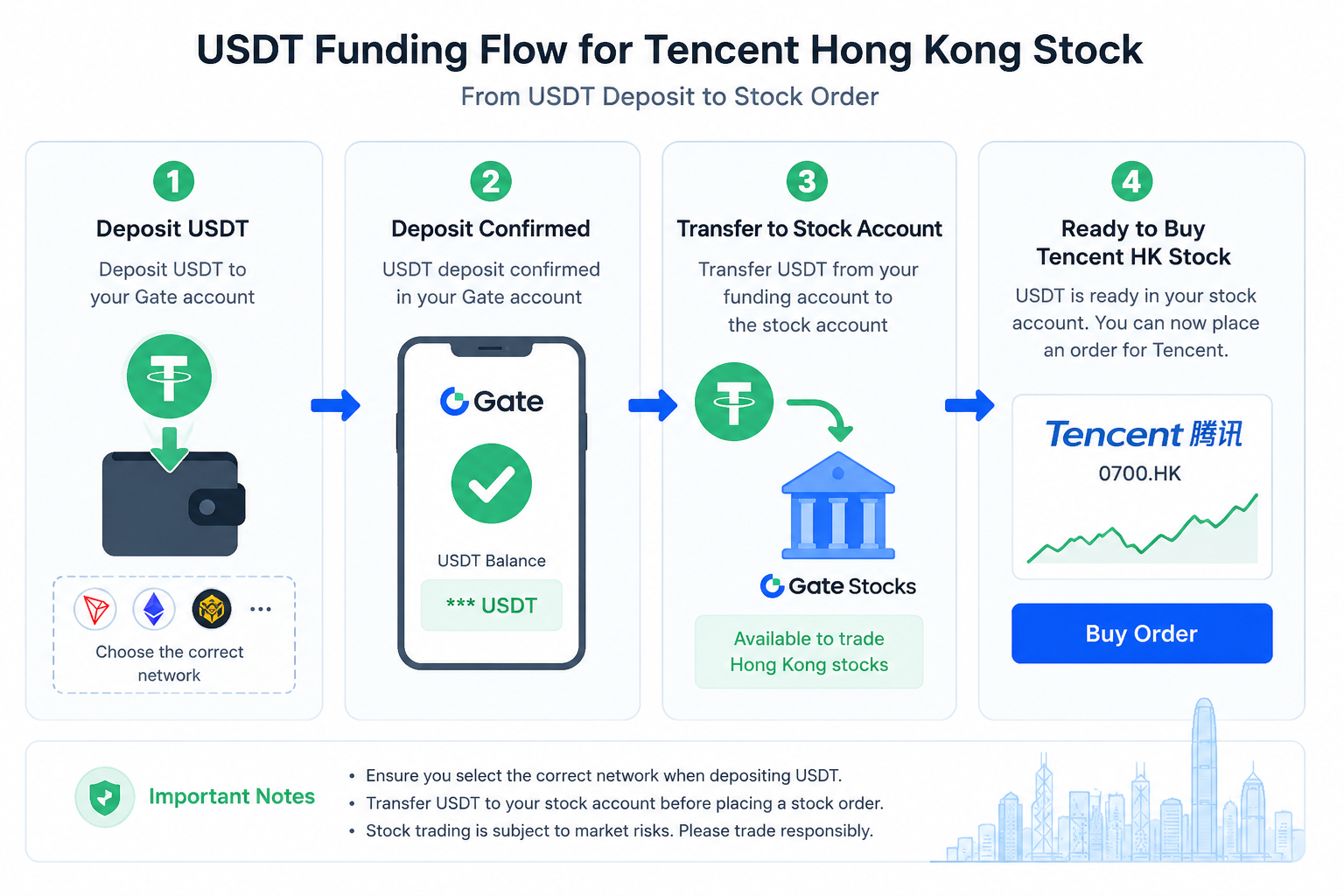
In practice, users may need to hold USDT in their Gate spot or funding account first, then transfer the required amount into the stock account before buying Hong Kong stocks.
Users should also understand the difference between crypto spot balances and stock account balances. Holding USDT in a crypto account does not automatically mean the balance is ready for Tencent Hong Kong Stock orders. The USDT must be available in the correct stock trading account according to Gate’s latest product rules.
| Requirement |
Why it matters |
User note |
| Gate account |
Needed to access Gate services |
Account access alone may not mean stock access |
| Identity verification |
Required for compliance where applicable |
Availability depends on region and product rules |
| USDT balance |
Used as the funding asset |
Check the correct deposit network and balance location |
| Stock account |
Used to manage stock orders and holdings |
It may be separate from the spot account |
| Gate Stocks access |
Needed to find Hong Kong stocks |
Product access may vary by region |
| Product rule awareness |
Helps users understand rights, fees, and execution |
Verify current rules before trading |
This preparation step matters because buying Tencent stock with USDT involves both crypto account operations and stock trading operations. A user who only checks the Tencent stock code but does not confirm account status, regional access, or available USDT may not be ready to place an order.
Step 1: How to Deposit USDT on Gate
To begin, users need USDT available on Gate. A user who already holds USDT on Gate may only need to transfer it to the relevant stock account. A user who holds USDT outside Gate needs to deposit it into the correct Gate wallet address and select the correct network before sending funds.
Network selection is important. USDT exists on multiple blockchain networks, and choosing a network that does not match the deposit address may result in failed or delayed deposits. Users should always copy the deposit address directly from Gate, check the network, verify any memo or tag requirements if shown, and send a small test amount if they are unfamiliar with the process.
After the deposit arrives, the user should confirm that the balance is visible in the Gate account. The next step is to move USDT into the stock account if Gate’s current interface requires a separate transfer. The how to buy Hong Kong stocks with USDT workflow is built around this connection between a digital asset balance and the Hong Kong Stocks section.
Users should not assume that deposits, internal transfers, or stock account balances appear instantly. Processing can depend on blockchain confirmation, network conditions, account status, and Gate’s internal product rules.
Step 2: How to Find Tencent Hong Kong Stock on Gate
After funding is ready, users can enter Gate Stocks and open the Hong Kong Stocks section. Tencent Holdings Limited should be searched by company name or stock code. The Hong Kong stock code is 700, often displayed as 0700.HK in market data contexts.
This step should be handled carefully because stock names, tickers, and market codes can look similar across regions. Users should confirm that they are selecting Tencent Holdings Limited Hong Kong Stock, not a similarly named asset, unrelated crypto token, derivative, or another market listing.
As of June 2026, Gate Hong Kong Stocks is positioned as a way for eligible users to access Hong Kong-listed securities through a digital asset account structure. Product availability can change, so the Tencent Hong Kong Stock page, stock code, supported order types, and trading access should be verified inside Gate before placing an order.
Users comparing this process with traditional securities accounts should understand the difference between Gate Hong Kong Stocks and traditional Hong Kong stock investing. The funding path, account system, settlement asset, and product interface can differ from a bank-linked brokerage account.
Step 3: How to Place an Order for Tencent Hong Kong Stock
Once Tencent Hong Kong Stock is selected, users can open the order page and review the available order options. If market orders are available, they are generally designed to execute based on current market conditions. If limit orders are available, users can set a price level at which they are willing to buy, subject to execution.
Before confirming an order, users should review the estimated price, quantity, fees, available balance, and total cost. The displayed quote and final execution price may differ because stock prices can move, market liquidity can change, and order execution depends on current market conditions.
Order placement is not the same as guaranteed final execution. A market order may execute at a price different from the last displayed quote, while a limit order may remain unfilled if the market does not reach the selected price. Users should check the order status after submitting the order and verify whether the Tencent Hong Kong Stock position appears in the stock account after execution.
| Step |
User action |
Gate Stocks process |
Risk check |
| 1 |
Select Tencent Hong Kong Stock |
Opens the Hong Kong stock order page |
Confirm stock code 700 / 0700.HK |
| 2 |
Choose order type |
Displays available order methods |
Check whether market or limit order fits the intent |
| 3 |
Enter amount or quantity |
Calculates estimated order value |
Review available USDT balance |
| 4 |
Review fees and quote |
Shows estimated cost before confirmation |
Final execution may differ from quote |
| 5 |
Confirm order |
Sends order for execution |
Check order status after submission |
| 6 |
View position |
Records position in stock account if executed |
Monitor holdings and transaction history |
The order review page is the most important checkpoint. Users should not confirm an order only because the correct stock name appears. The quantity, cost, fee estimate, execution method, and market status all need to be checked together.
What Are the Trading Fees for Tencent Hong Kong Stock on Gate? (As of June 2026)
Trading fees, spreads, settlement details, and other applicable costs for Tencent Hong Kong Stock should be checked on Gate before placing an order (As of June 2026). Fee information can change, and different products may have different cost structures.
Users should review the order page before confirmation because the displayed quote, estimated fees, final execution price, and actual filled cost may not always be identical. Market movement, liquidity, and order type can affect the final result.
Gate Stocks is different from crypto spot trading, stock CFDs, and traditional brokerage trading. Users comparing product structures should understand how Gate Stocks vs brokers vs stock CFDs may differ in execution, cost visibility, rights, and risk exposure.
Users should verify the latest fee schedule on Gate before placing an order.
What Risks Should You Understand Before Buying Tencent Hong Kong Stock?
Buying Tencent Hong Kong Stock with USDT involves market risk. Tencent’s share price can move due to company performance, Hong Kong market conditions, technology sector sentiment, regulatory developments, currency factors, and broader macroeconomic events. Past performance does not guarantee future results.
Stock-specific risk also matters. Tencent is a large technology and internet company, but size does not remove business risk. Earnings changes, competition, regulatory updates, product performance, advertising demand, gaming revenue trends, cloud services, investment holdings, and market expectations can all affect price movement.
Liquidity risk should also be considered. Even widely followed Hong Kong stocks may experience changing liquidity during different market sessions. Order execution may vary depending on market conditions, order type, and available market depth.
There is also product-structure risk. Gate Stocks gives users access to stock market exposure through Gate’s product framework, but users should not assume that every right is identical to a traditional brokerage account. The distinction between stock economic rights and shareholder rights is especially important when evaluating dividends, corporate actions, voting rights, and registered shareholder status.
USDT-related risk should not be ignored. USDT is used as the settlement or funding asset in this tutorial flow, but stablecoins can involve issuer, redemption, market, and regulatory risks. A user’s final account value may be affected by both stock price movement and stablecoin-related considerations.
Regional eligibility risk also applies. Gate Stocks access, Hong Kong stock availability, account verification, and product functions may vary by jurisdiction. Users should confirm that Tencent Hong Kong Stock trading is available to them under Gate’s current rules before preparing funds.
Summary
Buying Tencent Hong Kong Stock with USDT on Gate follows a practical sequence: prepare a Gate account, complete required verification, deposit or transfer USDT, open Gate Stocks, find Tencent Holdings Limited by name or stock code 700 / 0700.HK, review the order page, and confirm only after checking the estimated price, fees, quantity, and risk details.
The main benefit of the process is operational convenience for users who already hold USDT and want to access Hong Kong stock trading through Gate Stocks. The main consideration is that this is still stock market exposure with market risk, product rules, possible regional restrictions, and fee considerations.
Users should also understand that Gate Stocks may differ from traditional broker-held shares in account structure, rights handling, settlement, and operational flow. Verification inside Gate remains necessary because supported assets, fees, product rules, and account access may change.
FAQs
How to buy Tencent stock with USDT on Gate?
To buy Tencent stock with USDT on Gate, users need a verified Gate account, available USDT, and access to Gate Stocks. After transferring USDT to the stock account, users can search for Tencent Holdings Limited in the Hong Kong Stocks section, review the order details, and submit the order if they accept the displayed terms.
How to buy Tencent Hong Kong stock if I only hold USDT?
To buy Tencent Hong Kong stock with USDT, the USDT must be available in the correct Gate account balance for stock trading. Users may need to deposit USDT first, then transfer it from a spot or funding account into a stock account according to the current Gate interface.
Is Tencent Hong Kong Stock on Gate the same as buying through a traditional broker?
Tencent Hong Kong Stock on Gate gives users access through Gate Stocks, while a traditional broker normally uses a brokerage and bank account structure. Product rights, settlement, account records, shareholder status, dividend handling, voting rights, and transfer rules may differ, so users should verify Gate’s latest product terms.
What is the ticker for Tencent Hong Kong Stock?
Tencent Holdings Limited is listed on the Hong Kong Stock Exchange under stock code 700, often written as 0700.HK in market data tools. Users should confirm the company name and stock code inside Gate before placing an order.
Are dividends available when holding Tencent Hong Kong Stock on Gate?
Dividend handling depends on Gate Stocks product rules and the specific corporate action process in effect at the time. Users should check Gate’s latest rules on economic rights, dividend treatment, and stock account records before relying on any dividend expectation.
Can I sell Tencent Hong Kong Stock on Gate at any time?
Tencent Hong Kong Stock trading is linked to Hong Kong stock market rules and Gate Stocks product availability. Users should check market hours, order status, liquidity, and regional access before assuming that a sell order can be executed immediately.
Stock investing involves market risk, and prices may fluctuate significantly. Please make decisions carefully based on your own risk tolerance. This article does not constitute investment advice.







