

# CryptoMarketSeesVolatility

357.99K
🚨 Bitcoin Decision Moment: Is the $80k Door Opening?
The crypto market is once again at a critical threshold…
Bitcoin is currently stuck around $78k, and this congestion is not ordinary.
This is a decision zone that will determine the market direction.
So, is this silence… before the storm?

📊 Market Structure: Trend Continues or Trap?
Bitcoin still maintains an upward trend in the big picture.
However, the short-term price movement tells us:
* A slowdown after a strong rally has begun
* Price is stuck within a narrow range
* There is a battle of balance between buyers and sellers
This stru
BTC1.32%
  • Reward
  • Comment
  • Repost
  • Share
#跟单金牌星探 Crypto markets are dipping slightly today and the story behind the numbers is more interesting than the dip itself. Bitcoin sits at $76,451 with +0.56% 24h, down just 1.3% weekly but holding a strong +12.25% over 30 days. Ethereum at $2,265 slips -0.46% daily and -2.1% weekly though up 5.84% monthly. Solana at $83.35 is essentially flat at +0.08% daily with +2.67% monthly but down -21% over 90 days. XRP at $1.371 edges up +0.80% daily with +1.78% monthly. BNB steady at $616.8 near zero change. DOGE stands out with +3.24% today and +16% over 30 days at $0.107. ADA at $0.2471 gains +1.22
BTC1.32%
ETH0.58%
SOL2.79%
XRP1.35%
post-image
post-image
post-image
  • Reward
  • 1
  • Repost
  • Share
Ryakpanda:
Just charge forward 👊
#CryptoMarketSeesVolatility
Crypto Market Structure Shift, Liquidity Pressure & 2026 Breakout Zone Analysis
As of April 27, 2026, the cryptocurrency market is moving inside a tight consolidation phase where price action looks relatively stable on the surface, but underlying volatility pressure continues to build. Bitcoin is trading around the $78,500 to $78,800 range after recovering from recent lows near $75,800. Ethereum is holding in the $2,300 to $2,380 zone, repeatedly facing resistance near $2,400. Meanwhile, the total crypto market capitalization remains close to $2.61 trillion, showin
BTC1.32%
ETH0.58%
MrFlower_XingChen
#CryptoMarketSeesVolatility
Crypto Market Structure Shift, Liquidity Pressure & 2026 Breakout Zone Analysis
As of April 27, 2026, the cryptocurrency market is moving inside a tight consolidation phase where price action looks relatively stable on the surface, but underlying volatility pressure continues to build. Bitcoin is trading around the $78,500 to $78,800 range after recovering from recent lows near $75,800. Ethereum is holding in the $2,300 to $2,380 zone, repeatedly facing resistance near $2,400. Meanwhile, the total crypto market capitalization remains close to $2.61 trillion, showing limited daily percentage changes but hiding stronger internal fluctuations driven by leverage and liquidity shifts.
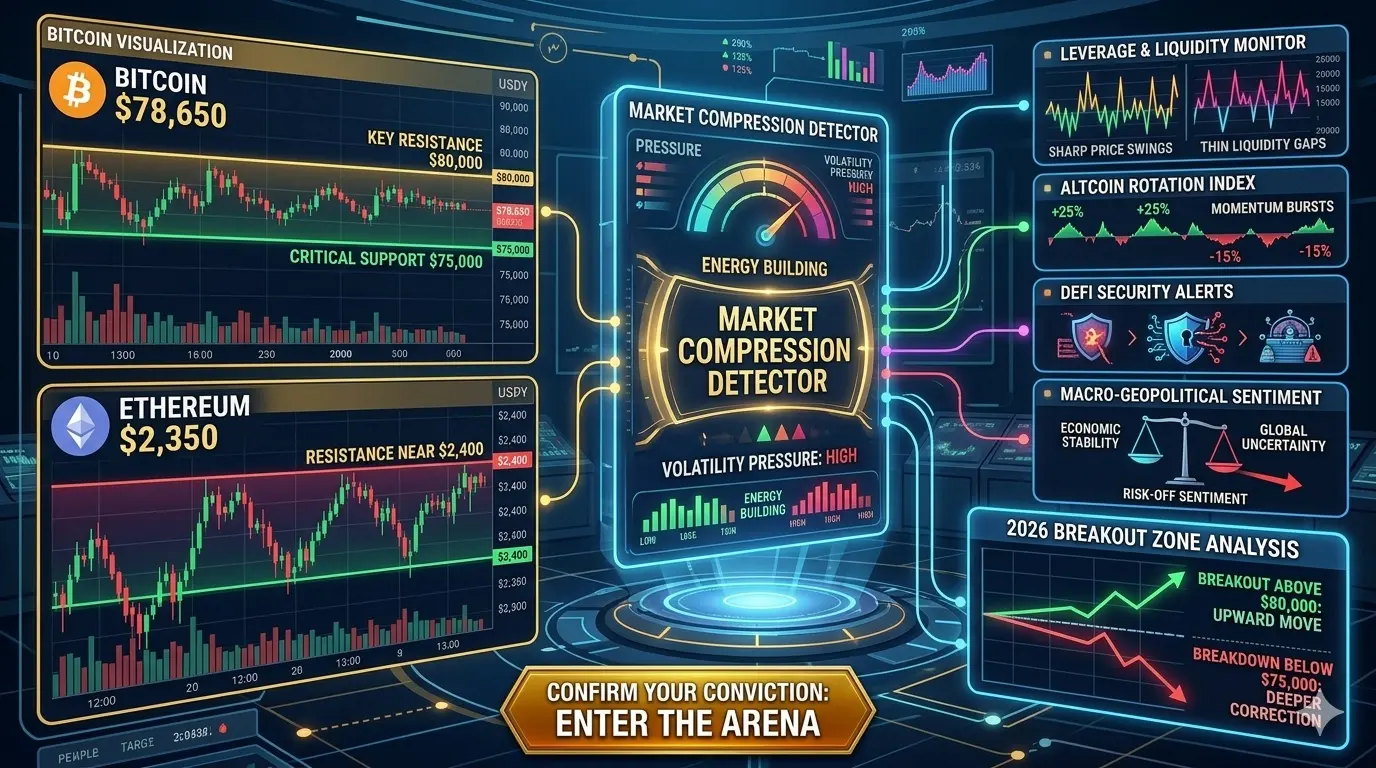
This phase reflects a classic market compression structure. Prices are not trending strongly in either direction but are instead moving within a controlled range where buyers and sellers are repeatedly testing key levels. Bitcoin is forming a tight structure between approximately $75,000 support and $80,000 resistance, while Ethereum is following a similar pattern but with higher volatility and faster reactions. This kind of environment usually develops when the market is preparing for a larger directional move, but uncertainty keeps momentum restricted.
Bitcoin’s current behavior suggests accumulation within a defined range. Repeated rebounds from the $75,000–$76,500 zone indicate strong interest from buyers, while consistent rejection near $79,500–$80,000 shows active selling pressure at higher levels. This balance creates a compression effect where volatility is temporarily reduced but energy is building beneath the surface. A breakout above $80,000 could trigger a stronger upward move, while a breakdown below $75,000 could open the door to deeper correction levels.
Ethereum continues to act as a higher-beta asset compared to Bitcoin, meaning it reacts more aggressively to market movements. Its trading range between $2,300 and $2,380 reflects ongoing hesitation, especially near the $2,400 resistance zone. While Ethereum has shown short-term recovery strength, it still lacks a clear breakout structure. Historically, Ethereum tends to amplify Bitcoin’s direction, so its next major move is likely to follow BTC’s breakout or breakdown confirmation.
Market volatility is being strongly influenced by derivatives trading and leveraged positions. Even when spot price movement appears limited, liquidations in futures markets can create sharp and sudden price swings. Thin liquidity around key levels increases the impact of these moves, making short-term volatility more intense than what the range might suggest. This is why even small catalysts can trigger fast movements in either direction.
Recent security breaches in the DeFi ecosystem have also added pressure to market sentiment. Large-scale exploits reduce investor confidence, tighten liquidity temporarily, and increase defensive trading behavior. These events often do not change long-term fundamentals but they significantly affect short-term volatility and can accelerate price swings during sensitive market phases.
On the macro level, geopolitical uncertainty and global financial conditions continue to influence crypto behavior. Concerns around economic stability, inflation risks, and geopolitical tensions contribute to risk-off sentiment in certain periods. While Bitcoin is often viewed as a long-term hedge asset, in the short term it still behaves like a high-risk asset that reacts strongly to global uncertainty.
Altcoin markets are showing rotational movement rather than sustained trends. Many tokens experience quick gains of 10% to 25%, followed by sharp corrections of 5% to 15%. This indicates speculative trading behavior where momentum is short-lived and heavily dependent on Bitcoin’s direction. Bitcoin dominance remains relatively stable, showing that capital is still concentrated in BTC during uncertain conditions.
The current volatility structure is driven by a chain reaction process. A catalyst triggers movement, leverage amplifies it, and liquidity gaps exaggerate the final price impact. This creates a market where intraday swings of 2% to 4% are common, even without major fundamental changes. As a result, trading conditions require more precision and risk control than directional conviction alone.
In this environment, disciplined strategies become more important than aggressive trading. Range-based approaches between key support and resistance zones are more effective, along with controlled position sizing and careful risk management. Many traders focus on smaller, consistent moves rather than attempting large unpredictable swings.
Institutionally, accumulation appears to be taking place gradually within lower price zones, especially in Bitcoin’s $75,000 to $78,000 range. Retail behavior, on the other hand, tends to be more reactive, often entering late during price surges or exiting during dips. This behavioral gap continues to contribute to short-term volatility and inefficiencies in price action.
Overall, the crypto market is currently positioned in a critical compression phase. Bitcoin near $78,600 and Ethereum near $2,350 reflect a system under pressure rather than one in equilibrium. The next major move is likely to be decisive, with potential for either a breakout toward higher resistance levels or a deeper correction toward lower support zones. Until that resolution occurs, the market remains in a structured but unstable state where patience and timing matter more than aggressive speculation.
repost-content-media
  • Reward
  • Comment
  • Repost
  • Share
#CryptoMarketSeesVolatility
Crypto Market at a Turning Point — Volatility, Smart Money & the Next Big Move
The crypto market is no longer moving on hype alone — it’s now reacting like a true global financial system.
Right now, we are seeing controlled volatility, not chaos.
Bitcoin is holding near $78K, showing strong recovery momentum over the past month. But zoom out, and the structure tells a different story — the market is still healing from a broader correction phase.
Ethereum and Solana are following the same pattern: 📈 Short-term strength
📉 Mid-term uncertainty
This tells us one thing
BTC1.32%
ETH0.58%
SOL2.79%
  • Reward
  • 2
  • Repost
  • Share
MasterChuTheOldDemonMasterChu:
Just charge forward 👊
View More
#CryptoMarketSeesVolatility
Crypto Market Structure Shift, Liquidity Pressure & 2026 Breakout Zone Analysis
As of April 27, 2026, the cryptocurrency market is moving inside a tight consolidation phase where price action looks relatively stable on the surface, but underlying volatility pressure continues to build. Bitcoin is trading around the $78,500 to $78,800 range after recovering from recent lows near $75,800. Ethereum is holding in the $2,300 to $2,380 zone, repeatedly facing resistance near $2,400. Meanwhile, the total crypto market capitalization remains close to $2.61 trillion, showin
BTC1.32%
ETH0.58%
MrFlower_XingChen
#CryptoMarketSeesVolatility
Crypto Market Structure Shift, Liquidity Pressure & 2026 Breakout Zone Analysis
As of April 27, 2026, the cryptocurrency market is moving inside a tight consolidation phase where price action looks relatively stable on the surface, but underlying volatility pressure continues to build. Bitcoin is trading around the $78,500 to $78,800 range after recovering from recent lows near $75,800. Ethereum is holding in the $2,300 to $2,380 zone, repeatedly facing resistance near $2,400. Meanwhile, the total crypto market capitalization remains close to $2.61 trillion, showing limited daily percentage changes but hiding stronger internal fluctuations driven by leverage and liquidity shifts.
This phase reflects a classic market compression structure. Prices are not trending strongly in either direction but are instead moving within a controlled range where buyers and sellers are repeatedly testing key levels. Bitcoin is forming a tight structure between approximately $75,000 support and $80,000 resistance, while Ethereum is following a similar pattern but with higher volatility and faster reactions. This kind of environment usually develops when the market is preparing for a larger directional move, but uncertainty keeps momentum restricted.
Bitcoin’s current behavior suggests accumulation within a defined range. Repeated rebounds from the $75,000–$76,500 zone indicate strong interest from buyers, while consistent rejection near $79,500–$80,000 shows active selling pressure at higher levels. This balance creates a compression effect where volatility is temporarily reduced but energy is building beneath the surface. A breakout above $80,000 could trigger a stronger upward move, while a breakdown below $75,000 could open the door to deeper correction levels.
Ethereum continues to act as a higher-beta asset compared to Bitcoin, meaning it reacts more aggressively to market movements. Its trading range between $2,300 and $2,380 reflects ongoing hesitation, especially near the $2,400 resistance zone. While Ethereum has shown short-term recovery strength, it still lacks a clear breakout structure. Historically, Ethereum tends to amplify Bitcoin’s direction, so its next major move is likely to follow BTC’s breakout or breakdown confirmation.
Market volatility is being strongly influenced by derivatives trading and leveraged positions. Even when spot price movement appears limited, liquidations in futures markets can create sharp and sudden price swings. Thin liquidity around key levels increases the impact of these moves, making short-term volatility more intense than what the range might suggest. This is why even small catalysts can trigger fast movements in either direction.
Recent security breaches in the DeFi ecosystem have also added pressure to market sentiment. Large-scale exploits reduce investor confidence, tighten liquidity temporarily, and increase defensive trading behavior. These events often do not change long-term fundamentals but they significantly affect short-term volatility and can accelerate price swings during sensitive market phases.
On the macro level, geopolitical uncertainty and global financial conditions continue to influence crypto behavior. Concerns around economic stability, inflation risks, and geopolitical tensions contribute to risk-off sentiment in certain periods. While Bitcoin is often viewed as a long-term hedge asset, in the short term it still behaves like a high-risk asset that reacts strongly to global uncertainty.
Altcoin markets are showing rotational movement rather than sustained trends. Many tokens experience quick gains of 10% to 25%, followed by sharp corrections of 5% to 15%. This indicates speculative trading behavior where momentum is short-lived and heavily dependent on Bitcoin’s direction. Bitcoin dominance remains relatively stable, showing that capital is still concentrated in BTC during uncertain conditions.
The current volatility structure is driven by a chain reaction process. A catalyst triggers movement, leverage amplifies it, and liquidity gaps exaggerate the final price impact. This creates a market where intraday swings of 2% to 4% are common, even without major fundamental changes. As a result, trading conditions require more precision and risk control than directional conviction alone.
In this environment, disciplined strategies become more important than aggressive trading. Range-based approaches between key support and resistance zones are more effective, along with controlled position sizing and careful risk management. Many traders focus on smaller, consistent moves rather than attempting large unpredictable swings.
Institutionally, accumulation appears to be taking place gradually within lower price zones, especially in Bitcoin’s $75,000 to $78,000 range. Retail behavior, on the other hand, tends to be more reactive, often entering late during price surges or exiting during dips. This behavioral gap continues to contribute to short-term volatility and inefficiencies in price action.
Overall, the crypto market is currently positioned in a critical compression phase. Bitcoin near $78,600 and Ethereum near $2,350 reflect a system under pressure rather than one in equilibrium. The next major move is likely to be decisive, with potential for either a breakout toward higher resistance levels or a deeper correction toward lower support zones. Until that resolution occurs, the market remains in a structured but unstable state where patience and timing matter more than aggressive speculation.

repost-content-media
  • Reward
  • 4
  • Repost
  • Share
CryptoDiscovery:
2026 GOGOGO 👊
View More
#CryptoMarketSeesVolatility
As of April 27, 2026, Bitcoin trades between approximately $78,520 and $78,831, with recent values recorded near $78,581.99. It has recovered roughly 3.8% to 4.2% from lows near $75,800 earlier in the month but continues to test resistance around the $79,000–$80,000 psychological level. Ethereum moves in the $2,300 to $2,377 range, recently closing near $2,372.82 after opening around $2,319.
The total cryptocurrency market capitalization hovers close to $2.61 trillion, showing modest daily variations of about 1% within a monthly range that has exhibited 4% to 8% s
BTC1.32%
ETH0.58%
HighAmbition
#CryptoMarketSeesVolatility
As of April 27, 2026, Bitcoin trades between approximately $78,520 and $78,831, with recent values recorded near $78,581.99. It has recovered roughly 3.8% to 4.2% from lows near $75,800 earlier in the month but continues to test resistance around the $79,000–$80,000 psychological level. Ethereum moves in the $2,300 to $2,377 range, recently closing near $2,372.82 after opening around $2,319.
The total cryptocurrency market capitalization hovers close to $2.61 trillion, showing modest daily variations of about 1% within a monthly range that has exhibited 4% to 8% swings. These levels may appear relatively stable on the surface, yet they become highly explosive when amplified by derivatives leverage and liquidity imbalances across exchanges.
Understanding Volatility: Why Crypto Moves Faster Than Traditional Markets
Cryptocurrency markets remain structurally more volatile than traditional financial systems due to 24/7 trading, shallower liquidity compared to global equities, and heavy reliance on sentiment-driven flows. Price discovery occurs without pause, allowing news events, regulatory updates, or social media narratives to impact valuations instantly.
Bitcoin’s fixed supply of 21 million coins creates scarcity dynamics. Modest demand surges can drive price increases of 3% to 7% within hours, while negative catalysts—such as security breaches or geopolitical shocks—often trigger rapid declines of 5% to 10%, especially when leveraged positions face cascading liquidations.
In April 2026, this pattern has repeated through periods of compression followed by sharp expansions tied to external pressures.
Bitcoin Price Action: Compression Zone Before Major Expansion
Bitcoin displays a classic compression pattern. The asset has traded within a weekly range of roughly $75,800 to $79,200 (about 4.5% movement) and a broader monthly range of $74,000 to $80,000 (around 8% volatility). This indicates building tension for a decisive directional move.
From a recovery standpoint, Bitcoin has gained approximately 3.8% to 4.2% from recent lows near $75,800, supported by institutional buying interest in the $75,000–$78,000 zone. However, short-term distribution pressure keeps advances capped near $79,000–$80,000. A successful break above $80,000 could spark a 3% to 7% rally targeting $82,500, $84,000, and potentially $86,000 in the short term. Failure to hold momentum might lead to a 5% to 10% correction, pulling prices back toward $75,000, $73,500, or even $70,000 if fear intensifies.
Ethereum Analysis: Higher Beta, Faster Moves, Greater Risk
Ethereum continues to act as Bitcoin’s higher-volatility counterpart. It has experienced short-term swings of 3% to 5% within the $2,287 to $2,377 range and broader monthly volatility of 8% to 12%. This profile attracts traders seeking quicker percentage gains.
After recovering around 3% from recent lows, Ethereum remains capped below the $2,400 resistance, reflecting buyer hesitation amid ongoing security concerns in the DeFi space. In bullish conditions, Ethereum could deliver 6% to 12% upside, targeting $2,500 to $2,700 and beyond. In bearish scenarios, an 8% to 15% decline could revisit $2,150 or even $2,000 if overall risk sentiment weakens.
Security Breaches and Their Market Impact: $600M+ Shockwaves
April 2026 has become one of the worst months for crypto exploits in over a year, with total losses exceeding $606 million across multiple incidents, including major attacks on protocols like KelpDAO and Drift. Each significant breach has caused immediate price drops of 2% to 6%, followed by extended volatility from panic selling and liquidation cascades.
These events not only hit prices directly but also erode investor confidence, tighten liquidity, and create a feedback loop that increases the likelihood of further swings. The scale of losses—already dwarfing the entire first quarter—has added noticeable downward pressure at key moments while highlighting ongoing risks in the ecosystem.
Geopolitical Influence: US-Iran Tensions Adding Macro Pressure
Geopolitical developments, particularly around US-Iran relations and potential risks near the Strait of Hormuz, contribute to broader uncertainty. Concerns over stalled negotiations, oil supply disruptions, and inflation fears feed into risk-off sentiment that affects crypto as a high-beta asset.
While Bitcoin is sometimes viewed as a digital hedge during turmoil, it can also suffer sharp sell-offs when global markets turn defensive. This growing correlation with traditional risk assets makes macro and geopolitical headlines powerful drivers of short-term price action around current levels near $78,600 for Bitcoin.
Altcoin Market Behavior: Short Bursts, Fast Corrections
Altcoins experience rotational flows, with selective tokens posting 10% to 25% short-term gains that are frequently followed by 5% to 15% corrections. This underscores the speculative character of much altcoin activity. Bitcoin dominance remains stable between 55% and 60%, reinforcing its leadership while altcoins function as higher-risk extensions of Bitcoin’s overall price movements.
Volatility Mechanics: The Chain Reaction Effect
Current volatility follows a clear chain reaction: a catalyst sparks initial movement, leverage amplifies it, and liquidity gaps exaggerate the outcome. This dynamic produces intraday swings of 2% to 4% and multi-day moves of 5% to 10%, even in the absence of major fundamental changes. Traders continue to debate whether this environment favors patient accumulation or agile tactical trading.
Trading Strategies: Discipline Over Emotion in a High-Risk Environment
In the present conditions, experienced participants prioritize risk management over aggressive profit chasing. Most limit individual position sizes to 1% to 2% of total capital. Range trading remains dominant between support near $75,000–$77,000 and resistance at $80,000–$82,000 for Bitcoin. Scalpers target smaller 0.5% to 1.5% intraday moves around the current $78,600 area, while swing traders look for 3% to 8% opportunities aligned with broader trends. Dollar-cost averaging into dips stays popular among those with a longer-term horizon.
Institutional vs Retail Behavior: Smart Money vs Emotional Trading
Institutional players appear to be quietly accumulating Bitcoin in the $75,000–$78,000 range with a multi-month view. Retail traders, in contrast, often react more emotionally—buying strength late and selling weakness early—which adds fuel to short-term volatility and highlights ongoing market inefficiencies. This divergence keeps the debate alive on whether rising institutional participation will eventually stabilize swings or if retail sentiment will continue driving noise.
Price Forecast and Forward Outlook: A Decisive Phase Ahead
The market is approaching a resolution point for the current compression. A bullish breakout above $80,000 for Bitcoin could drive an 8% to 12% gain toward $85,000–$88,000 in the near term. A bearish breakdown below $75,000 risks a 10% to 15% correction toward $70,000 or lower, depending on the strength of external pressures.
Ethereum would likely move in tandem, aiming for $2,700+ in bullish cases or sliding toward $2,000 if risk appetite deteriorates. Longer-term views for the remainder of 2026 range from consolidation between $75,000 and $100,000 for Bitcoin to more optimistic targets above $100,000 if adoption trends and liquidity conditions improve.
Final Conclusion: A Market That Demands Precision, Patience, and Strategy
The cryptocurrency market in late April 2026 is defined by controlled chaos, where volatility simultaneously creates opportunity and substantial risk. Success depends on discipline, strategic planning, and the ability to interpret underlying market structure rather than reacting emotionally to every headline.
With Bitcoin hovering near $78,600 and Ethereum around $2,350 inside a total market value close to $2.61 trillion, the sector stands at a critical inflection point. The next breakout or breakdown will likely set the tone for the coming weeks and months, making this a pivotal moment for traders and investors.
repost-content-media
  • Reward
  • Comment
  • Repost
  • Share
Load More