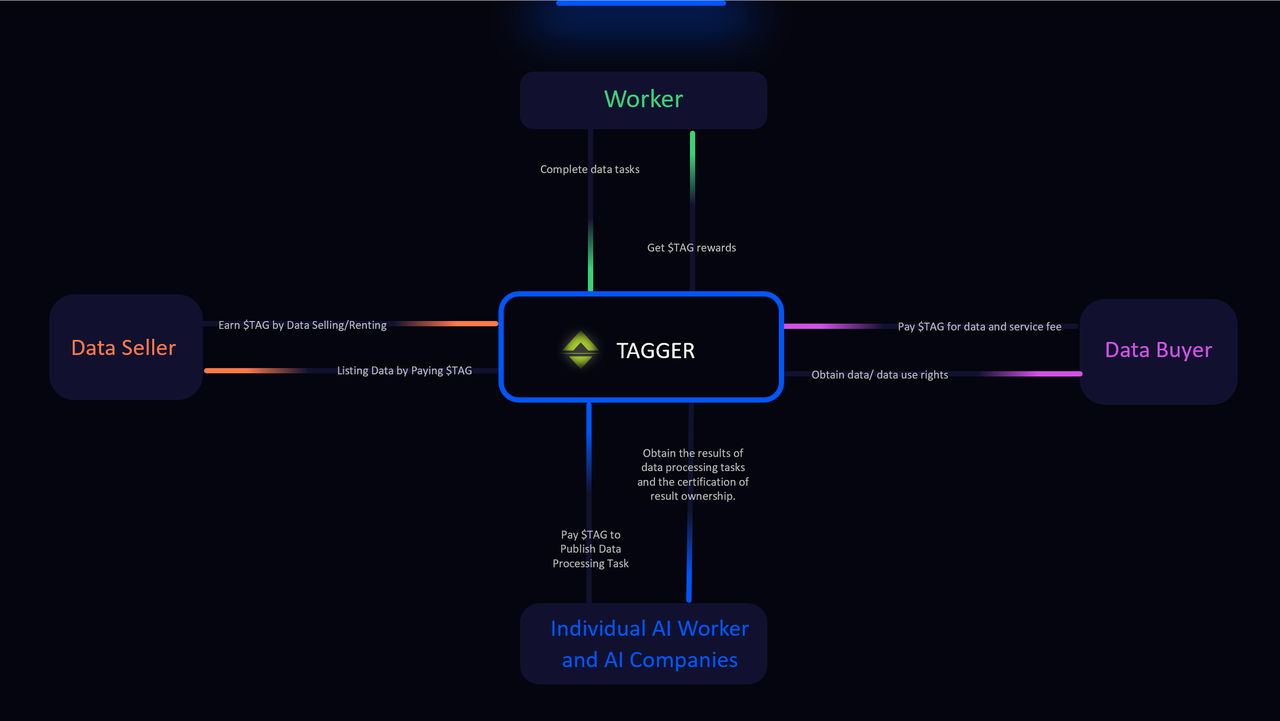
Within this ecosystem, TAG acts as the central medium, connecting data requesters, data contributors, and data consumers. Whether posting data tasks, completing annotation work, or executing data transactions and approvals, TAG facilitates value transfer, establishing a fully closed-loop data economy.
Over the long term, Tagger’s tokenomics not only emphasizes incentive allocation but also addresses core challenges within the AI data sector—namely, limited data supply, inconsistent quality, and inequitable value distribution. Leveraging a “Proof-of-Human-Work” model and on-chain settlement, Tagger transforms data production into a sustainable economic activity.
The Role of TAG in the Tagger Network: Data Payment, Incentives, and Value Circulation
TAG is the primary utility token within the Tagger Network, underpinning payment, incentives, and value circulation. For payments, TAG is used to launch data tasks, purchase datasets, and cover platform service fees, serving as the foundational currency for the data marketplace.
On the incentive side, TAG powers data production through a rewards mechanism. Data annotators, cleaners, and validators earn TAG after completing tasks, and this “contribution-based distribution” model sustains ongoing momentum in data production. The AI Copilot tool and standardized validation protocols further boost task efficiency and ensure fair rewards.
For value circulation, TAG converts data from a “static resource” to a “tradable asset.” Data can be sold, approved, or leased, with all transactions conducted via TAG, enabling continuous movement and value creation throughout the network and establishing a comprehensive data economic cycle.
In summary, TAG is more than a payment instrument—it is the essential link connecting data supply and demand, as well as incentive structures, empowering the Tagger Network with self-sustaining growth.
Tagger (TAG) Data Annotation Fee Structure: Task Pricing and Payment Logic
Tagger’s fee structure centers on “data task pricing,” creating a transparent payment system. When posting tasks, data requesters pay a specified amount of TAG based on task scale, complexity, and data type, covering both task rewards and platform fees.
Typically, the platform charges a service fee as a percentage of the task amount. For data annotation, cleaning, or collection tasks, Tagger charges approximately 5% as a platform fee, with the remainder distributed to data contributors. This approach ensures platform sustainability while providing fair returns to participants.
In data transaction scenarios, the fee structure differs. Upon completion of a data transaction, the platform typically charges around 1% as a trading fee to support ongoing marketplace operations. This low fee rate enhances data liquidity and lowers transaction barriers.
Overall, Tagger’s fee structure embodies “low friction + high liquidity,” balancing platform revenue with active user participation through a rational fee model.
Source: tagger.pro
Tagger (TAG) Annotator and Validator Incentive Mechanism Analysis
Tagger’s incentive system is anchored in “Proof-of-Human-Work,” focusing on generating token value through authentic data labor. Unlike traditional mining, which depends on hash rate, Tagger transforms data processing into a process of value creation.
During the annotation phase, participants earn TAG rewards for completing tasks such as data annotation, cleaning, and classification. The AI Copilot tool enables ordinary users to achieve professional-level annotation, expanding data production capacity. The platform also conducts standardized validation of results to ensure rewards correspond to actual contributions.
For verification, certain participants are responsible for quality review and consistency checks, combining AI and manual methods to improve efficiency and reduce errors. Validators also receive TAG rewards, establishing a dual-layer incentive structure.
The key advantage of this mechanism is its direct conversion of “data production capability” into a source of return, enabling broader participation in the AI data economy while enhancing data quality and supply.
TAG Supply and Distribution Structure: Tagger Tokenomics Model Analysis
TAG’s supply model is distinctly “contribution-oriented.” The total supply is approximately 405,380,800,000 tokens, with most gradually released through data work rather than all at once.
Distribution-wise, about 74% of tokens are allocated to Proof-of-Human-Work, issued to participants for data annotation and processing. This ensures token distribution is directly linked to actual contributions, fostering a fair economic system.
Additionally, around 21% is allocated for ecosystem experiments and market incentives (such as Tag-to-Pump) to drive early network growth, and about 5% is reserved for liquidity support to maintain stable marketplace operations. This structure balances long-term incentives with short-term liquidity needs.
TAG adopts a “halving mechanism,” gradually reducing rewards as issuance progresses to control inflation and enhance scarcity. This approach, similar to Bitcoin’s model, helps stabilize long-term value.
Tagger (TAG) Data Economy and Value Capture Logic
Tagger’s core value proposition is built on the idea of “data as assets”—capturing value through data creation, processing, and trading. Data serves not only as an AI training resource but also as a tradable economic element.
Value capture stems from three main sources: first, data task fees paid by enterprises or developers to acquire data; second, income from data transactions (sales, approvals); third, ongoing usage revenue, such as long-term demand from data reuse or model training.
As the network grows, data supply and demand create positive feedback: more data → higher model quality → greater demand → more task creation. This cycle gives Tagger the potential to generate network effects and enhance overall economic value.
From a long-term perspective, Tagger aims to build a “decentralized data marketplace infrastructure,” with TAG as the core asset facilitating value flow.
Tagger (TAG) Tokenomics Risks and Sustainability Analysis
Despite its innovative economic model, Tagger faces several challenges. Data quality control remains critical; even with AI assistance and validation, maintaining high-quality data in large-scale crowdsourcing environments is difficult.
Sustainability of the incentive model depends on genuine demand. If data demand stagnates and task volume declines, participant returns suffer, reducing network activity—a common challenge for “usage-driven tokenomics.”
Maintaining balance between token release and market liquidity is essential. While the halving mechanism helps control inflation, insufficient demand growth may still exert downward price pressure.
Ultimately, Tagger’s long-term sustainability hinges on its ability to expand AI data demand scenarios and maintain stable equilibrium among “data quality, user scale, and incentive mechanisms.”
Summary
Tagger (TAG) establishes a tokenomics model centered on data, integrating annotation, trading, and validation into a unified value system. Through Proof-of-Human-Work and on-chain settlement, it incentivizes and monetizes data production.
In essence, TAG’s tokenomics not only facilitates data circulation but also seeks to redefine value distribution in the AI data industry, transforming data from a passive resource into an active asset. As AI demand accelerates, this data economy model may become a foundational infrastructure for Web3 and AI convergence.
FAQ
What is the primary function of TAG?
TAG is used for data task payments, incentivizing data contributors, and serving as the value medium for data transactions.
How are Tagger’s data annotation fees calculated?
Fees are typically based on task scale and complexity, with the platform charging approximately 5% as a service fee.
What is Proof-of-Human-Work?
It is a mechanism that generates token rewards through genuine data labor, turning data processing into value creation.
Does TAG have an inflation mechanism?
TAG employs gradual release and a halving mechanism to control issuance, mitigating long-term inflation.
What are Tagger’s sources of value?
Primarily from data task fees, data transaction revenue, and ongoing usage value driven by AI data demand.







